Author: Cube Labs
Source: Cube Labs
TL;DR
- The growth of Web3 is becoming more professionalized and refined, and the proportion of high-quality users in projects driven by data-driven operations is significantly higher than that of ordinary projects.
- The common joint activities (Joint Campaign) in Web3 are indeed useful for growth, but the growth effect depends on how the project party accurately converts the target users. Different operational means should be used for the four different types of users.
- For projects that have passed the scale-up stage, simple growth is no longer the pain point, and how to do a good job in retention is the key.
Background
Recently, the growth tactics in Web3 have not changed much, but interestingly, joint activities between projects are becoming more and more common. It is obvious that the growth of individual projects is weak, and the mutual exchange of traffic has become the norm for Web3 growth.
But how effective are the common joint activities involving multiple projects?
Do we really know who our target users are?
How to track data and dig out real users to improve conversion?
How to accurately attract the big users or KOLs of the other project to your own project?
To find the answers, I conducted a growth experiment on a joint activity last month, with 18 projects participating, and set up 20 user tracking data points, including but not limited to the following indicators:
Activity indicators:
- User join time of Discord
- Roles and quantities held in Discord
- Number of messages sent and invitations
Purchasing power indicators:
- Token balances of various types in the wallet
- Number of blue-chip NFTs held
Influence indicators:
- Number of Twitter followers
- Total views and impressions brought by user retweets and likes
Loyalty indicators:
- Average number of activities participated in
- Number of POAPs and OATs held
Unfortunately, only 10 projects were able to track the data indicators for the first 10 days, and the accuracy of the conclusions will be biased due to the limited data volume, but we can still see a glimpse of the situation.
Joint Activity Data Review
This activity lasted 10 days, with a social media exposure of about 45k, and about 21k users were activated to the campaign page. **The users who completed all the tasks, had wallets, and had on-chain interaction behavior and social media dynamics (i.e., real users) were about 2.3k, with an overall conversion rate of about 10%. It is very regrettable that the data of 8 high-quality project parties was not fully tracked. The following is a detailed data analysis. [Note: Conflict of Interest - All data in this article comes fromClique]
Real Traffic Distribution
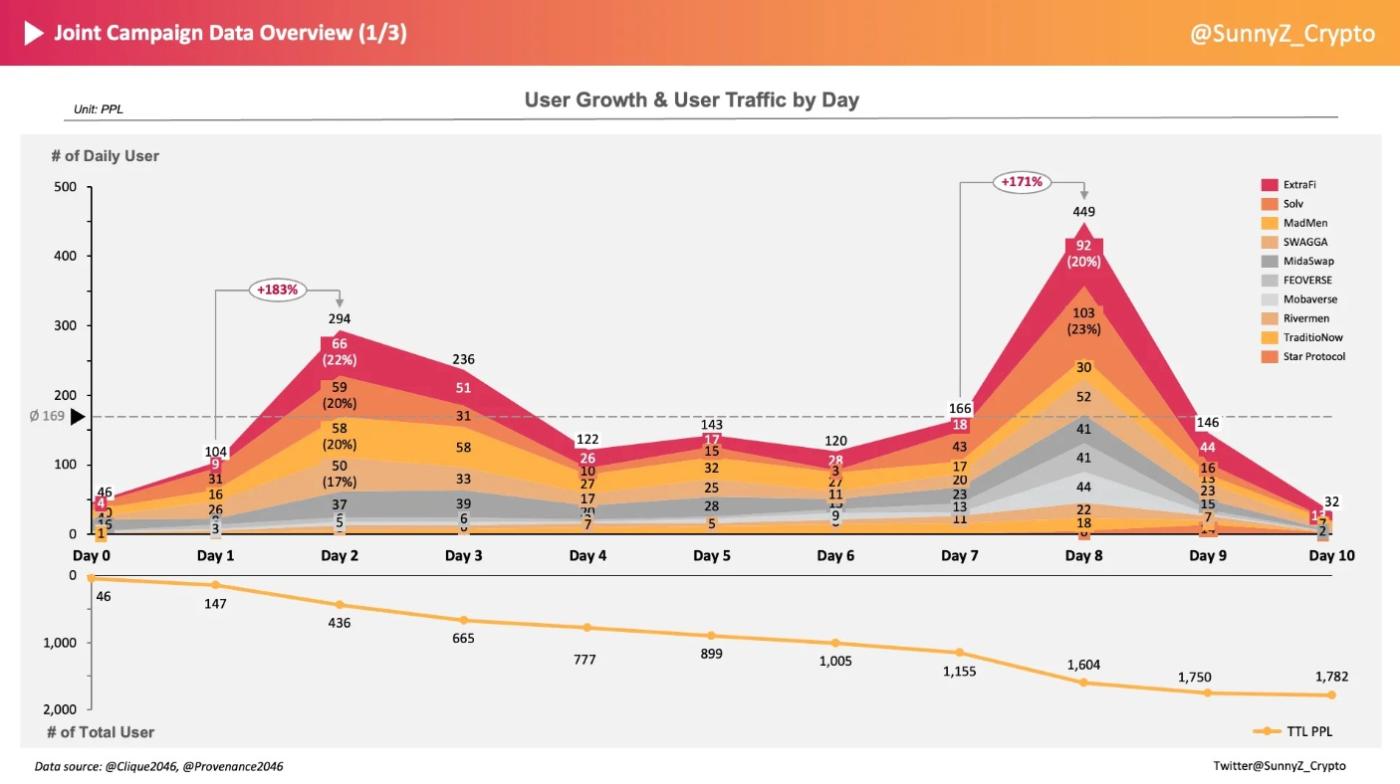
During the activity, users increased at a steady pace every day, with more overall participation on the 2nd and 8th days. On the one hand, this indicates that information dissemination takes time, and on the other hand, it also shows that user participation is higher at the beginning and end of the activity. As the activity cycle is extended, user enthusiasm will decrease.
New and Old User Distribution
- In this activity, 89% of the users were new users who followed the project's Twitter and joined the project's Discord during the activity, which can be considered as new users. This shows that the joint activity's demand for the project parties to bring in their own traffic can be basically met, and it also indirectly shows that the current single-task type of activity is relatively difficult to recall old users.
- Although the proportion of old users is not high, the quality is relatively good. The ETH balance in the wallets of the 11% old users accounts for 26% of the total user balance, and the number of followers accounts for 31% of the total. Their purchasing power is more than twice that of new users, and their social media influence is about 3 times that of new users. Their overall value is relatively high. If you can design **activation-type campaigns for old users, the cost-effectiveness will be higher than new user acquisition activities. The recent rapid growth of Crew3 also confirms the strong demand for Web3 project activation, and the growth focus is gradually shifting from new user acquisition to improving retention.
- Among the projects, the 5 with the most new users include 3 DeFi/NFTFi projects, and the other 2 projects have high reward values, indicating that new users prefer to participate in trading-related or high-reward tasks. The most active old users are the DeFi projects Solv and ExtraFi, which shows that although the tracks and new narratives are diverse, real users are still concentrated in the DeFi-related field.
User Segmentation Portrait
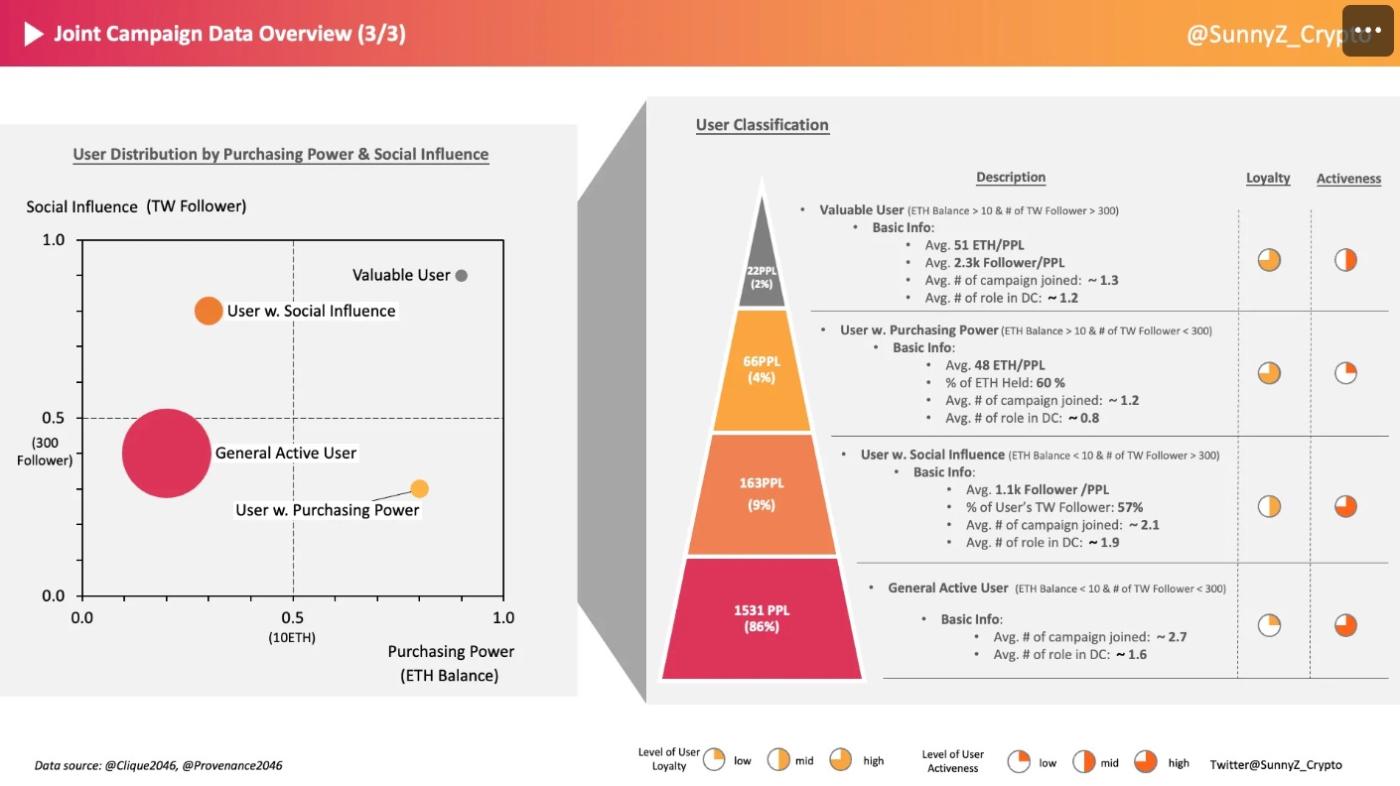
By segmenting users based on purchasing power and influence, using the ETH balance and stablecoin total value in the user's wallet as indicators to measure purchasing power, and using the user's Twitter follower count as an indicator to measure social influence (the median purchasing power is 10ETH, and the median influence is 300 followers), and at the same time using the average number of activities the user has participated in and the number of roles held in Discord to measure the user's loyalty and activity, the following 4 user profiles are obtained:
- Valuable User【High Comprehensive Value User】
- Prefer DeFi projects, have high loyalty, basically only participate in the activities of one project, and are relatively active. They have been verified on Discord and hold roles, with an average of 14 POAPs held, indicating that this group understands the gameplay of Web3 projects and likes to participate in high-quality project activities, they are absolutely the type of people who are knowledgeable and love to play;
- Although this group accounts for only 2% of the total, their average wallet balance is about 51 ETH, and they have an average of 2.3k Twitter followers. They hold 21% of the total ETH and have 16% of the total user followers, with both purchasing power and influence, belonging to the core users. If it is a large-scale campaign, it is recommended to design more on-chain interactive tasks and allocate more rewards to this group;
- User w. Purchasing Power【High Purchasing Power User】:
- They have no obvious project preferences, with both DeFi and Non-Fungible Token types, have higher loyalty, and almost only participate in the activities of specific projects. This group has a high degree of overlap with the addresses of project whales, and they are likely to know the project parties;
- They have relatively low activity, do not spam the Discord group much, and have few held roles, with an average of 4 POAPs. They do not speak out frequently on social media, so they have few followers, which is a typical silent wealth accumulation type;
- These 4% of high purchasing power users hold 60% of the total ETH, with an average wallet balance of about 48 ETH, and there are many whale accounts with nearly a thousand ETH. This group has strong purchasing power, but it is difficult to reach them through ordinary information channels. It is recommended that the project parties pull the whale group or open a Whale Channel on Discord, and separately notify them of important activities to achieve higher reach;
- User w. Social Influence【High Influence User】:
- They have no project preferences, have general loyalty, and will participate in the activities of multiple projects at the same time. Their distribution is relatively average in each project party. They have high activity and at least 2 roles in the project party's Discord. They have an average of 16 POAPs, and although their capital is not large, their influence is relatively high, belonging to the Web3 micro-KOL type;
- These 6% of high-influence users have 57% of the total Twitter followers. For this type of user, you can design more retweet, tag friends, and invitation tasks. It is recommended to directly reward Tokens to fully utilize the low-cost new user acquisition and user multiplier effect of social media;
- General Active User【Active User】:
- They have no project preferences, have relatively low loyalty, and will participate in the activities of at least 3 projects at the same time. They are very active and have 1-2 roles in the project party's Discord, and basically hold POAPs or OATs, which should belong to the brick-moving party or wool-picking party;
- 86% of users are concentrated in this field, with a large number. How to exert the value of such users is a challenge for project parties. I have always believed that every real user has value, as long as they are not bots. Designing a good conversion plan can achieve growth, so for this part of the users, you should design more Daily tasks, and it will be more reasonable to track long-term activity and distribute rewards.
- As a project party, when designing relatively large-scale activities, if you can stratify and grade the rewards based on multi-dimensional user data and accurately distribute different rewards to different types of users, this will be more helpful to improve retention, optimize ROI, and grasp core users, rather than just a raffle. There are too many wool-picking parties and scientists in this industry. If the rewards ultimately end up in the hands of non-real users, it is not beneficial for the long-term development of the project.
Project Data Analysis
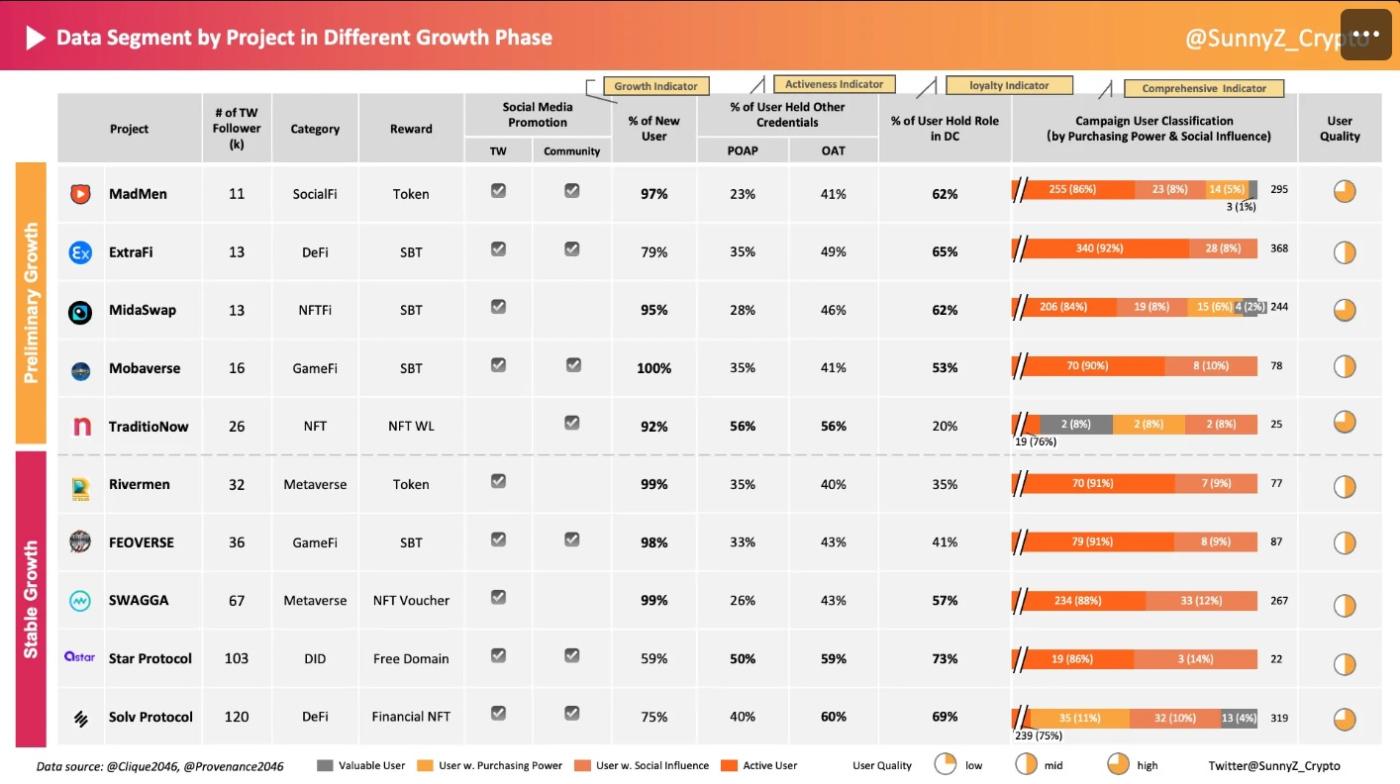
Since the promotion methods, timing, and cycles of all participating parties in the joint activities are determined, and the task release platform is also consistent, there are not many external influencing factors, which is equivalent to a controlled variable comparative experiment. However, the growth effects are quite different. Among them, 7 projects have a new user ratio of over 90%, with an average of over 65% of users verified their identity and held roles on Discord, while some projects did not meet the expected results.
Is the difference in conversion data due to the problem of user track preferences, or the difference in reward settings and operation methods? Maybe the reasons can be found in the horizontal comparison of data from each project party.
According to the operation duration and fan volume of the projects, the project parties are divided into two major categories: Initial Growth Projects and Stable Growth Projects:
- Initial Growth Projects:
- This type of project has a small user base, and the main appeal of the campaign is user growth. They are more willing to pay for traffic, and do not pay too much attention to user quality, as they are in the stage of initial growth;
- Among them, MadMen and MidaSwap have relatively high-quality participants, with a relatively reasonable distribution of the 4 major user types. The interviews found that:
- MadMen integrated the platform's own channels in the promotion, encouraging users who watched the promotional video to directly enter the activity page, and the rewards were coupons that could be exchanged for Tokens. MadMen's early users came from the cooperation with high-quality GameFi projects, and these users basically have certain assets and are willing to participate in activities and invest time, so the overall data is better;
- MidaSwap also launched promotions on other platforms during the activity period, with cross-platform user flow, but since it is still in the internal testing stage and has not started large-scale promotion, the NFT whales and KOLs are relatively more;
- ExtraFi, as a new project that has not yet launched the product, the large number of users is likely related to the high relevance of the rewards. In addition to the SBT, all qualified users can get the Discord OG role, corresponding to the expected future Token rewards;
- So for this type of project, promotion channels and valuable rewards are the main factors affecting the participation volume of the activity;
- Stable Growth Projects:
- This type of project has a certain user base, and the main appeal is real user growth and core user conversion, focusing on both increments and quality, and is in the stage of efficiency improvement;
- Among them, SWAGGA and Solv Protocol have relatively high user stickiness. Both parties said that they did not have any special promotion or rewards, and the current participation volume is just a basic operation. They often hold activities to keep users active. The whales are already quite concerned about the project dynamics, and they are projects that have not yet issued Tokens, so users may have an optimistic expectation for the project parties' future;
- So for this type of project, long-term operation to improve user interaction rate is the main factor affecting the participation volume of the activity;
- Promotion time
- Based on the traffic time distribution, the suggestion for the operations side is to start the activity preheating 2 days in advance, and remind 1-2 days before the end. The activity cycle should be as short and fast as possible, and a single activity should not exceed 5 days. If it is a large-scale activity, it can be designed and released weekly.
- Layered rewards, precise activation
- After finding different types of users based on the profile, you need to set different operation methods and layered rewards. For OGs, leave enough reward share, design more on-chain interactive tasks, and distribute rewards to this group; for users with purchasing power, expand the whale group or open a Whale Channel in DC, and notify them separately for important activities; for users with influence, you can directly reward Tokens in activities, and design more tasks like reposting, tagging friends, creating, or inviting; for a large number of active users, you need to design more daily tasks and track long-term activity to distribute rewards.
- Screening joint activity participants
- Clearly define the purpose of doing joint activities, who the target audience is, and then screen and target BD for qualified cooperation projects, rather than accepting all comers and blindly participating in activities, only to find that the effect is general and the reason is unknown.
After 1o1 interviews, I found that whether it is an early project or an established project, project parties with refined operations have higher user quality and stickiness. In the current Web3 growth model of function stacking, user experience stacking, and reward stacking, the importance of professional operations is gradually becoming more prominent.
Analysis of New User Behavior
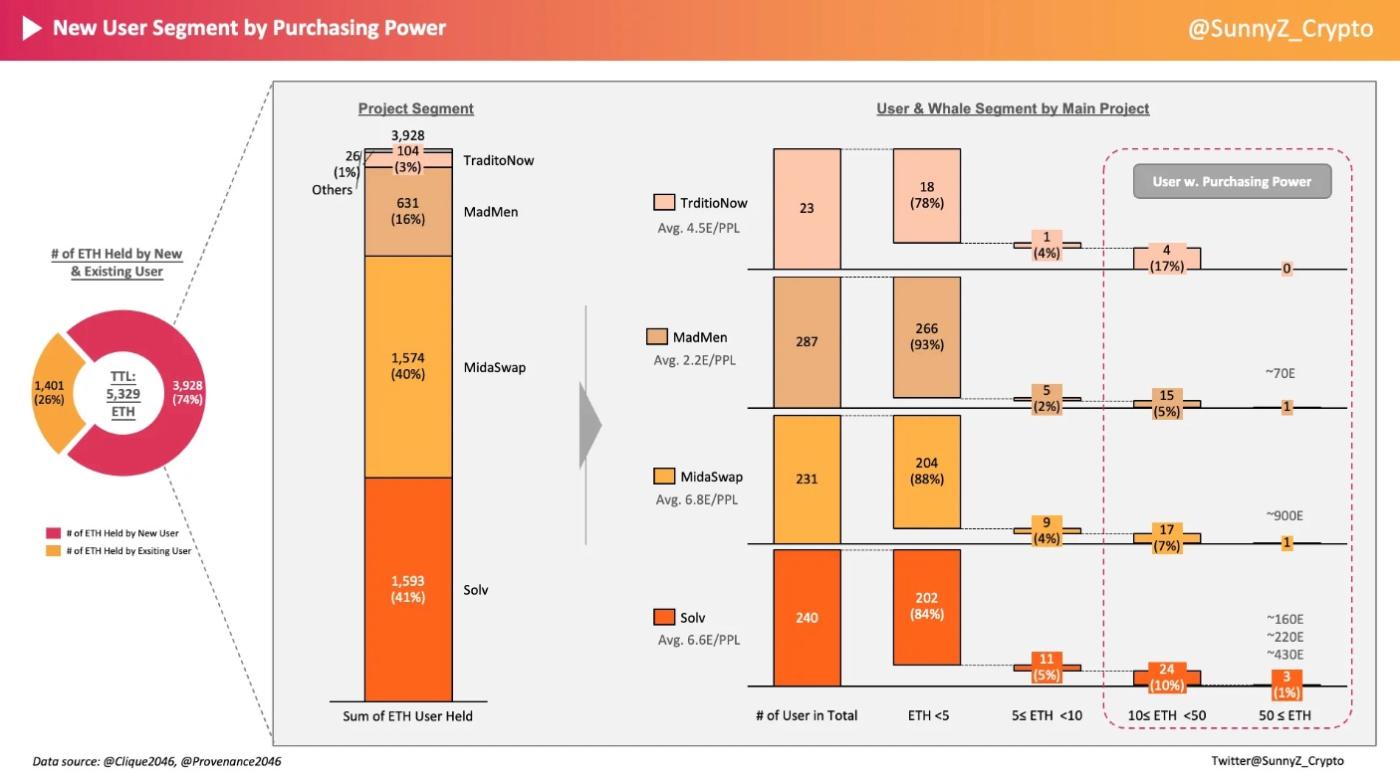
Using joint activities to mutually introduce traffic and increase real users is the core demand of project parties. The new users here are the target audience, because this part of the people are willing to participate in similar activities and easy to be converted by other project parties. If you can dig out and convert the users with purchasing power or influence in the public domain traffic, it will be twice the result with half the effort in terms of growth effect.
Purchasing Power
The whales among the new users are mainly distributed in projects such as Solv, MidaSwap, MadMen, and TraditioNow, with an average wallet balance of about 46 ETH. Solv has several new users holding over 150 ETH, and MidaSwap has a whale holding over 900 ETH. If you want to accurately reach the whales in the joint activities, it is recommended to cooperate deeply with such projects and provide higher-quality rewards. The 60+ users marked as User w. Purchasing Power in the figure below are relatively easy to convert target objects.
Influence
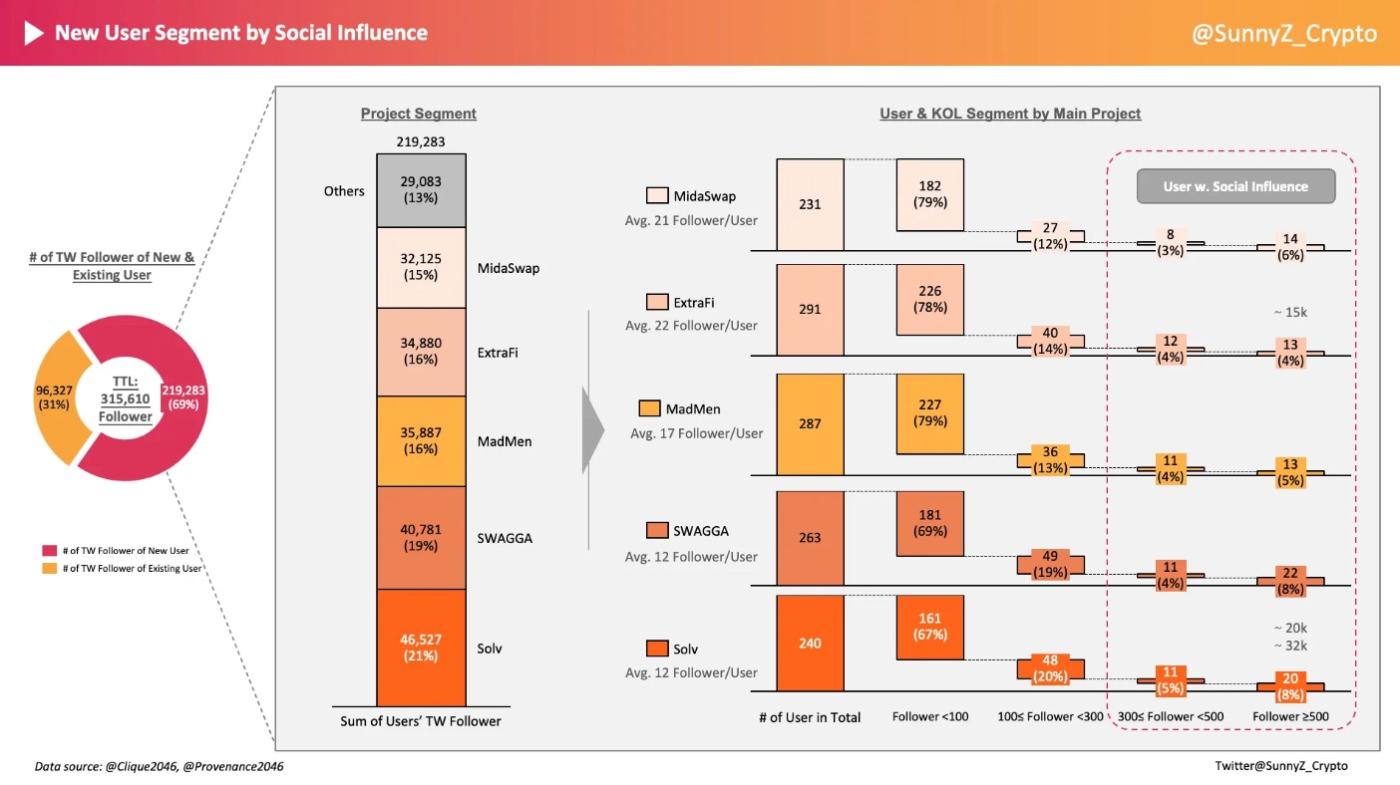
The KOLs (Key Opinion Leaders) among new users are mainly distributed in Solv, SWGGA, MidaSwap, MadMen, and ExtraFi projects, with an average of about 1,000 followers per KOL. There are 3 KOLs with more than 15k followers, with the highest having 32k, which is more than the followers of many project parties.
According to the user profile data in the above text, KOLs are easier to convert than whales, as they have high activity but are not as difficult to reach as whales. **If you want to convert the influence of these KOLs, it is recommended to increase social media reposts or invitation tasks in joint activities.** The 190+ users marked as "User w. Social Influence" in the figure below are the target audience.
How to optimize operations based on data and set data indicators
The first step in doing fine-grained operations is to set data indicators, as you need data to talk about optimization, otherwise it will be very blind.
The data of Web3 users is quite special, as asset, interaction, and some behavioral data are on-chain, but more information is still off-chain. To build user profiles, you need to integrate on-chain and off-chain information, including but not limited to user identity information, transaction records, social data, asset data, and other dimensions of data.
In the data analysis above, many suggestions for the operations side have already been mentioned. Here is a simple summary: