Author: Matthis Herbrecht & Achim Struve, Outlier Ventures Token Team; Translator: Jinse Finance xiaozou
1, Suggestions on Ecosystem Incentive Activities
Implement a Multi-Stage Airdrop Strategy: Follow the multi-round airdrop model of Optimism to maintain long-term user stickiness. This approach helps retain users after the initial token release and encourages long-term participation in the ecosystem.
Allocate Significant Resources to Grant Programs: Allocate a portion of your incentive budget to fund developers and builders. This medium-term approach helps build a strong Dapp ecosystem, which is crucial for user retention and sustainable growth. Then, implement a robust monitoring system to track key metrics and analyze the impact of incentive measures. This will enable data-driven adjustments and a continuous optimization of the grant program.
Focus on Long-Term Reduction of User Cost per MAU: The goal for a mature network is to reduce the cost per monthly active user (MAU). Optimism's approach of combining recurring grants with strategic airdrops has resulted in a relatively low cost per MAU of $304. Set a long-term goal to achieve similar or better efficiency within 12-18 months.
Prioritize Ecosystem Development Before Token Release: Consider Base's approach, which focuses on culture, builder stickiness, and ecosystem development, all without the need for a token. Allocate resources in the form of targeted small grants to founders and projects aligned with the ecosystem vision, rather than relying solely on token incentives.
Balance Short-Term and Long-Term Incentives: The goal is to strike a balance between short-term incentives (such as airdrops) and long-term incentives (such as grant programs and ecosystem funds). This balance can attract initial users while maintaining long-term growth.
Implement User Retention Strategies Beyond Economic Incentives: Develop a strong community culture, focus on smoothly onboarding developers, create engaging experiences and events, and improve user experiences similar to Base. This helps maintain user stickiness, even in the absence of ongoing economic incentives.
2, Introduction
Layer 2 (L2) networks have become a key solution to the blockchain scalability challenge. As these networks fiercely compete for market share, incentive programs (particularly grants and airdrops) have become a crucial factor in their growth strategies. Given the significant resources invested, we step back to examine their effectiveness through this analysis.
(1) Scope of Research
The focus here is on two main incentive mechanisms: grants and airdrops.
The analysis excludes application-level incentive measures, such as liquidity mining or yield strategies, to maintain a clearer focus on L2 blockchains.
Our research covers the data range from 2021 to September 2024.
(2) Key Performance Indicators
We consider two main metrics to evaluate the performance of incentive programs:
Revenue Generation: Ideally, revenue growth should at least offset a portion of the incentive program costs, indicating a positive return on investment and a successful program.
User Acquisition + Retention: Achieving sustainable short-term/medium-term user growth at the lowest possible cost. Therefore, we will track the evolution of monthly active users (MAU).
Revenue generation and user acquisition are closely linked. More MAU will increase network activity and transactions, thereby boosting sequencer revenues. Higher revenues mean the network is valuable and can attract and retain users, further increasing revenues. This positive feedback loop is crucial for long-term success.
By closely monitoring these numbers, we can clearly understand the incentive activities of each chain and their impact on these two metrics.
(3) Understanding Relevant Background and Constraints Before Diving In
As with any deep dive into complex data, it is important to note certain constraints:
Layer 2 lacks clear incentive dashboards displaying grant details, such as dates and exact token amounts. Ecosystems also have different views on airdrops and grants. For example, some ecosystems consider private investments in tokens or equity as grants. However, in our research, we do not classify these as grant programs. The lack of transparency and the multiple definitions of grants and airdrops make data collection particularly challenging.
We do not consider the Optimism Superchain and ZK stacks, only the mainnet. Base receives grants from Optimism, but these are not accounted for.
The definitions of grants and airdrops may overlap, particularly in the context of Optimism.
Incentive mechanisms also impact other metrics, such as protocol TVL or application count, but we have chosen to focus on MAU and chain revenue as the primary metrics for evaluating L2 incentive mechanisms. These metrics were selected because they are easily quantifiable, and the data is readily available from public sources. While MAU and chain revenue are related, they also provide valuable insights into the short-term and long-term impacts of incentives. Ultimately, it is best to stick to 2-3 key metrics to keep the analysis concise and understandable.
Although MAU and revenue are closely related, other factors also play a crucial role. Community culture, narratives, marketing, technological advancements, and macroeconomic conditions all have a significant impact on the results. However, this research adopts a simplified approach to examine the impact of incentive measures in a more isolated manner.
Incentive costs are calculated based on the token USD value at the time of token issuance.
Data on more recent L2s (such as Starknet, Blast, or ZK Sync Era) is just emerging, making it difficult to draw conclusions in the short term.
With the relevant background in mind, let's dive into the analysis.
3, Impact of Incentives on MAU (Monthly Active Users)
Let's start with a simple chart showing the monthly active user numbers for various L2s.
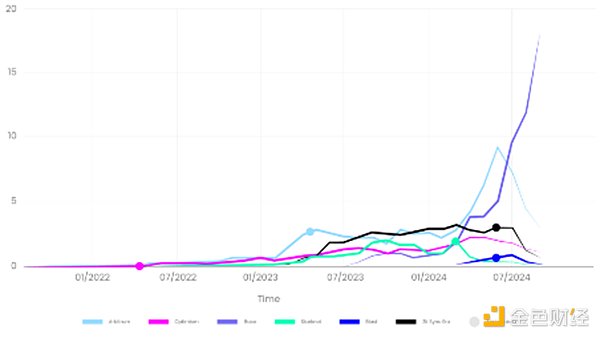
The chart shows:
Base is the only chain with an average sustained MAU growth of 56%, and its retention rate has not shown a clear decline, while other chains have experienced user declines in recent months.
All other L2s have experienced user declines in recent months.
After airdrop events, the monthly active users of the newest chains, such as ZK Sync Era, Blast, and Starknet, have decreased, while the MAU of L2 solutions like Optimism and Arbitrum have seen slight increases.
We believe the main reasons are:
Recently, we have seen an increasing number of L2 solutions launching. As a result, user numbers have been diluted across these L2s and their respective airdrop activities. This trend may explain why new L2s struggle to retain users after airdrops.
Another explanation could be the grant programs of Arbitrum and Optimism, which are an effective strategy for long-term user retention. The upward trend after airdrops suggests these projects have successfully maintained user stickiness, unlike the emerging L2 solutions. Based on this, we can hypothesize that this is due to a lack of grant incentives and/or a small ecosystem with few applications.
As chains mature, culture becomes a key differentiating factor for L2s. Optimism, Arbitrum, and Base may have an advantage in this regard, as they have been around for longer. The security/decentralization stage is also relevant, with two of the chains (Arbitrum and Optimism) still in the first phase according to "L2beat".
Base does not have a token. People are staying with Base despite expecting an airdrop because it is the last major L2 without a token; they are enjoying Base's culture and activities; and they trust Base, as it is backed by Coinbase.