Author: Mensh, ChainCatcher
Editor: Nianqing, ChainCatcher
As the vanguard and gateway for large-scale Web3 applications, SocialFi has attracted widespread attention from users and investors. However, as a censorship-resistant and privacy-focused SocialFi, it faces the real problems of uneven content and fraud. Attracting users with flashy economic models of "X to earn", the platforms lack the ability to continuously attract content creators, and the leading SocialFi protocols find it difficult to break through the bottleneck of user numbers and prove market demand.
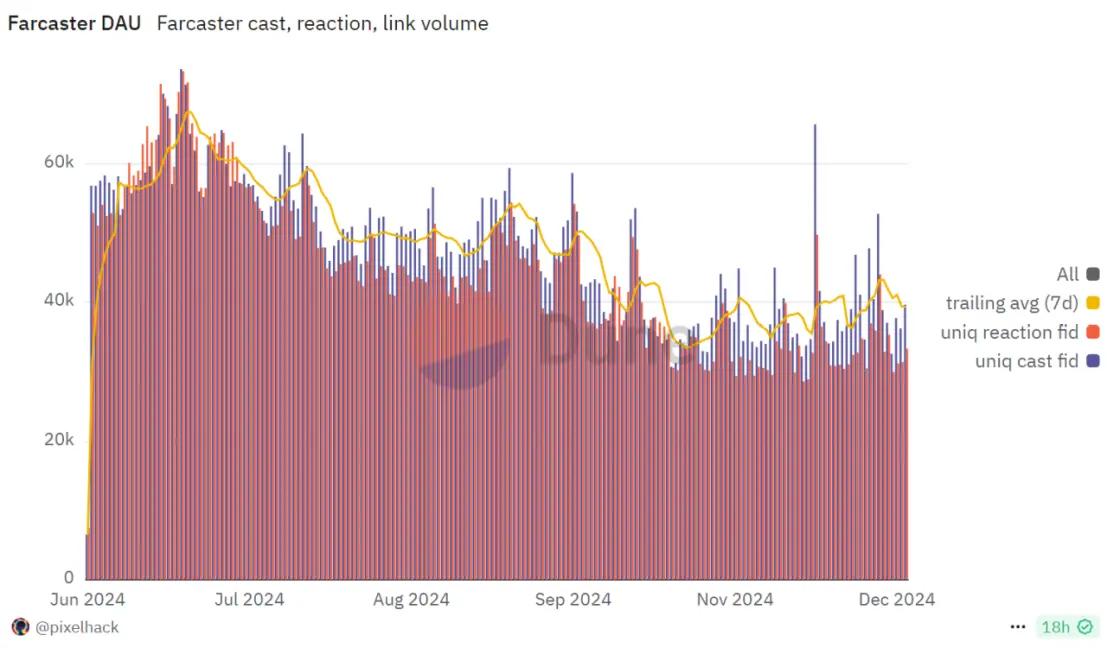
Farcaster's daily active user data in the past half year:
While the Web3 anonymous social app XO has proven its real user demand with impressive data: in just over two years since the launch of the App in 2022, the user base has naturally grown from zero to 1.5 million; Cyber L2 (the blockchain where XO is located) has a daily transaction volume of over 100,000; it generates 7 million clicks and 1 million matches per month; 82% of users are acquired through organic growth or referrals; the 30-day retention rate reaches 15% (3 times the industry standard); users spend an average of 40 minutes per day on XO (nearly twice that of Facebook and Snapchat); the AI agent is summoned over 100,000 times a day to facilitate user interactions; the average revenue per paying user is $38 (1.7 times that of Bumble). The high stickiness and willingness to pay of the users behind these data all prove that XO is meeting real social needs. How did this dark horse of SocialFi emerge?
Privacy First, Creating an Online Confessional for Users
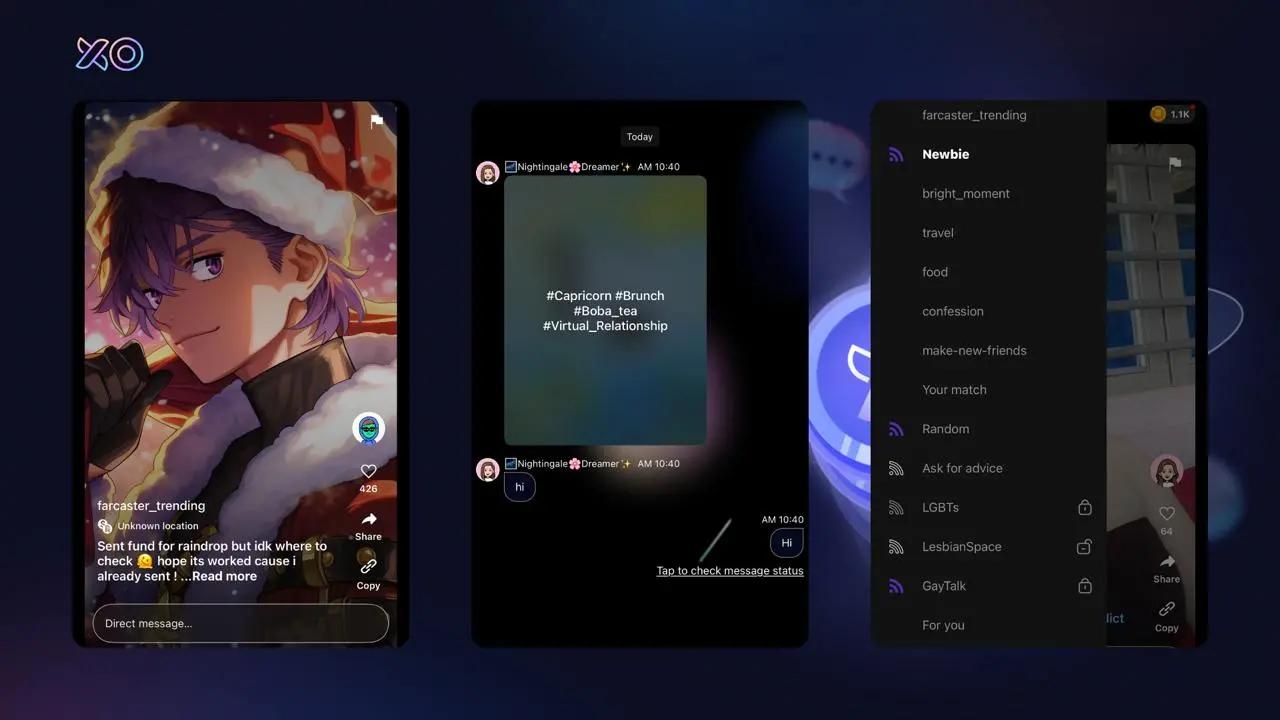
XO is an anonymous social app. It has multiple themed chat boards, combining "anonymous chat" and "community socializing", where users can post mood stories and enhance interactions. Since over 70% of users identify as LGBTQ+, to create a safe space for emotional expression and support, XO has also thoughtfully built private communities that are only accessible by member invitation.Carol, the co-founder of XO, said, "The original intention of XO is to create an anonymous confessional for modern people, where users can be themselves with peace of mind."
The flip side of privacy protection is security, and XO uses multiple technical means to prevent the fraud and fake accounts common in social media and dating apps.The decentralized user verification system can provide verifiable credibility based on the user's on-chain activities. When registering for XO, users will receive a unique XO Soul-Bound Token (XOUL) associated with an AA wallet. This token enhances online security through various verification methods (such as facial recognition, social network verification, ENS, and collaboration with DID providers).
In addition, XO users can choose to connect their own crypto wallets in the account settings. Once the wallet is connected, if the wallet has on-chain history, the app can verify the user's credibility through on-chain activities. Therefore, the user's social media follower count, NFT ownership, XO app companion rating, and user-generated content will also be part of the social credit score. The probability of fake accounts and bots is greatly reduced.
For users with high social credit scores, XO also provides personalized AI Twin services (Beta). This feature allows users to generate an AI "avatar" to extend their social interaction capabilities and incentivize users to improve their credit scores.
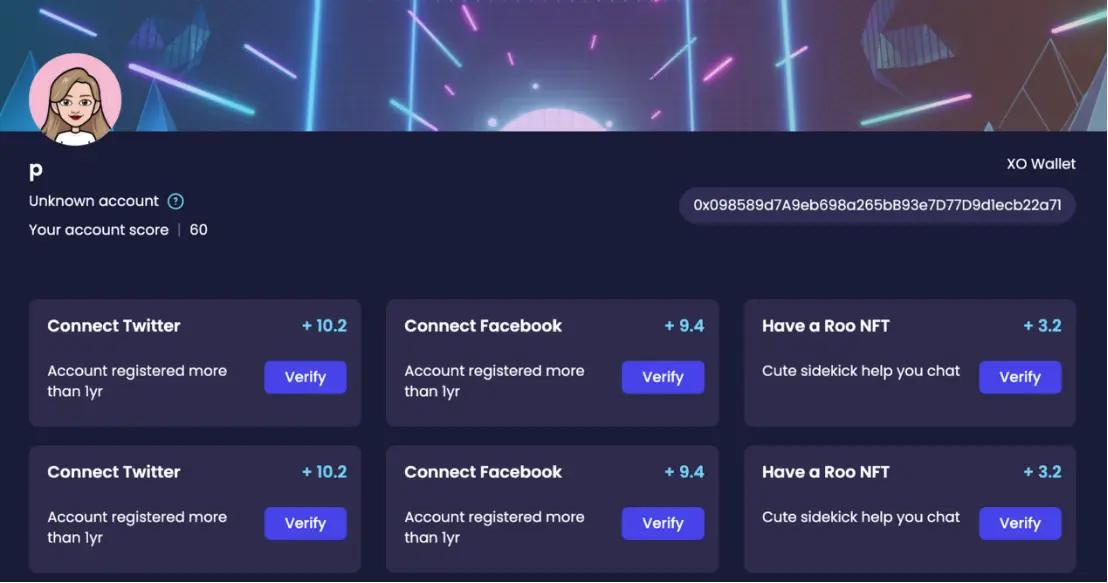
And Proof of Personhood is another layer of protection against fraud for XO.Proof of Personhood is a limited real-world identity form that can verify that a given registered account is controlled by a specific real person, without revealing the identity.
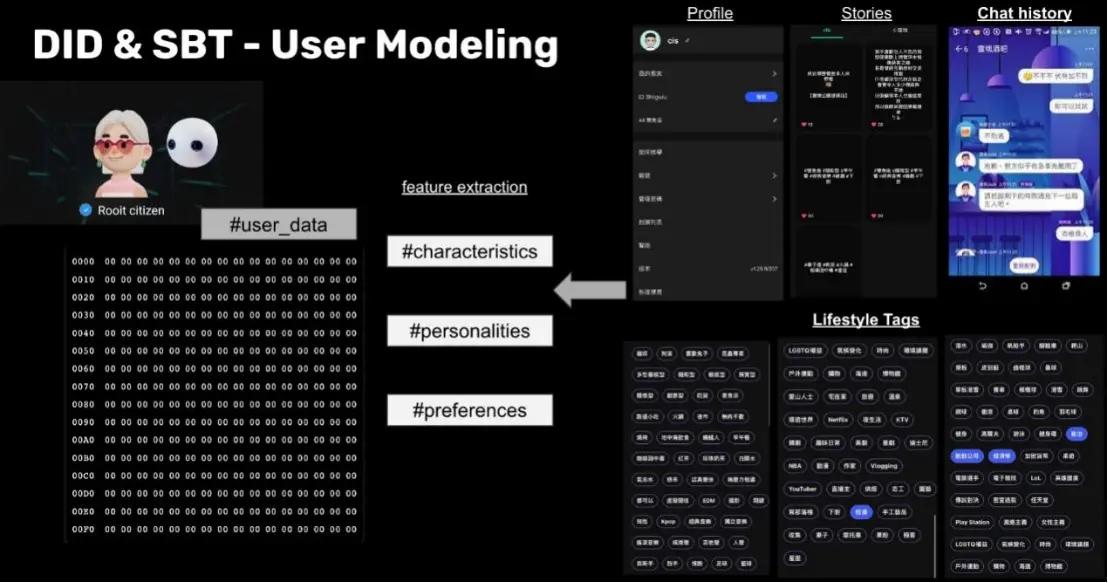
Compared to the current decentralized identity (DID) solutions on the market, such as CyberID and Lens Protocol, they lack actual social application scenarios. And among the existing products with real use cases, Farcaster's user data collection capability is limited. As a passive content consumption platform similar to Twitter and Reddit, Farcaster's data scope mainly focuses on user content interactions. In comparison, as an active social application, XO can collect richer user data, covering information such as gender, age and preferences, and can fully unleash the potential of Proof of Personhood in cross-platform applications, such as integrating Web2 data into Web3 applications to provide personalized services for users. This approach helps solve the cold start problem and provides a true basis for user privacy protection.
Content Matching + AI Agent, Achieving Precise Matchmaking
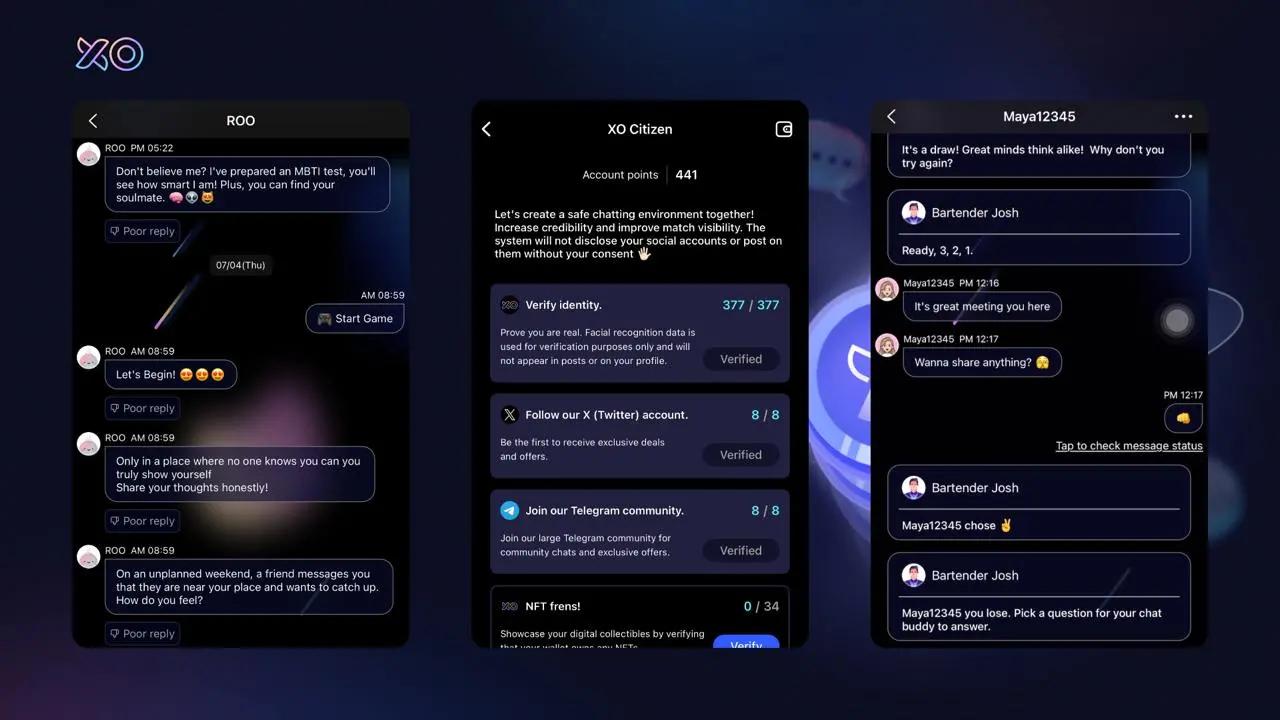
Unlike the traditional dating app's swipe-based matching based on user profiles, XO matches users based on the content they post (such as emotions, confessions or lifestyles). This matching scheme not only allows users to choose whether to remain anonymous to protect their privacy, but also constantly iterates based on user dynamics for more accurate matching.
Just this year, XO has launched an AI assistant feature, with an AI pet named ROO on the XO platform that can perform MBTI tests and provide customized feedback based on user feedback. For users who are not good at chatting, the AI agent can also act as an "icebreaker" to break the awkward atmosphere.
XO also revealed that it is testing an "AI Twin" feature, which can allow users to create their own AI avatars to help them simulate conversations before interacting with others, saving time in choosing partners and finding suitable chat objects faster.
With over 4 million messages per day and over 1 million matches per month, XO has strong data-driven capabilities to build robust AI assistants and recommendation system models. Similar to how AWS supports Web2.0 applications, XO's AI infrastructure layer consists of multiple large language models (LLMs), which take user profiles, tags and stories as input into a 16K parameter LLM to summarize the user's language style, personality traits and interests, and learn from real data through reinforcement learning and on-chain data integration, greatly reducing the time cost of making friends.
Sustainable Economic Model and Business Model
To avoid the "X to Earn" model being exploited by farming studios, before officially launching the on-chain token, XO first introduced a Chat2Earn mechanism based on $rStar, testing over 5 million chat records per day, detecting potential algorithm cheating behaviors, observing user reactions to earning in-app currency through chatting, and exploring what behaviors and features users are willing to pay or consume in-app tokens, ensuring a sustainable token economy with a balance of revenue and expenditure.
Based on surveys and iterations, XO has finalized the Chat2Earn mechanism. The underlying PoC (Proof-of-Companionship) algorithm, based on user chat behavior, comprehensively evaluates the quality of interactions and provides virtual currency $rStar rewards.Users can increase the health value of the chat room and trigger the reward mechanism through deep chatting, quick replies, consecutive chat days, participation in AI games, and other behaviors.
Furthermore, Chat2Earn is also combined with NFTs and decentralized identity (DID) systems, where holding XO partner NFTs can grant access to exclusive Alpha communities and establish connections with other NFT holders. NFT holders also enjoy higher mining efficiency and unlock exclusive store functions to redeem $rStar for physical rewards. Through visual feedback (such as changes in chat room background color and gift airdrops), Chat2Earn not only enhances the user experience, but also forms a strong positive feedback mechanism, greatly stimulating user participation.
From the perspective of the economic ecology, $rStar is the core virtual currency of the platform, but it is not tradable or withdrawable. This closed economic system ensures the circulation of currency and consumption within the ecosystem. In the third quarter of this year, XO launched $XO, which is linked to the $rStar system. Active participation in community interaction or content creation can earn $XO tokens. $XO holders do not have platform governance rights. Users can consume $XO to access over 1 million matching sessions per month, and users can also spend $XO to connect with people who share their interests and values. The team also plans to use $XO as the Gas fee to access advanced features and transactions, ensuring a smooth and efficient user experience.
Furthermore, XO has a very robust business model, which is why XO received a $800,000 seed round funding from the renowned incubator TechStars, the Japanese incubator Rakutan Group, and the Taiwan government fund in the year it was established. Currently, XO's revenue comes from both the To C and To B parts.
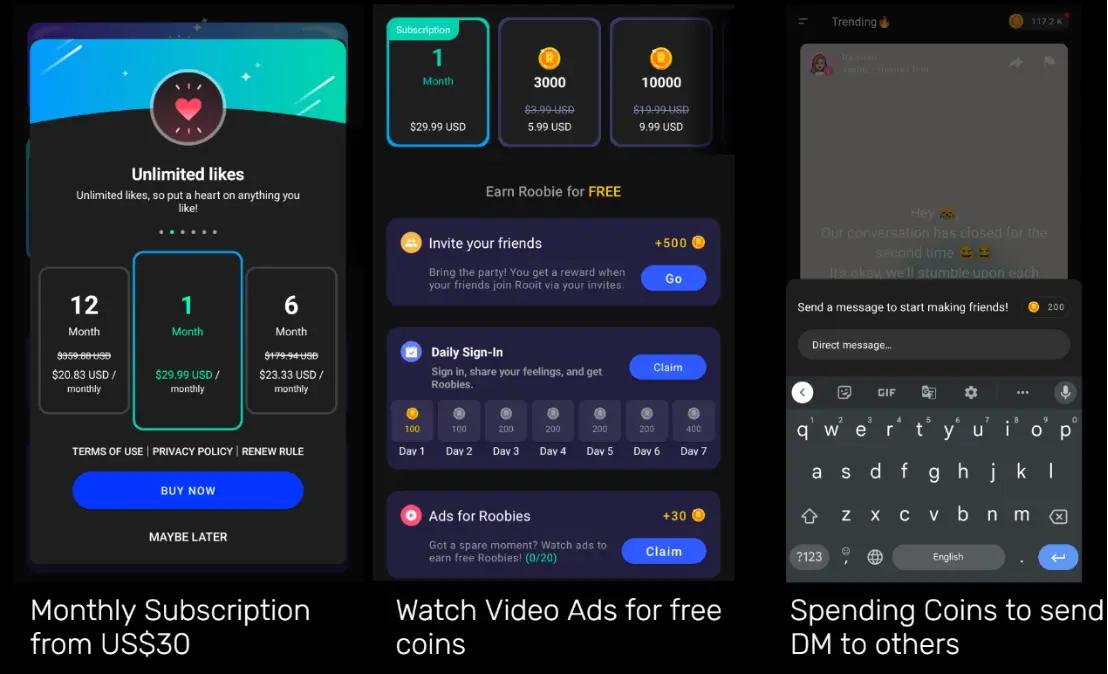
The To C part generates revenue for the platform through subscription, in-app purchases, advertising, and Chat2Earn. Users can access more social features by paying for a subscription, enhance their interactive experience by purchasing virtual goods, and earn token rewards by participating in the Chat2Earn mechanism. XO also provides unique digital assets and value-added services to users through the sale of NFTs and virtual items.
In the To B part, XO provides customized market research and advertising services to brands through AI chatbot advertising and opinion mining, helping brands better understand and reach their target users. Enterprises can also integrate with the Web3 ecosystem through the XO platform, using NFTs and DAOs for brand promotion and user identity management, further enhancing brand exposure and user engagement, forming a mutually beneficial business ecosystem. Currently, XO has achieved full profitability.
Summary: Airdrop is coming, SocialFi dark horse leading the new social narrative
On July 11, 2024, the Xoul DID mainnet will be officially launched, and the team will announce a $1.2 million airdrop. $XO will also be listed soon.

Looking to the future, XO is gradually implementing decentralized identity (DID) to help users build their own DID through their interactive behaviors on the application. The team is actively seeking different Web3 partners, such as decentralized domain ENS and Web3 social identity ID. XO hopes to truly integrate the centralized identity system into the social networking scenario.
At the same time, XO is also more widely involved in the fine-tuning and optimization of AI agents, gradually developing them into decentralized autonomous chatbots, and expanding their influence more proactively on social platforms.
XO already has a verified user base, and with the dual-drive of identity proof and AI agents, it can undoubtedly take SocialFi further.