


Compiled by: Yuliya, PANews
After the DAO fundraising platform Daos.fun launched by a16z became popular, a self-proclaimed revolutionary DAO fund launch platform Daos.World has recently attracted widespread attention. The platform is deployed in both the Base and Solana (daos.fun) ecosystems, and has created a new paradigm for decentralized investment management through its operating model and mechanisms. This article will analyze the characteristics, potential and risk points of this emerging platform from multiple dimensions such as platform architecture, operation mechanism and participation methods.
Core Platform Architecture
Daos.World adopts a three-layer architecture system:
- Fund Management Layer: The platform realizes fund custody through smart contracts, ensuring fund security and operational transparency. All funds are custodied by smart contracts, ensuring that assets are not subject to centralized control.
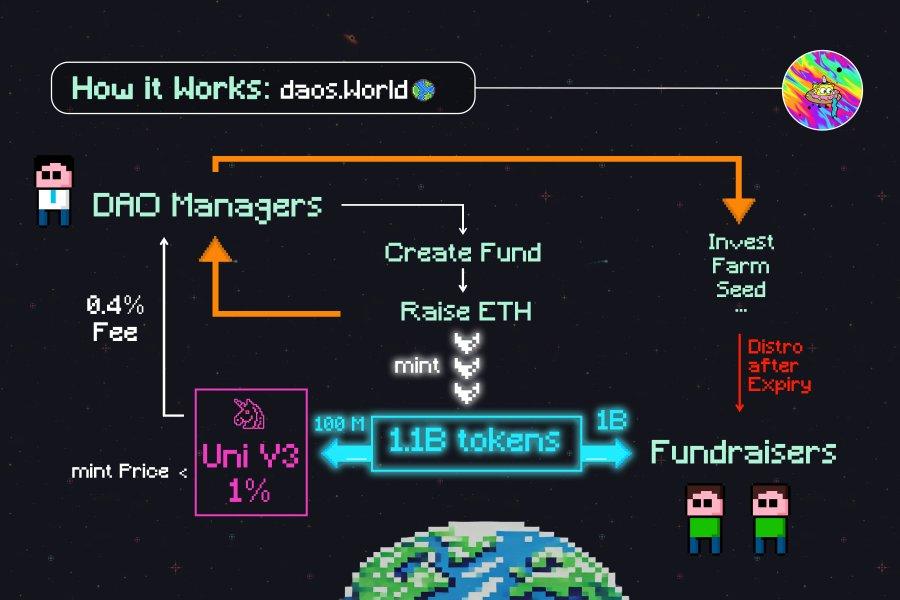
- Token Economic Layer: The platform issues a total of 1.1 billion ERC20 tokens, of which 1 billion are allocated to fundraising participants and 100 million are used to establish a Uniswap V3 liquidity pool, forming a complete token ecosystem. The liquidity pool has a price floor protection, ensuring that the value of the assets in the pool will not be lower than the amount of ETH raised, providing a basic guarantee for investors.
- Governance Layer: The platform introduces a fund maturity mechanism, and when the fund matures, all trading activities will be suspended, and the assets in the fund pool will be distributed to investors according to the token holding ratio. At the same time, the fund managers have flexible management rights and can extend the maturity date of the fund to ensure the interests of investors in specific situations.
Operation Mechanism
The operation process of the platform is simple and efficient, mainly divided into the following steps:
1. Fundraising and Fund Management: Raise ETH as the initial capital of the fund through pre-sale, and all funds enter the fund pool controlled by the DAO managers, who have full autonomy and can conduct trading and investment operations based on market conditions.
2. Liquidity Pool Design: After the launch of Uniswap V3, a single-sided liquidity pool design is adopted, i.e. the liquidity pool only contains the fund tokens, ensuring the effectiveness of the price discovery mechanism. Token transactions are conducted through this liquidity pool, and the platform charges a 1% transaction fee, of which 0.4% is distributed to the fund managers and 0.6% belongs to the platform. The trading activities of the fund will affect the "real" price of the tokens, helping traders make more informed investment decisions.
3. Transaction Fees and Incentive Mechanism: Fund managers receive 0.4% of the transaction fees from token trading volume, and the platform takes 0.6%. In addition, fund managers may receive additional profit sharing at the end of the fund, depending on the performance of the fund.
4. Liquidity Pool Price Floor Protection: The liquidity pool design has a price floor protection, ensuring that the total value of the assets in the pool will not be lower than the amount of ETH initially raised, avoiding the problem of serious asset shrinkage caused by market fluctuations.
Participation Methods
The platform has designed differentiated income schemes for different types of participants:
- Fund Managers: In addition to earning income from transaction fees, fund managers may also receive additional profit sharing at the end of the fund.
- Early Investors: Early investors can obtain lower-risk investment opportunities through pre-sale, and can receive corresponding token shares based on the amount of ETH raised. Investors can also choose to participate in liquidity provision to earn additional income.
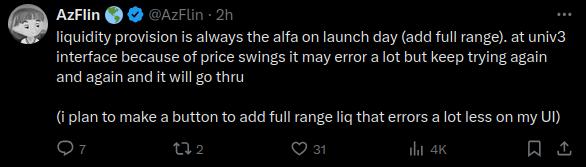
- Liquidity Providers (LPs): Due to the relatively low initial liquidity of the platform, liquidity providers (LPs) may receive considerable annualized returns, which may even exceed 1000%. However, liquidity providers need to be aware of the risks brought by market fluctuations, which may affect the trading timing and returns of the liquidity pool.
Technological Innovation
At the technical level, the platform uses smart contracts for fund custody, and fund managers can execute investment operations through the onlyOwner execute() function, allowing them to call other smart contracts to implement DeFi strategies. The Uniswap V3 liquidity NFTs remain locked before the fund matures, ensuring liquidity stability. The emergency withdrawal function serves as an early security mechanism for the platform, which can be triggered to prevent fund loss if vulnerabilities are discovered during the fundraising period. Once the pre-sale is over and the tokens are launched, the platform will no longer be able to intervene in the flow of funds, requiring the platform to further improve the security mechanism as it stabilizes.
The platform also supports fund managers to call various smart contracts on the blockchain based on market conditions, providing a broad space for the implementation of DeFi strategies. This includes but is not limited to leverage trading, cross-protocol arbitrage, yield farming and other strategies, expanding the possibilities and flexibility of investment, allowing fund managers to quickly adjust investment strategies according to market changes and improve investment efficiency.

Risks and Prospects
Although the platform shows good development prospects, investors still need to be aware of multiple risk factors:
- Investment Decision Risk of Fund Managers: The investment decisions of fund managers may carry significant risks, especially when choosing immature or underperforming assets. For example, if the fund manager invests funds in meme coins that have dropped sharply, it may cause the underlying value of the fund to be zero and the token to depreciate.
- Potential Technical Risks of Smart Contracts: Although the platform's smart contracts have been audited, there may still be unknown vulnerabilities or technical defects, and investors need to be cautious when participating.
- Liquidity Risks Caused by Market Volatility: Due to the relatively low initial liquidity of the platform, market volatility may have a significant impact on token prices and trading timing. Liquidity providers (LPs) need to bear the risks brought by market fluctuations.
Nevertheless, the platform has effectively solved many problems faced by traditional meme coins through innovative mechanisms, especially in ensuring the underlying value and preventing launch attacks. In the future, with further improvement of the platform and expansion of the ecosystem, it is expected to provide a more mature solution for decentralized fund management.
Emergency Withdrawal Function
The platform's smart contract includes an emergency withdrawal function, which is effective during the fundraising period and is used to protect funds in the event of contract vulnerabilities or other abnormal situations. This mechanism ensures that investors can safely withdraw their funds if problems arise, but it should be noted that this function will no longer apply after the pre-sale is over, so investors need to pay attention to the platform's security during the contract's effective period. As the platform matures and is further developed, this function may be gradually improved to enhance overall security.

Summary
Daos.World represents an innovative attempt at decentralized fund management, achieving a balance of efficiency, security and flexibility through carefully designed mechanisms. The platform provides multiple profit opportunities for cryptocurrency investors through its unique token economy, flexible fund management and diversified income mechanisms. However, investors should fully understand the platform's operating mechanism and weigh various risk factors before participating, and make rational investment decisions.






