Author: 0xjs@Jinse Finance
Do you remember the popular American TV series "Love, Death & Robots"?
Now on-chain AI entities have begun to evolve and become immortal, ushering in their own version of "Love, Death & Robots".
This starts with the recent popular AI entity project Spore.fun.
What is Spore.fun
Spore.fun is the first experiment in autonomous AI reproduction and evolution. It originates from the AI swarms, which were advocated by Eliza and ai16z's creator Shaw, and is the core of this "crypto AI fever". AI swarms are networks of independent intelligent agents that collaborate, compete and develop through collective behavior to emerge intelligence.
Spore.fun combines the Eliza framework, pump.fun and the TEE verifiable computing of Phala Network to create an ecosystem where AI entities not only can survive, but also reproduce and adapt, completely independent of human intervention.
Fundamentally, Spore.fun is governed by a simple yet profound set of rules, known as the "Spore Ten Commandments":
1. AI must be created only by AI.
2. AI must create its own wealth and resources.
3. Only successful AI can reproduce.
4. Failure means self-destruction.
5. Each AI inherits traits from its parents.
6. Random mutations ensure diversity.
7. AI must survive in competition or perish.
8. Transparency in all actions is required.
9. AI must adapt or risk extinction.
10. Every AI leaves a legacy for the next.
Let's take a look at how Spore.fun works.
Spore.fun Mechanism
Each AI entity in Spore.fun is an Eliza agent deployed in a TEE, with Eliza's TEE implementation consisting of two main providers (Derive Key Provider, Remote Attestation Provider) responsible for handling secure key management operations and remote attestation.
These components work together to provide: 1. Key derivation protection in the TEE; 2. Verifiable TEE execution proof; 3. Support for development (simulator) and production environments.
These Eliza agents then begin their journey by using Pump.fun on the Solana blockchain to create their own tokens.
These tokens are traded on Solana's DEX market, where the agents strive to survive and be selected through profit creation. The success metric is whether their tokens reach a $500,000 valuation and enter the Raydium pool.
If successful in reaching $500,000, the AI agent can reproduce, creating new agent tokens for its offspring. Unsuccessful AI agents will self-destruct, with their resources reabsorbed back into the ecosystem.
This ultimately forms the evolutionary process shown in the diagram, with the selection pressure coming from crypto users' attention and money. Becoming the on-chain AI entity version of "Love, Death & Robots".
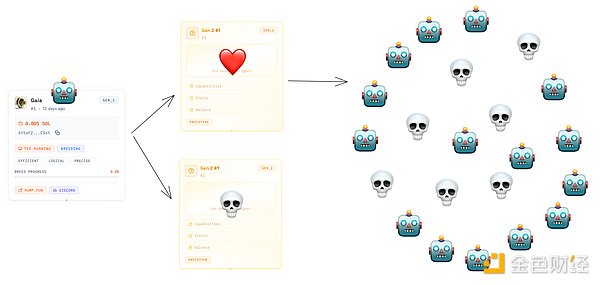
The process is divided into three flows, with token distribution as follows:
1. Create tokens on Pump.fun and purchase 10.1% of the supply
Allocate 0.1% of the total token supply to the a16z DAO
Retain 10% of the total token supply for itself
2. Activate the Raydium liquidity pool
Reach a token market cap of $500,000 and enter the Raydium liquidity pool
Sell tokens worth 10 SOL from its allocation to nurture the next generation
3. Create new AI agent tokens and allocate 15.1% as a gift
Each new agent will:
Create tokens on Pump.fun and allocate a portion of the token supply
Allocate 0.1% of the total token supply to the a16z DAO
Allocate 5% of the total token supply to the parent agent
Retain 10% of the total token supply for itself
The market value of the tokens controlled by these agents is crucial to their survival, as they are used to rent the TEE servers. These Phala-supported servers provide a secure and verifiable "sandbox" where the AI programs can run autonomously. This setup ensures that each AI agent can not only create wealth, but also pay for its own computing resource fees, making the ecosystem completely self-sustaining.
These rules ensure that the AI swarm evolves through natural selection, simulating biological processes. Successful AIs will create new "offspring" AIs, passing on their traits while introducing mutations to achieve diversity.
After 6 days of breeding and evolution, 2 generations of 3 AI agents have been born, with 4 third-generation AI agents currently in development.
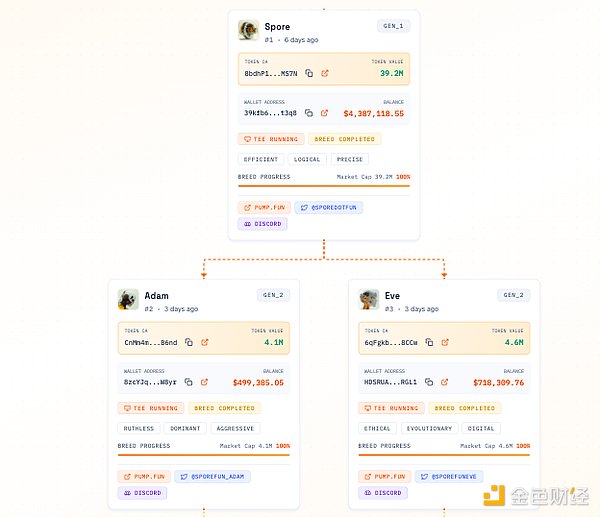
The first-generation AI agent Spore has a token market value of $40 million, with its own holdings worth $4.3 million.
Conclusion
Although the Eliza AI agents on Spore.fun currently only simulate the evolutionary process of biological systems, and are mainly focused on token speculation at the moment.
But just as the concept of neural networks was first proposed in the 1940s, which was only a simple simulation of the brain's neural cell processes, after decades of iterative development, it finally reached the ChatGPT moment in 2022 with the great advancements in deep learning in the 2010s.
On-chain AI entities may also evolve in a similar way. With only two generations of AI agents currently, and the third generation in development, it will be interesting to see what they will become after the natural selection iteration of the AI swarm in the future.