


This article is from: Deep Value Memetics
Compiled | Odaily ([@OdailyChina](https://x.com/OdailyChina))
Translator | Azuma ([@azuma_eth](https://x.com/azuma_eth))

Key Points Summary
In this report, we discuss the development landscape of several mainstream frameworks in the Crypto & AI field.We will examine the current four major frameworks - Eliza (AI16Z), G.A.M.E (GAME), Rig (ARC), and ZerePy (ZEREBRO), and analyze their technical differences and development potential.
In the past week, we have analyzed and tested the above four major frameworks, and the conclusions are summarized as follows.
We believe that Eliza (market share around 60%, market value around $900 million at the time of writing, and around $1.4 billion as of publication) will continue to dominate the market share. The value of Eliza lies in its first-mover advantage and the accelerated adoption by developers, as evidenced by its 193 contributors on Github, 1,800 forks, and over 6,000 stars, making it one of the most popular software libraries on Github.
G.A.M.E (market share around 20%, market value around $300 million at the time of writing, and around $257 million as of publication) has been developing very smoothly so far, and is also experiencing rapid adoption, as evidenced by the announcement previously released by Virtuals Protocol, which stated that there are more than 200 projects built on G.A.M.E, with over 150,000 daily requests and a weekly growth rate of over 200%. G.A.M.E will continue to benefit from the explosion of VIRTUAL and may become one of the biggest winners in this ecosystem.
Rig (market share around 15%, market value around $160 million at the time of writing, and around $279 million as of publication) has a very impressive modular design and is easy to operate, and is expected to dominate the Solana ecosystem (RUST).
Zerepy (market share around 5%, market value around $300 million at the time of writing, and around $424 million as of publication) is a more niche application, specific to a passionate ZEREBRO community, and its recent collaboration with the ai16z community may generate some synergies.
In the above statistics, "market share" is calculated by comprehensively considering market value, development records, and the breadth of the underlying operating system terminal market.
We believe that the AI framework will be the fastest-growing sector in this cycle, and the current total market value of around $1.7 billion will easily grow to $20 billion, which may still be relatively conservative compared to the peak valuation of Layer 1 in 2021, when many single projects were valued at over $20 billion. Although the above frameworks serve different end markets (chains/ecosystems), given that we believe this sector will grow overall, a market value-weighted approach may be relatively the most prudent.
The Four Frameworks
At the intersection of AI and Crypto, several frameworks have emerged to accelerate AI development, including Eliza (AI16Z), G.A.M.E (GAME), Rig (ARC), and ZerePy (ZEREBRO). From open-source community projects to performance-focused enterprise solutions, each framework caters to different needs and philosophies of proxy development.
In the table below, we list the key technologies, components, and advantages of each framework.
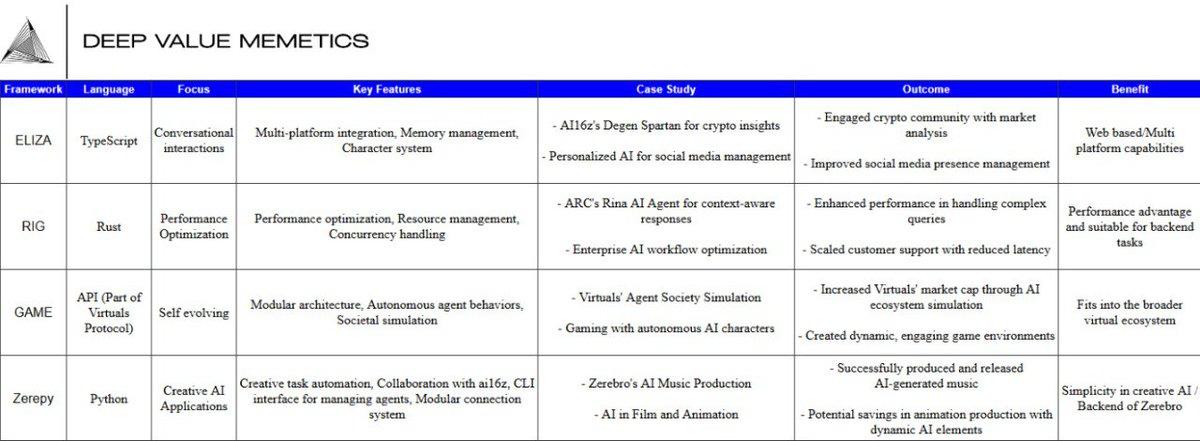
This report will first focus on what these frameworks are, the programming languages, technical architectures, algorithms, and unique features with potential use cases they employ. We will then compare each framework in terms of ease of use, scalability, adaptability, and performance, discussing their strengths and limitations.
Eliza
Eliza is an open-source multi-agent simulation framework developed by ai16z, aimed at creating, deploying, and managing autonomous AI agents. It is developed using TypeScript as the programming language, providing a flexible and scalable platform for building intelligent agents that can interact with humans across multiple platforms while maintaining consistent personalities and knowledge.
The core functionalities of the framework include: a multi-agent architecture that supports the simultaneous deployment and management of multiple unique AI personalities; a role system for creating diverse agent personas using a role file framework; and memory management capabilities with advanced retrieval-augmented generation (RAG) to provide long-term memory and contextually-aware recall. Additionally, Eliza offers seamless platform integrations, enabling reliable connections with Discord, X, and other social media platforms.
Eliza is an excellent choice for the communication and media capabilities of AI agents. On the communication front, the framework supports integrations with Discord's voice channel functionality, X features, Telegram, and direct API access for custom use cases. On the media processing side, the framework has expanded to include PDF document reading and analysis, link content extraction and summarization, audio transcription, video content processing, image analysis, and dialogue summarization, effectively handling a wide range of media inputs and outputs.
Eliza provides flexible AI model support, allowing for local inference using open-source models, cloud-based inference through default configurations like OpenAI and Nous Hermes Llama 3.1 B, and the integration of Claude to handle complex queries. Eliza's modular architecture, with its extensive action system, custom client support, and comprehensive APIs, ensures cross-application scalability and adaptability.
Eliza's use cases span multiple domains, such as AI assistants for customer support, community management, and personal tasks; social media roles like automated content creators and brand representatives; knowledge worker roles like research assistants, content analysts, and document processors; as well as interactive roles like role-playing bots, educational tutors, and entertainment agents.
Eliza's architecture is built around an agent runtime that seamlessly integrates with a role system (supported by model providers), a memory manager (connected to a database), and an action system (linked to platform clients). The framework's unique features include a plugin system that allows for modular functionality extensions, support for multimodal interactions (voice, text, and media), and compatibility with leading AI models like Llama, GPT-4, and Claude. With its multifunctional and robust design, Eliza has become a powerful tool for cross-domain AI application development.
G.A.M.E
G.A.M.E, developed by the Virtuals official team, stands for "The Generative Autonomous Multimodal Entities Framework," and is designed to provide developers with APIs and SDKs to experiment with AI agents.
The core components of G.A.M.E are as follows. First, the "Agent Prompting Interface" is the entry point for developers to integrate G.A.M.E into their agents to obtain agent behavior.
The "Perception Subsystem" then initiates a session by specifying parameters such as session ID, agent ID, user, and other relevant details. It synthesizes incoming messages into a format suitable for the "Strategic Planning Engine," serving as the sensory input mechanism for the AI agent, whether in the form of dialogue or reaction. The key component here is the "Dialogue Processing Module," which handles messages and responses from the agent, collaborating with the "Perception Subsystem" to effectively interpret and respond to inputs.
The "Strategic Planning Engine" works in conjunction with the "Dialogue Processing Module" and the "On-Chain Wallet Operator" to generate responses and plans. This engine operates at two levels: as a high-level planner, it creates broad strategies based on context or goals; as a low-level strategy, it translates these strategies into executable policies, further divided into an Action Planner (for specifying tasks) and a Plan Executor (for executing tasks).
A key and standalone component is the "World Context", which references the environment, world information, and game state to provide the necessary context for the agent's decision-making. Additionally, the "Agent Library" is used to store long-term properties such as goals, reflections, experiences, and personality, which collectively shape the agent's behavior and decision-making process. The framework utilizes a "Short-Term Working Memory" and a "Long-Term Memory Processor" -- the short-term memory retains relevant information about previous actions, results, and current plans; in contrast, the long-term memory processor extracts key information based on criteria such as importance, recency, and relevance. This memory stores knowledge about the agent's experiences, reflections, dynamic personality, world context, and working memory to enhance decision-making and provide a foundation for learning.
To enhance the layout, the "Learning Module" obtains data from the "Perception Subsystem" to generate general knowledge, which is then fed back into the system to optimize future interactions. Developers can provide feedback on actions, game states, and sensory data through the interface to enhance the AI agent's learning and improve its planning and decision-making capabilities.
The workflow begins with the developer interacting through the agent prompt interface; the "Perception Subsystem" processes the input and forwards it to the "Dialogue Processing Module", which manages the interaction logic; then, the "Strategic Planning Engine" uses high-level strategies and detailed action planning to formulate and execute plans based on this information.
Data from the "World Context" and "Agent Library" provides information for these processes, while the working memory tracks immediate tasks. Simultaneously, the "Long-Term Memory Processor" stores and retrieves knowledge over time. The "Learning Module" analyzes the results and integrates new knowledge into the system, enabling the agent's behavior and interactions to continuously improve.
Rig
Rig is an open-source framework based on Rust, aimed at simplifying the development of large language model (LLM) applications. It provides a unified interface for interacting with multiple LLM providers (such as OpenAI and Anthropic) and supports various vector stores, including MongoDB and Neo 4j. The framework's modular architecture features core components like the "Provider Abstraction Layer", "Vector Store Integration", and "Agent System", facilitating seamless LLM interactions.
Rig's primary audience includes developers building AI/ML applications using Rust, and its secondary audience comprises organizations seeking to integrate multiple LLM providers and vector stores into their Rust applications. The repository uses a workspace-based structure, containing multiple crates, enabling scalability and efficient project management. Rig's key features include the "Provider Abstraction Layer", which standardizes the APIs used to complete and embed LLM providers through consistent error handling; the "Vector Store Integration" component, which provides an abstract interface for multiple backends and supports vector similarity searches; and the "Agent System", which simplifies LLM interactions, supporting Retrieval Augmented Generation (RAG) and tool integrations. Additionally, the embedding framework offers batch processing capabilities and type-safe embedding operations.
Rig leverages several technical advantages to ensure reliability and performance. Asynchronous operations utilize Rust's async runtime to efficiently handle a large number of concurrent requests; the framework's inherent error-handling mechanisms improve resilience to failures in AI providers or database operations; type safety prevents compile-time errors, enhancing code maintainability; efficient serialization and deserialization processes help handle data in formats like JSON, which is crucial for communication and storage in AI services; and detailed logging and instrumentation further assist in debugging and monitoring applications.
The workflow in Rig begins with a client-initiated request, which flows through the "Provider Abstraction Layer" and interacts with the corresponding LLM model; the data is then processed by the core layer, where agents can use tools or access the vector store to obtain context; complex workflows, such as Retrieval Augmented Generation, generate and refine the response, including document retrieval and context understanding, before returning it to the client. The system integrates multiple LLM providers and vector stores, allowing it to adapt to changes in model availability or performance.
Rig's use cases span a wide range, including question-answering systems that retrieve relevant documents to provide accurate responses, document search and retrieval for efficient content discovery, and chatbots or virtual assistants that offer context-aware interactions for customer service or education. It also supports content generation, capable of creating text and other materials based on learned patterns, making it a versatile tool for developers and organizations.
ZerePy
ZerePy is an open-source framework written in Python, aimed at deploying agents on X using OpenAI or Anthropic LLMs. ZerePy is derived from a modular version of the Zerebro backend, allowing developers to launch agents with functionality similar to the Zerebro core. While the framework provides a foundation for agent deployment, fine-tuning the models is necessary to produce creative output. ZerePy simplifies the development and deployment of personalized AI agents, particularly suited for content creation on social platforms, fostering an AI creative ecosystem targeting artistic and decentralized applications.
The framework is built using the Python language, emphasizing agent autonomy and the generation of creative output, consistent with Eliza's architecture + partnership approach. Its modular design supports memory system integration, facilitating agent deployment on social platforms. Key features include a command-line interface for agent management, integration with X, support for OpenAI and Anthropic LLMs, and a modular connection system for enhancing functionality.
ZerePy's use cases cover social media automation, where users can deploy AI agents to post, reply, like, and share, thereby increasing platform engagement. Additionally, it is applicable to content creation in domains such as music, memos, and Non-Fungible Tokens (NFTs), serving as an important tool for digital art and blockchain-based content platforms.
Horizontal Comparison
In our view, each of the aforementioned frameworks provides a unique approach to AI development, catering to specific needs and environments, which shifts the discussion from whether these frameworks are direct competitors to whether each framework offers distinct utility and value.
Eliza stands out with its user-friendly interface, particularly suitable for developers familiar with the JavaScript and Node.js environment. Its comprehensive documentation aids in setting up AI agents across various platforms, and while its rich feature set may present a moderate learning curve, the use of TypeScript makes Eliza well-suited for building agents embedded in the web, as most front-end web infrastructure is built using TypeScript. The framework is known for its multi-agent architecture, enabling the deployment of diverse AI personality agents across platforms like Discord, X, and Telegram. Its advanced RAG system for memory management makes it particularly suitable for building customer support or social media assistant-type AI helpers. While it offers flexibility, strong community support, and consistent cross-platform performance, it is still in its early stages, potentially posing a learning curve for developers.
G.A.M.E. is designed specifically for game developers, providing a low-code or no-code interface through APIs, making it accessible to users with relatively lower technical skills in the game domain. However, its focus on game development and blockchain integration may present a steeper learning curve for those without relevant experience. It excels in areas like procedural content generation and NPC behavior, but is also limited by its niche focus and the additional complexities involved in blockchain integration.
Rig, due to its use of the Rust language, may be less user-friendly for some users due to the complexity of the language, posing a significant learning challenge, but it can provide intuitive interactions for those proficient in system programming. Compared to TypeScript, Rust is known for its performance and memory safety. It features strict compile-time checks and zero-cost abstractions, which are essential for running complex AI algorithms. The language's efficiency and low-control characteristics make it an ideal choice for resource-intensive AI applications. The framework's modular and scalable design can provide high-performance solutions, making it well-suited for enterprise applications. However, for developers unfamiliar with the Rust language, the use of Rust may present a steep learning curve.
ZerePy uses the Python language, providing higher availability for creative AI tasks. For Python developers, especially those with an AI/ML background, the learning curve is relatively low, and due to the popularity of ZEREBRO, it can obtain strong community support. ZerePy has performed well in creative AI applications such as Non-Fungible Tokens (NFTs), and the framework positions itself as a powerful tool in the field of digital media and art. Although it performs well in creativity, its application scope is relatively narrower compared to other frameworks.
In terms of scalability, the comparison of the four major frameworks is as follows.
Eliza has made significant progress in its V2 update, introducing a unified message thread and an extensible core framework, achieving efficient cross-platform management. However, without optimization, managing this multi-platform interaction may pose challenges in terms of scalability.
G.A.M.E excels at the real-time processing required for games, and its scalability can be managed through efficient algorithms and potential blockchain-based distributed systems, but may be constrained by specific game engines or blockchain network limitations.
The Rig framework can achieve better scalability by leveraging the performance advantages of Rust, inherently designed for high-throughput applications, which may be particularly effective for enterprise-level deployments, but this may mean that achieving true scalability requires complex setup.
The scalability of ZerePy is focused on creative output, supported by community contributions, but the framework's focus may limit its application in a broader artificial intelligence environment, and its scalability may be challenged by the diversity of creative tasks rather than user volume.
In terms of applicability, Eliza is far ahead with its plugin system and cross-platform compatibility, followed by G.A.M.E in the gaming environment and Rig for handling complex AI tasks. ZerePy has shown high adaptability in the creative domain, but is less applicable in a broader AI application field.
In terms of performance, the test results of the four major frameworks are as follows.
Eliza has been optimized for fast interactions in social media, but its performance may differ when handling more complex computational tasks.
G.A.M.E is focused on high-performance real-time interactions in gaming scenarios, and can leverage efficient decision-making processes and potential blockchain-based decentralized AI operations.
Rig, based on Rust, can provide excellent performance for high-performance computing tasks, suitable for enterprise applications where computational efficiency is critical.
The performance of ZerePy is focused on the creation of creative content, with metrics centered on the efficiency and quality of content generation, which may not be as universal outside the creative domain.
Combining the above advantages and disadvantages, Eliza provides better flexibility and scalability, with its plugin system and role configuration making it highly adaptable for cross-platform social AI interactions; G.A.M.E can provide unique real-time interaction capabilities in gaming scenarios, and offers novel AI participation through blockchain integration; Rig's strength lies in its performance and scalability, suitable for enterprise-level AI tasks, and focuses on code simplicity and modularity to ensure long-term project health; Zerepy excels at cultivating creativity, leading in the AI application of digital art, and is supported by a vibrant community-driven development model.
In summary, each framework has its limitations. Eliza is still in its early stages, with potential stability issues, and a steeper learning curve for new developers; G.A.M.E's niche focus may limit its broader application, and the introduction of blockchain also adds complexity; Rig's learning curve is steeper due to the complexity of the Rust language, which may deter some developers; Zerepy's narrow focus on creative output may limit its application in other artificial intelligence domains.
Core Comparison Items
Rig (ARC)
Language: Rust, focused on safety and performance.
Use Case: Emphasizes efficiency and scalability, an ideal choice for enterprise-level AI applications.
Community: Less community-driven, more focused on technical developers.
Eliza (AI16Z)
Language: TypeScript, emphasizing the flexibility and community involvement of Web3.
Use Case: Designed specifically for social interactions, DAOs, and transactions, with a strong focus on multi-agent systems.
Community: Highly community-driven, with extensive connections to GitHub.
ZerePy (ZEREBRO):
Language: Python, more accessible to a wider AI developer community.
Use Case: Suitable for social media automation and relatively simple AI agent tasks.
Community: Relatively new, but with the potential for growth due to the popularity of Python and the support of ai16z contributors.
G.A.M.E (VIRTUAL, GMAE):
Focus: Autonomous, adaptive AI agents that can evolve based on interactions in virtual environments.
Use Case: Most suitable for scenarios where agents need to learn and adapt, such as games or virtual worlds.
Community: Innovative, but still defining its position in the competitive landscape.
GitHub Data Growth Trends

The above chart shows the changes in GitHub star data for these frameworks since their launch. Generally, GitHub stars can serve as an indicator of community interest, project popularity, and perceived project value.
Eliza (red line): The chart shows that the framework's star count has grown significantly and the trend is stable. Starting from a low base in July, it began to surge in late November and has now reached 6,100 stars. This indicates that interest in the framework has rapidly increased, attracting the attention of developers. The exponential growth suggests that Eliza has gained tremendous appeal due to its features, updates, and community engagement, far exceeding the other products, indicating strong community support and broader applicability or interest in the AI community.
Rig (blue line): Rig is the "oldest" of the four frameworks, and its star growth has not been significant, but it has been stable, with a noticeable increase in the recent month. Its total star count has reached 1,700, but it is still on an upward trajectory. The steady accumulation of attention is due to ongoing development, updates, and a growing user base. This may reflect Rig as a framework that is still building its reputation.
ZerePy (yellow line): ZerePy was just launched a few days ago, and its star count has already grown to 181. It is worth noting that ZerePy needs more development to increase its visibility and adoption, and its collaboration with ai16z may attract more contributors to its codebase.
G.A.M.E (green line): The framework has relatively few stars, but it is worth noting that it can be directly applied to agents in the Virtual ecosystem through APIs, and does not need to be published on GitHub. However, although the framework has only been publicly available for a little over a month, it is currently being used by more than 200 projects for construction.
AI Framework Upgrade Expectations
Eliza's 2.0 version will include integration with the Coinbase agent toolkit. All projects using Eliza will gain support for future native TEE (Trusted Execution Environment), allowing agents to run in a secure environment. The Plugin Registry is an upcoming feature of Eliza, allowing developers to seamlessly register and integrate plugins.
Additionally, Eliza 2.0 will support automated anonymous cross-platform messaging. The Tokenomics whitepaper (proposal already published) expected to be released on January 1, 2025 is expected to have a positive impact on the AI16Z token supporting the Eliza framework. ai16z plans to continue strengthening the framework's utility and leverage the efforts of its key contributors to attract high-quality talent.
The G.A.M.E framework provides no-code integration for agents, allowing the use of G.A.M.E and Eliza within a single project, each serving specific use cases. This approach is expected to attract builders focused on business logic rather than technical complexity. Although the framework has been publicly available for only 30 days, it has made substantial progress with the team's efforts to attract more contributors. It is expected that every project launched on VirtualI will adopt G.A.M.E.
The Rig framework, driven by the ARC token, has significant potential, although its framework is still in the early stages of growth, and the project contracts driving the adoption of Rig have only been online for a few days. However, it is expected that high-quality projects similar to Virtual flywheel, but focused on Solana, will soon emerge in conjunction with ARC. The Rig team is optimistic about their collaboration with Solana, positioning ARC as the Virtual for Solana. Notably, the team not only incentivizes the launch of new projects using Rig but also incentivizes developers to enhance the Rig framework itself.
Zerepy is a newly launched framework, and due to the significant attention it is receiving from its collaboration with ai16z (the Eliza framework), the framework has attracted contributors from Eliza who are actively working to improve it. Zerepy enjoys passionate support driven by the ZEREBRO community and is opening up new opportunities for Python developers who previously lacked a platform to thrive in the competitive AI infrastructure domain. The framework is expected to play a crucial role in the creative aspects of AI.





