Author:Stoic
Compiled by: TechFlow
We distill the core views of top global institutions, saving you hundreds of pages of report reading time.
Data sources: J.P. Morgan, Blackrock, Deutsche Wealth, World Bank, Goldman Sachs and Morgan Stanley.
1. Key views from J.P. Morgan
Global economic growth: Global economy is expected to maintain growth in 2025, but the Chinese economy may see a significant slowdown.
Stock market forecast: The S&P 500 index is expected to reach 6500 points, but global stock markets may show divergent performance.
Global market outlook
In the coming months, market trends will be influenced by the interaction of macroeconomic trends and monetary policy, while policy changes by the new US administration will also bring uncertainties.
Technological innovation, especially the "continuation of the AI boom", will be an important factor driving the market.
Interest rate outlook
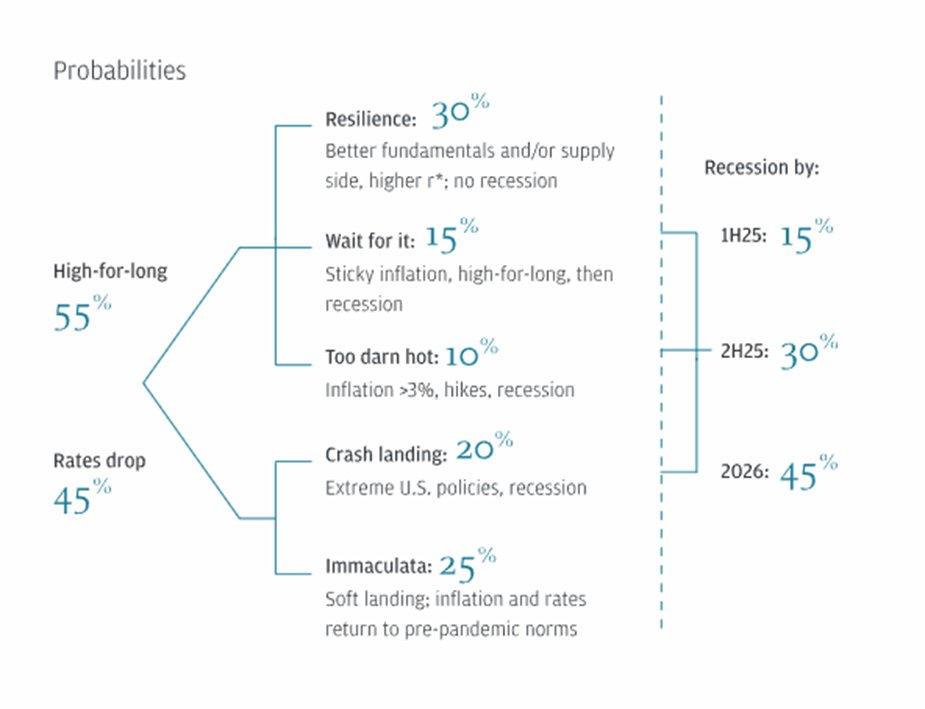
The baseline forecast suggests that global economic growth is resilient, but the persistence of inflation will limit the room for further monetary policy easing in 2025.
However, the new Trump administration may bring risks, such as overly aggressive trade and immigration policies that could disrupt the supply side and undermine global market confidence.
Baseline scenario forecast
Strong global economic growth.
Positive outlook for US stocks and gold, but pessimistic for oil and base metals.
2. Key views from Blackrock
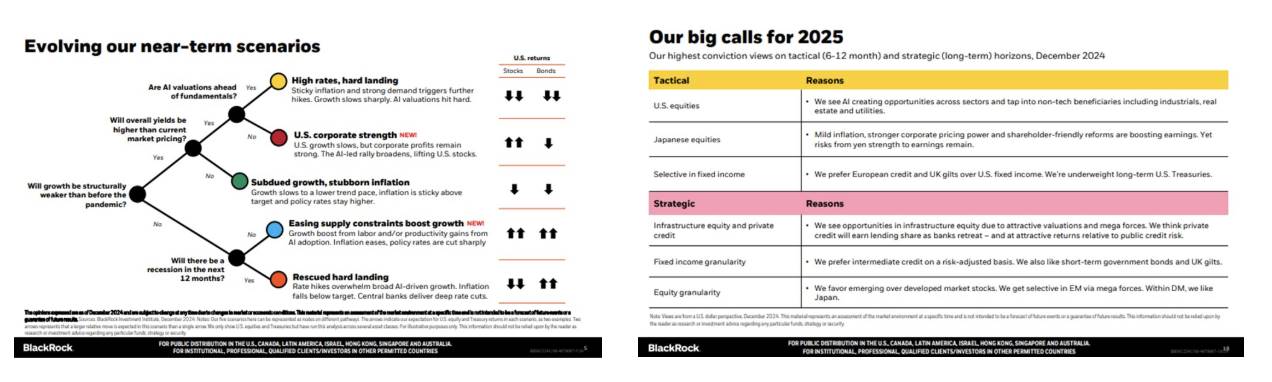
Unique market environment: The current market is in a unique stage, with long-term assets showing an unusually strong reaction to short-term events.
Investment strategy: Continue to be bullish on risk assets, further increasing exposure to US stocks, as the "AI theme is rapidly expanding".
Inflation and interest rates: Inflation and interest rates are expected to remain at levels higher than pre-pandemic.
Market outlook for 2025
Inflationary pressure: Due to the intensification of geopolitical fragmentation and the acceleration of spending driven by "AI infrastructure construction and low-carbon transformation", inflationary pressure is expected to persist.
Fed policy: The Fed is unlikely to cut rates significantly, and interest rates are not expected to fall below 4%.
Long-term bond yields: Given the budget deficit, inflation persistence, and increased market volatility, investors may demand higher risk premiums, leading to a rise in long-term government bond yields.
Key investment themes
AI-driven investment boom: The AI race will continue to drive market investment.
US stocks to continue outperforming: US stocks are expected to continue performing well, but investors need to be flexible in responding to market changes.
Watch for risk signals: Factors such as a surge in long-term bond yields or an escalation of trade protectionism may be key signals to adjust investment strategies.
3. Key views from Deutsche Wealth
Against the backdrop of a "challenging economic environment", inflation may persist due to "higher fiscal spending and potential tariff hikes".
"This will limit the central bank's ability to stimulate the economy through rate cuts, forcing it to balance growth and inflation control. This uncertainty may change market expectations and lead to more volatility than in 2024. Meanwhile, geopolitical conflicts triggered by changes in trade policy may further exacerbate market instability."
Asset allocation themes
The US economy may achieve a soft landing, with steady economic growth and strong investment.
Focus on growth stocks, but be wary of high volatility risks.
Corporate profit growth and large-scale stock buybacks will be positive for the US stock market.
Investment recommendations:
Focus on the long-term positive trend of economic growth.
Recommend a diversified investment portfolio and active risk management.
Key points summary
Despite geopolitical tensions and high interest rates, global economic growth is expected to rise slightly from 2.6% in 2024 to 2.7% in 2025-26.
Although the short-term growth outlook has improved, the growth of most global economies remains below the average of the 2010s.
Global inflation is expected to decline slowly, averaging 3.5% in 2025. Central banks may remain cautious in policy easing.
Risks such as geopolitical conflicts and climate disasters still exist, with a greater impact on vulnerable economies.
Policy recommendations include supporting green and digital transformation, promoting debt relief, and improving food security.
4. Key points from the World Bank Group's 2025 outlook
Despite facing challenges from geopolitical tensions and high interest rates, global economic growth is expected to remain at 2.6% in 2024. By 2025-2026, as trade and investment gradually recover, this growth rate may rise slightly to 2.7%.
Although the short-term growth outlook has improved, the overall performance remains weak. During 2024-2025, nearly 60% of economies will grow at a rate below the average of the 2010s, accounting for over 80% of global economic output and population.
Global inflation is expected to ease more slowly than previously anticipated, with an average rate of 3.5% this year. Due to persistent inflationary pressures, central banks may be more cautious in easing monetary policy.
The multiple shocks in recent years have caused many emerging markets and developing economies to stagnate in their catch-up process with advanced economies. Data shows that nearly half of EMDEs underperformed advanced economies in 2020-2024. For fragile economies heavily affected by conflicts, the future outlook is even more bleak.
Although risks are somewhat balanced, the overall risks are still tilted to the downside. The main risks include:
Persistent geopolitical tensions.
Potential escalation of global trade fragmentation.
Persistently high interest rates, combined with continued inflationary pressures.
Frequent natural disasters related to climate change.
To address these challenges, global policies need to focus on the following areas:
Maintaining the stability of the international trade system.
Promoting green and digital transformation to support sustainable economic development.
Providing debt relief support to help alleviate the pressure on highly indebted countries.
Improving food security, especially in vulnerable economies.
For emerging markets and developing economies, high debt levels and their servicing costs are a severe challenge. These countries need to find a balance between meeting their huge investment needs and maintaining fiscal sustainability.
To achieve long-term economic and social development goals, countries need to adopt the following policy measures:
Increase productivity growth and improve economic efficiency.
Improve the efficiency of public investment to ensure proper use of funds.
Strengthen human capital development, such as education and skills training.
Narrow the gender gap in the labor market and increase female labor force participation.
5.Key Insights from Goldman Sachs
"2025: The Year to Unlock Outperformance"
- Declining interest rates and economic growth occurring simultaneously could be favorable for the stock market.
- Current stock valuations are near highs, so future earnings growth will be the primary driver of the market.
- Global stocks have risen 40% since October 2023, making the market more vulnerable to negative news.
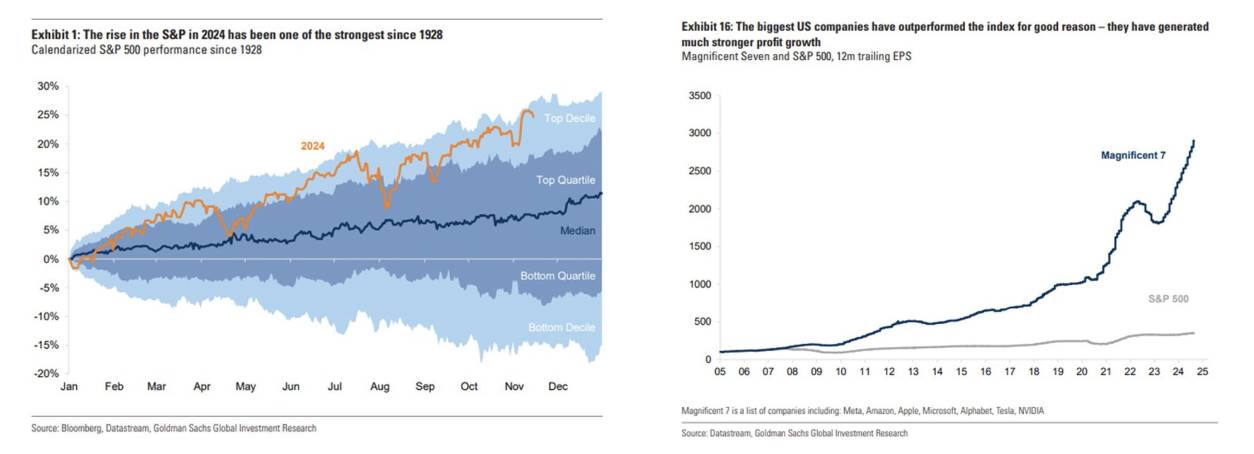
- The S&P 500 index's gain is one of the strongest since 1928. The Nasdaq has risen over 50%, with NVIDIA surging 264%, driven by expectations of "peak inflation" and a "Fed policy pivot".
- Rising price-to-earnings ratios have pushed stock and credit valuations to historical highs, with European and Chinese markets nearing long-term averages and no longer undervalued.
- Despite high valuations, further upside is not entirely precluded, but high valuations may put some pressure on future returns.
- The outperformance of large U.S. tech companies reflects their strong profit growth, with their valuations reflecting their quality fundamentals rather than market exuberance.
Risk Analysis
- The recent market optimism may have already discounted some of the returns, making the market more vulnerable to corrections.
- Uncertainties remain around tariff risks.
Goldman Sachs emphasizes the strategy of "diversifying investments and generating alpha" to address these risks.
- Expanding the investment universe to participate in more asset classes.
- Seeking potential value investment opportunities.
- Achieving geographic diversification to mitigate risks.
6.Morgan Stanley's Market Outlook
Key Themes
- Elevated Market Valuations Morgan Stanley believes current market valuations are generally high, and most investors no longer see asset prices as cheap. Therefore, it recommends optimizing asset allocation and investment selection to prioritize alpha generation over relying solely on market beta.
- Bull Market Entering the Optimistic Phase The market is entering the "optimistic phase" of the bull market, which is typically the late stage, followed by the "euphoric phase" before the onset of a bear market. Morgan Stanley states that "the market performance in 2025 is still worth looking forward to."
- Impact of Generative AI on the Private Equity Market The potential impact of Generative AI on the private equity market is considered a key theme for 2025. The rapid development of this technology may bring new opportunities and challenges to private equity investments.
Summary and Recommendations
The perspectives from various institutions reveal some common trends and themes, such as high market valuations, the impact of AI technology, and the importance of diversified investments. These can serve as references for investors in formulating their strategies.
It is important to note that these views are not absolute truths but provide different perspectives for investors to compare and analyze.
If this content is of interest, I plan to write a dedicated article exploring the prospects of the cryptocurrency market. If there are other reports or research from institutions worth highlighting, please feel free to recommend them, as I would be happy to further investigate.