Author: TechFlow
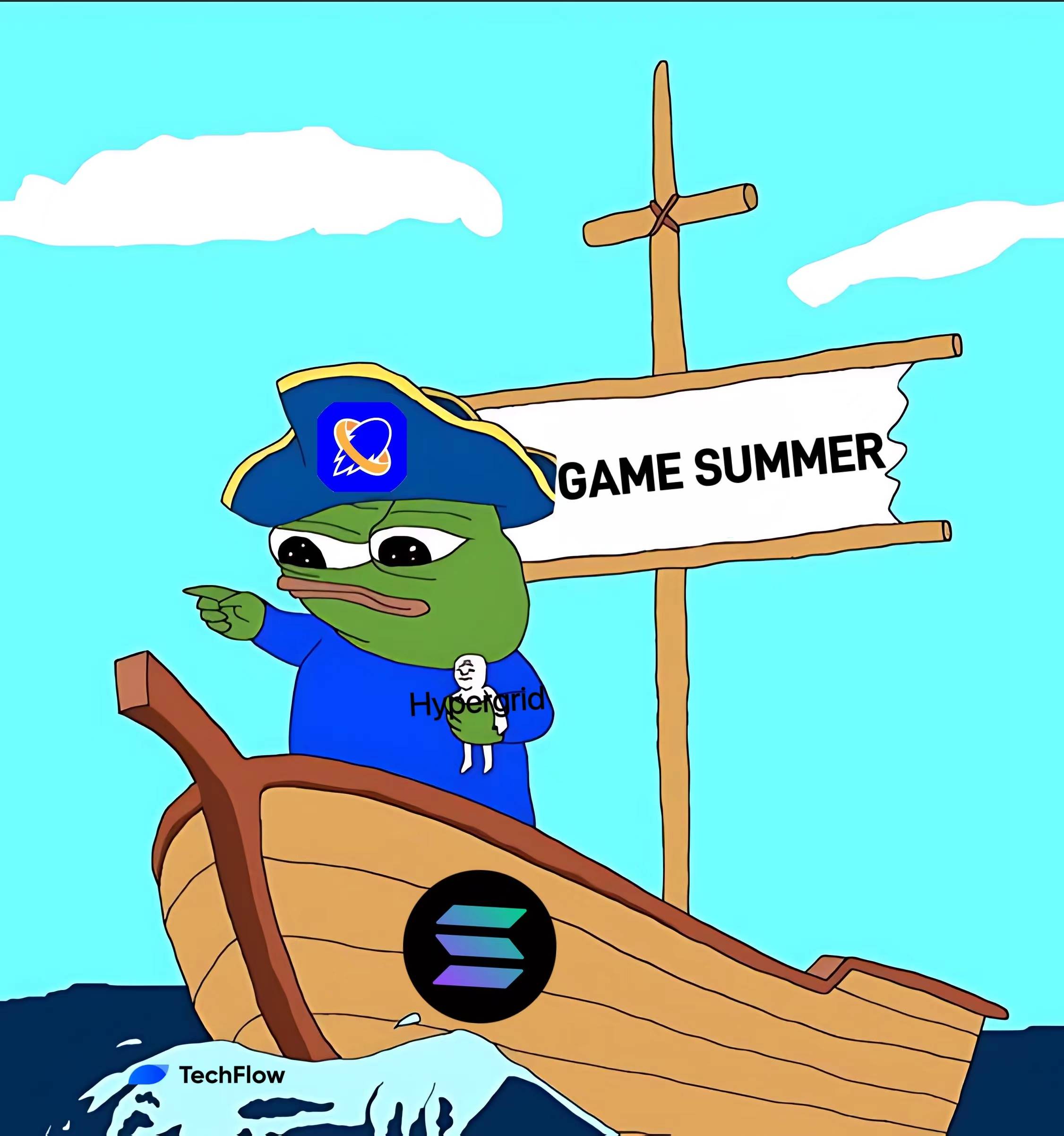
The market is dull, lacking a phenomenon-level new project to drive the narrative shift.
But looking back, Solana is still worth paying attention to. User demand is obvious, and the transaction frequency and activity have been maintained at a certain level.
As liquidity and attention are accumulating, a trigger is needed to break the dull market structure.
Currently, games on Solana seem to have been overshadowed by the MEME hype, but the imagination space is huge:
First, there is still no game on Solana that has reached the same scale as the ETH-related ecosystem; secondly, against the backdrop of mobilization and narrative rotation, the overall Solana game track is waiting to be activated, to take over the existing liquidity and attention.
From the "Dull Summer" to the "Game Feast", which projects will become the key drivers, providing support in terms of technology, ecology, and capital?
Sonic, the first Layer2 built for games on Solana, and also the first modular SVM chain on Solana, may be worth watching.
The project has proposed a Rollup expansion framework called HyperGrid, which can combine the speed of Solana and the customizability of game-specific rollups, creating conditions for the explosion of the game ecosystem on Solana.
Also, in June this year, Sonic raised $12 million in funding led by Bitkraft, with participation from Galaxy and Big Brain Holding. The token will be launched in October, with high expectations. According to public information, Sonic is also carrying out game and partner cooperation plans, trying to incentivize more games to be introduced into the Solana ecosystem;
For more "Degen" users, Sonic has been conducting node pre-sales in the past few days, which also adds more reasons to pay attention to this project.
The Times Make the Hero, the Rationality and Timing of Sonic
Don't rush in.
Whether a project is worth paying attention to, the "rationality" of demand and narrative is important.
Before understanding Sonic itself, you must be more puzzled: Does Solana, which is already fast enough, still need L2? What capabilities does Sonic itself have to meet these needs?
For stereotypes, it seems full of problems at first glance. But if you think about it, you will find new market opportunities.
For example, Solana's 2nd generation mobile phone sales received 60,000 orders in 3 weeks, indicating a significant market demand for mobile devices. But the games in the ecosystem are lacking (regardless of whether Web3 games are fun, the lack of games is the primary issue):
Currently, the main Web3 games are basically on Polygon/BNB/ETH. Although Solana is called the "retail chain", the game categories closest to retail users have actually not yet developed.
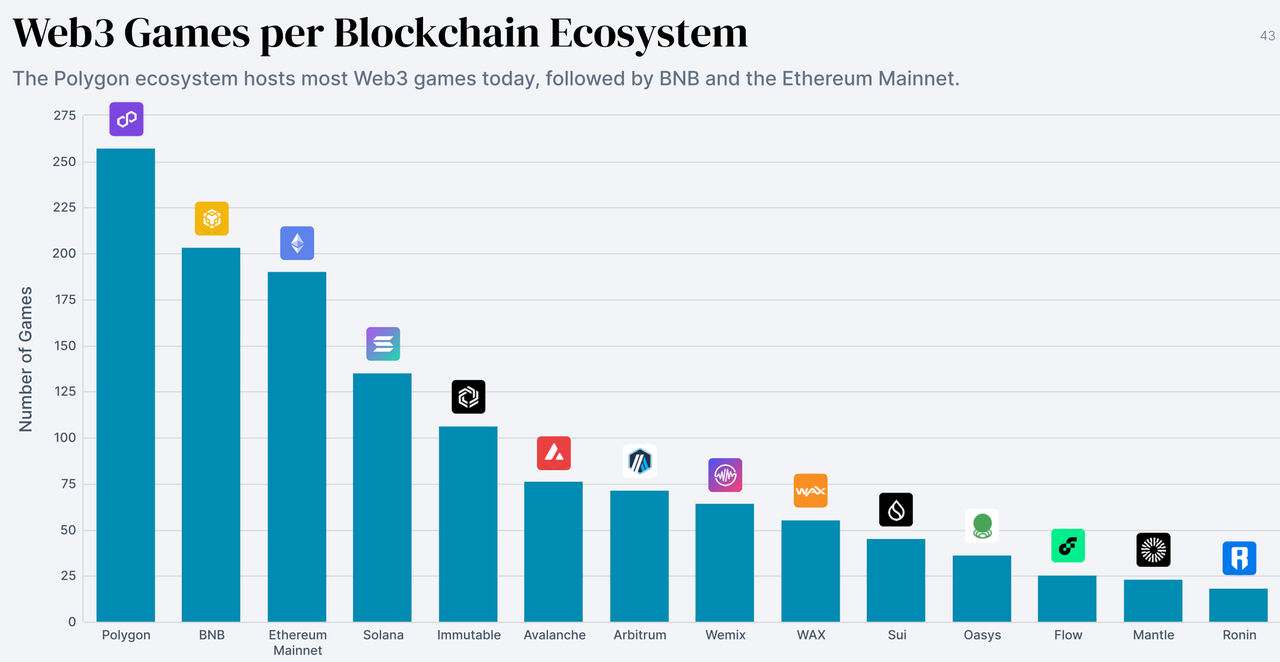
Data from DappRadar shows that none of the TOP25 UAW (Unique Active Wallets) games are on Solana; none of the TOP10 market cap games are on Solana either.
This is like the two sides of a coin, you can see the lack of games, and it also means there is a great opportunity to provide a seat for games.
As for the other question, whether Solana needs L2, in fact, the technology, public opinion, and applications all show the demand.
Technically, Solana's mainnet L1 faces foreseeable performance pressure and needs a way to offload; Rollup L2 is an option.
With the accelerated growth of dAPPs and DeFi activities on Solana, the daily on-chain transactions have exceeded 200 million as of January 2024, and conservative estimates suggest the transaction volume will exceed 4 billion by 2026.
Under this foreseeable pressure, Solana's TPS is around 2500-4000, and the average ping time of the Solana cluster fluctuates between 6 seconds and 80 seconds; when TPS is saturated or even exceeds 4000, the success rate of Solana transactions is only 70% to 85%.
At the same time, when on-chain MEME transactions are frequent, other applications are affected; when games have high-frequency interactions, they are also to some extent constrained by the L1 performance.
In terms of applications, some projects have already started to consider Rollup-like designs.
Due to the lack of advanced data structures for games on Solana, project developers need to manually implement them in smart contracts, increasing the difficulty of building games on Sol; and the lack of a caching mechanism also means that common game operations like cross-transaction calls and data account access are difficult to handle, further increasing the difficulty of game development.
Non-game projects, such as Pyth building application chains based on Solana, and Grass using zk-aggregation to pack high-frequency DePIN data into L1, are exhibiting L2-like behaviors.
For applications (games), they obviously prefer to have their own L2 Rollup, which is more conducive to capturing the value of their own fees, privacy, and achieving real-time settlement.
In the public discourse, the founders of Solana-related ecosystem projects have also been discussing the need for L2.
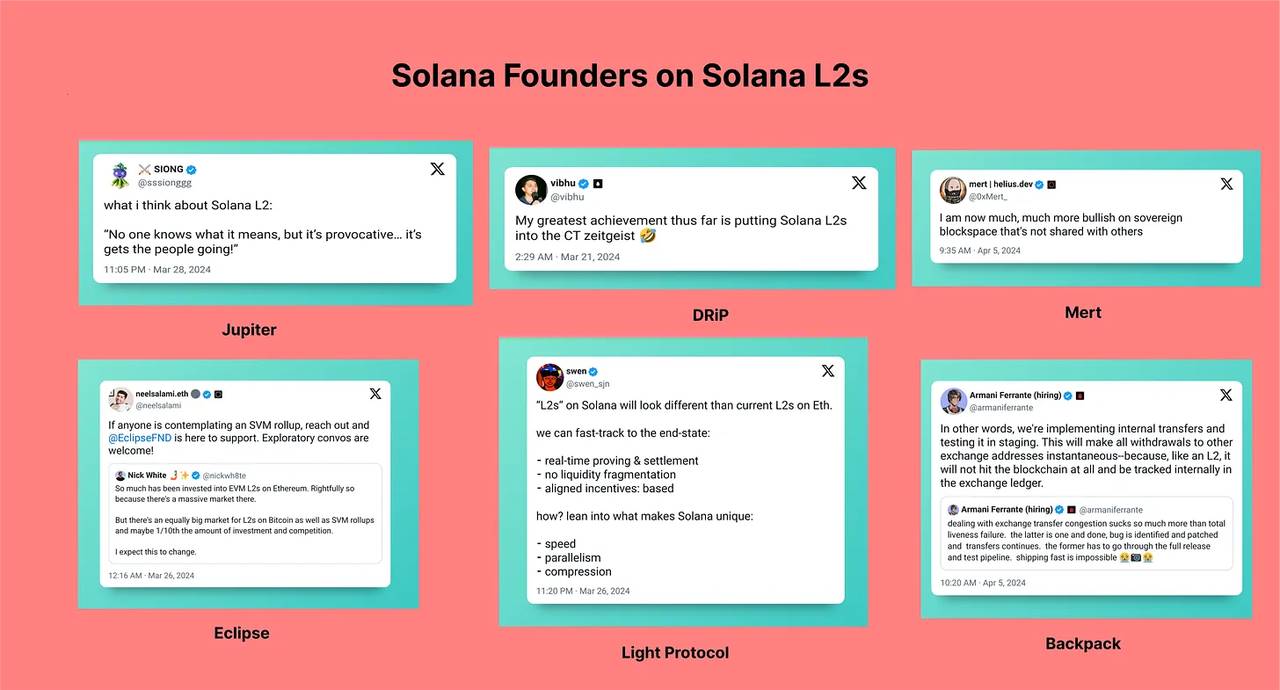
From the perspectives of performance, ecology, applications, and dissemination, Solana does need a game chain to expand its ecosystem.
Shifting the perspective to investment research, the above information means that: Whoever solves the needs in the Solana ecosystem first, will have a better chance of becoming the next Alpha.
This is the rationality and timing that Sonic is facing.
HyperGrid, the Secret Weapon for "One-Click Chain Deployment"
After understanding the necessity, let's see how Sonic plans to do L2.
The uniqueness of Sonic lies in HyperGrid, a horizontal scaling Rollup architecture designed specifically for Solana SVM.
You can think of Sonic's L2 as being built on top of HyperGrid, which is Solana's first concurrent expansion framework; furthermore, the name "HyperGrid" implies that it allows multiple independent grids to run simultaneously, each grid can process transactions independently, but ultimately achieve consensus and confirmation through the Solana mainnet.
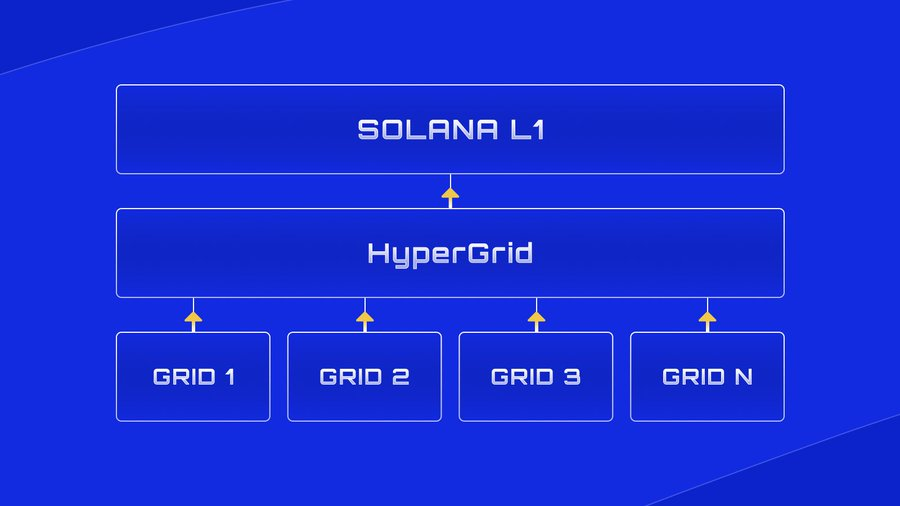
The advantage of this design is that it can greatly improve the scalability and performance of the system.
You can imagine it as a "self-governing system" that can operate independently and centrally:
Independent Operation: Each grid can independently process its internal transactions, including verification, recording, and state changes. This means that the applications within a grid will not affect the operation of other grids.
Connected to the Mainnet: Although the grids can operate independently, the final consensus and confirmation still depend on the Solana mainnet. This ensures the data consistency and security across all grids.
Flexible Scaling: Developers can choose to use a public grid or create an independent grid to obtain higher performance isolation and control.
If you still can't understand, a better analogy is a large shopping mall and the independent stores within it.
Imagine HyperGrid as a large shopping mall, and each Grid is an independent store in the mall. Each store (Grid) can operate independently, handling its own transactions and customers (application transactions).
The real estate (Solana mainnet) is responsible for the overall security and management of the mall, ensuring that the transaction records and state changes of each store are ultimately confirmed. If the business of a particular store is especially busy, it can open a new branch (create a new independent Grid) to ensure the smooth operation of the business without affecting other stores.
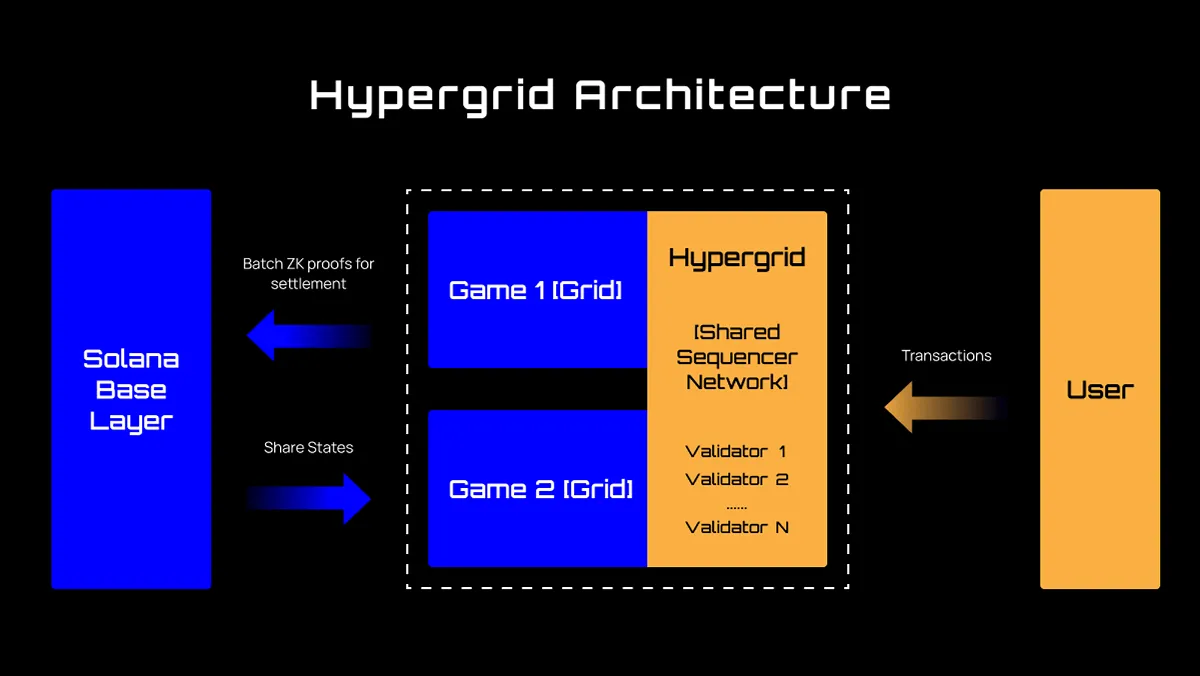
Specifically, HyperGrid is actually composed of the following parts:
Solana Base Layer: Responsible for the final consensus and data recording, this layer receives batch zero-knowledge proofs from HyperGrid for settlement and shares state information.
HyperGrid: A shared ordering network that coordinates and manages multiple grids, and also includes multiple validators, each responsible for processing and verifying transactions.
Different Grids: Each grid can be seen as an independent application or service (such as a game), handling its specific transactions and state changes.
User: Trades with Hypergrid, which is responsible for receiving and processing these transactions. The transactions are processed by Hypergrid's validators and ultimately settled and recorded on the Solana base layer.
Having just the Hypergrid architecture is not enough to fully unleash its potential, and it needs some auxiliary tools to make it more user-friendly.
First is the EVM interpreter, which allows existing Ethereum-based games to be deployed on Hypergrid with only minor modifications; at the same time, Hypergrid has also developed a native game engine that covers the game runtime loop, game-specific types and containers, and the sandbox environment, reducing various barriers in game integration, development, and debugging.
In the final asset interaction process, Hypergrid also provides a complete payment and settlement infrastructure, such as an embedded market, token swap, bridging and liquidity pools, identity authentication, and wallet tools.
Therefore, with Hypergrid and the above tools, developers can quickly build their own customized Rollup for their games, without having to reinvent the wheel from scratch, leveraging the ready-made architecture and toolkits to handle all the necessary aspects of a Web3 game end-to-end.
At the same time, the benefits to developers will ultimately spill over to all stakeholders around the Solana ecosystem.
Crypto players can get better trading and gaming experiences, but technically they won't feel any changes, just a subjective feeling of faster transaction speed. For the entire Solana ecosystem, the applications' own customized Rollups can also reduce the mainnet performance pressure, allowing more Solana games to be introduced, and each game will bring user traffic and liquidity for in-game assets, which will also permeate the Solana base layer.
It's worth mentioning that as an L2, Hypergrid's system also adopts a staking design, where the network's validators need to stake SOL to become nodes, which indirectly enhances the value capture effect of SOL.
Ultimately, Sonic's Hypergrid design greatly enhances the system's scalability and performance, while ensuring data consistency and security; allowing all parties in the Solana ecosystem to benefit, which the author believes is a reasonable choice with multiple parties able to participate and have the motivation to do so.
Concerns Beyond Technology
As an L2 infrastructure project that can benefit multiple parties, technology is certainly important, but more critical is how many partners can play together and to what extent they can expand their business circles.
Therefore, factors such as Sonic's resources, collaboration capabilities, community building, and market entry strategies are more important.
In June this year, Sonic announced that it had raised $12 million in a Series A round led by Bitkraft, with participation from Galaxy Interactive, Big Brain Holdings, and others.
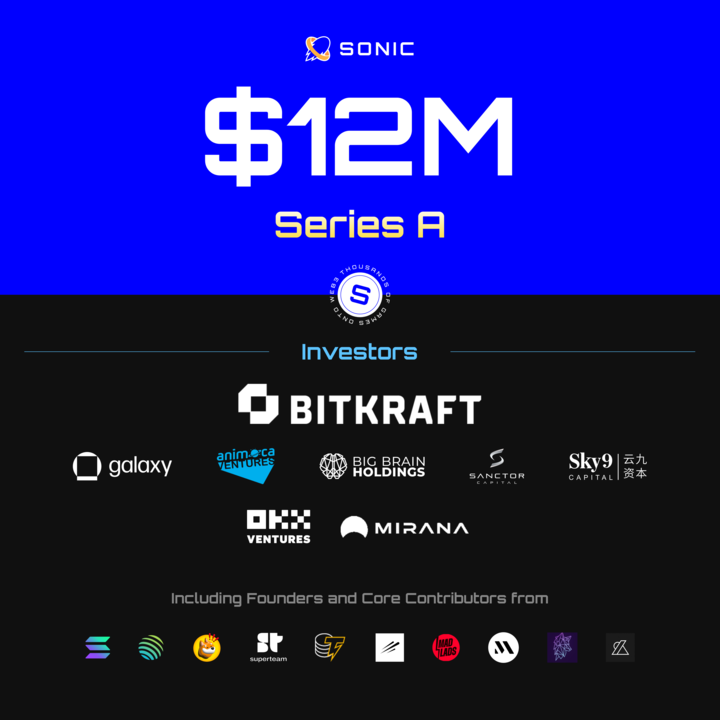
The developers behind Sonic - Mirror World - also have stronger capabilities. They received a $4 million seed round as early as 2022, with investments from CEXs like OKX and Bybit. Building on this foundation, if Sonic's token TGE further increases the expected listing, it would be even more promising.
On the other hand, Sonic and Mirror World have close ties with Solana.
Public information shows that Solana's Asia-Pacific growth team, gaming team, and ecosystem technology lead are all advisors and angel investors in the Sonic project, which undoubtedly adds legitimacy to the project.
More official organizational connections also mean broader connections and resources, making it easier to collaborate within the Solana ecosystem and pave the way for project development.
Specifically, Mirror World's application development platform SDK has previously been deployed to 50 game clients as initial distribution nodes, and has already established good cooperative relationships with existing games, making it easier to migrate existing games to Sonic and complete Sonic's ecosystem cold start.
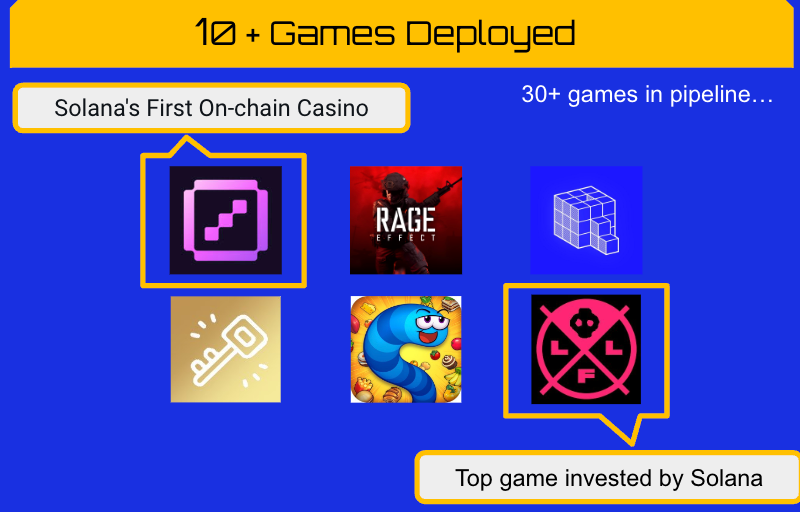
Currently, on Sonic's testnet, more than 10 on-chain games have been successfully deployed, including Zeebit, the first on-chain casino in the Solana ecosystem, and Lowlife Forms, a top-tier shooting game officially invested by Solana.
At the same time, Sonic's testnet has already taken shape.
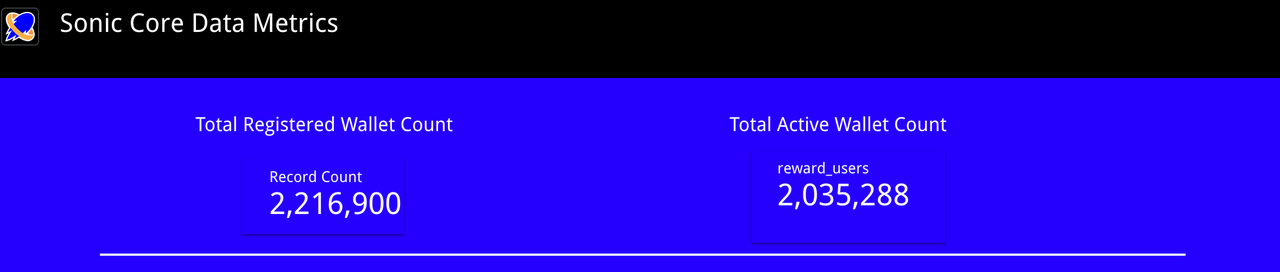
Looking at the official data dashboard, Sonic currently has over 2 million active wallets. With Sonic's mainnet launch scheduled for September, we can expect more games to be introduced, and if a phenomenal game emerges, this number is likely to keep growing.
But everyone knows that Web3 games will inevitably attract users from within the circle first, so how to activate the inner circle users and inject initial traffic and attention becomes even more critical.
The author has always emphasized that for an infrastructure project, the ability to organize and mobilize resources directly determines the lower limit of the project. In this regard, Sonic's advantage is very obvious, as its key collaborative advantage is the ability to establish good cooperative relationships with non-gaming projects, providing liquidity, traffic, and security support for this chain.
For example, Backpack, OKX wallet, Metaplex, Solayer (over $25 million SOL staked), Jito, and other exchange, , and projects have already become Sonic's partners, jointly infusing this L2 with resources.
In addition to connecting with partners, Sonic has also been constantly increasing its influence in the community recently to strengthen brand awareness.
As a globally-oriented L2, Sonic has now recruited ambassadors in various countries and held community meetups in emerging Web3 markets like Turkey and Nigeria to strengthen its position in the minds of users and developers.
At the same time, from recent actions, Sonic has also accelerated its exposure frequency. Sonic has co-hosted important events in the Solana ecosystem, such as Solana's hacker house and breakpoint; and it has also been actively sharing as a guest speaker in both the Solana Chinese and global communities.
In these gradual actions, we ultimately see Sonic as a project with multi-VC investment, Solana official support, global user reach and good activity, as well as strong resource connection capabilities and a growing ecosystem.
More importantly, Sonic's proactive narrative (the first L2 oriented towards games on Solana) and the accumulation of these factors constitute the reasons why you should pay attention to Sonic.
Current Participation Opportunity: HyperFuse Guardian Node NFT Sale
Currently, Sonic's token $SONIC is planned to have its TGE in October. Although we cannot directly participate in the token at the moment, we can learn about its economic model and utility in advance, and participate in the upcoming node pre-sale activity.
First, the SONIC token is designed for three types of roles: token holders, builders and contributors, and users and community.
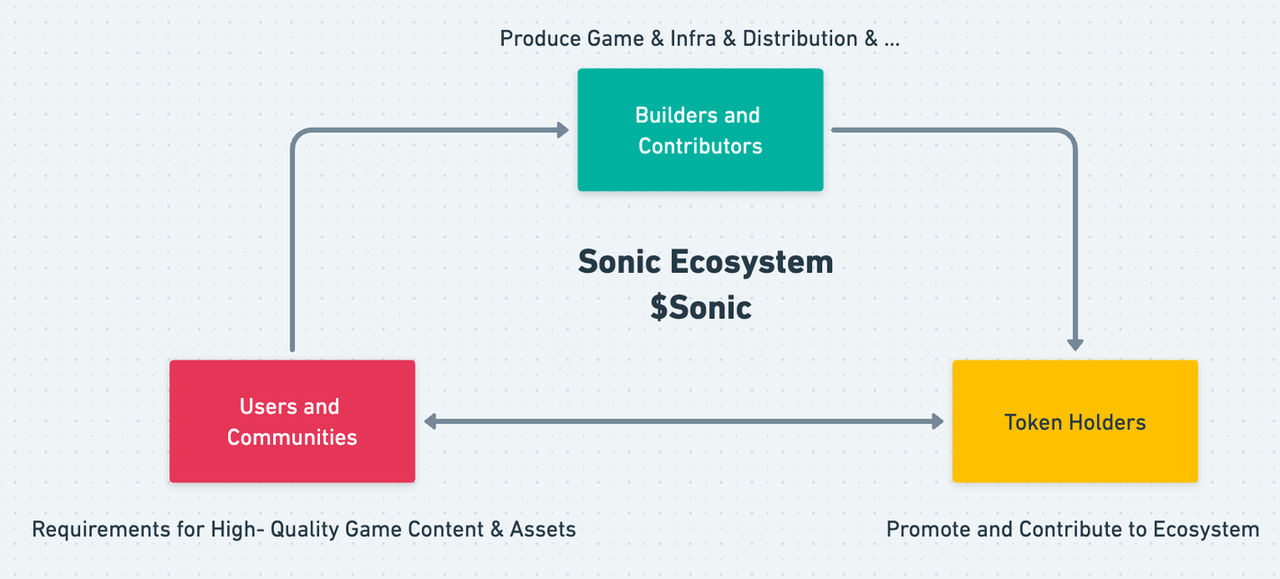
Token Holders: Can exchange $Sonic 1:1 for $veSonic, which can be used to participate in ecosystem governance voting or delegated to different validators to earn additional rewards.
Builders and Contributors: Can participate in the Sonic Collaboration Partner Innovation Network (SPIN) and Sonic Accelerator Program to receive ecosystem support and jointly build high-quality games, infrastructure tools, or support the development of other parts of the ecosystem.
Users and Community: Participate in interactive experiences in ecosystem projects. Through Sonic's activities, users can earn reward points that can be exchanged for tokens or other ecosystem rewards.
So, what are the current user participation opportunities to earn token rewards?
On September 16th, Sonic will launch a sale of 50,000 s representing the right to operate nodes in Sonic's HyperGrid network (visit here).
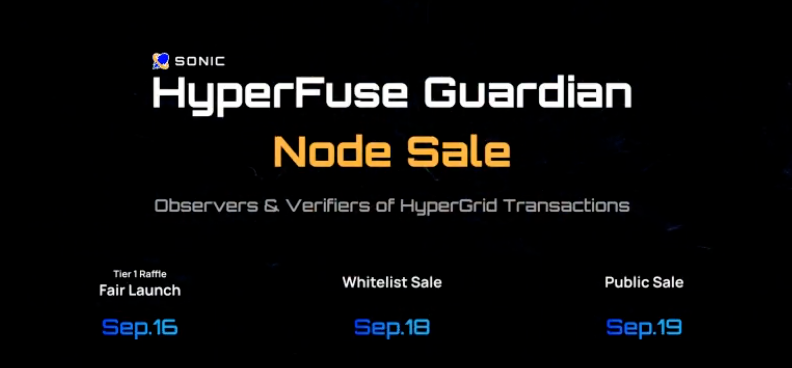
Each NFT represents the operation rights of a Guardian Node, and different levels of NFTs correspond to different node weights and reward ratios.
First, we need to understand what the HyperFuse Guardian nodes do.
In HyperGrid, Guardian nodes are an important part of maintaining the network's normal operation. The main responsibilities of these nodes include monitoring network transactions and state transitions, detecting anomalies; and verifying that the state submitted by the HyperGrid Shared State Network (HSSN) to Solana is correct, and ensuring that all operations in the Grids rollup meet security standards.
You can understand it as the role of a "validator node".
It is worth noting that even if users do not have the technical capability to run a node, they can still purchase NFTs and delegate them to other operators, thereby participating in the network and receiving rewards.
At the same time, the threshold for running a node is also very low, and a node can be run with just a browser in a lightweight manner.
Therefore, participating in the operation of the HyperFuse Guardian Node not only helps maintain network security, but also has the potential for economic returns.
Token rewards: The project allocates 10% of the tokens for rewards, of which 9% is for node operation rewards and 1% is for network expansion rewards, such as referrals and invitations (the unlocking rules for different rewards are as follows).
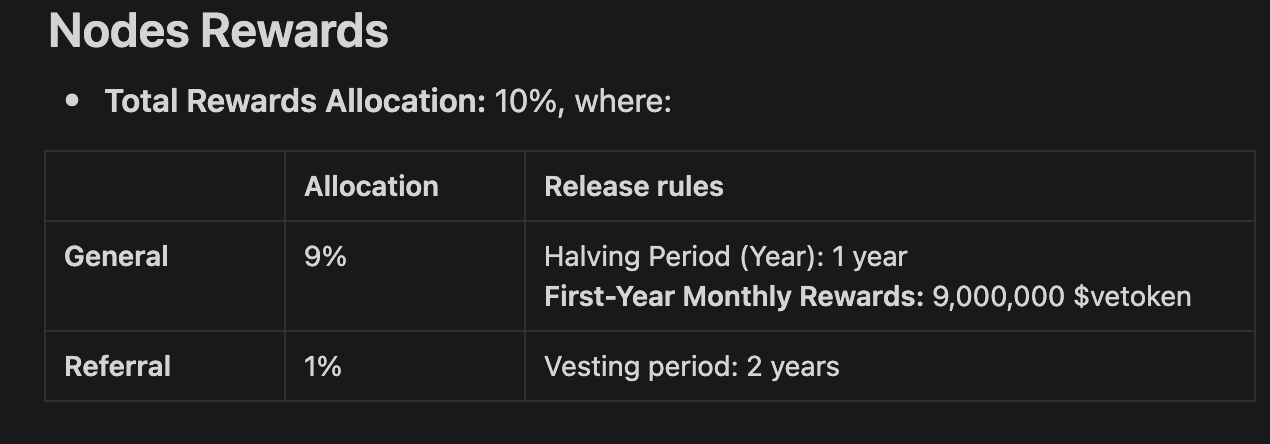
In terms of specific rules, Sonic has divided the pre-sale of this node NFT into three stages:
Lottery stage: September 16, 2024 13:00 UTC (lasting 24 hours)
Whitelist sale: September 18, 2024 13:00 UTC (lasting 24 hours)
Public sale: Starting September 19, 2024 13:00 UTC
Different nodes adopt a dynamic pricing mechanism, with a price range from $155 to $554. Support for purchasing with SOL, USDT or USDC on the Solana network. Different levels of NFTs have different purchase limits to ensure broader community participation.
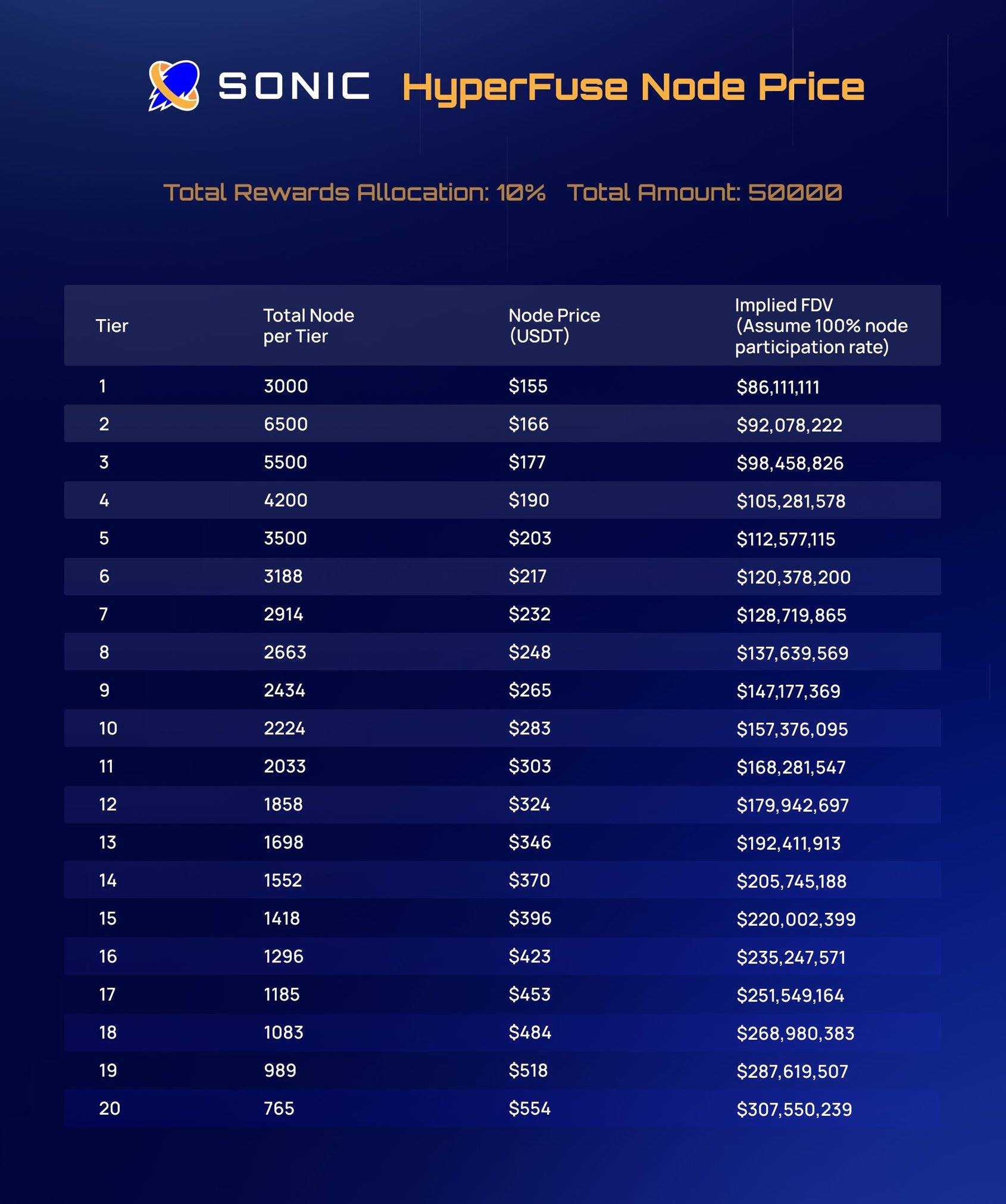
It is worth mentioning that the initial price of the node NFT sale is relatively low, starting at $155, which is not a very expensive price, and 70% of the nodes are priced below $300.
In terms of grading, the sale of Level 1 nodes (the cheapest) adopts a Fair Launch model, which is relatively fair for most players to participate in, and will certainly have the greatest appeal at a low price, so interested players can prepare in advance and participate on the 16th.
In addition, Level 2 to Level 8 nodes are only sold to whitelist holders, with prices ranging from $166 to $248. Whitelists can be obtained through the Odyssey activity on the testnet and cooperation with community partners.
The currently known partner communities include MadLads, Solayer, Send, MonkeDAO and other well-known communities in the Solana ecosystem, as well as a wider crypto community.
Players interested in the specific rules can check here for more details.
From a valuation perspective, the node pre-sale is good news for the community and retail investors, as some of the nodes offer lower costs than VC funding rounds.
In the first 30% of node sales, the fully diluted valuation (FDV) remains below $100 million, lower than the previous VC valuation. This means that early participants have the opportunity to enter the project at a relatively favorable price and have the potential for appreciation.
We can see that the nodes also adopt a tiered pricing strategy. Early participants can obtain nodes at a lower price, while the node price gradually increases as the sales process progresses. This not only rewards early supporters, but also provides participation opportunities for investors with different budgets, which is beneficial to expanding the community base.
Conclusion
Solana's Game Summer has not yet arrived, but the pathfinders who are driving its arrival are certainly worth watching.
Sonic's strong resource connectivity, professional-oriented products, and event organization have given the existing liquidity and attention a new destination; whether it's professional grinders, ordinary players, or game project parties, new, useful, and sufficiently anticipated projects will become the darlings of the market.
However, how long they can be pampered also depends on Sonic's own good operation and subsequent development - as the flow of water competes to be first, it also competes to be endless, and iterating itself in the constantly changing market expectations and demands is the survival philosophy for Web3 projects to go further.