



What is Solayer Chain, with 1 millisecond transaction confirmation and 100 Gbps?
Author: KarenZ, Foresight News
This week, Solana's staking project Solayer unveiled its 2025 roadmap, with the core highlight being the upcoming hardware-accelerated SVM blockchain - "Solayer InfiniSVM". For Solayer, "Solayer InfiniSVM" is undoubtedly an important step in realizing its long-term vision.
Solayer's chief engineer Chaofan Shou, after abandoning his doctoral studies at UC Berkeley, joined the Solayer team. He revealed that the team gained a lot of inspiration from the Solana validator client Firedancer during the development process, and decided to offload most of Solana's components to SmartNIC and programmable switches. This approach greatly enhances the network's processing capability, making transaction processing more efficient.
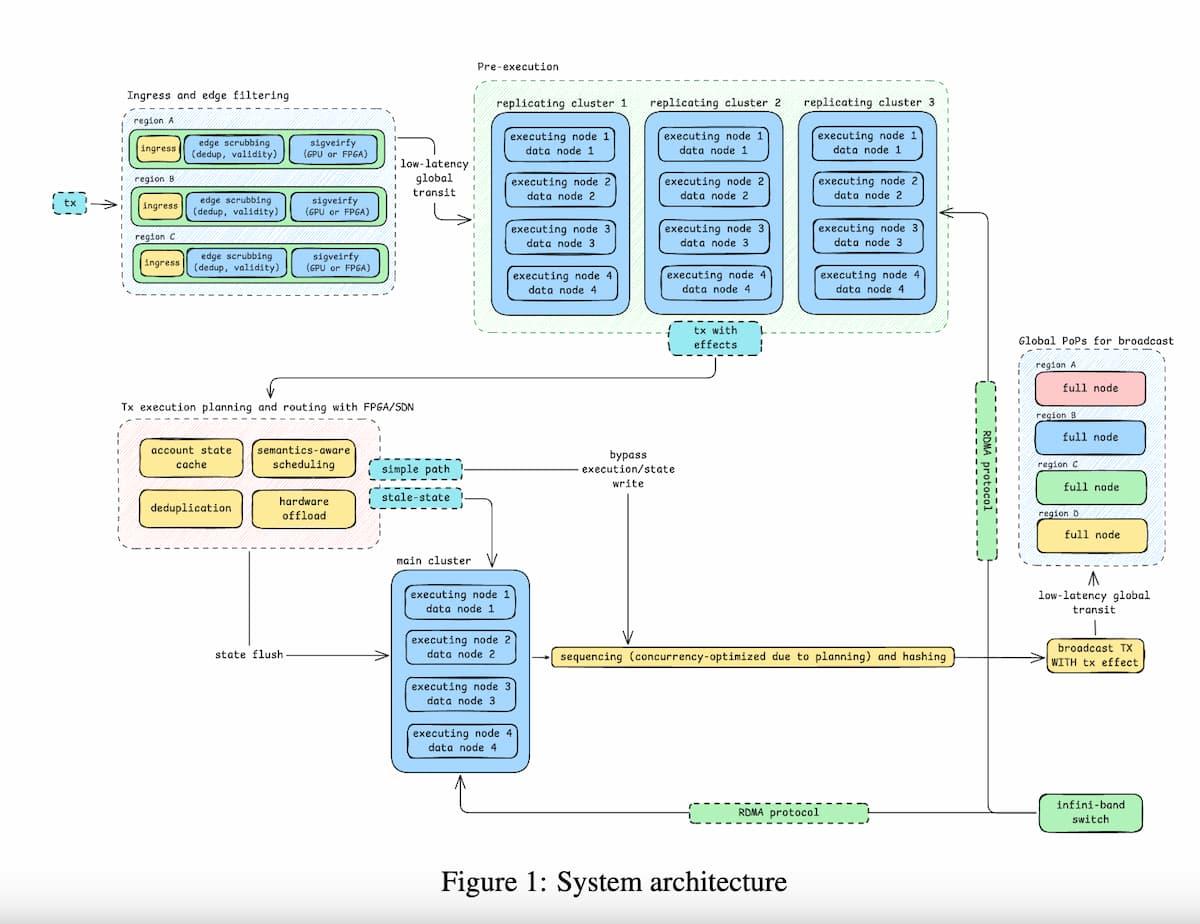
In the Solayer Chain, each transaction follows a workflow. Transactions first enter a scalable entry cluster of tens of thousands to millions of nodes, which will clean and pre-execute the transactions based on probabilistic predictions of future state. Then, all execution snapshots are sent to an orderer built with Intel Tofino switches and additional FPGAs. It's worth noting that most transactions have already been confirmed as valid during the pre-execution stage, so there's no need to re-execute them on the orderer. For the remaining conflicting transactions, Solayer Chain's orderer uses a state-of-the-art scheduling algorithm based on the fine-grained account access patterns collected during pre-execution to ensure fairness and efficiency.
In terms of performance, Chaofan Shou stated that for simple workloads, Solayer Chain can achieve over 16 billion transactions per second (TPS); and for workloads with conflicts, it can reach 890,000 TPS. This means that on Solayer Chain, billions of USDC transfer requests and millions of meme coin trades on Raydium can be processed every second.
So how is Solayer InfiniSVM achieved?
How does Solayer Chain work?
According to the Solayer Chain Lightpaper, Solayer Chain achieves infinite scalability of a single-state blockchain by distributing workloads between dedicated hardware and clusters, while retaining a global atomic state.
Solayer claims that through SDN (Software-Defined Networking) and RDMA (Remote Direct Memory Access) connections, it can achieve 100 Gbps while maintaining atomic state. Solayer InfiniSVM, by offloading to hardware circuits and kernels across ingress, ordering, scheduling, banking, and storage, achieves 1ms transaction confirmation.
Here's a brief overview of the Solayer Chain workflow:
1. Transaction ingress: Each transaction enters an initial entry point, which performs signature verification (sigverify) and local deduplication (to avoid duplicate transactions).
2. Pre-execution stage: Verified transactions are then sent to a pre-execution cluster for pre-execution.
3. Ordering and scheduling: Transaction results and intermediate snapshots are sent to the orderer via InfiniBand. The orderer uses SDN switches and FPGAs to determine if a transaction takes the simple or complex path.
Simple path: If all accounts in the transaction are the latest version during pre-execution, the state changes will be directly applied via RDMA, using local caching on the SDN, avoiding further processing by the orderer.
Complex path: If at least one account has an updated version, the transaction will enter the local mempool. The orderer schedules the transactions in the local mempool to achieve fairness and optimal parallelism.
4. State update: The executed transaction state changes are updated to the sharded database. The sharded database uses the RDMA protocol to achieve efficient cross-node data access.
5. Transaction broadcast: After execution and state update, the transaction is broadcast globally through PoPs (Points of Presence).
In terms of consensus, Solayer Chain uses a Proof-of-Authority-and-Stake hybrid consensus protocol, batching transactions into shreds, with each shred containing a slot number, a transaction vector, version metadata of accessed accounts, and a linking hash. Trusted entities act as orderers and publish shreds, while validators stake and vote to determine if shreds can be accepted.
It's worth mentioning that Solayer Chain not only focuses on performance, but also introduces several user experience improvements, especially at the chain level, such as:
- Hooks: Allow developers to embed post-transaction logic such as arbitrage, liquidation, and accounting directly into the chain.
- Mega transactions: Support larger transaction sizes, allowing cross-program invocations.
- Cross-chain calls: Achieve atomic operations across chains through built-in system programs.
- Built-in OAuth support: Allow users to use OAuth services like Google, X, or Reddit as their wallets.
Hooks deserve special emphasis, as they allow developers to embed post-transaction logic such as arbitrage, liquidation, and accounting directly into the chain. Solayer Chain also has an incentive and fee model for Hooks. The execution of Hooks follows a Dutch auction-like bidding model. Developers or users who want to attach a Hook to a specific program need to bid (bid for the right to execute the Hook in the next epoch, one epoch at a time), and the bidding price determines whether the Hook can be executed and its priority. The top 16 highest bidders win.
Each time a Hook is executed, its bidding amount is distributed as follows:
- 40% to the transaction initiator.
- 40% to the program owner, to incentivize them to develop and maintain high-quality programs.
- 20% to the network, to offset the additional on-chain computation cost.
This model of distributing the bidding fee to the transaction initiator and program owner will encourage more developers and users to participate in the use of Hooks. This not only improves the functionality of the platform, but also increases the activity of the network. Through this, Solayer Chain can also effectively prevent spam transactions or malicious MEV exploitation off-chain, providing an additional layer of protection for the network.
Solayer Chain's vision is not only to improve performance, but also to integrate more user experience and developer-friendly features into blockchain technology.






