Title: MegaETH vs Monad vs Hyperliquid: Who Leads in Instant Blockchain Transactions?
Author: Three Sigma
Translated by: Odaily
In the ever-evolving blockchain landscape, instant transactions are no longer a luxury, but a necessity. As DeFi, payments, gaming, and high-frequency trading continue to push the boundaries of traditional blockchain capabilities, the demand for real-time performance has never been more pressing. Among the solutions redefining transaction speed and scalability, MegaETH, Monad, and Hyperliquid emerge as formidable contenders.
As mentioned in our previous article, MegaETH is an emerging Layer 2 solution that prioritizes real-time performance, with its promised near-instant block times and high transaction TPS attracting widespread attention.
However, Hyperliquid and Monad have also emerged as strong competitors, each optimizing blockchain performance in their unique ways. This article will delve into the advantages, architectures, and comparisons of these solutions, exploring who can lead the race in instant blockchain transactions.
MegaETH Overview
MegaETH is a Layer 2 scaling solution designed for Ethereum. The standout feature of MegaETH is its focus on real-time blockchain performance, enabling applications that require instant responsiveness to achieve ultra-low latency and scalability.
Key highlights:
Latency and Speed: MegaETH's block times range from 1 to 10 milliseconds, capable of processing up to 100,000 transactions per second (TPS).
Specialized Nodes: It employs a Sequencer-centric model, with nodes divided into Sequencers, Provers, and Full Nodes, simplifying the execution process and reducing redundancy.
Integration with EigenDA: MegaETH leverages EigenDA for data availability guarantees, allowing it to scale without compromising reliability or performance.
MegaETH's architecture is designed for speed and efficiency, setting it apart in the competitive Layer 2 landscape:
Low Latency: Its near-instant transaction processing is well-suited for high-frequency trading, gaming, and payment systems.
Scalability: By processing blocks in milliseconds, MegaETH avoids the congestion issues common to other L2 solutions during peak demand.
EVM Compatibility: Fully compatible with the Ethereum ecosystem, allowing seamless integration with existing DApps while maintaining security.
Hyperliquid and Monad
While MegaETH focuses on real-time performance, it faces fierce competition from Hyperliquid and Monad, two platforms that have adopted different approaches to optimizing blockchain transactions.
Hyperliquid Overview
Hyperliquid is a fully on-chain perpetual trading protocol, built on its own Layer 1 blockchain, optimized for low latency and high TPS. By integrating spot, derivatives, and pre-release markets into the platform, Hyperliquid introduces HyperBFT, a high-performance consensus mechanism, and plans to launch HyperEVM, aimed at expanding its ecosystem through efficient liquidity aggregation.
Vision: Hyperliquid's goal is to redefine the trading experience by providing high-speed, decentralized market infrastructure, making it particularly appealing to financial institutions and high-volume traders.
Market Expertise: Hyperliquid's unique combination of spot and perpetual markets enables seamless liquidity aggregation and rapid settlement.
Hyperliquid's technology stack includes a broader set of financial primitives, such as lending, governance, and a native stablecoin. Based on its HyperBFT consensus mechanism, Hyperliquid achieves a 0.2-second block time while maintaining a unified state across all components, ensuring performance, liquidity, and programmability. With over 262,000 users and processing 200,000 transactions per second, Hyperliquid is clearly positioning itself as a leader in decentralized market infrastructure.
To further expand its reach, Hyperliquid offers Builder Codes, a feature that allows other DApps and CEXes to seamlessly integrate its liquidity by paying a fee per transaction. Builder Codes not only expand Hyperliquid's coverage but also enhance liquidity and network effects by incentivizing external platforms to leverage its high-performance trading infrastructure.
Monad Overview
Monad has redesigned the EVM architecture to enable high-speed TPS through parallel execution. By addressing the limitations of Ethereum's sequential transaction processing, Monad has broken through the efficiency and scalability bottleneck, ushering in a new performance tier.
Vision: Monad aims to provide cutting-edge blockchain performance while maintaining decentralization, setting a new standard for Layer 1 scalability.
Parallel Execution: Monad's architecture supports multiple EVM instances processing transactions concurrently, ensuring seamless integration with existing user and developer workflows.
Full Compatibility: Monad maintains complete bytecode compatibility with Ethereum, while improving performance through internal optimizations without changing the development experience.
Monad introduces pipelining techniques to optimize transaction execution, consensus processes, and state synchronization, maximizing hardware efficiency and minimizing latency. Based on the HotStuff-based MonadBFT consensus mechanism, the protocol supports a robust and decentralized validator set, while achieving fast block finality.
Key innovations include MonadDB (a database specifically designed for Ethereum state access) and Optimistic Parallel Execution (ensuring high TPS with minimal overhead). Monad's separation of the consensus and execution layers further enhances scalability, enabling developers to build applications that require exceptional performance and low latency.
Monad's groundbreaking advancements make it a powerful platform for enterprise-grade applications, providing developers with the tools to create high-TPS DApps while maintaining Ethereum compatibility and embracing the future of blockchain innovation.
Comparative Analysis
By evaluating MegaETH, Hyperliquid, and Monad across key metrics, we can gain a comprehensive understanding of their unique strengths and trade-offs. In this comparison, we focus on latency, TPS, EVM compatibility, use cases, Time-to-Finality (TTF), and decentralization considerations. These features highlight the fundamental requirements to ensure real-world utility and performance when scaling blockchain infrastructure.
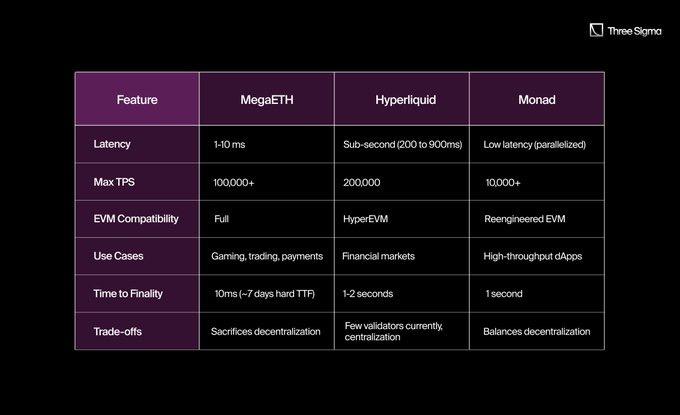
Latency:
MegaETH exhibits extremely low latency (1-10 milliseconds) in Layer 2 transactions, making it well-suited for applications that require near-instant responsiveness, such as high-frequency trading or competitive gaming.
Hyperliquid's latency is under one second, optimized for financial markets to execute orders quickly and provide a seamless trading experience.
Monad's parallel low-latency execution ensures consistent performance even under heavy network loads, supporting a wide range of DApps. The team has not yet released specific time claims.
TPS:
MegaETH's TPS exceeds 100,000 TPS, highlighting its scalability for large-scale applications.
Hyperliquid achieves 200,000 TPS through its proprietary HyperBFT consensus mechanism and Layer 1 optimizations.
Monad supports up to 10,000 TPS, aiming to strike a balance between high performance and decentralization.
EVM Compatibility:
MegaETH is fully EVM-compatible, ensuring seamless onboarding for developers and existing DApps.
Hyperliquid has integrated HyperEVM, a customized version of the EVM for financial market use cases.
Monad's redesigned EVM maintains compatibility with Ethereum tools and standards while providing high-performance execution.
Use Cases:
MegaETH primarily targets gaming, trading, and payment systems, emphasizing real-time interactivity and high scalability.
Hyperliquid is focused on financial markets, providing robust infrastructure to support derivatives, spot trading, and market making.
Monad's versatility supports a wide range of DApps, particularly those requiring high TPS and low latency.
Time-to-Finality (TTF):
MegaETH's near-instant block times result in extremely low TTF, ensuring rapid transaction finality.
Hyperliquid's 0.2-second block times translate to fast TTF, crucial for financial applications.
Monad's MonadBFT consensus mechanism achieves fast block finality, supporting low-latency use cases.
Decentralization:
MegaETH's Sequencer-centric model introduces some centralization, but its use of Provers and Full Nodes maintains a degree of decentralization.
Hyperliquid's HyperBFT consensus mechanism supports a robust and decentralized validator set, ensuring a high level of decentralization.
Monad's MonadBFT consensus protocol is designed to be highly decentralized, with a focus on maintaining the security and integrity of the network.
MegaETH Layer 2 transactions can achieve near-instant confirmation (10 milliseconds), but full settlement on Ethereum L1 takes about 7 days.
Hyperliquid's confirmation time is 1-2 seconds, balancing low latency and a robust consensus mechanism.
Monad completes transaction confirmation within 1 second, providing a practical balance of speed and security.
Decentralization trade-offs:
MegaETH's centralized sequencer design sacrifices decentralization to some extent in order to achieve real-time performance at the Layer 2 level.
Hyperliquid's market-focused architecture prioritizes low latency and high TPS, rather than decentralization.
Monad's design aims to maintain a balance, utilizing parallel execution and delayed state updates to optimize performance and decentralization.
Conclusion
MegaETH, Hyperliquid, and Monad each bring unique innovations to the blockchain ecosystem, catering to different needs:
MegaETH: Excels in latency and TPS, well-suited for real-time applications, but its centralized sequencer design raises questions about decentralization.
Hyperliquid: Stands out in financial markets with its HyperEVM and liquidity integration, but its generality across other DApp categories is not as strong as MegaETH.
Monad: Provides a balance of decentralization and performance through parallel execution, enhancing TPS and supporting a variety of applications.
The answer depends on the specific use case:
For trading and liquidity, Hyperliquid is a strong contender, focused on financial markets.
For general dApp scalability, MegaETH leads in real-time performance and broad application range.
For decentralized high-TPS applications, Monad's parallelized EVM offers a powerful choice for developers prioritizing decentralization.
Key observations:
MegaETH's trade-offs: By sacrificing decentralization, MegaETH achieves unparalleled speed, making it highly attractive for real-time systems like transactions and gaming. However, while MegaETH relies on Ethereum Layer 1 for settlement (ensuring trust and security), it still inherits Ethereum's final settlement latency. In contrast, Monad and Hyperliquid achieve faster local finality through independent consensus mechanisms, prioritizing instant performance, but sacrificing Ethereum's shared security guarantees.
Hyperliquid's specialization: Hyperliquid excels in financial markets, leveraging its unmatched speed, liquidity aggregation, and seamless trading infrastructure. However, its focus on trading limits its generality across the broader dApp ecosystem, reducing its appeal for general applications. Additionally, its centralized HyperBFT consensus mechanism raises concerns about decentralization and trust, and its performance and ecosystem growth are heavily dependent on external liquidity.
Monad's balance: Monad achieves a balance between scalability and decentralization through its parallel execution model, offering high TPS without sacrificing EVM compatibility for developers. However, the reliance on powerful hardware (e.g., 32 GB of memory and high bandwidth) limits the accessibility for smaller operators, potentially leading to network centralization. Its independent Layer 1 consensus provides autonomy, but at the cost of Ethereum's security guarantees, which may deter developers who prioritize trust and shared security.
Summary
The competition between MegaETH, Hyperliquid, and Monad highlights a key aspect of blockchain development: there is currently no single solution that can dominate all use cases. Each platform excels in its respective domain, offering unique value propositions to meet different needs. For developers and enterprises, the ultimate decision often comes down to the specific application requirements, whether it's speed, market liquidity, or the scalability of decentralization.
These projects also underscore the importance of continuous innovation in blockchain infrastructure. As adoption grows, the industry must find a balance between the scalability trilemma, low fees, high performance, and robust security. Collaborative innovation across ecosystems may drive the next wave of blockchain breakthroughs. As blockchain technology evolves, these platforms are pushing the boundaries, paving the way for faster, more scalable, and more efficient decentralized systems.
Ultimately, the choice comes down to the priorities of developers and users: speed, decentralization, or specialization.