



By 2024, the development of stablecoins has gone through 10 years, during which it has withstood multiple risk shocks and trust adjustments, and has re-entered a rapid development track since the second half of 2023, attracting widespread attention from the industry, policymakers and academia. From the development trend, stablecoins have shown good resilience, gained increasingly higher market recognition, and have shown obvious oligopolistic characteristics, with the market capitalization share of the top two stablecoins exceeding 90%, and the market capitalization share of US dollar-pegged stablecoins exceeding 95%, and they are showing a trend of integration and development with traditional financial institutions; From the application scenarios, stablecoins were initially mainly used for trading of crypto assets, but in recent years, their applications in conventional financial activities such as cross-border payments and foreign exchange savings, as well as in new financial activities such as decentralized finance (DeFi), have been rapidly expanding; From the development prospects, the future development space of stablecoins depends on whether they can solve the redemption run risk in risk management, whether they can handle the market competition between central bank digital currencies and digital currency bridges in the development model, and whether they can cope with the increasingly strict access and compliance policy requirements in financial regulation.
Source: International Finance Magazine
Author: Shen Jianguang, Zhu Taihui
Stablecoins are digital currencies issued by the private sector based on fiat currencies or other assets (such as USDT, USDC, DAI, etc.), of which more than 95% are US dollar-pegged stablecoins; there are also stablecoins pegged to digital assets or collateralized (such as DAI), stablecoins pegged to physical assets such as gold and silver (such as PAXG), and a small number of algorithmic stablecoins without collateral (such as FRAX). Since the launch of the first stablecoin (USDT) in 2014, the development of stablecoins has withstood multiple risk shocks, and has re-entered a rapid development track since the second half of 2023, with a total market capitalization approaching $200 billion as of November 2024, and with the rapid development of Web3.0, the development trend, application scope and future prospects of stablecoins have once again attracted widespread attention from all walks of life.
Stablecoins are issued based on Block technology, and have a good balance between openness and stability in their functional characteristics. Specifically, stablecoins have very good openness, support controllable anonymity, can be traded directly peer-to-peer, and have cross-border attributes by nature; at the same time, unlike "native" cryptocurrencies such as Bitcoin, stablecoins maintain relatively stable value by pegging to the US dollar, Euro and other traditional fiat currencies, or pegging to physical assets such as gold.
Stablecoins are the bridge between central bank digital currencies (the digitization of fiat currencies) and digital assets (Token based on algorithms). In the digital asset (cryptocurrency) field, liquidity has a pronounced pyramid structure: at the top are stablecoins pegged to fiat currencies, followed by Bitcoin and Ethereum, then ERC20 type crypto assets and native tokens of other blockchains, and at the bottom are Non-Fungible Tokens (NFTs) (Zou Chuanwei et al., 2023). As of November 2023, the total market capitalization of digital assets has exceeded $3.27 trillion. In most cases, digital assets can only obtain real purchasing power after being converted into fiat currencies. Stablecoins, especially US dollar stablecoins, are the unit of account, medium of exchange and store of value in the digital asset and cryptocurrency market, with trading volume already exceeding the sum of the two largest cryptocurrencies - Bitcoin and Ethereum.
Development Trends of Stablecoins
(I) In terms of total volume, stablecoins have recovered a rapid growth momentum after weathering the shocks
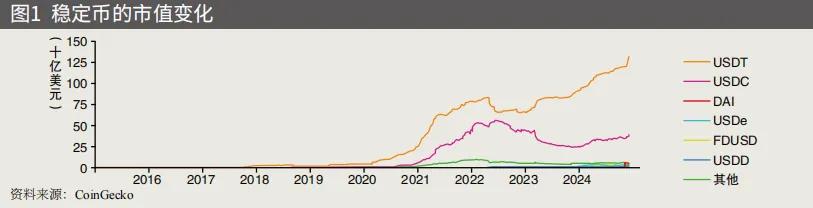
Three factors drove the rapid growth of the stablecoin market in 2017-2021. USDT and USDC are the two largest stablecoins globally, accounting for about 90% of the stablecoin market, and their trends basically represent the overall trend of the stablecoin market. Prior to 2017, USDT's market capitalization was always below $700,000, but starting in 2017, benefiting from the bull market in digital assets, Tether's simultaneous listing on three major exchanges, and China's ban on virtual token issuance, USDT saw a surge in volume, reaching nearly $14 billion by the end of 2017, and has maintained rapid growth for nearly 5 years since then. USDC's growth trend was similar to USDT's from its launch to May 2022.
The collapse of UST led to about a year of correction in the stablecoin market. In the first half of May 2022, the value of the world's third largest stablecoin TerraUSD (UST) plummeted from $1 to a low of $0.04 in 5 days, causing a huge shock to the entire stablecoin market. USDT's market capitalization fell from $83 billion to $65.8 billion in mid-July 2022, not returning to $83 billion until May 2023. USDC's market capitalization fell from around $55 billion in May-June 2022 to around $45 billion at the end of 2022; in March 2023, it was further impacted by the collapse of Silicon Valley Bank and the regulatory decoupling investigation (at the time, USDC's reserve funds were held in custody at Silicon Valley Bank), and by December 2023 its market capitalization had fallen to around $25 billion.
Stablecoins have gradually resumed rapid growth since the second half of 2023. With the dissipation of risk shocks and the improvement in stablecoin transparency, the stablecoin market has re-entered a rapid growth track since the second half of 2023, especially since November. As of November 24, 2024, the total market capitalization of stablecoins has reached nearly $200 billion, with USDT's market capitalization exceeding $130 billion, more than 1.5 times the pre-May 2022 high; USDC's market capitalization has exceeded $39 billion, still some distance from the $56 billion high in May-June 2022.
(II) In terms of structure, the stablecoin market exhibits a clear oligopolistic characteristic
In terms of issuers, stablecoins issued by Tether and Circle account for about 90%. USDT was launched in November 2014 and USDC in October 2018, and they are the two largest stablecoins globally, accounting for about 70% and 20% of the stablecoin market respectively, and their trends basically represent the overall trend of the stablecoin market.
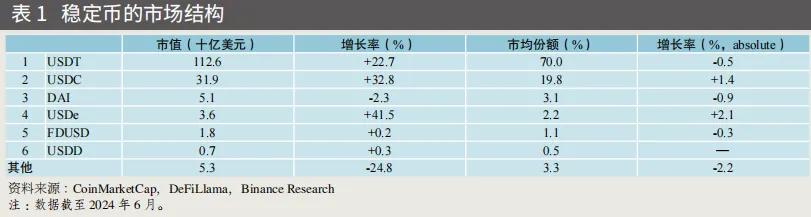
In terms of currency types, US dollar stablecoins are the main channel for capital inflow and outflow in the crypto asset market. Currently, fiat-pegged stablecoins dominate, with US dollar stablecoins serving as the unit of account, medium of exchange and store of value in the crypto asset market, with trading volume already exceeding the sum of the two largest cryptocurrencies - Bitcoin and Ethereum. The two largest stablecoins, USDT and USDC, are both US dollar stablecoins, and together with other types of US dollar stablecoins, US dollar stablecoins account for more than 95% of the supply. In addition, these stablecoins are mainly issued on the Ethereum blockchain, with increasing attention on blockchains such as TRON.
(III) In terms of model, the cooperation between stablecoins and traditional financial institutions is constantly expanding
In the payment sector, in 2020, the US online payment company PayPal began to support consumers to trade cryptocurrencies through their PayPal and Venmo accounts, and launched the US dollar-pegged stablecoin PayPal USD; in September 2024, it announced that it would allow merchants to buy, hold and sell cryptocurrencies through their business accounts. In October 2024, the US online payment company Stripe acquired the stablecoin platform Bridge for $1.1 billion, the largest acquisition in the cryptocurrency field to date. At the same time, Stripe has resumed the service of US businesses making cryptocurrency payments using USDC on Ethereum, Solana and Polygon.
In the financial institution sector, in September 2024, Japan's three major banks - Mitsubishi UFJ Financial Group (MUFG), Sumitomo Mitsui Banking Corporation (SMBC) and Mizuho Bank - jointly launched a cross-border payment system called "Project Pax": using stablecoins instead of traditional intermediary banks in cross-border payment models to improve efficiency and reduce costs. The project integrates SWIFT payment information into the stablecoin system, allowing banks to use stablecoins for settlement, but corporate clients do not need to contact or understand the operation of stablecoins.
In terms of asset allocation, a survey by EY-Parthenon (2023) of 256 global institutions in April 2023 showed that while some institutional investors remain cautious about investing in cryptocurrencies and crypto assets, more and more institutional investors are optimistic about the investment prospects in this field and will increase their investment allocation: 25% of institutional investors increased their holdings of cryptocurrencies, crypto assets and related products in 2022, 38% of institutional investors will increase their holdings in 2023, and 69% of institutional investors are expected to increase their holdings in 2024-2025, with asset management companies and hedge funds expected to increase the most (81% and 71% respectively).
Application Scenarios of Stablecoins
(I) The Activity of Stablecoins in Cross-border Transaction Settlement is Constantly Rising
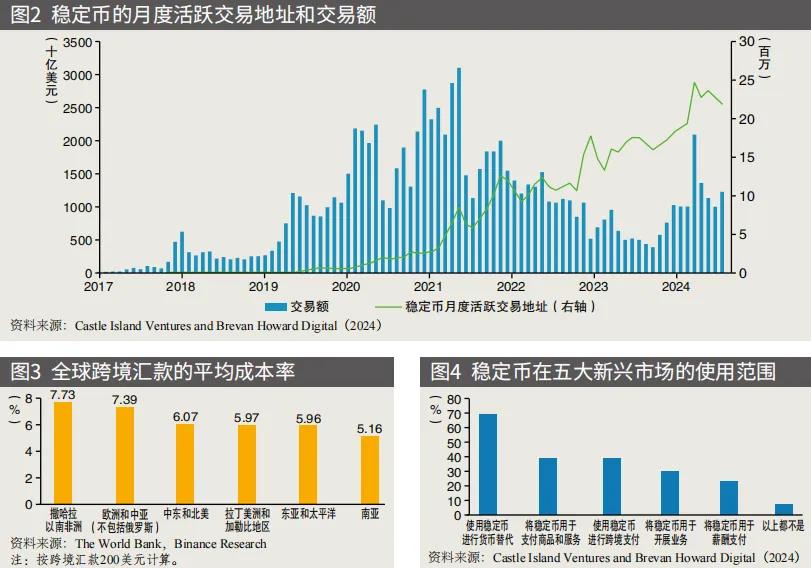
After accumulating a large user base and application scenarios in the crypto asset market, US dollar stablecoins are now expanding into mainstream payment scenarios. Since 2022, the monthly active users and monthly transaction volume of Binance Pay, a blockchain-based platform, have grown nearly 5-fold globally, reaching about 13.5 million users and about 1.96 million transactions. According to estimates by Castle Island Ventures and Brevan Howard Digital (2024), the payment settlement volume of stablecoins will reach around $2.5 trillion in the 12 months prior to May 2024, 10 times the 2020 payment settlement volume; there are 20 million active blockchain addresses transacting stablecoins monthly, with over 120 million addresses holding non-zero stablecoin balances; the total stablecoin settlement amount is conservatively estimated at $3.7 trillion in 2023, and has already reached $2.62 trillion in the first half of 2024, with the full-year expected to exceed $5.28 trillion.
Stablecoins have obvious advantages in terms of payment time and cost. In terms of time, existing bank cross-border remittances usually take up to 5 business days to settle, with about 30% of digital payments based on the cross-border banking communication system taking more than a day to complete; blockchain-based cross-border payments complete 100% of transactions in less than 1 hour. In terms of cost, according to World Bank data, the average cost rate for traditional cross-border remittances in the first quarter of 2024 was 6.35%, with some regions even above 7%; but the average cost of sending stablecoins via high-performance blockchains like Solana is about $0.00025, and the cost of point-to-point stablecoin transfers on platforms like Binance Pay is even lower, charging $1 when the transfer amount exceeds 14,000 USDT. However, compared to bank account payments, stablecoin cross-border payments currently have significant shortcomings in terms of payment capability and stability (Binance Research, 2024).
(II) The Realistic Application Scenarios of Stablecoins are Developing in a Diversified Manner
The real-world use cases of stablecoins are constantly expanding. In addition to trading digital assets/cryptocurrencies, in recent years stablecoins have also been rapidly applied to currency substitution (to avoid large fluctuations or devaluation of local currencies), as a substitute for US dollar bank accounts (to avoid the impact of lack of US dollar banking services), for business-to-business and consumer payments, for cross-border trade settlement, and for other financial investments and physical investments. In September 2024, with the support of Visa, a survey by Castle Island Ventures and Brevan Howard Digital (2024) on the use of stablecoins in five emerging markets - Brazil, India, Indonesia, Nigeria and Turkey - showed that the main purpose of using stablecoins is still to trade cryptocurrencies or Non-Fungible Tokens, but other uses also account for a relatively high proportion, with 47% of respondents primarily using them to store funds in US dollars, 43% to get better exchange rates, and 39% to earn returns.
Stablecoins are gradually being integrated into the daily financial activities of the general public. The use of stablecoins in emerging markets has gone beyond the traditional realm of crypto trading. The research by Castle Island Ventures and Brevan Howard Digital (2024) on the frequency of stablecoin use and user behavior in five countries not only quantified the penetration of stablecoins, but also revealed their widespread application in currency substitution, cross-border payments and savings tools, demonstrating the diversified development trend of stablecoins in emerging markets: 69% of respondents use stablecoins for currency substitution, 39% use stablecoins to pay for goods and services, 39% use stablecoins for cross-border payments, and 20%-30% of respondents use stablecoins for payroll and business operations.
(III) DeFi is Experiencing Rapid Development with the Support of Stablecoins
Since 2024, a large amount of capital has flowed into Decentralized Finance (DeFi), with the Total Value Locked (TVL) increasing from $54.4 billion at the beginning of the year to $94.1 billion, an increase of 72.8%. At the same time, the number of DeFi's de-duplicated users also reached a new high of 8.9 million in June 2024, up from 4.9 million at the beginning of the year. Almost all DeFi sub-sectors have experienced significant growth, no longer driven solely by decentralized exchanges (DEXs). By June 2024, the on-chain TVL of decentralized lending reached $33.7 billion, an increase of 51.7% from the beginning of the year.
Compared to USDT, USDC has become the preferred choice for decentralized finance protocols due to its compliance, transparency and high stability. Currently, major DeFi protocols such as MakerDAO, Compound, Aave, and Curve are all major supporters of USDC, which can be used as collateral for lending and trading, or as an asset in liquidity pools to earn interest. These developments have allowed USDC to go beyond being a simple medium of exchange or store of value.
Development Prospects of Stablecoins
The future development prospects of stablecoins will depend on the ability to effectively address the following three challenges.
(I) In risk management, the risks of customers being unable to fully redeem fiat currency and losing private keys need to be addressed
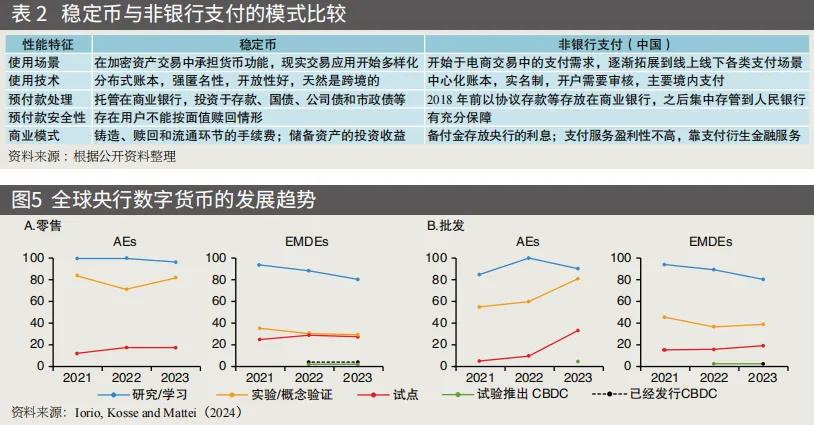
From the perspective of issuance and operating model, bank account fiat deposits are protected by deposit insurance, and the fiat reserve funds of non-bank payment institutions are centrally deposited with the central bank, enjoying stable excess reserve interest income, with no risk of misappropriation or loss. However, the investment of stablecoin prepayments currently lacks clear investment products and risk requirements, and if the investment incurs losses, stablecoins issued at a 1:1 ratio with legal currency reserves will face the risk of concentrated "bank runs" and inability to fully redeem at a 1:1 ratio.
At the same time, in stablecoin wallets, only holding the private key can sign transactions and authorize asset transfers, but the private key of stablecoins is a long string of characters that users find difficult to memorize and are very easy to lose, and once lost, the user will lose control of the stablecoins in the wallet; and the distributed nature of stablecoins means that there is no central institution that can help users recover the private key or restore wallet access. In contrast, bank accounts and non-bank payment accounts have very strong customer information registration and KYC (Know Your Customer) requirements, and with a centralized account management mechanism, if users lose their account passwords, they can retrieve them with the assistance of the centralized management institution.
(II) In terms of development model, the competition between central bank digital currencies and digital currency bridges in cross-border payments needs to be addressed
The advantage of stablecoins in cross-border payment settlement is real-time payment settlement and low payment costs, but their carrying capacity and stability in cross-border use are poor. The combined development of "central bank digital currency + multilateral digital currency bridge" will greatly improve the existing cross-border payment system, posing a competitive challenge to the application and promotion of stablecoins in cross-border payments.
Currently, various countries are actively exploring the development of central bank digital currencies, while the BIS is collaborating with multiple countries to build a "multilateral digital currency bridge": a cross-border payment platform based on distributed ledger technology, with a single synchronized and real-time updated ledger that all participants use; adopting a Single System Model, where the central banks and commercial banks of the participating countries and regions can directly access the platform. According to a survey by the BIS (2024), about 100 countries and regions are actively testing central bank digital currencies at the wholesale and retail levels, exploring experiments; at the same time, the "multilateral digital currency bridge" has entered the minimum viable product stage, and can also realize cross-border point-to-point payments and synchronized settlement, with more than 30 central banks following up and observing as of October 2024.
The "Multi-Currency Bridge" platform conducts cross-border payments, and the transaction parties do not need to keep separate accounts. Cross-border transactions can be settled synchronously, and it can also be used for cross-border transfers of two currencies (cross-border foreign exchange transactions), realizing synchronous settlement of foreign exchange transactions (PvP).
Compared to the traditional cross-border payment model, the "Multi-Currency Bridge" has the function of "point-to-point" payment. Benefiting from the use of distributed ledger technology, the banks on the platform can realize "payment is settlement" without the need to open accounts with each other or open accounts with a third-party institution, realizing synchronous settlement of foreign exchange transactions (PvP), and the entire process is completed in real-time, greatly improving the efficiency of payment settlement. At the same time, the "Multi-Currency Bridge" uses modular construction, separating and modularizing different functions, improving the scalability of the platform, and countries and regions can join the "Multi-Currency Bridge" without the need to establish a local CBDC system, greatly reducing the entry threshold.
However, it should be pointed out that although it has programmability based on smart contracts, which improves the efficiency of payment settlement, some users are concerned that the government can control the use of CBDC, and privacy cannot be fully protected due to the monitoring of transactions.
(Three) In financial regulation, policy uncertainty will still be the most important factor affecting the development of stablecoins
Stablecoins have a substitution effect on the currencies of the countries and regions where users are located. At present, only a few countries and regions such as the European Union have formulated relevant laws, and other countries and regions have not yet clarified the regulatory policies for stablecoins in payment and asset transactions. Regulatory uncertainty will have a significant impact on the development of stablecoins and digital assets, as well as the development of high-compliance stablecoins (such as USDC) and low-compliance stablecoins (such as USDT).
In October 2020, the Financial Stability Board proposed high-level regulatory recommendations for the sound development of stablecoins. The core of the FSB's regulatory recommendations is to comprehensively include stablecoin-related activities and functions into regulation in accordance with the principle of "same business, same risk, same regulation" (FSB, 2020), specifically including: clarifying the specific regulatory authorities based on the functions and activities of stablecoins, defining the product attributes of stablecoins (whether stablecoins are securities or commodities, etc.), and the institutional licenses that stablecoin issuers need to hold (whether they need to hold money transfer service provider licenses or banking-type licenses); clarify the specific regulatory measures for stablecoin-related activities, such as the requirements for stablecoins to deal with redemption "bank runs", anti-money laundering and counter-terrorist financing requirements, etc.; strengthen cross-border regulatory coordination and cooperation (especially in cross-border payments).
The European Union is at the forefront of crypto-asset regulation. In April 2023, the European Parliament formally adopted the Regulation on Markets in Crypto-Assets (MiCA), which clarified the types of crypto-assets covered by regulation, the transparency and disclosure requirements for the issuance, public offering and trading of crypto-assets on trading platforms; the authorization and supervision requirements for crypto-asset service providers, issuers of asset-referenced tokens and e-money tokens, as well as their operational, organizational and governance requirements; the protection requirements for holders of crypto-assets in issuance, public offering and trading; the protection requirements for clients of crypto-asset service providers; and measures to prevent insider trading, unlawful disclosure of inside information and market manipulation. With the formal implementation of MiCA, the crypto-currency exchange OKX has stopped supporting USDT trading pairs within the EU, and Binance and Kraken are considering delisting USDT from their European platforms; but the issuer of USDC, Circle, announced in July 2024 that USDC and EURC stablecoins have complied with MiCA and become the first globally compliant stablecoin issuers under the MiCA regulation.
It is expected that licensed access and compliant regulation for stablecoin operations will be the trend in the future. In December 2023, the Hong Kong Monetary Authority and the Hong Kong Financial Services and the Treasury Bureau jointly issued a public consultation document on the regulation of stablecoins and digital assets, requiring stablecoin issuers to apply for relevant licenses from the Monetary Authority and meet requirements such as capital requirements, stabilization mechanisms, and compliance with anti-money laundering and counter-terrorist financing regulations. The United States is also developing a regulatory framework for stablecoins and digital assets, with the current direction being that stablecoin operations must comply with existing regulations and legal requirements, such as meeting the anti-money laundering and know-your-customer (KYC) requirements of the Financial Crimes Enforcement Network (FinCEN) and obtaining money transmission licenses in various states.





