I. Project Introduction
1. Project Basic Information
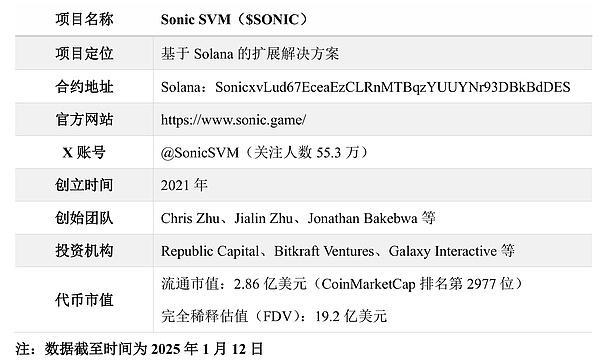
Sonic SVM is the first SVM (Solana Virtual Machine) Layer 2 network expansion project based on the Solana blockchain, focusing on the optimization of games and high-frequency interactive applications. The project's vision is to expand Solana's infrastructure based on the HyperGrid architecture, providing game developers with a high-performance, low-cost blockchain environment to support large-scale online games and applications, and meet the growing demand of Web3 users.
2. Project Development History
2023: The core team of the project was initially formed, and the technical R&D work officially started, focusing on the design of the Sonic HyperGrid framework, and gradually improving it through multiple rounds of technical verification.
March 2024: The Sonic SVM whitepaper was released, detailing the architecture and mechanisms of Sonic SVM, laying a theoretical foundation for the development of the project.
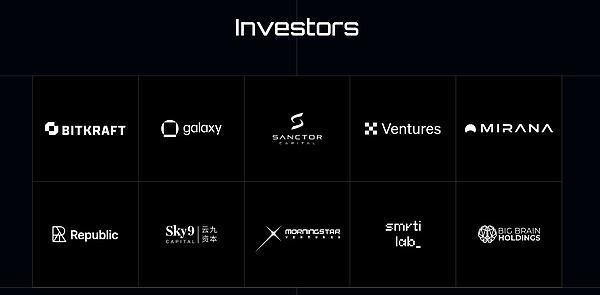
June 2024: Completed a $12 million financing, led by Bitkraft, with participation from Galaxy Interactive, Big Brain Holdings, Morningstar Ventures, etc., providing financial support for the further development of the project.
June 2024: Launched the testnet, started to attract developers and users to participate in the testing, and verified the performance and stability of the project. Within a week, it accumulated more than 100,000 wallet addresses.
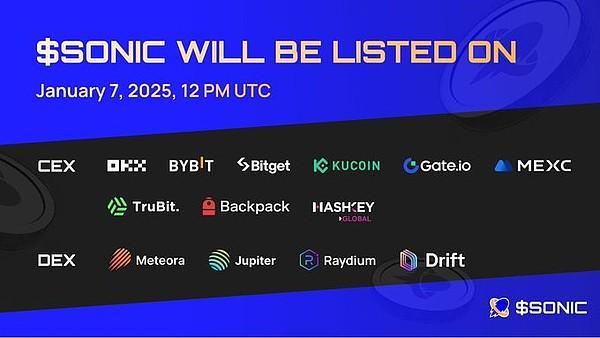
January 2025: The $SONIC token was officially generated (TGE) and simultaneously listed on well-known trading platforms such as OKX, Bybit, Bitget, and Kucoin.
3. Core Team Background
The core team of Sonic SVM is very young, with the main founders coming from rct AI. The key personnel include:
Chris Zhu, CEO, graduated from NYU Stern School of Business in 2020, previously worked at ByteDance and rct AI, founded Mirror World (Sonic's predecessor) in September 2021.
Jialin Zhu, Chief Product Officer, graduated from the Chinese University of Hong Kong in 2021, previously worked at rct AI, co-founded Mirror World in 2021.
Jonathan Bakebwa, CTO, graduated from Beijing Institute of Technology in 2020, previously worked at rct AI and founded Xtellar Works, co-founded Mirror World in 2021.
Yutong Li, Finance/Legal/HR Manager, graduated from the University of New South Wales in 2021, previously interned at companies like Accenture, BCG, ByteDance, and Alibaba, joined Mirror World in February 2022, previously served as a product manager.
Arif Kazi, Business Manager, graduated from BSE Institute Ltd in 2021, previously worked at mesha, Stader Labs, DappLooker, etc., joined Sonic in October 2023.
II. Business Model
1. Technical Logic
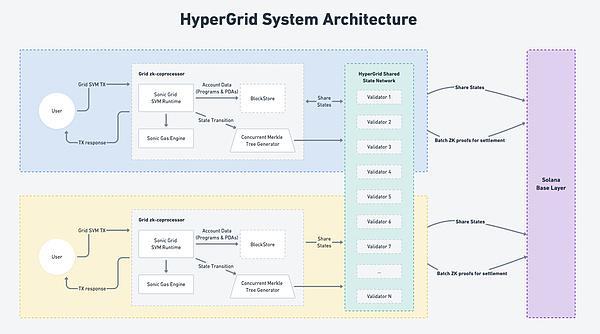
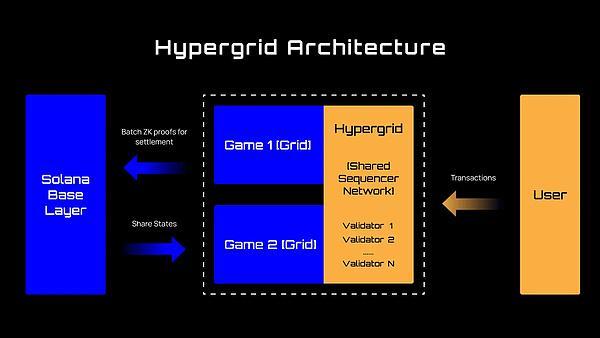
Sonic SVM is based on HyperGrid technology, building a multi-grid architecture (Grids) to achieve distributed operation of games and DApps.
HyperGrid is a parallel processing framework that can enhance Solana's infrastructure. The design of HyperGrid is aimed at achieving high customization and scalability, while maintaining native composability with Solana. Applications supported by HyperGrid can be written on EVM, but ultimately executed on Solana, with Solana as the final settlement layer, which is beneficial for bringing the EVM ecosystem applications to the Solana chain. This is different from the direction of the MoveVM technology where the final settlement layer is Ethereum.
Grids are designed to allow a large number of DApps to run on HyperGrid, reducing the impact on Solana L1 performance and minimizing performance interference between DApps. With the support of the HyperGrid architecture, DApp developers can choose to use the HyperGrid public grid based on their own needs, or horizontally scale to create their own dedicated grids. The choice depends entirely on the developer's evaluation of performance and cost. In addition, DApp developers can also shut down the grids they create without affecting other grids, as the verification, recording, and reading of the transactions and state changes generated by each grid are independently completed through the connection between HyperGrid and Solana L1.
2. Staking and Validator Network
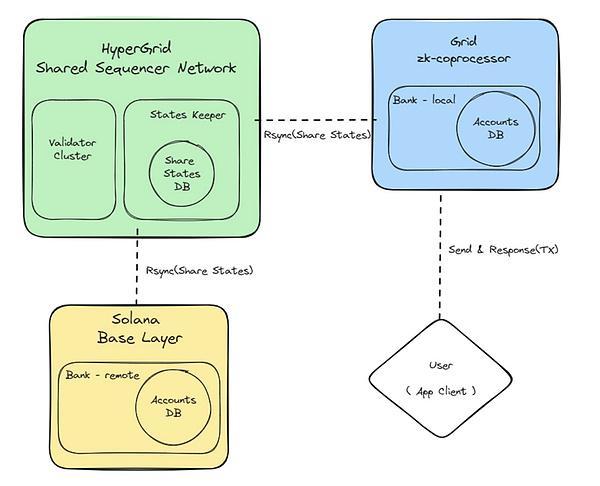
The HyperGrid ecosystem adopts a staking protocol, where Validators need to stake $SOL as collateral to participate in the network. This staking mechanism is not just a passive capital lock-up, but an active commitment to ensuring the security and continuity of all grids within HyperGrid. In line with the concept of re-staking in EigenLayer, the collective staking pool serves as the underlying security guarantee for the entire HyperGrid system.
Validators in HyperGrid take on multiple roles, not just block production. Their responsibilities include:
Ø Transaction Sequencing: Validators order transactions from the grids to ensure order and consistency in the processing flow.
Ø Slot Proposal: As network facilitators, Validators propose Slots (equivalent to blocks) to each grid. This can be seen as an outsourcing of execution, where the grids are responsible for the computation of state transitions.
Ø Execution Verification: After execution, Validators verify that the results match the expected state transitions. This step is crucial for maintaining the integrity of the ledger.
Ø State Commitment: After successful verification, Validators are responsible for publishing the verified state transitions to the Solana mainnet.
3. Incentive Model
Delegating a series of actions to Validators is crucial for maintaining a trustless and decentralized environment, ensuring that no single entity can exert undue influence on the network.
To recognize the critical role of Validators, they are rewarded with HyperGrid tokens for the services they provide. This incentive model aims to encourage honest participation and deter malicious behavior. The reward structure, including detailed numbers and equations, is planned to be adjusted through an iterative development process. It will be calibrated based on the network's performance and security requirements, ensuring that the Validators' interests are closely aligned with the health and success of the HyperGrid ecosystem.
Launching a Validator requires the operator to stake 100 SOL tokens. Once a Validator is established, they become eligible to receive votes from other users. These users participate by purchasing SONIC tokens, which are then locked and converted to $veSonic. Users can share the rewards generated by the Validators by staking their $veSonic tokens to them. This mechanism creates a symbiotic relationship within the system, encouraging participation and investment in the network's health and growth.
Within the HyperGrid ecosystem, Validators also take on the responsibility of sharing sequencers, so the L2 platforms built on HyperGrid will prioritize these Validators as shared sequencers. As part of their compensation, Validators will receive a portion of the sequencing fees, which helps to increase their revenue streams.
Additionally, the system incorporates Observer Nodes, responsible for verifying the accuracy of transactions conducted on various L2s. As a key component in safeguarding the system's security, these Observer Nodes play a crucial role in detecting any centralized malicious activities, which could trigger a slashing mechanism. They will receive SONIC tokens as a reward for their monitoring work.
Holding $veSonic represents capturing value within the ecosystem, such as a portion of embedded exchange fees, NFT market transaction fees, and a share of launchpad revenue. This reflects the intrinsic value proposition of $veSonic. Additionally, as recognition for contributing to the ecosystem, $veSonic holders are eligible to receive additional ecosystem rewards. Priority is given to $veSonic holders, and future games launched on HyperGrid will provide rewards for them, allowing users to choose the game rewards they wish to receive, thereby enhancing interactivity and engagement within the ecosystem.
4. Token Economics
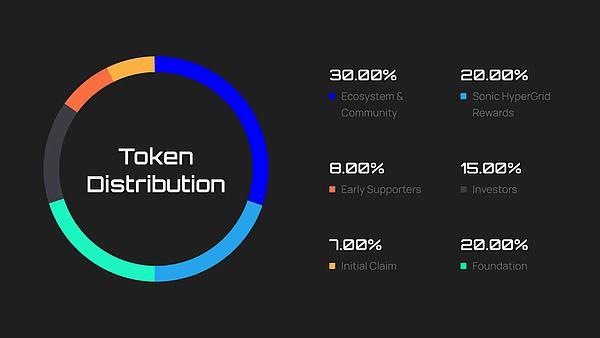
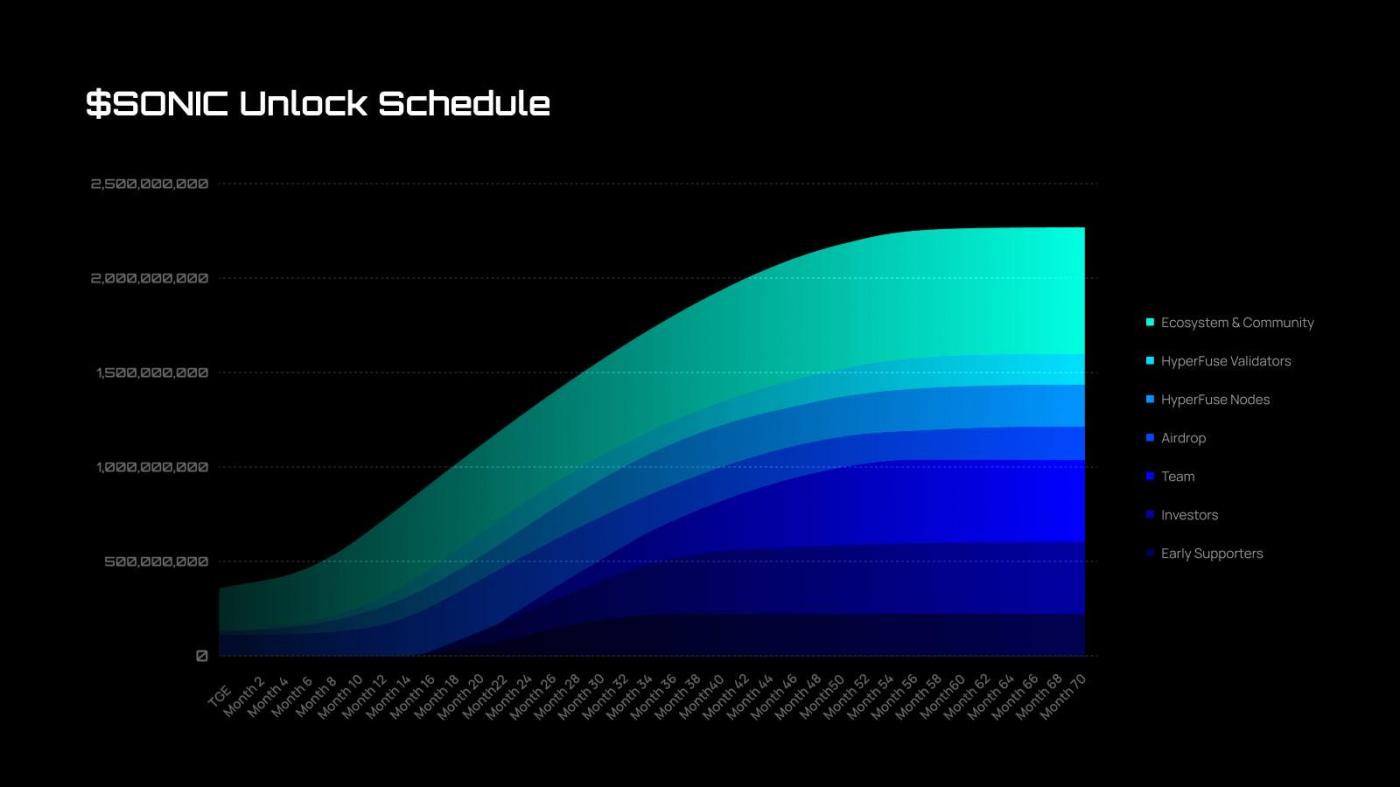
The native token of Sonic SVM is $SONIC, with a total supply of 2.4 billion and an initial circulating supply of 15%. The specific allocation is as follows:
Ø Community: 57% allocated to the community, including ecosystem and community development (30%), initial claim (7%), and HyperGrid rewards (20%).
Ø Early Supporters: 8% allocated to early supporters, with these tokens beginning linear unlocking after 12 months, continuing for 24 months.
Ø Investors: 15% allocated to investors, with these tokens beginning linear unlocking after 12 months, continuing for 24 months.
Ø Foundation: 20% allocated to the foundation, including team members and advisors, with these tokens beginning linear unlocking after 18 months, continuing for 36 months.
The main uses of the token are:
Ø Payment Tool: $SONIC can be used to pay for in-game assets, Non-Fungible Tokens (NFTs), and other application services.
Ø Staking and Rewards: Users and validators can earn network rewards by staking $SONIC.
Ø Governance Voting: Token holders can participate in key network decisions, including new project funding and network upgrade proposals.
Ø Incentive Mechanism: Supporting developers and users to earn token rewards through participating in ecosystem activities.
III. Project Prospects
1. Industry Analysis
Blockchain technology provides new opportunities for game developers, such as digital asset ownership, decentralized economics, and community governance. The blockchain game and decentralized application industry is growing rapidly. According to data analysis, the global blockchain game market size is expected to reach $30 billion by 2025. The number of Web3 game users is also growing at a rate of 50% per year. However, scalability remains one of the major challenges facing Web3 games.
Users have a strong demand for high-performance, low-cost gaming experiences, especially in high-frequency interaction and real-time response scenarios. Developers need a blockchain platform that can support large-scale users and high throughput to build and operate successful Web3 games.
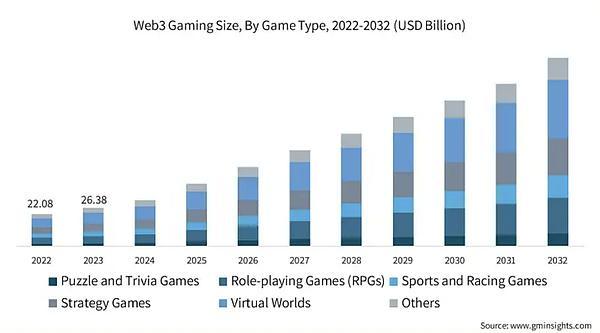
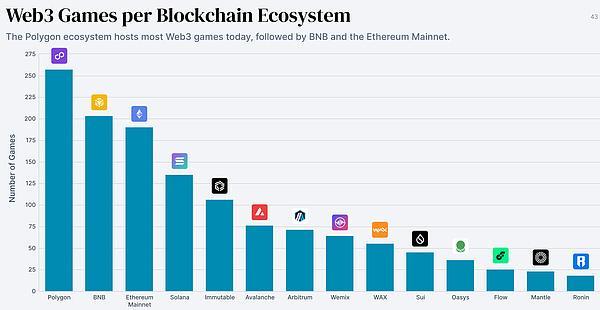
With the continuous progress of technology and market maturity, Web3 games are expected to become an important part of the mainstream gaming market. However, most of the current mainstream Web3 games are deployed on Polygon, BNB, and ETH chains, and none of the Top 25 UAW games are running on Solana; none of the Top 10 market cap games are born on Solana either. Therefore, Sonic SVM, with its high performance and low latency features, is expected to occupy an important position in this market and drive the large-scale adoption of Web3 games.
2. Ecosystem Building
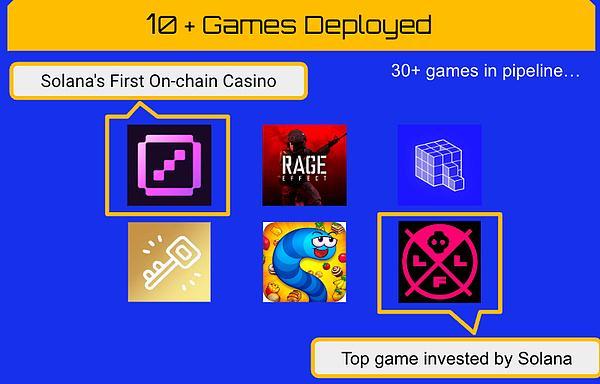
As a project born for Web3 games, Sonic SVM closely collaborates with game studios, providing not only technical support but also jointly conducting marketing activities. For example, the collaboration with the renowned game studio 343 Industries to launch the first 3A title resulted in over 100,000 downloads in the initial period. The two parties deeply bound their interests through revenue sharing and NFT co-issuance, with the in-game NFT sales exceeding $500,000 on the first day. Furthermore, the cooperation with social media platforms like TikTok has brought massive traffic to the ecosystem, achieving exponential user growth and retention through creative challenges, influencer marketing, and other forms, with the challenge participation exceeding 5 million and the influencer marketing bringing over 2 million new users.
In terms of community building, Sonic SVM has established an active community governance mechanism, where $SONIC token holders can participate in project decisions, including protocol upgrades, fee adjustments, and the use of the ecosystem fund. Regular community AMA (Ask Me Anything) events are held at least twice a month, bringing the team and users closer, collecting feedback, and promptly optimizing the project's development path, with over 80% of community suggestions effectively responded to and implemented.

3. Development Plan
According to the Roadmap published by Sonic SVM, the development plan is as follows:
(1) Phase 1: Network Genesis (Q4 2024 - Q1 2025)
Ø HyperGrid Network Genesis: Launch the HyperGrid shared state network, supporting the creation of interconnected SVM networks and achieving seamless interoperability.
Ø Sonic SVM Genesis: The Sonic SVM network officially launches, laying the foundation for scalable on-chain gaming.
Ø HyperFuse Network Security: Deploy a decentralized node cluster to ensure the security and accuracy of HyperGrid.
Ø $SONIC TGE: Complete the token generation event of $SONIC, unlocking its full ecosystem potential.
(2) Phase 2: Mainnet Alpha Launch (Q1 2025)
Ø Sonic Mainnet-Alpha: The Sonic SVM mainnet Alpha version is officially launched, including key services such as bridging, decentralized exchange, oracles, and NFT programs.
Ø Sonic X - TikTok App Layer: Launch native Android and iOS applications to provide support for high-quality game and digital asset distribution.
Ø Sonic Bridge: Integrate the official token bridge, supporting assets such as SOL, sSOL, sonicSOL, and stablecoins (USDC/T).
Ø HSSN Validator Onboarding: Activate HSSN validators to ensure network security and operations.
(3) Phase 3: Ecosystem Expansion (Q2 2025)
Ø HyperGrid Optimistic Rollup Stack: Integrate new SVMs into the HyperGrid Op-Rollup stack to enhance network scalability.
Ø Grid v2 Deployment: Launch the Sonic Grid v2 testnet and plan to integrate it into the mainnet, improving network performance.
Ø $SONIC Staking & Rewards: Introduce $SONIC staking and reward programs, where holders can earn rewards through HSSN validators, and implement a penalty mechanism to ensure network security.
Ø RUSH ECS Growth: Expand the RUSH ECS framework, adding support for more on-chain game SDK clients.
4. Competitors
Sonic SVM is the first expansion solution for games on the Solana blockchain. Similar projects include other Layer 2 solutions, as well as blockchain platforms specifically designed for games, such as Immutable X and WAX.
(1) Immutable X
A Layer 2 solution on Ethereum specifically for NFTs, which has already attracted several well-known game projects, such as Gods Unchained. Immutable X has gained market recognition due to its high performance and low fees.
(2) WAX
WAX is a blockchain platform focused on games and Non-Fungible Tokens (NFTs), and has established a rich ecosystem supporting multiple games and applications. WAX attracts a large user base through its efficient transaction processing capabilities and low fees.
Compared to similar competitors, Sonic SVM's Layer 2 solution based on Solana's high TPS (theoretical peak over 60,000 TPS) can ensure second-level transaction confirmation and average transaction fees as low as $0.5, providing users with a smooth, low-cost interaction experience that far exceeds the transaction efficiency of most competitors on public chains. In addition, through collaborations with mainstream social platforms like TikTok, Sonic SVM has a massive potential user base, with a broader audience and greater user growth potential compared to being limited to the crypto-native community.
5. Investment Potential
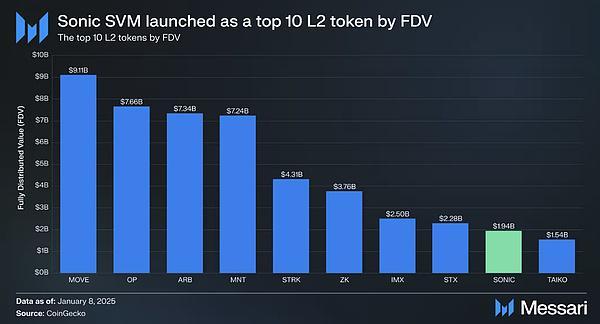
Sonic SVM, with its unique technical architecture, innovative business model, and forward-looking ecosystem layout, has opened up a new track. Since its launch, the project has shown strong development momentum through a series of key breakthroughs. Sonic SVM's high-performance and low-latency features are expected to occupy an important position in the Web3 gaming market.
From the perspective of token utility, $SONIC, as the native token of the Sonic SVM ecosystem, has a wide range of use cases. In terms of token allocation and unlocking rhythm, the distribution ratio is relatively reasonable, but a large amount of token unlocking will occur after 12 months, and the uncertainty remains as to whether Sonic SVM's development can meet the expected goals.
Overall, Sonic SVM's most important investment story still lies in the traffic inflow from platforms like TikTok (it is worth mentioning that the founder of Sonic SVM worked at ByteDance for 2 years, but the position was relatively low, so the extent to which he can leverage resources is questionable). If it can successfully achieve large-scale breakthroughs, the valuation of the $SONIC token may have at least a 10-fold upside potential from the current level, which may be worth a small-scale gamble on the upside probability; however, if it fails to attract a large number of Web2 users as expected, coupled with the uncertainty of Solana's network in the Web3 gaming market, the Sonic SVM story may also be difficult to continue.
In summary, it is recommended to consider the investment in $SONIC with caution.
IV. Conclusion
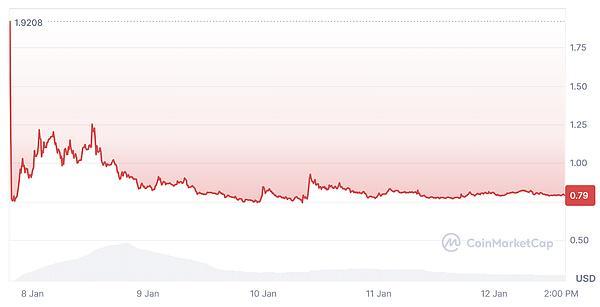
As a new Layer 2 solution in the Solana ecosystem, Sonic SVM provides a high-performance and low-cost blockchain environment for games and high-frequency applications through its innovative technical architecture and customized functions. Its collaboration with TikTok and successful market performance further demonstrate its strong ability to attract users and developers. With the continuous expansion of the ecosystem and the ongoing optimization of technology, Sonic SVM may achieve greater breakthroughs in the Web3 field, driving the large-scale adoption of Web3 games.
For investors with higher risk appetites and long-term optimism about the development of Web3 games and applications, they can allocate a small amount of $SONIC with close attention to the progress of technology and ecosystem, in order to gamble on the probability of the project becoming a hit product; for conservative investors, it is recommended to wait and observe, and make decisions after the market becomes more mature and the project's uncertainties are reduced.