


Author: Frank, PANews
On January 14, Solana's official Twitter account pinned a recommendation for a DePIN project called Roam, introducing that Roam is unifying over 1 million WiFi hotspots onto the Solana network. However, there has not been much prior introduction about Roam in the crypto space.
According to DePINscan data, Roam currently has a total of about 1.21 million devices, ranking first globally. What is the "magic" behind this rapid growth? Can its core model - "low-threshold router mining + token incentives" truly support the global expansion of the roaming WiFi network?
Low-threshold routers + token expectations attract millions of nodes
Roam was established in 2021 and has completed two rounds of financing totaling $7 million (seed round of $2 million, strategic financing of $5 million). As a DePIN project, Roam has managed to "do a big thing with small money" compared to the well-funded projects like IoTeX, io.net or Helium. The reason for this may be related to Roam's business model.
Roam is a decentralized WiFi network operator, with the main goal of building a global decentralized WiFi roaming network. The narrative is relatively simple - users can contribute their home WiFi to the Roam network, and if other users connect to the WiFi, the contributing user can receive corresponding reward points. These reward points can then be exchanged for ROAM tokens.
In the research, PANews found that as of July 2024, Roam had only about 400,000 registered users and devices, but in just 7 months, the number of devices has surged by 800,000 to 1.21 million, ranking first globally according to DePINscan data, with a total of 2.08 million registered users.
In addition to users contributing their personal routers to the Roam network, Roam's economic mechanism also includes a self-operated WiFi miner device, where users can purchase Roam's official routers and in addition to the basic rewards and obtaining an NFT, they can also receive additional rewards, such as an extra 60 points per day, or up to 150 points when a user logs in. Currently, Roam has launched two routers: MAX30 ($199) and MAX60 ($499), but only MAX60 users can enjoy the extra point rewards. Apart from the extra point rewards and NFT, these two routers do not seem to have any particularly innovative performance, and a similar performance device from a domestic tech brand is priced below 300 RMB on average, over 5 times cheaper than the MAX30.
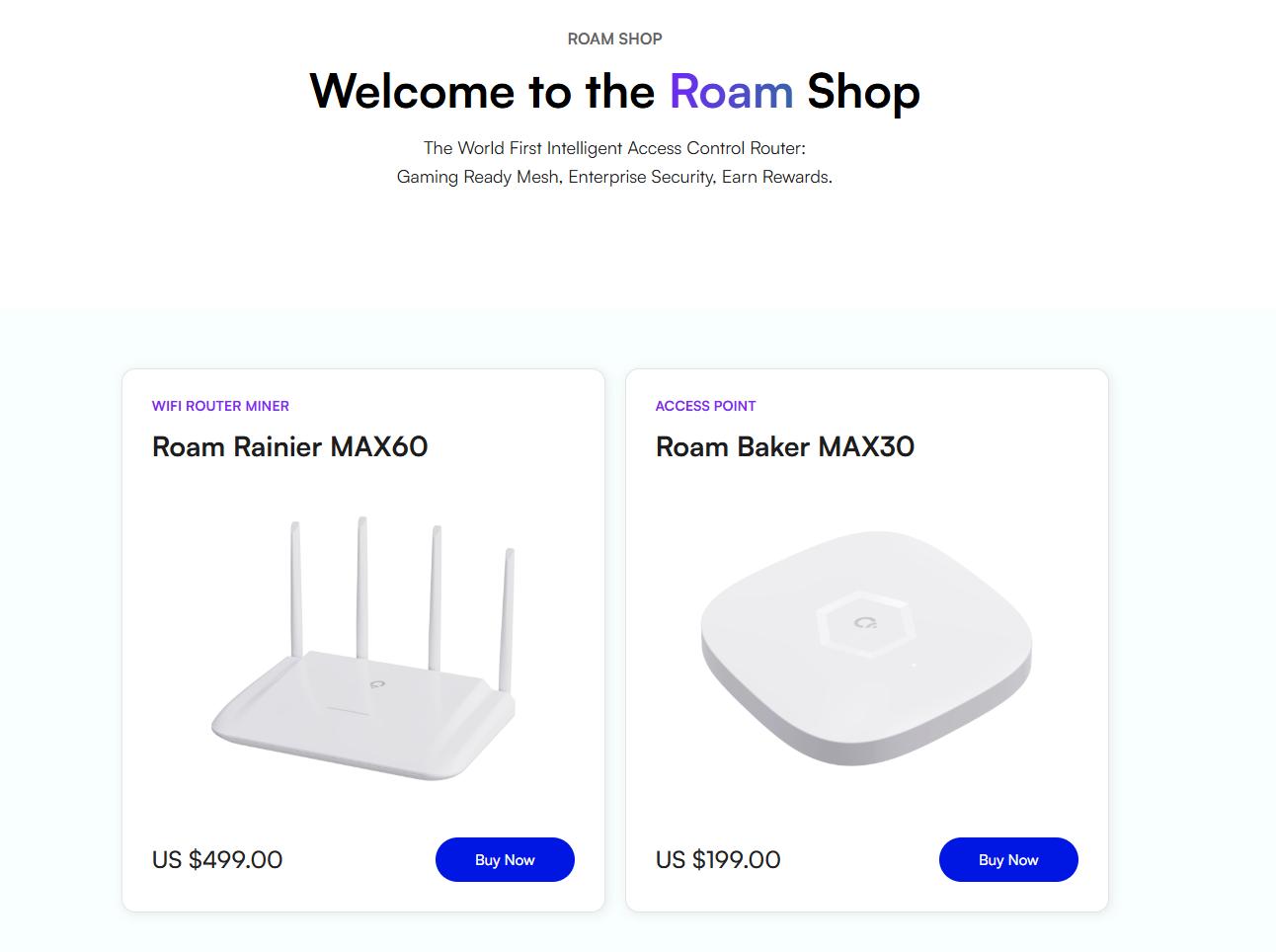
In this narrative, the reason Roam was able to quickly gain over 1 million users may be that routers are currently one of the most common household devices, with no special performance requirements and minimal setup, making the participation threshold relatively low.
When observing Roam's network distribution, PANews found that Roam's device density is highest in South Korea, almost ubiquitous across the country. It is also relatively dense in China, Southeast Asia, and Europe. The device density in the US is not as high. From these distributions, the main coverage areas are also concentrated in developed regions, with relatively low device coverage in underdeveloped regions like Africa. Roam's coverage has now exceeded 140 countries.

Can the premium router mining achieve excess returns?
According to the official introduction, the total supply of ROAM tokens is 1 billion, with 400 million generated during the TGE, and the remaining 600 million to be mined later. Of the 400 million generated during the TGE, 280 million are for sale and 120 million are reserved for the team. In September 2024, the official announced that 20 million tokens will be airdropped to holders of MAX60, MAX30 and NFTs, as well as previous Roam OG miners.
As of January 15, the total number of points issued by Roam is about 2.139 billion, but the exact conversion ratio between points and ROAM tokens has not been precisely disclosed, and the specific TGE timing has not been announced either.
However, we can do some simple estimates. Another DePIN project IOTX that has already issued tokens has a current circulating market cap of about $330 million, and Helium's HNT token has a market cap of about $867 million. If the initial circulating market cap of ROAM tokens can reach the level of IOTX, the average price per ROAM token would be about $0.825, and the airdrop scale would be about $16.5 million. With the currently announced 2.09 million registered users, the average points per user would be about 1,023, and the average amount per user would be about $7.8. Assuming half of the 1.21 million nodes are users who purchased the devices, then the average airdrop for the 600,000 device-purchasing users would be about $27.
Assuming the official uses all 280 million tokens in the TGE sale for point redemption, based on the current point issuance, the point-to-token conversion ratio would be about 7.6:1. If the market cap reaches the level of IOTX, the value of each point would be about $0.1. Calculating based on the 3,000 points reward for purchasing the device, plus 100 days of 60 points per day, the total points could reach 9,000, with a total return of about $900. However, this is the most ideal scenario, as the above calculations are estimates of two extreme methods, but they should still have some reference value. The average airdrop amount is likely to be between $7.8 and $900.
For users who purchase the devices, if the only return is $900 plus 100 days of time, the investment-to-return ratio may not be very high. For the Roam official, if half of the devices are user-purchased proprietary routers, the revenue from this part alone could reach at least $12.7 million. Even if only one-tenth of the devices are proprietary routers, the revenue could still reach at least $25.47 million. From this perspective, Roam's device revenue may make it the biggest winner in this airdrop narrative.
In addition to the decentralized WiFi network and token-linked model, Roam has also launched an international roaming eSIM network service, which currently covers 160 countries and regions according to the official introduction. This eSIM service is similar to the international roaming services offered by telecom operators, and the pricing ranges from $1.19 to $1.99 per 1GB, which is slightly higher than the roaming service prices of telecom operators in mainland China.
Roam has become an undeniable new force in the DePIN track, achieving the effect of "doing a big thing with small money" with only $7 million in financing, compared to many projects that have raised hundreds of millions. However, in terms of the current coverage areas, Roam's coverage is mainly in developed regions where the demand for WiFi is not necessarily urgent. The current device access is mainly driven by the expectation of token incentives. For the Roam official, the biggest challenge may be how to plan the token economy going forward. If the airdrop effect is not as expected, it may lead to a large-scale shutdown. Additionally, whether the current node count can be maintained and more nodes can be attracted after the airdrop is also an issue that cannot be ignored by Roam.






