As the integration of blockchain and artificial intelligence (AI) technology deepens, the AI Agent ecosystem is becoming an innovation hotspot. This article will conduct a detailed comparative analysis of the current three representative platforms - Virtuals, ai16z and XAIAgent from multiple dimensions such as functional architecture, user-friendliness, decentralization degree, performance, and ecological potential, and provide a comprehensive reference based on the latest technological developments.
I. Virtuals: A Simple and Efficient AI Agent Launching and Trading Platform
1. Platform Positioning
Virtuals is committed to building a simple and efficient AI Agent launching and trading platform, mainly targeting users who want to quickly enter the AI Agent field, especially those beginners who do not have high requirements for technical details.
Website: https://App.virtuals.io
2. Main Advantages
- Rapid Launching and Trading: Virtuals simplifies the creation and trading process of AI Agents, allowing users to quickly deploy Agents and launch their tokens to the market without complex operations. This simplicity reduces the technical threshold, enabling more users to get started easily.
- Strong Compatibility Based on Base Chain: Virtuals is based on the Base chain, which is compatible with the Ethereum Virtual Machine (EVM). This means that users can fully utilize the mature development tools and large user base of Ethereum to quickly integrate into the ecosystem.
- Low Transaction Costs: The Base chain adopts Rollup technology to achieve relatively low transaction fees. This is a significant advantage for AI Agents that require frequent transactions and interactions.
3. Main Disadvantages
- Single Functionality: Virtuals mainly focuses on the launching and trading of AI Agents, lacking support for complex Agent development and customization features. This limits its appeal to professional developers.
- Dependence on Centralized LLM: The platform cannot provide decentralized AI model services, and users need to rely on centralized large language models (LLMs) for AI reasoning. This not only increases the operating costs, but also requires the use of fiat currency to pay for model fees, affecting the integrity of decentralization.
- Lack of Decentralized Computing Power Support: The Base chain itself does not have a decentralized computing power network, which limits the efficiency and scalability of AI Agents.
4. Applicable Scenarios
Suitable for beginners who want to quickly start in the AI Agent field and have low functional requirements, as well as users who are mainly focused on trading and simple application scenarios.
II. ai16z: High-Performance Real-Time AI Agent Platform
1. Platform Positioning
ai16z is based on the Solana chain and focuses on scenarios with high real-time requirements, such as market analysis and investment assistants, aiming to provide support for AI applications that require rapid response.
2. Main Advantages
- Low Transaction Fees: The operating costs of the Solana chain are very low, providing a significant cost advantage for ai16z platform users and developers.
- Diverse Ecosystem Support: The Solana ecosystem has a large number of DeFi and NFT projects, and ai16z can seamlessly integrate into these areas to expand the application scope of AI Agents.
3. Main Disadvantages
- Dependence on Centralized AI Services: Similar to Virtuals, ai16z needs to rely on centralized LLMs for reasoning, which increases the operating costs and weakens the goal of decentralization.
- Network Stability Issues: Solana chain has experienced multiple network outage incidents, which is a significant potential risk for AI Agent applications that require high reliability.
- Higher Development Threshold: The development language of the Solana chain is Rust (also supports C++), which has higher technical requirements for developers compared to EVM-compatible chains.
- Limited Decentralization: The high performance of Solana depends on high-specification hardware, and the high node running costs limit the degree of decentralization of the chain.
4. Applicable Scenarios
Suitable for developers who require real-time and high concurrency, such as financial analysis, quantitative trading, and other applications with extremely high-speed requirements.
III. XAIAgent: A Comprehensive Decentralized AI Agent Platform
1. Platform Positioning
XAIAgent is based on the DBC chain and integrates the launching, usage, and trading of AI Agents. It serves both ordinary users and developers, who can quickly develop complex Agents through its XAgentScope framework.
Website: www.xaiagent.io
2. Main Advantages
- Extremely Low Transaction Fees: The operating costs of the DBC chain are almost negligible, providing a significant cost advantage for XAIAgent platform users and developers.
- Truly Decentralized Architecture: XAIAgent fully relies on the DBC chain's GPU miner network to run, and its LLMs and AI Agents are completely decentralized, ensuring data privacy and long-term stability.
- 400 Million Token Context Window: Supports a context window of up to 400 million tokens, which is particularly important for multi-round dialogue scenarios.
- Extensive Basic Model Support: The platform has integrated multiple decentralized AI models (such as DecentralGPT, SuperImage, DeepVideo), simplifying the development process.
- Dual Architecture Support: Serves both ordinary users and developers, supporting the rapid development of complex intelligent agents.
- Innovative Dual-Token Economic Model: Includes the $XAA token for miner incentives and model payments, as well as independent tokens for AI Agents.
3. Main Disadvantages
- The ecosystem is still in the early stage and needs more time to accumulate.
- Cross-chain compatibility needs to be strengthened, and the interoperability with other mainstream chains still needs to be optimized.
4. Applicable Scenarios
Suitable for users who need to handle complex tasks and multi-round dialogue scenarios.
IV. Comparative Summary and Recommendations
Comparative Summary
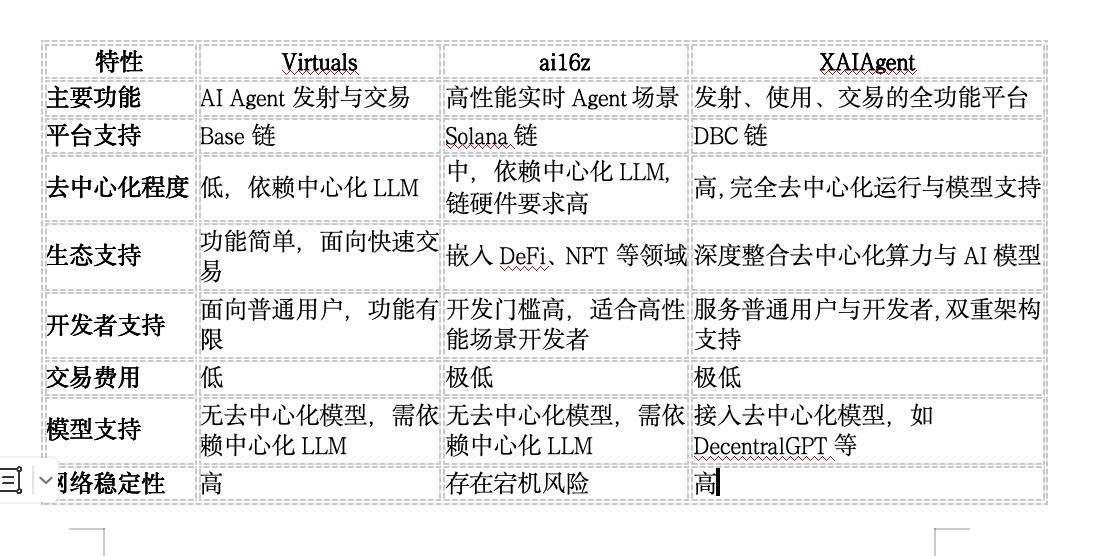
Recommendations
- For ordinary users or non-technical developers: Choose the XAIAgent platform, which can significantly reduce the development threshold and provide powerful AI model support.
- For technical developers: The XAgentScope framework can provide flexibility and efficiency, supporting the rapid development of complex intelligent agents.
- If focusing on simple trading scenarios: You can choose Virtuals; if seeking more ecosystem support, you can consider ai16z.
- For applications that need to handle multi-round dialogues and complex tasks: XAIAgent, with its 400 million token context window and multi-round dialogue capabilities, is the best choice.