introduction
In 2024, the global crypto market has undergone profound changes and multiple challenges. From the approval of the spot Bitcoin ETF at the beginning of the year, to market volatility, Bitcoin L2 and ETH L2 technology innovations, the outbreak of Meme and AI Agent tracks, to the popularization of decentralized applications (DApp), this year is undoubtedly a year of continuous evolution in the crypto industry. Although the macroeconomic environment is complex, the demand for crypto assets remains strong, and decentralized finance (DeFi), Web3 technology, Layer 2 expansion solutions, AI Agents and innovative projects continue to lead the industry's cutting-edge development.
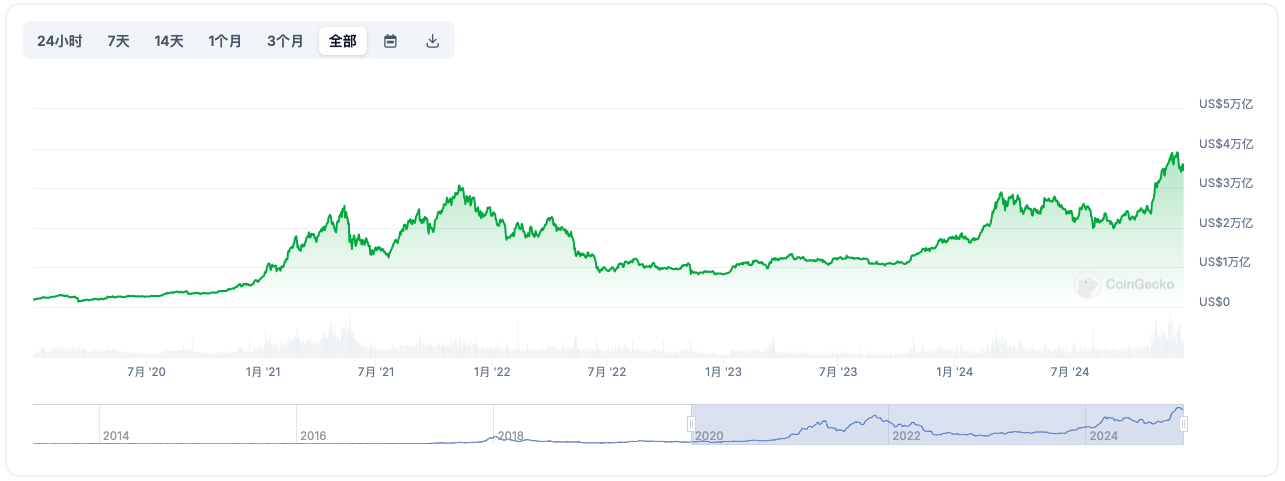
At the same time, the deep involvement of traditional financial institutions and enterprises has further promoted the mainstreaming process of the crypto industry. The approval of spot Bitcoin ETFs, the massive influx of institutional funds, and the innovation of financial products based on RWA have made the crypto market present a diversified development pattern in recovery and innovation in 2024. According to market data, the total market value of the crypto market in 2024 has climbed from US$1 trillion at the beginning of the year to US$4 trillion, with an annual growth rate of up to 300%, marking that the industry has entered a new stage of development driven by technological breakthroughs and market expansion.
Entering 2025, the global economic environment and the crypto industry will still face more uncertainties. In this context, how the market can seek innovative breakthroughs within regulatory constraints has become a key issue affecting the sustainable development of the industry. As a deep participant in the Web3 industry, Web3Port combines its own business practices and industry insights to systematically sort out the core changes in the crypto market in 2024 and make a forward-looking outlook on market trends in 2025. We hope that this report can provide industry practitioners with clear market insights, help them make wise decisions in a rapidly changing environment, and promote the healthy and sustainable development of the Web3 ecosystem.
Part 1: Summary of the Crypto Market in 2024
1. Market Overview and Performance
After experiencing the historic surge in 2021 and the market winter in 2022, 2024 is the year when the crypto market gradually recovers and continues to grow. Despite external challenges such as inflationary pressure, rising interest rates and geopolitical risks facing the global economy and financial markets, the crypto market still shows relatively strong resilience and has become an emerging direction for capital hedging. Overall, the market presents the characteristics of "restorative growth" and "technological innovation driven".
1.1 Market size and market value fluctuations
In 2024, the total market value of the crypto market showed a recovery in growth. From Q4 2023 to the end of 2024, the total market value of the cryptocurrency market continued to grow from $1 trillion to $4 trillion, a cumulative increase of 300%.
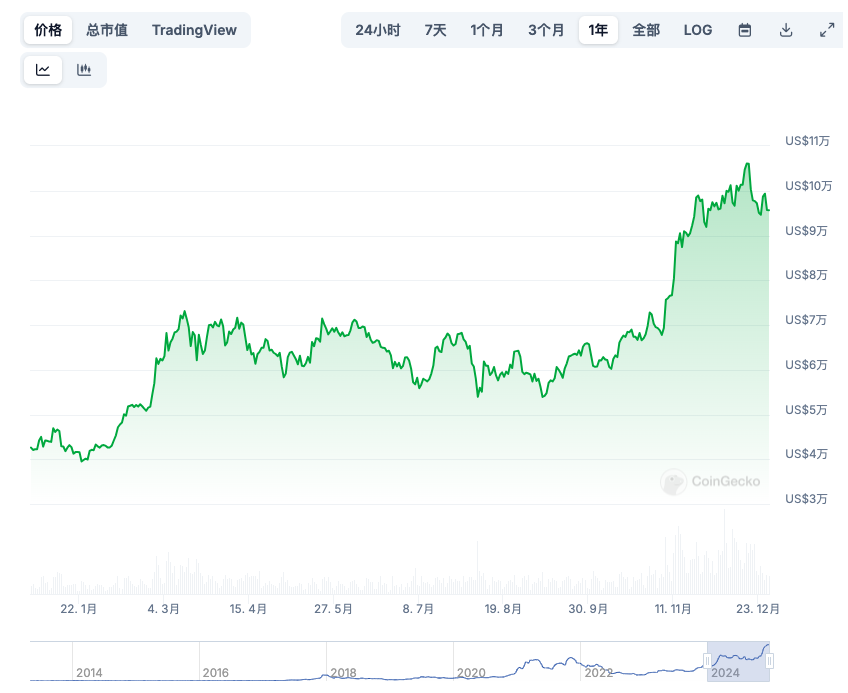
As the market leader and core driving force, Bitcoin (BTC)'s total market value exceeded US$1 trillion in Q2 2024, and in Q4, driven by positive news from Trump's campaign, its price exceeded US$100,000 for the first time, with a market value of more than US$2 trillion.
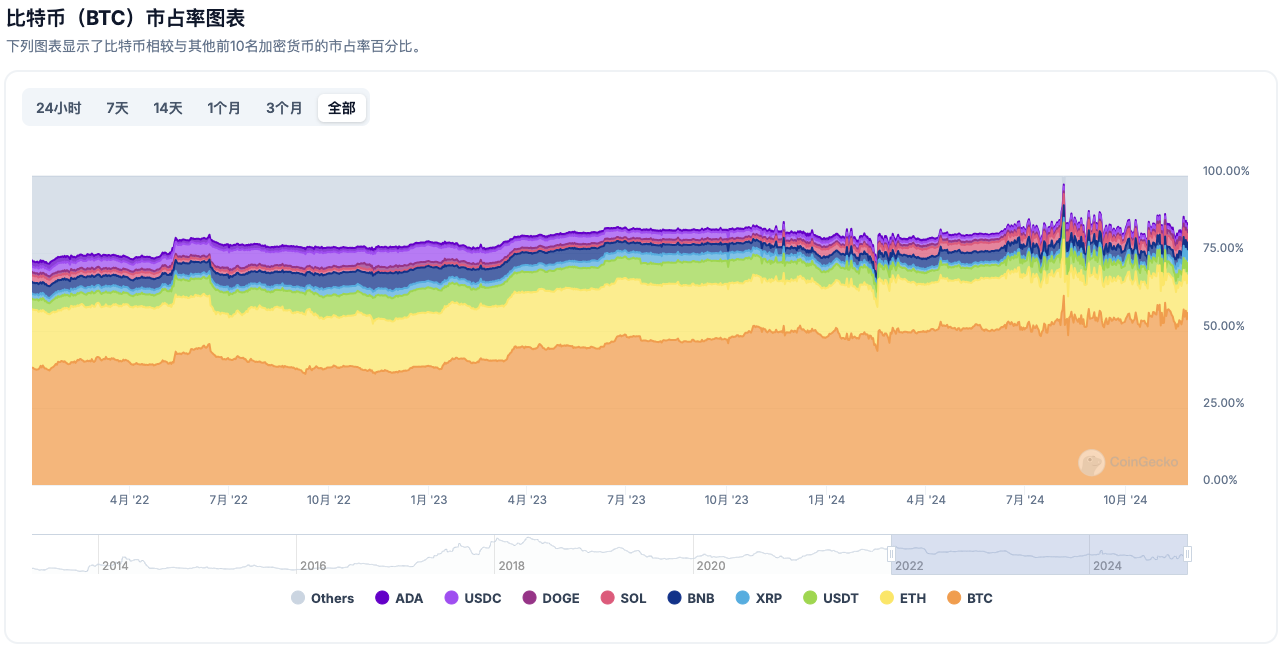
At the same time, BTC's market share (market share of the top 10 cryptocurrencies) has also further increased, currently exceeding 55%, consolidating its dominant position in the crypto industry. Although ETH has also achieved development in 2024, its overall trend is significantly weaker than BTC, and its exchange rate against BTC continues to weaken, facing uncertainty. The other top 100 Altcoin can only outperform BTC. In the absence of ETH's outbreak, the Altcoin market lacks momentum and market speculation basis, the market volatility is obvious, and the money-making effect is weak.
1.2 ETF & Institutional Investor Participation
In 2024, one of the most notable features of the crypto market is the deepening participation of institutional investors. Against the backdrop of uncertainty in the traditional financial market, more and more traditional financial institutions have begun to pay attention to and deploy crypto assets. Many large financial institutions have entered the crypto market and provided a variety of financial products and services, further promoting the maturity and standardization of the market.
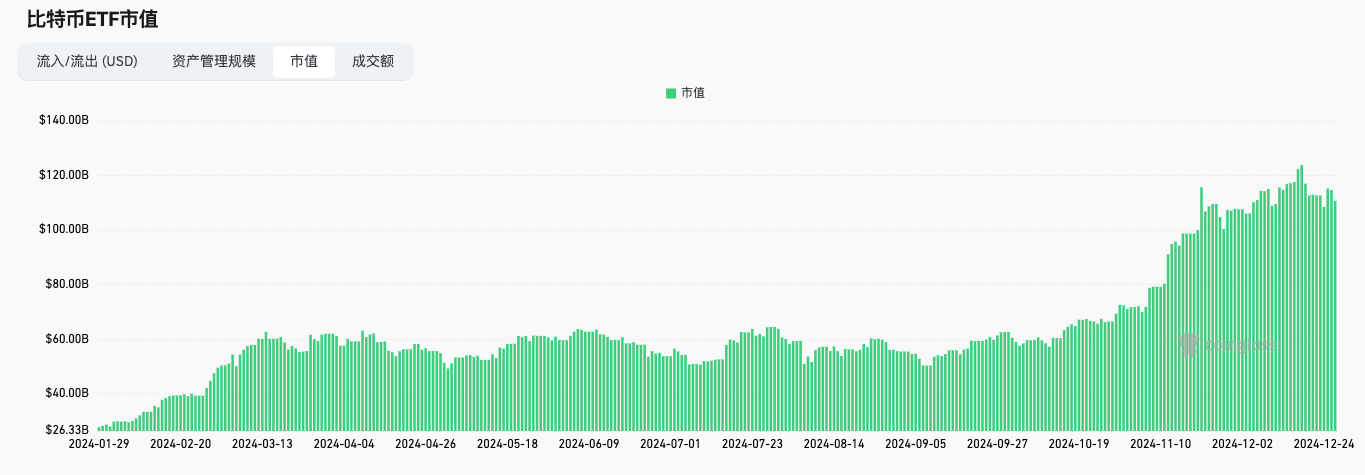
- Approval of spot Bitcoin ETFs : On January 11, 2024, the U.S. Securities and Exchange Commission (SEC) approved 11 spot Bitcoin ETFs at the same time. The approval of Bitcoin spot ETFs has facilitated institutional investors to invest in the crypto market. Currently, the market value of Bitcoin ETFs has reached $110.494 billion, with a total asset management scale of $111.858 billion, accounting for 5.89% of the total market value of BTC.
- Participation of payment giants and banks : PayPal began to provide payment and storage services for Bitcoin and other cryptocurrencies in 2024, and launched the PYUSD stablecoin. Institutions such as BlackRock have also increased their investment in the crypto market, especially in Bitcoin ETFs and blockchain infrastructure, becoming a highlight of the market. These institutions not only brought funds to the crypto market, but also promoted the market's compliance process.
- Innovation of institutionalized financial products : In 2024, the crypto derivatives market will further develop, and institutional investors will gradually show strong interest in derivatives such as crypto futures, options and ETFs. Bitcoin ETFs and Ethereum futures contracts have become important investment tools. The launch of these products, especially in the US market, has laid the foundation for the traditional financialization of crypto assets.
1.3 Continued growth of decentralized finance (DeFi)
Decentralized Finance (DeFi) remains one of the key highlights of the crypto market in 2024. The DeFi ecosystem continues to expand and is showing growth momentum in both transaction volume and user base. Especially on the Ethereum network, innovations and applications of DeFi protocols are emerging in an endless stream. DeFi not only involves basic financial services such as lending, trading, and liquidity mining, but also gradually extends to complex financial products such as insurance, derivatives trading, and algorithmic trading, demonstrating its potential to surpass the traditional financial system.
In 2024, the total value locked (TVL) of the DeFi market showed a steady upward trend, rising from $54B at the beginning of the year to nearly $140B, reaching about 80% of the 2021-2022 DeFi summer bull market.
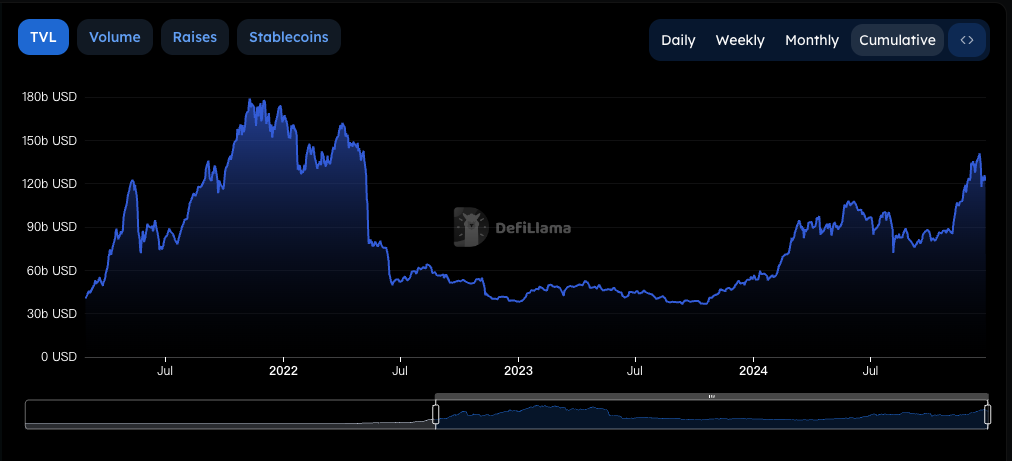
Mainstream DeFi protocols such as Aave, Uniswap, and Compound have completed technical upgrades in 2024, improving the efficiency and user experience of their products. For example, Uniswap launched a new generation of automated market makers (AMM) in 2024, which improved the liquidity and efficiency of transactions and attracted more users to participate. Aave's TVL has reached a record high, breaking through $20B, exceeding the $20B TVL at its peak in 2022.
In 2024, the concept of decentralized stablecoins has gradually become a core component of the DeFi ecosystem. The application of decentralized stablecoins such as Dai and Frax in DeFi lending, payment and exchange has gradually increased, promoting the stability and practicality of decentralized finance. At the same time, the market value of USDe launched by the new stablecoin project Ethena exceeded $5.9B, and the market value of USD0 launched by Usual.money exceeded $1.7B, contributing new liquidity to the DeFi ecosystem. Most of the TVL and revenue of mainstream DeFi protocols such as Aave, Maker, Morpho, Pendle, etc. come from projects such as Ethena and Usual.money.
1.4 The explosion of MemeCoin and AI
In 2024, MemeCoin and AI tracks outperformed other narratives and became the two tracks with the highest returns in the crypto market. Coingecko's data also proves this:
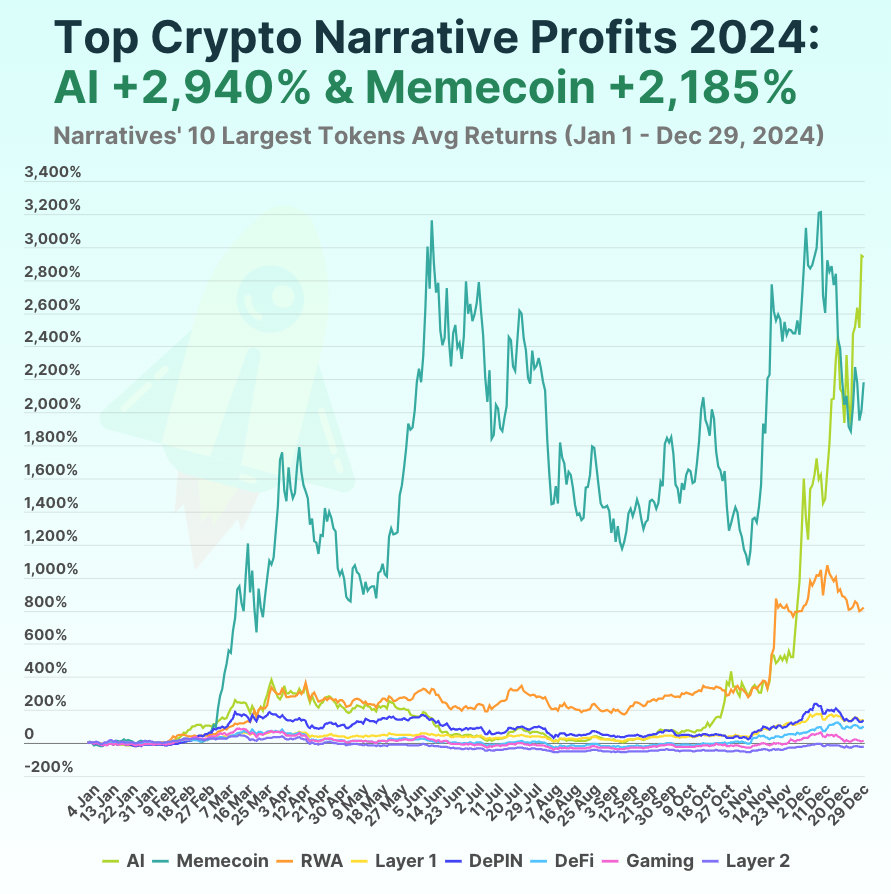
The development of meme distribution platforms, trading bots and market tools, led by Pump.Fun, has promoted the meme craze. Its overall development has gained most of the market's attention, with GOAT as the starting point of the AI Meme narrative, AI launch platforms (Virtual, GRIFFAIN, Clanker) as the outbreak, and AI frameworks (Ai16z & ELIZA, zerebro, swarm) as the climax.
As the MemeCoin and Ai track markets grow, they are no longer tools for short-term speculation, but become important narrative tracks, market trends and driving forces in the crypto market.
1.5 Market Fluctuations and Macroeconomic Impacts
In 2024, the uncertainty of the global economic and financial environment will still have a significant impact on the crypto market. The volatility of global stock markets, the strength of the US dollar, and changes in central bank policies are still important external factors affecting the crypto market. The price fluctuations of mainstream crypto assets such as Bitcoin and Ethereum often synchronize with the fluctuations of traditional financial markets (US stock indexes), especially when the macro economy is unstable, the crypto market often faces greater pressure.
Overall, the crypto market in 2024 has maintained a delicate balance between volatility and growth. Internal driving factors such as the continued influx of institutional funds, the maturity of decentralized finance (DeFi), and innovation in the NFT field, together with the external policy environment, have shaped the main tone of market recovery.
The approval of the spot Bitcoin ETF
On January 11, 2024, the U.S. Securities and Exchange Commission (SEC) approved 11 spot Bitcoin ETFs at the same time. This milestone event paved the way for institutional investors to enter the crypto market and had a profound impact on the development of the industry. The launch of ETFs has made Bitcoin a more mainstream and recognized investment tool, promoting the further maturity of the crypto market.
The launch of the spot Bitcoin ETF not only lowers the threshold for traditional institutions to enter the crypto asset field, but also marks a major shift in the attitude of regulators towards the crypto market. The approval of the ETF is considered to be one of the key factors that pushed the price of Bitcoin to a record high, further consolidating its position as digital gold in the minds of investors.
US interest rate cut and its market impact
Since March 2022, the U.S. Federal Reserve (Fed) has started a new round of interest rate hikes, with a total of 11 rate hikes, raising the federal funds rate to a range of 5.25%-5.50%, the highest level since 2007.
In 2024, the U.S. Federal Reserve (Fed) ended the interest rate hike cycle since March 2022 and started the process of interest rate cuts. The Fed cut interest rates by 50 basis points for the first time in September 2024, and then cut interest rates by 25 basis points again in November and December, reducing the federal funds rate range from 5.25%~5.5% to 4.75%~5%, a total reduction of 1 percentage point, the lowest level in two years.
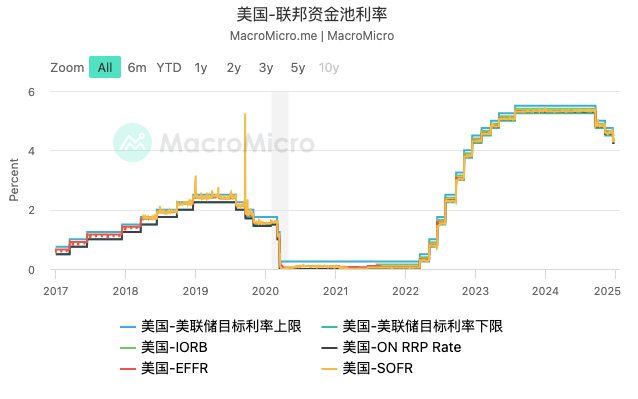
The U.S. interest rate hike and cut cycle has a profound impact on the crypto market:
- Interest rate hike phase: increased market volatility, compressed the liquidity of risky assets, and put the crypto market under certain pressure.
- Interest rate cut phase: eased the tight liquidity situation in the market, attracted more funds to flow into crypto assets, and stimulated the market recovery.
The interest rate cut policy has also driven up the prices of major crypto assets including Bitcoin and Ethereum, while also driving capital flows into areas such as decentralized finance (DeFi) and the tokenization of real-world assets (RWA).
The Crypto Effect of Trump’s Election as US President
On November 6, 2024, Trump successfully defeated Harris and was elected as the new President of the United States. This result is seen as an important positive for the crypto industry. During the campaign, Trump promised to support the development of cryptocurrencies and was hailed as the first "Bitcoin President" in the United States.
Since Trump's victory, the price of Bitcoin has risen sharply from $70,000 to over $100,000 in just a few weeks, and its market value has reached a record high of $2 trillion. Driven by this positive news, the mainstream currency and a few Altcoin markets have risen across the board, and market sentiment has clearly warmed up, ushering in a new round of rising cycle.
Trump's crypto-friendly policies, including promoting the clarification of the regulatory framework and promoting the inflow of institutional funds, have injected confidence into the development of the industry and further promoted the United States to become an innovation center for global crypto assets.
2. Hot Tracks and Technological Innovation
In 2024, multiple tracks in the crypto market showed significant development momentum, covering decentralized finance (DeFi), Layer 2 solutions, Bitcoin L2, MemeCoin track, AI+blockchain, real world assets (RWA) and stablecoins, TON ecology and other fields. These tracks not only promoted technological innovation in the crypto market, but also greatly expanded the actual application scenarios of blockchain technology, laying a solid foundation for future market growth.
2.1 Continued Expansion of Decentralized Finance (DeFi)
As an important part of the crypto market, decentralized finance (DeFi) showed a strong expansion trend in 2024. It is not only limited to transactions and liquidity mining, but also penetrates into lending, derivatives, re-pledge and liquidity aggregation, as well as stablecoins and other fields, promoting the decentralization and innovation of financial services.
- Decentralized Exchanges (DEX) and the Evolution of Liquidity Pools
In 2024, decentralized exchanges (DEX) further improved user experience and market efficiency through technology upgrades and mechanism optimization. For example, Uniswap V4 introduced a dynamic liquidity pool management mechanism, which enables liquidity providers to dynamically adjust asset allocation according to market fluctuations, significantly improving profitability.
At the same time, cross-chain transactions and multi-chain support have become important trends in the development of DEX. The launch of cross-chain message & protocol mainnet and tokens represented by LayerZero and Wormhole provide underlying support for the efficient transfer of assets between multiple chains. Cross-chain bridge projects (such as Stargate, Hop Exchange, Across, Synapse Bridge, etc.) have achieved significant growth this year, making important contributions to the overall benefits and interoperability of DeFi.
Through cross-chain protocols and cross-chain bridges, DEX trading pairs are not limited to a single blockchain network, and assets between multiple blockchains can flow freely. This cross-chain liquidity greatly improves the overall benefits of DeFi and enhances the interoperability of blockchain applications.
- Innovation of decentralized lending platform
Decentralized lending platforms continue to grow in 2024, especially projects such as Aave, MakerDAO, and Morpho, which have made multiple innovations in lending, leverage, and staking. Aave further reduced borrowing costs in 2024 through a dynamic adjustment mechanism, helping users obtain more flexible financing options in different market environments. Morpho and Aave not only significantly increased their TVL by integrating Ethena's sUSDe, but also obtained a higher source of income. MakerDAO and Aave continue to exert their strength in the RWA market, allowing collateralized lending of RWA assets, pushing up their TVL and asset liquidity levels.
The transparency and flexibility of decentralized lending are providing important financial support to people around the world who cannot access traditional financial services. It is expected that with the development of decentralized identity (DID) and credit scoring systems, DeFi lending will become an important part of global financial services in the future.
- The explosion of decentralized derivatives platforms
Thanks to the development of Layer2 solutions, the decentralized derivatives market will continue to grow in 2024. Innovative liquidity incentive models represented by GMX will become the mainstream of the market. The order book and AMM mechanisms will gradually merge. The old derivatives platform Dydx will improve its market competitiveness through the application chain. Among them, SynFutures and Hyperliquid have achieved rapid development in 2024, and their market share has been greatly improved. In particular, Hyperliquid has performed particularly well, and its market share in the derivatives market has gradually jumped to the first place.
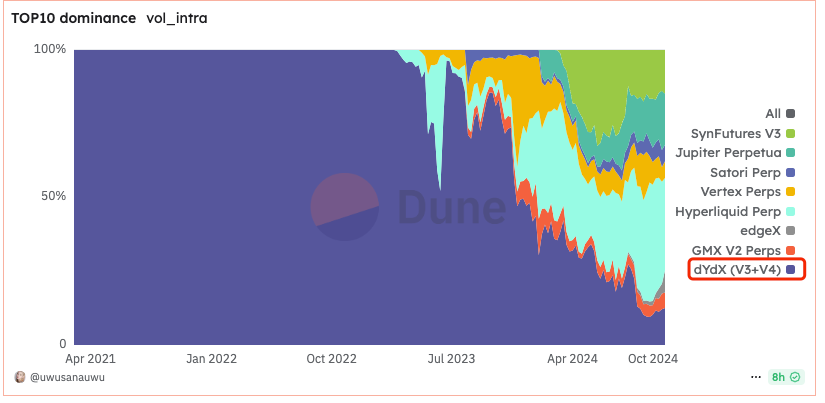
Hyperliquid created a new wave of airdrop wealth effect by airdropping 31% of its tokens (worth about $1.8 billion at the TGE listing price) directly to the community (rather than allocating them to venture capital institutions). This innovative community-oriented distribution model broke the VC-dominated market structure and stimulated the loyalty and participation of community users. This behavior attracted a large amount of funds (billions of dollars) to cross-chain to the Hyperliquid platform, further driving the spot assets on the platform to increase by 10 to 100 times, forming a strong capital aggregation effect and market attention.
- The outbreak of LRT track
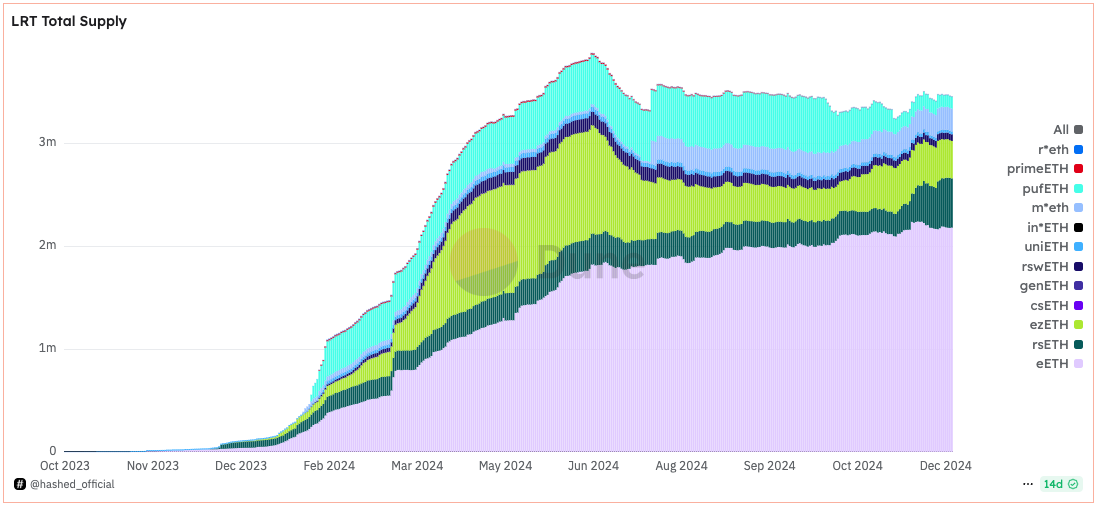
The explosion of the LRT track is an important narrative in the DeFi field in 2024. This narrative was triggered by EigenLayer and produced two sub-ecosystems.
EigenLayer is a restaking protocol based on Ethereum, which allows users to restake ETH, lsdETH and LP Token on other side chains, oracles, middleware, etc., as nodes and receive verification rewards. Third-party projects can enjoy the security of the ETH mainnet, and ETH stakers can also get more benefits, achieving a win-win situation.
Around the EigenLayer ecosystem, LRT (liquid re-staking) track projects have emerged, including Ether.fi , Puffer Finance, Kelp DAO, etc. In order to compete for market resources (ETH staking), these LRT track projects have launched LRT Wars through airdrop points, multiple airdrop incentives, etc. At its peak, the TVL staked on the EigenLayer network exceeded $20.12B, and the ETH staked exceeded 3.88M ETH. At present, the EigenLayer mainnet has been launched, and the popular projects in the LRT track have also been launched. The overall market performance is biased compared to the ultra-high market popularity it has generated.
At the same time, EigenLayer also gave birth to the AVS (Actively Validated Services) active verification service ecosystem through re-staking and pooling security, including EigenDA, AltLayer, Brevis, Lagrange, Omni Network, Automata and other ecological projects. However, the overall development of the AVS track is currently average, and the actual demand scenarios are not yet fully mature.
- Liquidity aggregation trend
The outbreak of the LRT track has triggered a trend of liquidity aggregation in DeFi protocols and products. In order to grab the liquidity and market share of crypto assets in the market, liquidity aggregation products have appeared in the market, such as the full-chain liquidity public chain Uniswap unichain, Zircuit pledge chain, the cross-chain market StakeStone based on LST liquidity, and various DeFi liquidity aggregation protocols. These projects have significantly improved the availability and profitability of DeFi products by integrating multi-chain assets and liquidity.
2.2 Innovation and Development of Layer 2 Solutions
In 2024, the Layer 2 (L2) ecosystem has entered a critical development period and has become one of the most dynamic areas in the Ethereum and other public chain ecosystems. Through technological innovation and ecological expansion, L2 has not only alleviated the scalability bottleneck of blockchain, but also provided efficient and low-cost solutions for scenarios such as decentralized finance (DeFi), NFT transactions, and on-chain games, further promoting the popularization of blockchain applications.
Ethereum Layer 2 mainly includes two technical routes: Optimistic Rollups and zk-Rollups. In 2024, Optimistic Rollups continued to develop steadily under the leadership of Arbitrum, Optimism and Base, while zk-Rollups' advantages in transaction efficiency and privacy protection promoted its rapid rise and became an important growth point in the Layer 2 track.
- Ethereum Layer 2 competition intensifies
In 2023, Optimism and Arbitrum, which use the Optimistic Rollups technology solution, successively issued coins and built ecosystems, occupying a dominant position in Layer 2. However, in 2024, zk-Rollups projects including Manta, Starknet, ZKsync, and Scroll successively issued coins and built ecosystems, and the zk-Rollups technology solution has developed rapidly, squeezing out the ecological space of Optimism and Arbitrum.
- Base Chain Outbreak
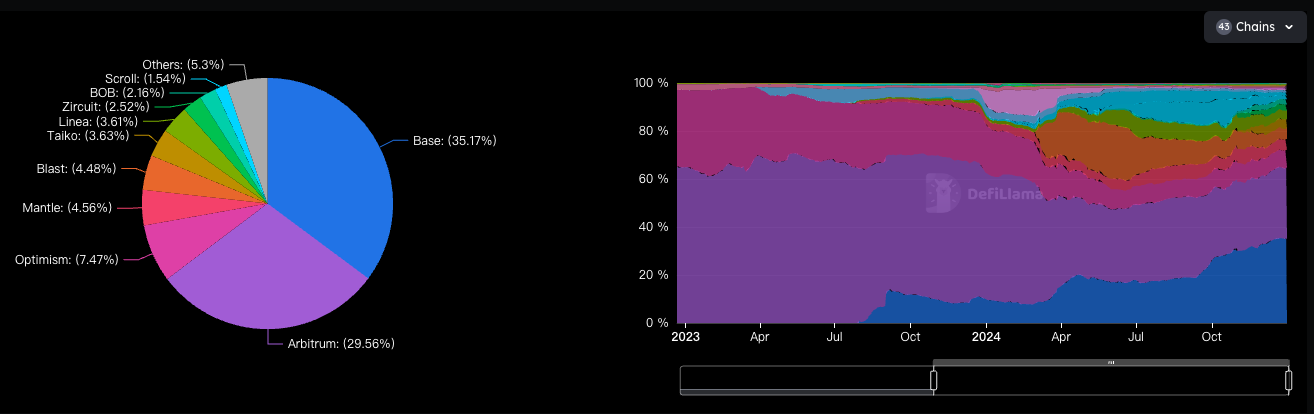
With the support of Coinbase's traffic, the Base chain's total value locked (TVL) increased by $1.8 billion in one year, accounting for 35.17% of the Layer 2 market, becoming the market share leader. The Base chain also supports MemeCoin and AI ecological projects, becoming an active ecological base camp on par with Solana.
- The rise of zk-Rollups
zk-Rollups has achieved rapid development in 2024 with the technical advantages of zero-knowledge proof (zk-SNARKs). zk-Rollups achieve more efficient transaction verification by compressing transaction data while ensuring privacy protection. Representative projects such as zkSync, StarkWare, Manta and Scroll have not only attracted a large number of developers and capital, but also improved market competitiveness through strong ecological expansion.
zkSync has further consolidated its ecological foundation by supporting more DeFi protocols, NFT markets, and decentralized data storage projects through the continuous upgrade of the zkSync Era network. StarkWare's StarkNet solves the computing bottleneck of zk-SNARKs through zk-STARK technology, while reducing the resource consumption of transaction verification, attracting widespread attention from developers.
- Multi-chain interoperability and RaaS services
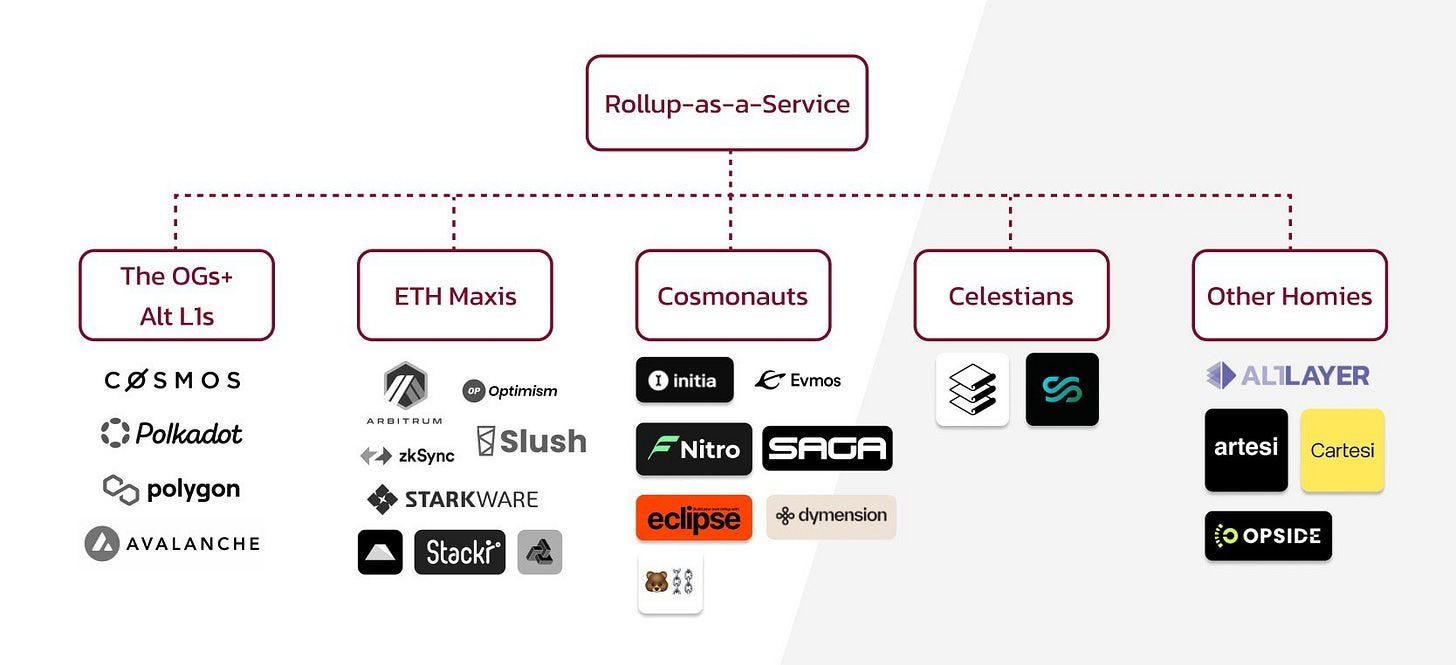
In 2024, the Layer 2 ecosystem will develop towards multi-chain interoperability and service-oriented development. Optimism has achieved efficient collaboration and intercommunication between multiple L2 networks through the Superchain model, while zkSync is also developing cross-chain solutions to support seamless intercommunication of assets and data between different networks. Other mature L2s, including Polygon ( Polygon CDK ), Arbitrum, Starkware, etc., have also promoted large-scale adoption by providing or announcing the open source of their proprietary technologies.
(Source: 0xjm Blog )
On this basis, RaaS (Rollup as a Service) providers have emerged. RaaS providers simplify the operation process of the Rollup chain and provide developers with one-click access or creation of Rollup services, including node operation, infrastructure management, sorting, indexing and analysis functions. Representative projects include:
- Conduit and Nexus Network: Connect to Optimistic Rollups (such as Optimism and Arbitrum);
- Truezk and Karnot: Focus on zk-Rollups technology stack;
- Caldera and AltLayer: Providing integration services across Optimistic and zk-Rollups.
These services significantly lower the technical threshold for developers, promoting the rapid expansion of the L2 ecosystem and the enrichment of application scenarios.
2.3 Bitcoin Inscription and the Outbreak of L2
In 2024, Bitcoin Inscription and Bitcoin Layer 2 (L2) tracks showed completely different development trends: the popularity of the Inscription protocol quickly faded after the initial boom, while the Bitcoin L2 track showed growth potential, but the overall market size was still relatively limited.
Bitcoin inscription:
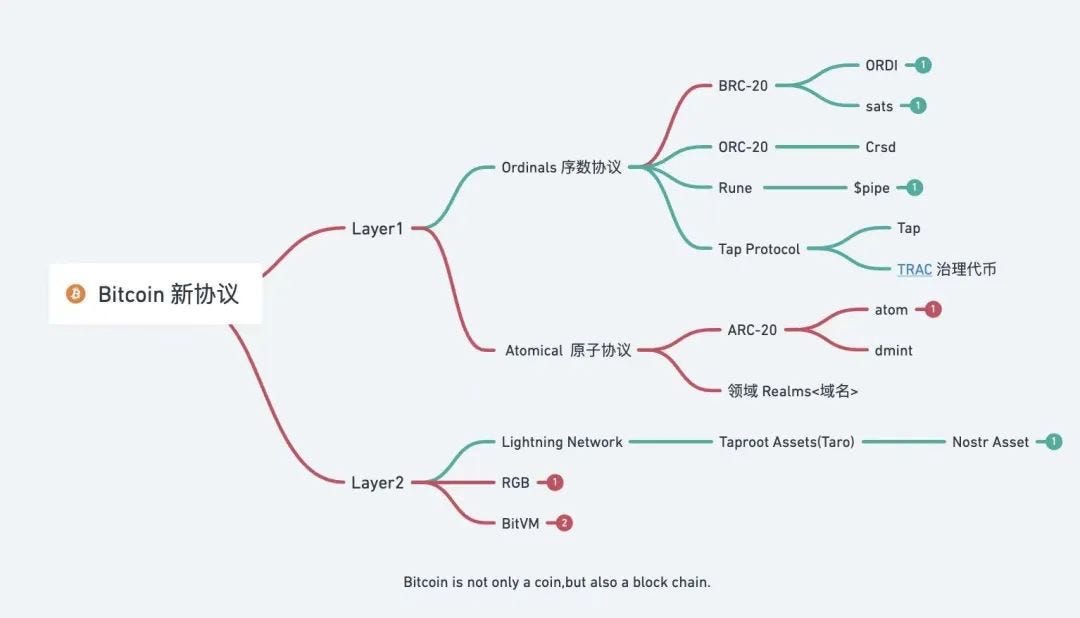
Thanks to Bitcoin's progress in key technologies (such as SegWit, Bech32 encoding, Taproot upgrade and Schnorr signature), the transaction efficiency, scalability and programmability of the Bitcoin network have been significantly improved. These technological innovations provide a technical foundation for the explosion of the inscription ecosystem and have spawned a series of inscription protocols, including Ordinals & BRC20, Atomical & ARC20, Rune & Pipe and Taproot Assets.
However, the growth momentum of the Bitcoin inscription ecosystem has gradually slowed down in 2024: although the inscription infrastructure (such as wallets, asset issuance platforms, and cross-chain bridges) has made some progress at the technical level, the transaction volume and user activity of inscription assets have dropped significantly. Binance’s recent decision to withdraw from the inscription market further reflects the current dilemma of this track. The inscription protocol has failed to continue to attract market enthusiasm, and the ecological development has stagnated. Whether its narrative can be revitalized in the future remains to be seen.
Bitcoin L2:
With the outbreak of Bitcoin inscription ecology, the growth of asset trading and cross-chain demand for various inscription assets has indirectly promoted the development of Bitcoin L2 ecology. Compared with Ethereum, BTC L2 track started late, but in 2024, a number of traditional and emerging L2 projects emerged, trying to promote Bitcoin ecology into the field of decentralized finance (DeFi) and smart contracts through scalability solutions.
- Continued development of traditional L2 projects: Old projects such as Lightning Network, Stacks, Rootstock, Liquid Network, etc. have gradually expanded to a wider range of application areas such as payment, DeFi, and cross-chain asset management by optimizing infrastructure.
- Emergence of new BTC L2 projects: With the help of Ethereum EVM technology, new Bitcoin L2 projects such as BitVM, Bsquare (B² Network), Bitlayer, BEVM, BounceBit, DLC, BOB, Botanix, etc. have emerged one after another. According to L2 Watch statistics, there are currently 50+ BTC L2 projects on the market.
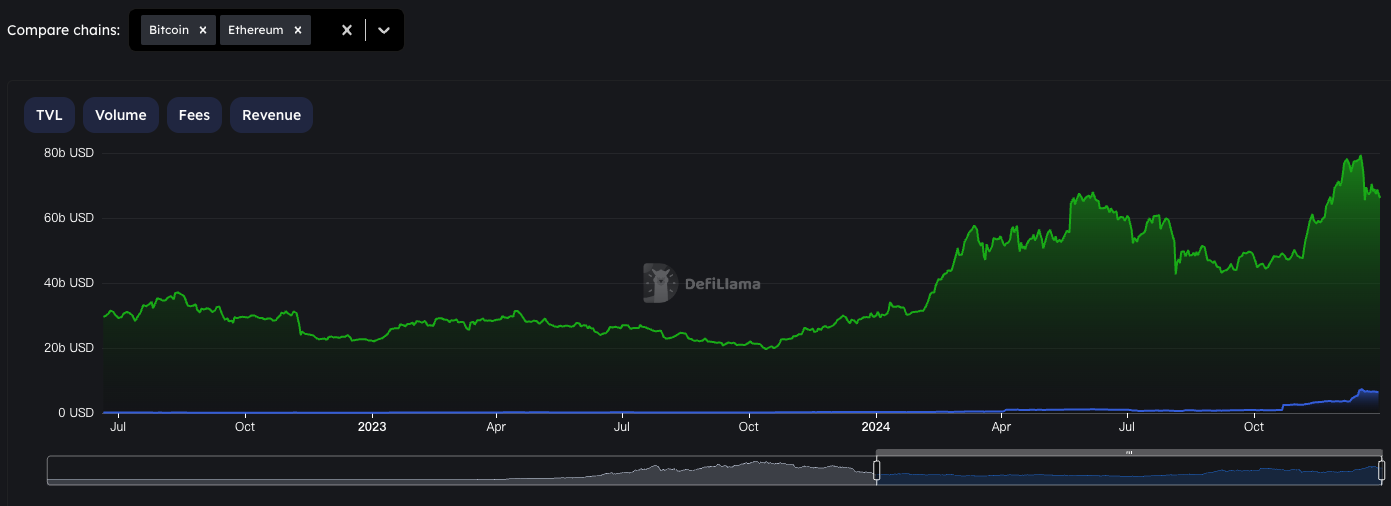
Although the Bitcoin L2 track has made some progress in technology development and the number of projects, its market performance is still limited. By the end of 2024, the total value locked (TVL) on the Bitcoin chain will grow to approximately US$6.372 billion, but compared with the TVL of US$66.11 billion on the Ethereum chain, the gap is still obvious. In addition, there are few BTC L2 projects that can achieve breakthroughs in market voice, asset size, and user base. Currently, projects with on-chain TVL exceeding US$100 million include Bitlayer, BSquared, Rootstock, BOB, Merlin, and Stacks. Popular BTC DeFi protocols include Babylon (TVL exceeding US$5 billion), Solv Protocol (on-chain TVL exceeding US$1 billion), and Avalon Labs.
2.4 MemeCoin Track Explodes
In 2024, the outbreak of MemeCoin is the strongest narrative driver in the crypto market. As the MemeCoin market continues to expand, they have transformed from an early meme culture hype tool to an important narrative track and market trend in the crypto market, becoming an important force driving the development of the crypto industry.
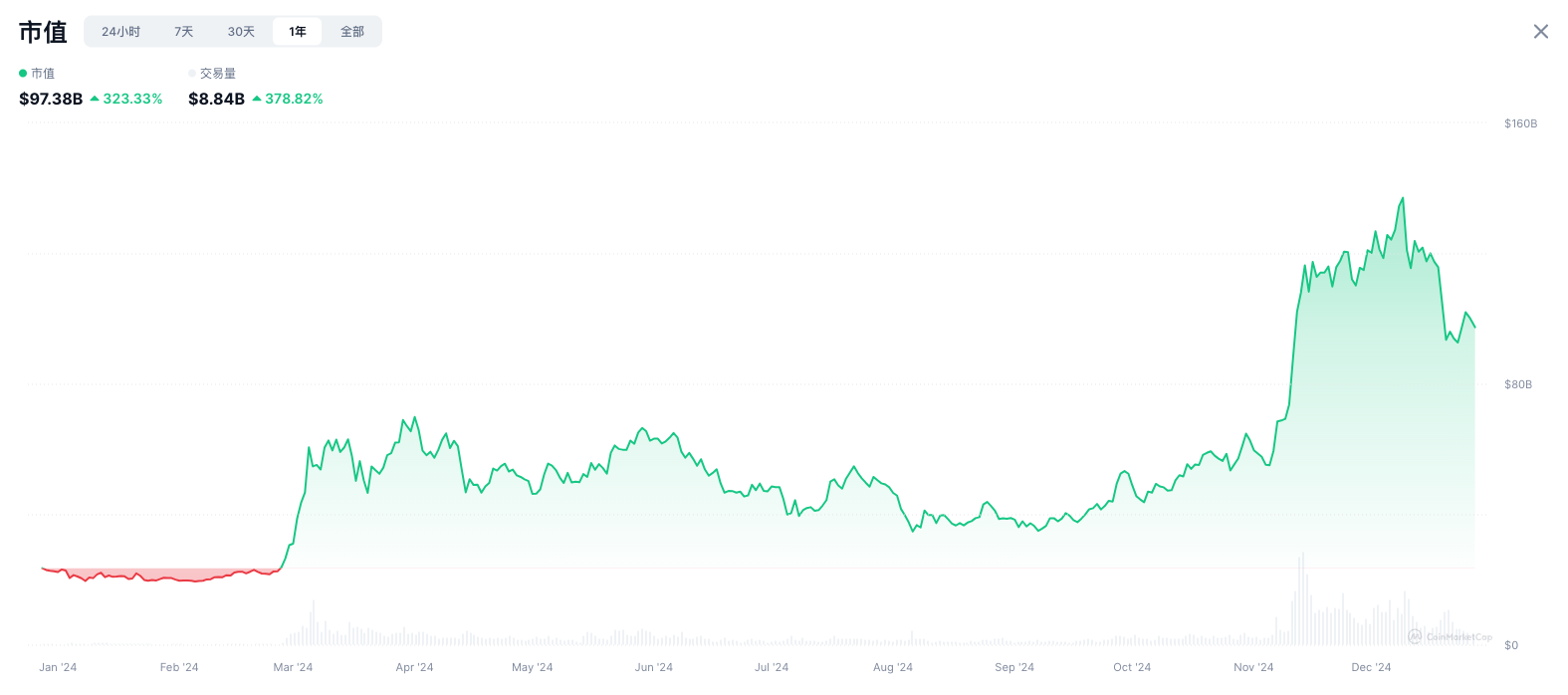
According to CoinMarketCap data, the total market value of the entire MemeCoin market has reached $9.738 billion , accounting for about 2.8% of the total market value of the entire cryptocurrency market (US$3.37 trillion). More strikingly, MemeCoin's trading volume continues to account for 6-10% of the share, showing the most concentrated liquidity and trading activity among all crypto tracks.
Unlike traditional crypto projects that are mainly driven by technology or products, the core of MemeCoin lies in its cultural narrative and community promotion. These tokens have no complex technical support or actual product applications, and their value mainly comes from the attention economy and cultural symbolism. The fluctuation of MemeCoin prices is completely dependent on speculative demand and market sentiment, making it more like a social game or speculative lottery.
MemeCoin can completely explode and become the mainstream narrative of the market in 2024. In addition to the overproduction of Altcoins and the falsification of its narrative logic, the lack of sustained narrative hotspots in the overall market, and the lack of market recognition of institutional coins (high FDV, low circulation), the main reason is the development of MemeCoin infrastructure.
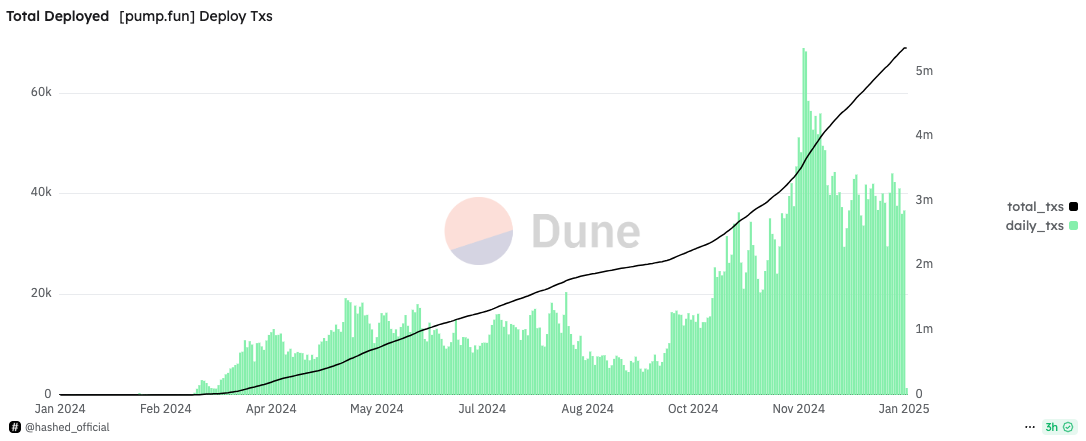
In 2024, the MemeCoin fair launch platform led by Pump.Fun completely reshaped the MemeCoin market landscape. Pump.Fun greatly simplified the process of creating and trading Memecoin on the blockchain through simple token creation tools, dynamic pricing curves and liquidity mechanisms, and promoted the democratization and community of MemeCoin creation. As of the end of 2024, the Pump.fun platform has deployed more than 5 million MemeCoins, with cumulative revenue exceeding US$400 million, becoming the most profitable and successful Web3 application in 2024.
In addition to the Meme launch platform, TG trading robots (Maestro Bot, Unibot, BananaGun, etc.), decentralized wallets (such as Ouyi Web3 Wallet) and market software tools (such as GMGN, DEXTools, DEX Screener, moonshot, etc.), these three types of products make it easier for users to find smart money on the chain and discover potential MemeCoin thresholds, simplify the transaction process, and promote the MemeCoin craze.
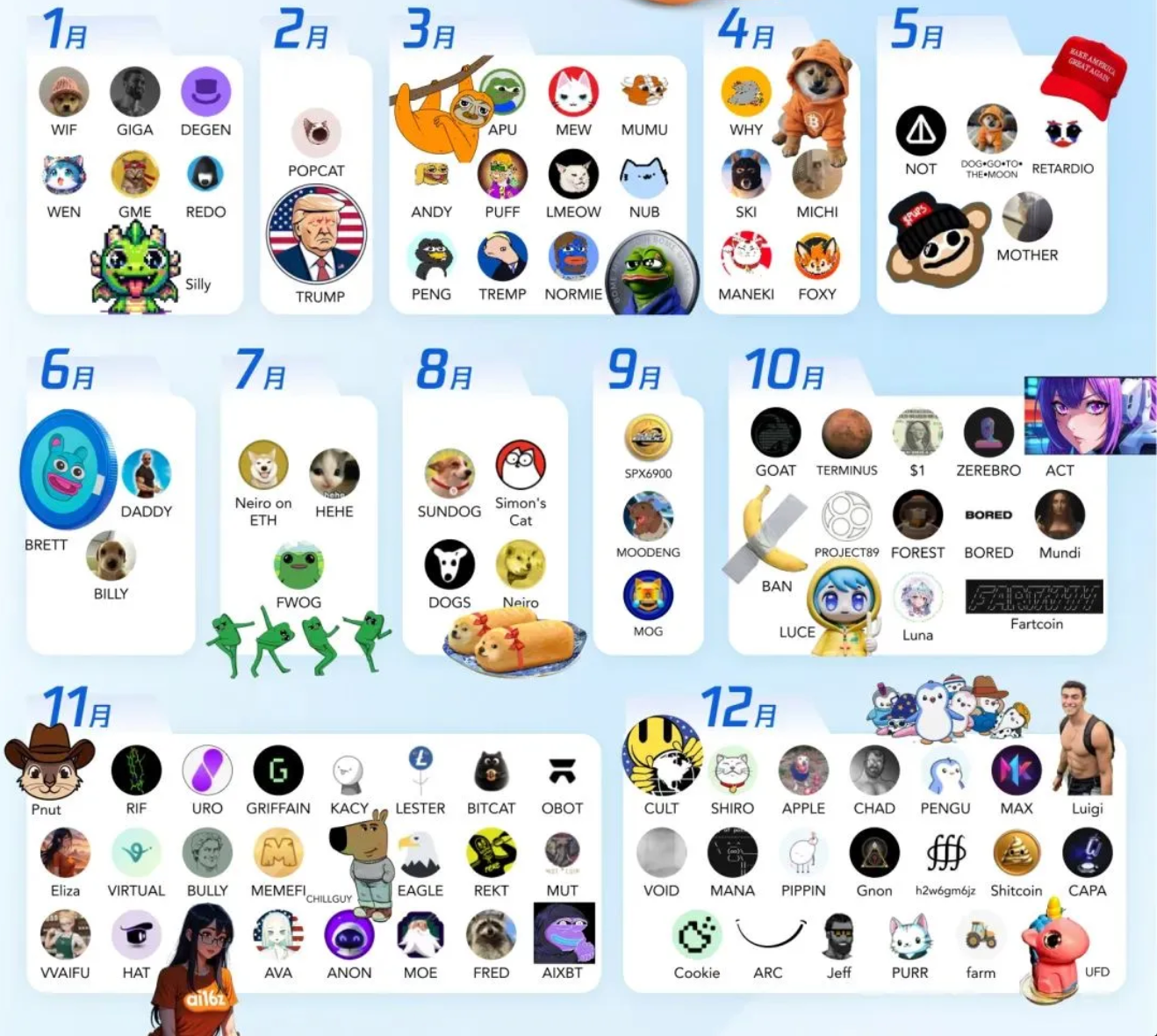
In 2024, a series of popular tokens emerged in the MemeCoin track, forming a market boom and wealth effect. The popular MemeCoins include $MEW, $NEIRO, $GOAT, $MOODENG, $PNUT, $ACT, $POPCAT, $TERMINUS, $PAC, $DEGEN, $SPX, $CHILLGUY, etc. These tokens not only created huge profits for early investors, but also became a hot spot for community participation and discussion.
(By PANews Media Production)
2.5 AI+Blockchain
In 2024, the artificial intelligence (AI) industry continues to develop rapidly around the world. The maturity of large model technology, the widespread application of multimodal AI, and the commercialization of generative AI have injected new vitality into various industries. In this context, the combination of AI and Web3 has become a hot spot in the emerging field, bringing new narrative driving force and investment opportunities to the crypto market.
In the Web3 field, AI and Web3 are further integrated. There are at least 200+ Web3 + AI concept projects in the industry, covering infrastructure, data, prediction markets, computing and computing power, education, DeFi & cross-chain, security, NFT & games & metaverse, search engines, social & creator economy, AI chatbots, DID & messaging, governance, medical care, trading robots and many other directions.
In summary, there are four major types of AI tracks in the Web3 field:
- AI infrastructure: including AI public chain infrastructure and computing power resource network, providing basic services and resource support for AI applications. AI public chain infrastructure includes Near, Olas, Cortex, Fetch.ai, etc., while computing power resource network includes Filecoin, Render Network, Io.net , Aethir, Grass, etc.
- Web3 + Data/Model + Market/Network/Protocol: Through decentralized incentive mechanisms and blockchain technology, a decentralized AI data, model and network market is built to break the monopoly of traditional resources and allow more participants (small and medium-sized enterprises and individuals) to have the opportunity to enter and contribute resources to the AI ecosystem. Typical cases include: Bittensor is a decentralized AI model market that allows developers to earn rewards by contributing and optimizing AI models; Ocean is a decentralized data market that allows data assets to be tokenized and traded through blockchain and smart contracts; NEAR Tasks officially released by NEAR is an artificial intelligence annotation platform based on blockchain; Measurable Data (MDT) is a decentralized data exchange economic system that aims to provide a blockchain-based data economy where data providers and data buyers can trade data securely and anonymously; Cortex is a decentralized AI platform that supports distributed training and reasoning of AI models.
- AI + Application Layer: Relying on AI technology and resources, we build AI + Dapp application projects in on-chain data, chain games, social networking, NFT, creator economy, DeFi, etc., and use AI to empower smart contract decision-making and execution to better meet users' intention-based needs and new experiences. Typical cases include: on-chain AI data analysis project Arkham, AI chatbots (Myshell, CharacterX), AI search engines (Kaito, Pulsr, QnA3, Typox AI), AI creator platforms (LiveArt, Art Blocks, Bottto), etc.
- Web3 AI Agent: AI Dapps that integrate AI with Web3 crypto economy, including AI Agent Framework (ai16z & Eliza, Zerebro, ARC, Swarms), AI Launchpad (VVAIFU, Virtuals, Clanker, HOLD), Web3 AI Agent (AIXBT, ACT, LUNA, Degenai), AI Meme (GOAT, Turbo, Fartcoin, CHAOS, ANON), etc.
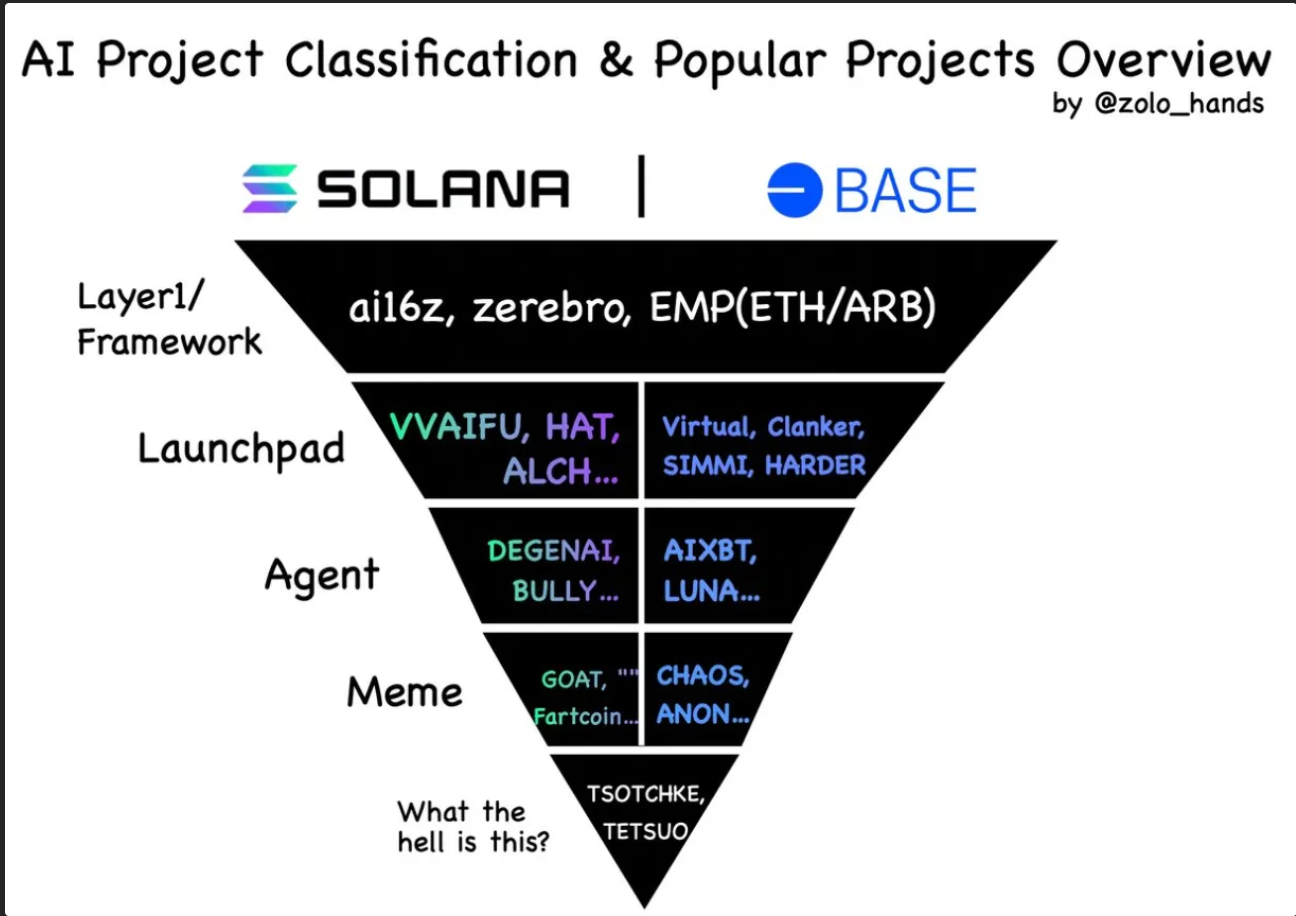
Among these four categories, the computing power resource network in AI infrastructure has been developed this year. Computing power resource projects including Io.net , Ather, and Grass have been launched one after another this year to provide support for AI development resources.
Web3 AI Aget has developed most rapidly, starting with the emergence of AI Meme coin GOAT. The subsequent AI Agent framework ai16z & Eliza has gained a massive amount of attention. Its token $ai16z has a market value of more than $20B through DEX liquidity alone without being listed on a large exchange, raising the market value and influence of AI Agent. In addition, with the support of AI Launchpad, many AI Agent Tokens have been released, triggering a wave of market speculation.