While most people are still discussing how AI will change the world, some have already achieved financial freedom by using ChatGPT templates.
This AI rags-to-riches story belongs to two Gen Zers - 18-year-old Zach Yadegari and 23-year-old Blake Anderson.
Last April, the two young men created a calorie-tracking AI app called Cal AI. The product's functionality is very simple - it can identify the calorie content of food through photos.
Surprisingly, Cal AI showed an incredible money-making ability as soon as it was launched.
One month after its launch, Cal AI's monthly revenue exceeded $1 million and continued to grow. By the end of last year, Cal AI's ARR reached $8 million.
The success of Cal AI was not a coincidence. This has happened twice before.
Before creating Cal AI, Anderson had already developed two other AI applications: the dating assistant Plug AI and the fashion assistant Umax.
The former earned $2.28 million, and the latter earned $6 million.
Even more astonishingly, Anderson has no programming knowledge, and the products were developed using no-code tools based on ChatGPT.
With these three products, Anderson's personal net worth has already exceeded $10 million.
So, how did Cal AI achieve such success?
Two points that outperform competitors: AI image recognition to track calories, with an accuracy rate of 90%
Before developing Cal AI, Zach had already made a judgment:
"Cal AI-type calorie-tracking applications can quickly become popular on social media."
The reason for this judgment was his deep insight into the trend of healthy eating.
In the past two years, healthy eating has become a consensus among Europeans and Americans, and calorie tracking is the most common method.
On TikTok, the "calorie counting" topic tag has accumulated 147 million posts. Some European and American companies have even directly integrated calorie-tracking applications into their employee health programs.

▲ Calorie-related searches on Instagram
Desire comes first, and the product demand follows. Among fitness and diet-related applications, calorie-tracking applications like Cal AI are at the forefront, with some even having over 200 million registered users.
Furthermore, mainstream wearable devices like the Apple Watch have also added calorie-tracking functions.
Obviously, Cal AI is not the first to do calorie tracking, so why was this product able to stand out?
This is due to two differentiating design features:
First, Cal AI clearly focuses on the core need of calorie tracking and simplifies the application design.
Zach noticed that traditional applications are outdated and complex, with MyFitnessPal still stuck in the manual input era. So, when designing the Cal AI prototype, he abandoned the complex features of similar applications, such as sleep tracking and hydration, and focused on building a system around "taking photos to get a calorie report".

▲ Comparison of user interfaces between Cal AI and other competing applications
In simple terms, Cal AI can assess nutritional components solely through AI image recognition.
According to Zach's sharing on the official website, when opening Cal AI and taking a photo of food, the phone's depth sensor will calculate the volume of the food. Based on this information, the AI trained on thousands of food images will break down the user's meal into different parts, calculate their respective proportions, and instantly calculate the calories and nutrients.
This is why Cal AI has the slogan "Track your calories with just one photo".
What also sets Cal AI apart is data accuracy.
Cal AI's backend is powered by the ChatGPT model, which can iterate the model based on user feedback. According to their testing, Cal AI's recognition technology can generally achieve an accuracy rate of 90%. "This is more reliable than the nutrition labels on food packaging, which are allowed to understate calories by up to 20%," Zach said.

▲ Example of Cal AI's recognition
Of course, a good product alone is not enough. Cal AI also excels in marketing and commercialization.
Mastering TikTok marketing, achieving an ARR of $8 million in 7 months
Cal AI's rapid growth can be attributed to its successful marketing strategy.
Looking at Cal AI's marketing approach, there are three main ways: KOL marketing, paid advertising, and viral marketing:
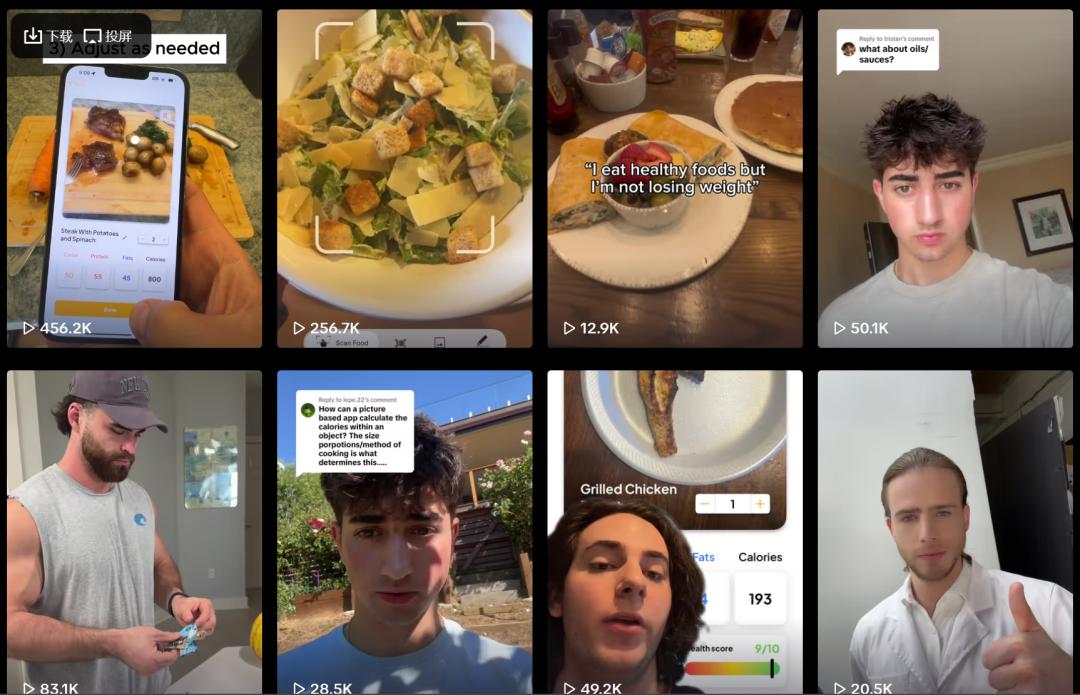
▲ The Cal AI founders created visually appealing videos for their initial promotion
①KOL marketing:
They selected health and fitness KOLs to collaborate with, using strategies like upfront payments and bundled video quantities to reduce costs. KOLs naturally integrated Cal AI ads into their lifestyle videos, while Zach's team managed the comments and guidance. (Sound familiar? It's practically the Little Red Book approach.)
③Paid advertising:
They tried various paid ad formats, including Facebook, Instagram, TikTok, and Apple Search Ads. Apple Search Ads can validate product competitiveness, with a daily ad spend of $7,000. Although the profitability of paid ads is not as high as KOL marketing, it is an important way to expand revenue scale.
③Viral marketing strategy:
Cal AI's photo-based calorie display feature has inherent virality. They planned to launch a free campaign during Thanksgiving to encourage user sharing. The team also developed internal marketing tools and released them on the viral.tech platform to help others with their marketing.
The above promotion methods allowed Cal AI to reach a wide audience at a very low marketing cost, quickly increasing its brand awareness and user engagement.
To better retain these users, Cal AI adopted a pricing strategy significantly lower than the market average.
For example, Cal AI has no free trial version, with a monthly fee of $10 or an annual fee of $30 (most users chose the annual payment), while health management products like MyFitnessPal have almost double the annual fee of $79.99.
Why is the pricing so affordable? Zach explained that Cal AI prioritizes user acquisition and market penetration over immediately maximizing revenue per user.
The excellent user growth strategy combined with the advantageous pricing allowed Cal AI to achieve remarkable commercial returns in a short period.
Developing two AI blockbusters without coding, earning tens of millions
You might think Cal AI is already impressive, but you may not know that this story has happened twice before.
Anderson, the other co-founder of Cal AI, had already launched two applications with over 1 million downloads - Plug AI and Umax - before developing this product.
Even more astonishingly, unlike Zach, Anderson has no programming knowledge, and the product development was entirely based on ChatGPT.
First, let's introduce the first application, Plug AI, which is an AI dating chat assistant.
Users can upload their conversation screenshots, and Plug AI will provide response suggestions. In the early stages of product development, the responses had an "AI flavor", but Anderson used ChatGPT to adjust the prompts and improve the output quality, making the responses more appealing.
Plug AI was launched on the Google Play Store in July 2023 and surpassed 1.5 million downloads in just four and a half months. Plug AI's monthly revenue reached $190,000, with a profit margin of 60%. To date, Plug AI has generated $4 million in revenue.
Anderson's marketing tactics are also quite unique. He only spent $100 to collaborate with two influencers, which brought 200,000 downloads in a week and $80,000 in first-month revenue, equivalent to a $200,000 economic value for those two videos.
He explained that he judged these two influencers to have a high active follower count, and the video views were highly correlated with the number of followers.
After the success of Plug AI, Anderson then launched a fashion application for men called Umax.
Umax promotes "male facial enhancement" and provides personalized style recommendations based on user-uploaded photos, using the GPT Vision (OpenAI's visual API) for image analysis.
Marketing, marketing, and more marketing.
To promote UMA, Anderson collaborated with fashion KOLs, such as the fashion blogger Sam Zia. The initial collaboration videos can bring thousands of downloads, and UMA's first-month revenue reached $100,000, with a stable monthly revenue of over $500,000 thereafter.
Since its launch at the end of 2023, UMA has accumulated over 15 million downloads and generated over $6 million in revenue.
As the founder of Plug AI, UMA, and Cal AI, Anderson's personal net worth has also exceeded $10 million.
Zach and Anderson's success tells us a truth:
In the wave of the AI era, the teams that can stand out may not necessarily be the deep-pocketed industry leaders. As AI gradually levels the technical gap, talent, creativity, and execution are the keys to competition.
This article is from the WeChat public account "Crow AI Talk", author: Lang Lang, authorized for release by 36Kr.