UNISWAP's official Twitter account recently announced that V4 is about to be launched. The biggest difference between V4 and V3 is the introduction of Hooks in V4. In simple terms, this means that users can customize their own DEX or other DeFi projects based on the basic framework provided by UNISWAP V4, which will lead to the emergence of a batch of new DeFi projects. Since all TVL is stored in the singleton contract of UNISWAP V4, the project parties do not control the TVL, so the security of Hook projects is higher and they can share liquidity.
The UNISWAP Foundation has recently provided a total of $1.2 million in Grants to 9 projects, which were interviewed and screened by their investment bank Areta (which helped UNISWAP acquire Genie and Sudoswap at a high price). The use of these Grants includes two aspects:
1. Full reimbursement of audit fees
2. Provision of legal assistance to open-source projects that implement BUSL v1.2. It is worth noting that BUSL v1.2 is more stringent than the self-use BUSL v1.1 of UNISWAP V4, because the following provisions have been updated:
Any entity that constructs the same or similar functionality using innovative key mathematical formulas or mathematically substantially similar formulas without authorization and declaration shall constitute an infringement of the relevant intellectual property rights. The "innovative key mathematical formulas" referred to here are mathematical methods or algorithms with originality, novelty and the ability to achieve specific DeFi functions.
Exceptions:
This statement does not apply to the following cases:
The mathematical formulas or algorithms used by existing decentralized finance (DeFi) projects;
Financial mathematics principles, theories, and methods that are already well-known to the public and widely applied or have been publicly published;
Cases of legal use, independent research and development, or legal authorization.
That is, not only is code-level forking an infringement of intellectual property rights, but forking at the principle level is also an infringement of intellectual property rights, unless it is declared on the homepage that the principles of these 9 Hook projects are used, further protecting the innovative leading advantage of UNISWAP V4 and its ecosystem.
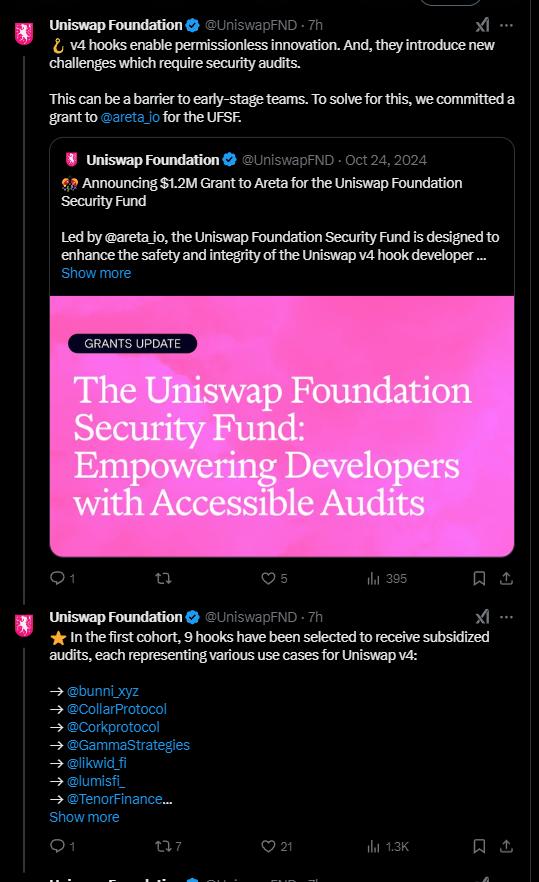
Now let's analyze these 9 projects and the potential airdrop opportunities one by one:
1. likwid.fi, this project is very interesting, it uses (x+x')*(y+y')=k to replace xy=k in web3, which simply implements spot leverage trading without audit and oracle, which means that in the future, meme coins can start leverage trading at the moment the pool is opened, including short selling. Its testnet UI is extremely simple, but from the documentation, the team's strength is deep, and around the simple function, they have successively realized the following functions:
(1) Spot Margin Trading, while everyone is rolling in the Swap and Prep tracks, likwid.fi is currently the only Margin Trading project.
(2) LP multi-yield, LPs not only have transaction fees, but also have lending income and liquidation penalties, which improves capital efficiency and yield.
(3) Truncated oracle, the innovation of the new price mechanism created by Uniswap in 2021 to defend against flash loan attacks and malicious price manipulation-induced liquidations on multiple DeFi projects using Uniswap prices as oracles, likwid is the first project to implement this mechanism, thereby defending against flash loan attacks and malicious price manipulation-induced liquidations.
(4) Structured liquidity, LP providers can choose whether their tokens are lent out.
(5) Dual liquidation mechanism, with a repayment-based liquidation mechanism and a simplified transaction-based liquidation mechanism, together ensuring timely liquidation.
(6) Anti-arbitrage and MEV variable fee mechanism, returning the MEV and arbitrage profits generated by liquidation to the LPs.
likwid's testnet is already online, and everyone can experience the first web3 unaudited leverage trading platform.
According to Twitter information, likwid also has an interesting V4 day 0 operation activity, as long as you add liquidity to the default pool of v4, and then confirm in the likwid wallet, you can get points, without taking any risk, and then complete the testnet tasks to get double the points, everyone can pay attention to it.
2. bunni, a version based on V3 already exists, and the V4-based bunni will provide other functional form Liquidity Density Functions (LDFs), its token LIT has been launched, and there is an opportunity to stake V4 to obtain LIT, but currently the annualized yield of pool 1 is generally less than 2%, and the annualized yield of pool 2 is less than 30%, the returns are low, and the staking cost performance is not high.
3. collarprotocol, an a16z crypto and Orange DAO incubated decentralized lending protocol, aims to provide lending services through market makers rather than liquidators. It uses a financial protocol called "Prepaid Variable Forward" to allow borrowers to eliminate the risk of being liquidated by setting a potential profit ceiling, a transaction structure similar to the collar option strategy, hence the name Collar Protocol.
Borrowers connect with market makers through Collar's on-chain RFQ process, and after reaching an agreement, the market makers create quotes on-chain, and the borrowers accept them, with both parties providing collateral as needed. This is called "just-in-time liquidity supply". Market makers need to hedge the collateral themselves to eliminate liquidation risk.
Main features:
(1) High Loan-to-Value (LTV): Collar offers industry-leading loan-to-value ratios, allowing users to borrow a higher percentage of the value of their assets.
(2) Full Collateralization: Market makers pre-provide collateral, if the asset price goes up, they will bear the loss; if the asset price goes down, they will make a profit.
(3) Asset Agnostic: Users can borrow any asset provided by market makers.
(4) Credit Agnostic: No need to worry about default risk or counterparty risk.
Collar Protocol's investors include Z Fellows, Arbitrum Foundation, Druid Ventures, Orange DAO, Nailwal Fellowship, Mac Venture Capital, Long Run Capital, a16z Crypto Startup Accelerator (CSX), J 17 Capital, Fun.XYZ, E V3, L2 IV, Wilson Sonsini, MH Ventures, as well as angel investors from Orange DAO, Harvard University, and Goldman Sachs.
Collar Protocol is currently in private testing and will not launch with V4's day 0.
4. Cork is also an a16z crypto and Orange DAO incubated decentralized insurance protocol, aimed at providing risk pricing and hedging tools for stablecoins and liquidity-pledged tokens in decentralized finance (DeFi). Its core product is Depeg Swap, a new financial primitive that allows investors to hedge and trade the de-pegging risk of their stablecoins.
Cork uses its custom Automated Market Maker (AMM) model to allow users to trade between Depeg Swap and Cover Token. This AMM uses a Yield Space curve to ensure prices gradually stabilize as maturity approaches, and provide flexibility in the event of a de-pegging event.
Main functions include:
(1) Depeg Swap: This is a tool that allows users to hedge the de-pegging risk of stablecoins. Through Depeg Swap, users can exchange between the stablecoin and the underlying asset at a 1:1 ratio, protecting the value of their assets in the event of a de-pegging event.
(2) Cover Token: Holders act as risk underwriters and can receive all assets in the Peg Stability Module upon protocol maturity. This provides risk premium returns for underwriters, while providing protection for Depeg Swap buyers.
(3) Peg Stability Module: This module receives the underlying asset (such as ETH or USDC) and creates Depeg Swap and Cover Token. It acts as the core of the protocol, ensuring the stability and liquidity of the stablecoin.
(4) Liquidity Vault: Users can deposit the underlying asset into the Liquidity Vault to provide liquidity, mint and sell Depeg Swap, and collect fees from the system. This provides yield for liquidity providers while lowering the cost of obtaining Depeg Swap protection.
In September 2024, Cork received support from well-known investment institutions including Andreessen Horowitz (a16z), IDEO Ventures, OrangeDAO, Outliers Fund and Steakhouse Financial.
Cork is currently conducting its second testnet trading competition to prepare for the mainnet launch. According to Twitter information, the team does not have a V4 day 0 operation activity.
5. Gamma Strategies is a limit order hook that allows users to earn maker fees when their limit orders are executed. It is a utility-type hook related to swaps and is not expected to issue a token.
6. Lumis can create synthetic ETH and synthetic stablecoins with dynamic impermanent loss hedging functionality. It is expected to launch with Uniswap v4 day 0, but the project is relatively small, with only 900 Twitter followers.
7. Tenor is a decentralized lending protocol that aims to enable peer-to-peer fixed-rate lending through a fully on-chain interest rate order book. Tenor's architecture supports on-chain interest rate order books, allowing users to trade rates in a manner similar to Uniswap trading prices. The order book natively supports limit orders, enabling borrowers and lenders to transact at a specific rate before maturity, reducing rate slippage and lessening dependence on liquidity providers.
Tenor's testnet is currently live, but it is unknown whether it will launch with Uniswap v4 or include staking incentives.
8. Paladin is a decentralized governance protocol that aims to unlock the value of DeFi through governance rights and the market. Its main product, Quest, allows users to earn rewards by voting for specific liquidity pools (Gauges) in ecosystems like Curve, Balancer, and Bunni. Users holding CVX, AURA, and LIQ tokens can also delegate their voting power to Paladin to maximize their earnings across all incentivized platforms.
Key features:
(1) Quest tasks: Users can participate in Quests by voting for specific liquidity pools to earn rewards. Before voting, ensure your voting power is available, and previous votes have been removed from the respective pools (there is a 10-day cooldown between votes). Voters can split their voting power to vote for multiple pools and earn rewards from multiple Quests.
(2) Voting delegation: To simplify the process of earning and claiming voting rewards, Paladin has set up a delegation address to optimize bribery earnings. This is beneficial for passive voters seeking to earn rewards. Voters holding vlCVX, vlAURA, or vlLIQ can delegate their voting power to Paladin to optimize their votes across all incentivized platforms.
(3) Governance participation: Paladin's governance votes are currently conducted through Paladin's Snapshot space. To create a proposal in this space, your address needs to be delegated to hold 5% of the circulating PAL. The quorum is 15% of the circulating supply.
Since the PAL token has already launched with a clear emission schedule, there are no potential airdrop opportunities.
9. Unicord: Integrates and maximizes the yields of stablecoin pools through lending protocols. The testnet has not yet launched, and there is no official website link available.
In the current context of the overall EVM ecosystem being in a slump (Solana's monthly transaction volume has surpassed $200 billion, exceeding the total of all EVMs), the EVM ecosystem is in urgent need of Uniswap v4-level Web3-native hardcore innovation to prove that the EVM ecosystem is the industry's innovation leader. There is a sense of mission, with the 'big EVM 8 chains and 24 L2s all relying on Uniswap' to carry the burden. Therefore, all major EVMs, whether L1 or L2, may take significant actions to coincide with the launch of Uniswap v4.
Meanwhile, the Trump family has launched a decentralized finance (DeFi) project called World Liberty Financial (WLFI) and has made significant purchases of ETH and other DeFi tokens. These initiatives may trigger an explosion in the modular DeFi industry narrative. The 9 hook projects mentioned, having been carefully selected by the Uniswap official, are highly likely to generate several significant alpha opportunities, so it is recommended to follow them closely.