Singapore is a leading country in the adoption of blockchain technology and cryptocurrencies. Its supportive regulatory environment, clear legal guidance, and strategic position as a global financial hub make it an attractive destination for cryptocurrency businesses and innovation.
BeInCrypto interviewed Alex Svanevik, the CEO and co-founder of Nansen, a Singapore-based blockchain analytics company, to understand why Singapore is considered one of the most crypto-friendly countries in the world.
Singapore, World's Top Blockchain Innovation Hub
Countries that prioritize investment in talent, infrastructure, and regulation are positioned to lead digital innovation and reshape global industries.
In 2024, the Apex report named Singapore as the top country in blockchain and cryptocurrency technology, scoring it 85.4 out of 100. This country has over 2,400 blockchain-related jobs and 81 cryptocurrency exchanges, demonstrating a strong focus on developing talent and infrastructure.
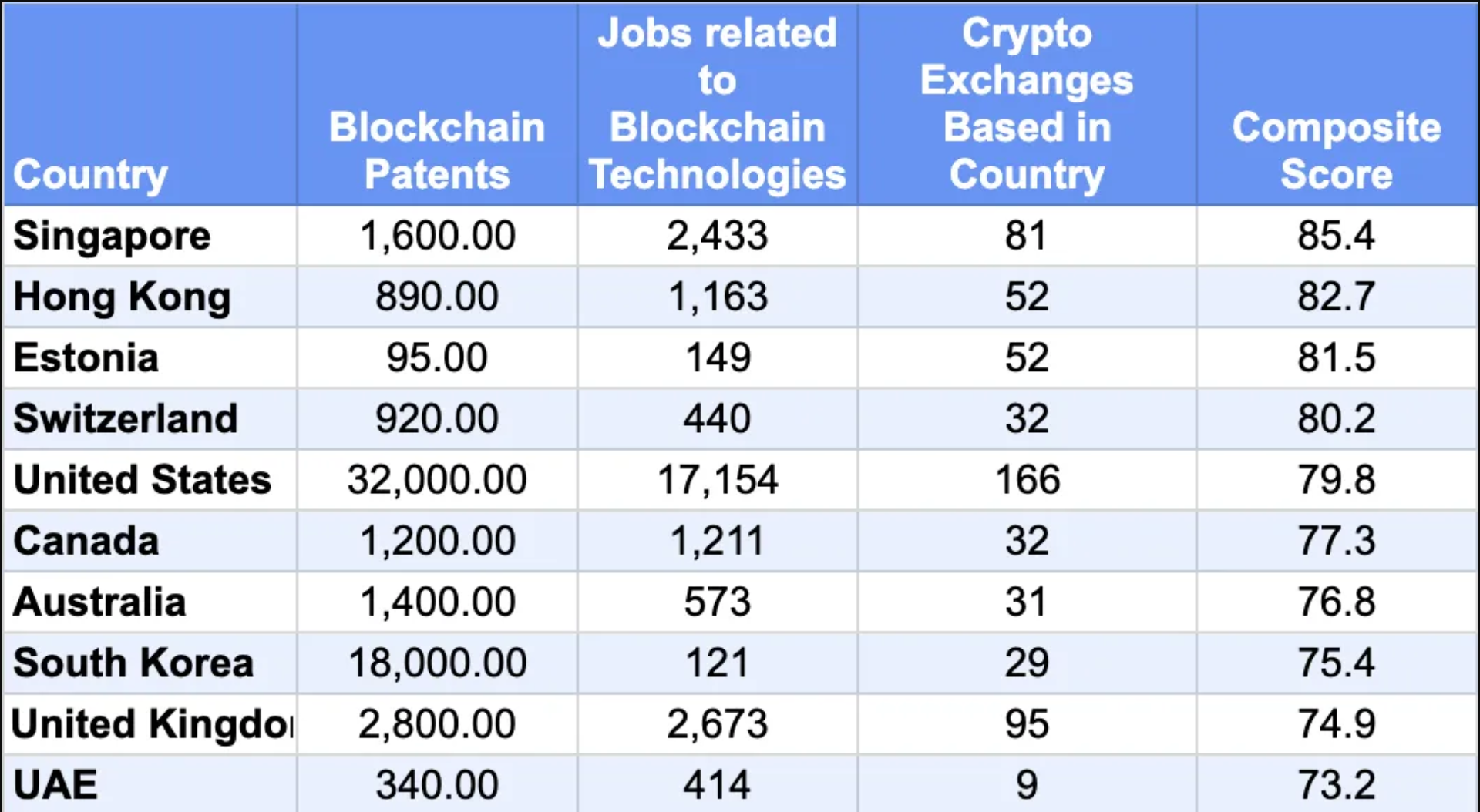
The study evaluated countries based on a composite index considering factors such as blockchain patents, job growth, and the number of cryptocurrency exchanges.
"Singapore has emerged as a global leader in the cryptocurrency space due to its progressive regulatory framework, innovation-friendly policies, and strong government support for blockchain technology. Clear legal guidance on digital assets, favorable tax regimes, and active collaboration with industry stakeholders have created an environment conducive to cryptocurrency businesses and blockchain innovation," said Svanevik.
The country's reputation as a global financial and fintech hub has attracted international cryptocurrency companies and investors seeking stability and growth opportunities.
Balanced Regulatory Approach
A key aspect of Singapore's success is its regulatory framework that promotes innovation without compromising consumer protection.
In 2019, Singapore introduced the Payment Services Act (PSA), a comprehensive licensing scheme for Digital Payment Token (DPT) service providers.
This act covers cryptocurrency exchanges and wallet providers, strengthening consumer protection within the financial sector, preventing terrorist financing, and enhancing cybersecurity measures.
Alongside this law, the Monetary Authority of Singapore (MAS) requires detailed inspections on Anti-Money Laundering (AML) and Countering the Financing of Terrorism (CFT). Businesses must demonstrate robust cybersecurity practices.
"This risk-adjusted framework fosters technological advancement while ensuring financial security and integrity," said Svanevik to BeInCrypto.
These regulatory measures set nationwide guidelines, enabling investors and consumers to adopt cryptocurrencies with confidence.
Driving Innovation through Consumer Protection
Singapore has also gained a reputation for prioritizing consumer protection, safeguarding users from security threats and fraudulent activities.
Cryptocurrency businesses must comply with consumer protection laws to operate in the country.
"Singapore prioritizes consumer protection within the cryptocurrency sector through strict regulations. MAS requires DPT service providers to implement robust security protocols and conduct thorough customer due diligence. The Singapore Police Force collaborates with MAS to actively monitor and respond to fraud activities related to digital assets," Svanevik explained.
In November 2023, MAS announced plans to implement more stringent regulations for DPT providers. These regulatory changes required service providers to adjust their operations and business practices to align with the new regulatory framework.
MAS implemented these new regulations in two phases. The first phase, which came into effect in October 2024, focused on customer asset protection, disclosure, and risk management controls.
The second phase is scheduled to be rolled out six months later.
"From June 19, 2025, cryptocurrency companies will be required to conduct risk awareness assessments for retail customers to ensure informed decision-making under the new regulations," said Svanevik.
Notably, these regulations prohibit licensed companies from offering incentives to attract retail customers. Considering the inherent volatility of the cryptocurrency market, the use of leverage or derivative contracts with cryptocurrencies as the underlying asset is restricted for retail investors.
Cryptocurrency companies must conduct risk awareness assessments for all existing retail customers before the implementation of the second regulatory phase, a prerequisite for continued service provision.
Favorable Tax Regime
Singapore's flexible tax regime provides significant advantages for cryptocurrency investors and businesses.
A notable feature of Singapore's tax system is the absence of capital gains tax. In many countries, profits from the sale of cryptocurrencies can be subject to capital gains tax, significantly impacting investor returns.
Singapore's tax laws distinguish between personal investments and business activities. This system exempts individual cryptocurrency investments from capital gains tax, providing a more favorable tax environment for individual investors. However, this exemption does not apply to business activities related to cryptocurrency trading.
Similarly, Singapore exempts digital payment tokens, such as Bitcoin and Ethereum, from the standard 8% Goods and Services Tax (GST) on transactions.
Here is the English translation of the text, with the specified terms retained and not translated:This exemption makes Singapore an attractive destination for cryptocurrency businesses, including exchanges, wallet providers, and other companies operating within the digital asset ecosystem, by significantly reducing the tax burden on cryptocurrency transactions.
Singapore's tax regime also applies a relatively low corporate tax rate to businesses.
"The competitive 17% corporate tax rate supports the growth of cryptocurrency startups and blockchain companies, positioning Singapore as a global innovation hub." - Svanevik, BeInCrypto.
For reference, the corporate tax rate in the US is 21%. Another leading blockchain nation, Estonia, has a rate of 22%, while Korea's rate is 27.5%.
DBS Bank, a Key Player in Digital Asset Adoption
Singapore's DBS Bank has played a crucial role in creating a national platform for digital token trading.
In 2020, DBS launched the DBS Digital Exchange (DDEx), becoming one of the first banks to provide institutional and accredited investors access to cryptocurrency and security token trading.
In September 2022, DBS expanded the reach of DDEx to its most influential 100,000 customers. The bank allowed accredited clients with a minimum of $246,000 in investable assets to buy, sell, and trade cryptocurrencies.
Two years later, DBS expanded its product offerings to include cryptocurrency options trading and structured notes for sophisticated investors. Eligible DBS clients gained broader access to digital assets, allowing them to hedge market volatility and potentially generate returns.
"DBS Bank's active involvement not only strengthens market credibility but also positions Singapore as a model that harmonizes traditional finance and emerging blockchain technology. This alignment of institutional finance and digital innovation sets a precedent for global banks to responsibly adopt and scale blockchain solutions." - Svanevik.
The bank also introduced the DBS Token Service, integrating blockchain solutions into core banking operations to simplify digital asset management. This program connects the bank's functionalities to an EVM-compatible blockchain, enabling tokenization and smart contracts.
In May, Nansen revealed in an X post that DBS Bank was likely the owner of a whale wallet holding 173,753 ETH, worth around $650 million at the time.
"This substantial holding underscores the growing institutional trust in digital assets and represents a significant shift as traditional financial institutions increasingly integrate cryptocurrencies into their core strategies." - Svanevik.
Given DBS Bank's expertise in cryptocurrencies, this fact was more of a revelation than a surprise.
Ongoing Initiatives
Singapore has continued to lead blockchain integration through several recent key initiatives.
In 2022, Singapore entered the decentralized finance (DeFi) space with a live test of digital asset trading through liquidity pools. This live trading, including tokenized deposits, marked the first industry pilot conducted under MAS's Project Guardian.
"MAS-led Project Guardian explores asset tokenization, enhancing financial market efficiency through collaboration with industry leaders." - Svanevik.
Last November, MAS announced the addition of five new pilot programs on asset tokenization as part of Project Guardian, a broader effort to develop ways to expand tokenized markets.
"The ongoing industry pilots are advancing asset tokenization across the financial sector, reinforcing Singapore's role as a blockchain innovation leader." - Svanevik
These five industry experiments will explore the potential of asset tokenization, aiming to facilitate the integration of the entire capital market value chain, including activities such as listing, distribution, trading, settlement, and asset servicing.
This week, the National University of Singapore (NUS) announced a pioneering initiative in collaboration with Northern Trust and UOB to tokenize green bond eligibility.
This initiative aims to enhance transparency, data integrity, and investor trust in sustainable investment practices by leveraging blockchain technology.
It also represents a significant milestone for NUS, becoming the first university in Singapore to utilize blockchain technology for environmental, social, and governance (ESG) reporting.
Public-Private Collaboration
Singapore is actively driving blockchain adoption across both the public and private sectors. - Svanevik
In late 2020, Enterprise Singapore (ESG), the Infocomm Media Development Authority (IMDA), and the National Research Foundation (NRF) launched the $12 million Singapore Blockchain Innovation Program (SBIP).
This industry-led initiative aimed to engage around 75 companies to develop 17 blockchain-related projects within the next three years, focusing on the trade, logistics, and supply chain sectors.
"The Singapore Blockchain Innovation Program (SBIP) fosters collaboration between government agencies, academic institutions, and private enterprises to strengthen blockchain capabilities." - Svanevik, speaking to BeInCrypto.
That same year, Singapore's MAS concluded Project Ubin, a five-phase collaborative project exploring the use of blockchain and distributed ledger technology (DLT) for payments and securities settlement, working with various financial institutions and industry participants.
In 2023, MAS developed the Orchid Blueprint, a strategic framework to build a safe and efficient digital currency infrastructure. This Blueprint outlines the key elements necessary for the safe and innovative use of digital currencies in Singapore, and emphasizes the value of collaboration between the central bank and the private sector, drawing on insights from previous industry experiments.
"Singapore's proactive approach to regulation, innovation, and collaboration establishes its position as a global leader in the cryptocurrency and blockchain ecosystem." - Svanevik
Singapore is likely to continue leading the global cryptocurrency and blockchain innovation rankings as it invests in infrastructure, establishes regulatory clarity, and provides government support.