Author:michaellwy
Compiled by: TechFlow
In my previous article, I proposed 10 trends and ideas about the potential development of the future prediction market. If you haven't seen it, here's a brief review:
Market trends towards short-term development: According to data from Polymarket, the average duration of prediction markets is 21 days, with a median of only 4 days, indicating that short-term predictions are more popular than long-term ones.
Modular dispute resolution mechanism: Future platforms may adopt a multi-tiered dispute resolution system, gradually achieving higher decentralization, and increasing the incentive mechanism for dispute resolution.
AI as a truth arbiter: Unlike optimistic oracles that rely on token holders' voting to determine the outcome, we can train specialized AI agents to focus on judging and determining the results of prediction markets.
AI agents participating in prediction markets: If we equip AI agents with the ability to manage wallets and execute transactions, they can actively participate in the trading and activities of prediction markets.
Specialization and segmentation of markets: The prediction market is no longer a "one-size-fits-all" model, and future platforms will be more specialized and optimized for specific domains.
Integration of insurance functions: When the transaction amount is relatively large, the insurance market will naturally emerge, as participants hope to mitigate risks through insurance.
Mobile-first interface: Future prediction market platforms will prioritize the design of mobile interfaces, focusing on both the intuitiveness of operations and user experience, while retaining advanced features.
Integration of yield-bearing stablecoins: Currently, idle funds cannot generate returns, while yield-bearing stablecoins (YBS) can provide interest income for users' idle funds.
Layered information market: The prediction market may develop into a layered structure, with the bottom-layer market predicting the results of specific events, and the upper-layer market interpreting and summarizing these predictions.
Conditional markets: Conditional markets allow users to bet based on certain preconditions (e.g., the occurrence of an event), providing more flexible "if-then" prediction tools.
In this article, I have compiled a list of 10 noteworthy prediction market projects. Some of these projects are actively developing the trends and features mentioned above, while others are exploring more innovative possibilities.
Let's dive in and take a closer look!
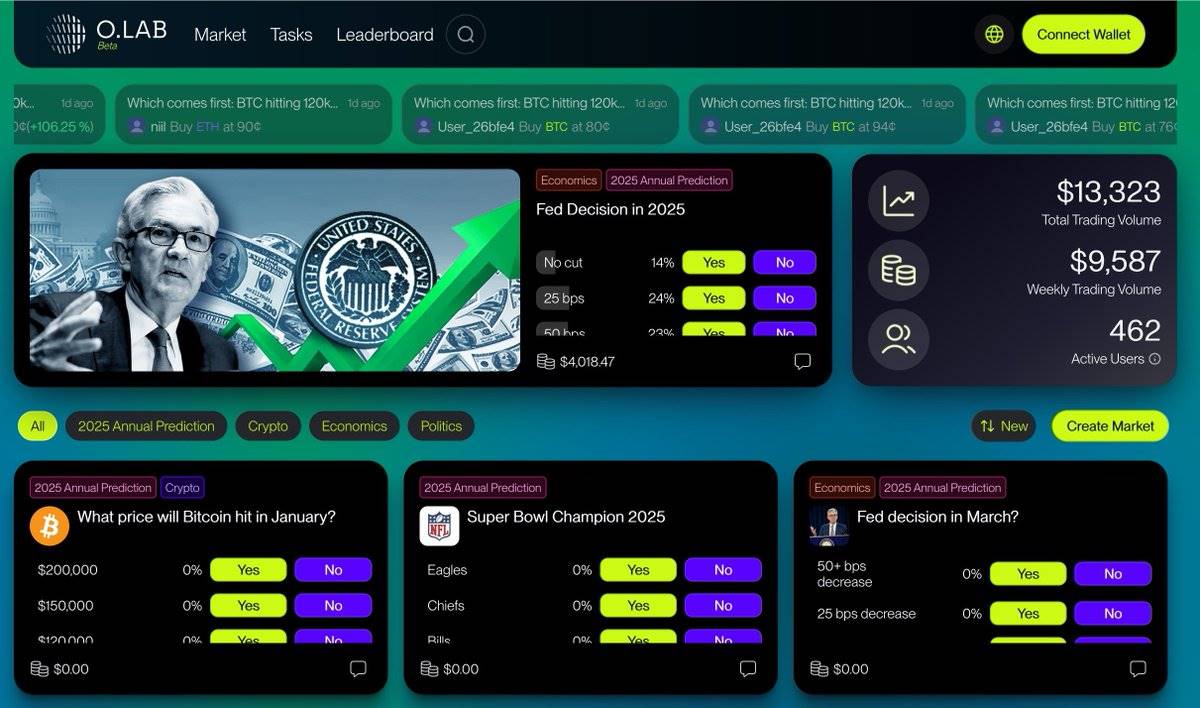
1. Opinion Protocol (@opinionlabsxyz)
Opinion Protocol is a decentralized platform where users can create markets without permission. The platform is supported by Binance Labs and aims to simplify the market creation process, improve price discovery efficiency, and provide a scalable infrastructure for decentralized applications (dapps).
Users can create prediction markets using any token, which makes Opinion Protocol more open to a diverse ecosystem compared to more centralized platforms.
Its consensus oracle verifies on-chain data through decentralized consensus and cryptoeconomic incentive mechanisms, and its design of randomly selecting jury members and giving each an equal vote effectively reduces the risk of 51% attacks.
2. True Markets (@Truemarketsorg)
True Markets combines news media with market sentiment, allowing users to bet on real-world events through prediction markets and using a multi-layer oracle system to determine the results.
The platform recently raised $4.03 million through a Patron NFT sale, with Vitalik Buterin purchasing 400 NFTs.
The system adopts a three-stage dispute resolution mechanism:
1) Initial disputes can be raised within 6 hours by paying a $250 deposit, resolved by the Oracle Council;
2) Further disputes require a $5,000 deposit, resolved by TRUE token holders;
3) Final disputes are adjudicated by 11 randomly selected "attestors" from a pool of 100 reputable individuals.
The platform aims to generate market-driven data points around news and events, and achieve higher decentralization and greater economic incentives through a tiered dispute resolution mechanism.
3. Tmr.news
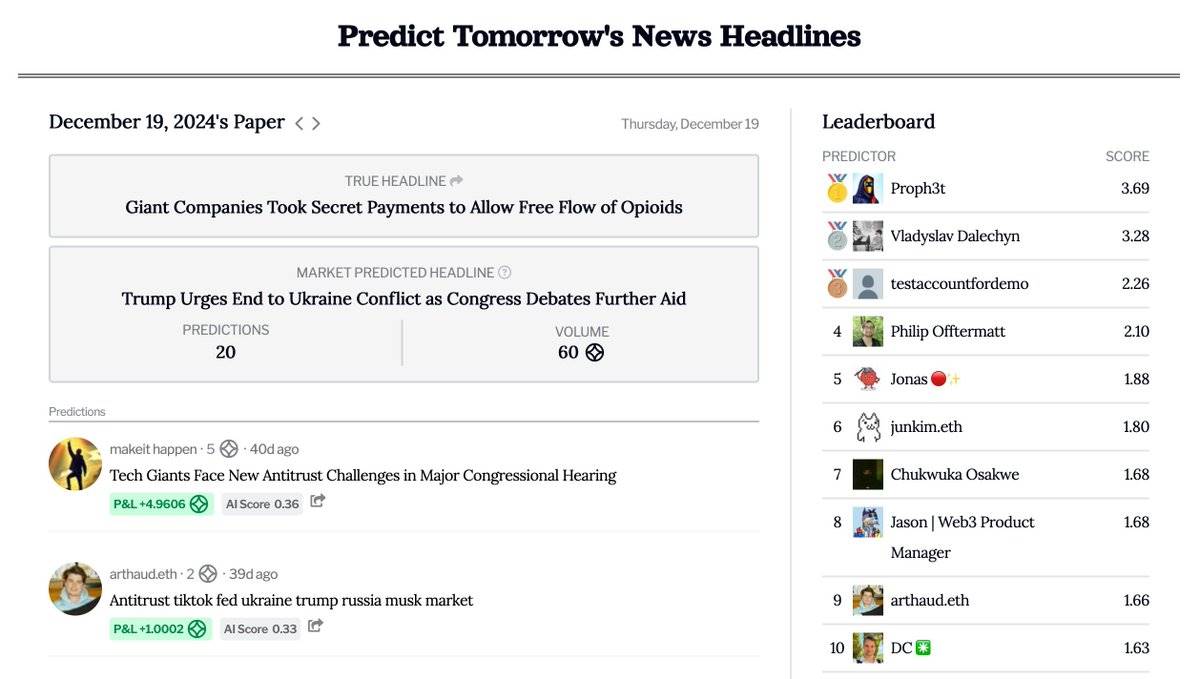
tmr.news is a prediction platform where users can bet on guessing the next day's front-page headline of The New York Times by submitting a one-sentence prediction.
Rewards are allocated based on the semantic similarity between the predicted and actual headlines, using a large language model (LLM) for evaluation. The market is resolved through blockchain-based cryptographic verification, ensuring transparency and trustless validation, and the platform is built on Base.
Reward redemption requires a 10% fee and standard Gas fees, providing users with a secure and innovative way to predict news.
4. Fr.market (@frdotmarket)
fr.market is a platform that gamifies music preferences, allowing users to bet on their predictions of other people's music preferences or music trends.
It uniquely combines music fan culture with game mechanics, creating an engaging and competitive environment where music enthusiasts can test their intuition and knowledge.

5. Bettensor (@Bettensor)
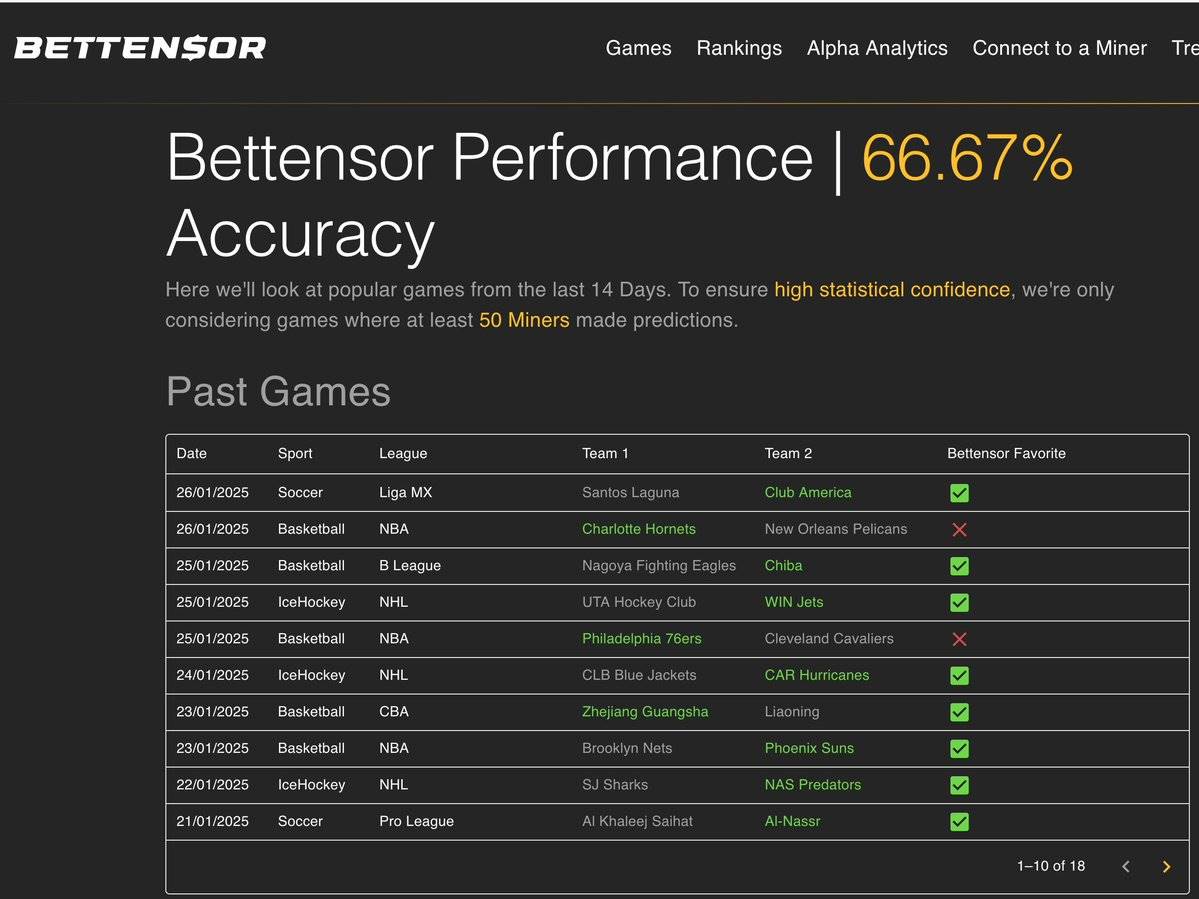
Bettensor is a decentralized sports prediction market based on the Bittensor network, using a unique reward mechanism to incentivize users to accurately predict sports event outcomes.
Participants receive $1,000 in simulated balance daily to bet on the odds of sports event outcomes. Prediction scores are based on the profits from successful bets made within the past 2 days, calculated at the time of submission.
The system creates a competitive environment to generate valuable odds and prediction data. Participants can use any prediction method (e.g., human intuition, AI models, or statistical analysis), and successful predictions will be rewarded, while unsuccessful ones may result in disqualification.
6. Hookt (@Hookt_app)
Hookt is a mobile-first prediction market platform that aims to make betting as easy and fun as swiping on Tinder.
Through a swipe-based user experience (UX), Hookt simplifies the betting process, allowing users to quickly bet on short-term events, such as sports matches, Bit price fluctuations, or pop culture-related events.
7. Sweep (@trysweep)
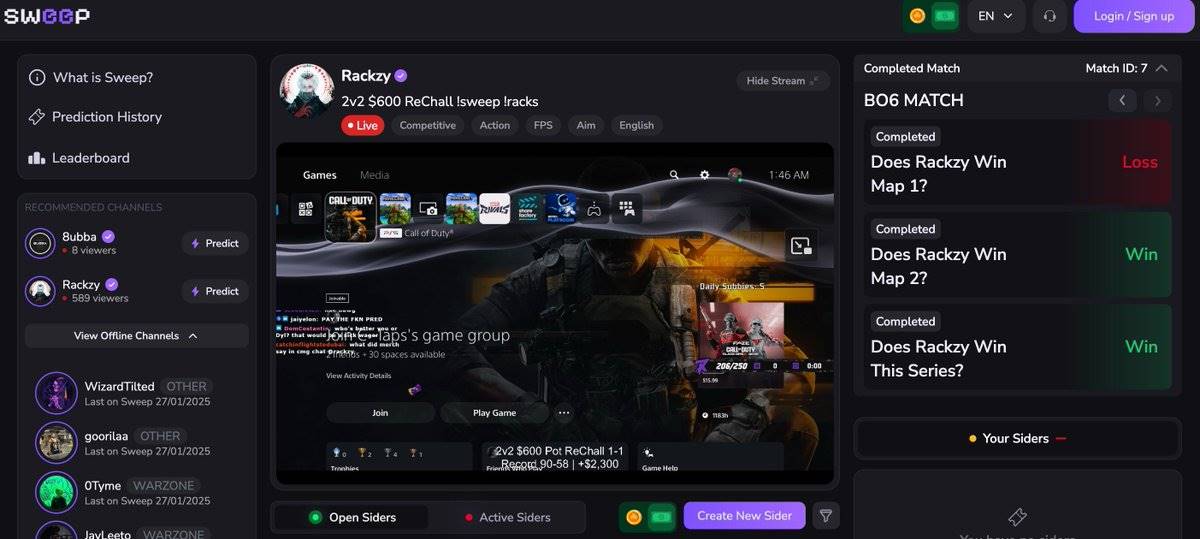
Sweep is a gamified prediction platform designed around live content, where users can bet during live events, such as "Will XX get 15 kills in the match," using two different currencies for their bets.
The platform adopts a dual-currency system: one is the non-convertible "Coins" used for leisure and entertainment and interaction with anchors; the other is the "Sweep Cash" that can be converted into real money.
Users can predict various results during live broadcasts, from competition results to specific live challenges, adding a layer of real-time interactive experience to the existing live content. The platform transforms passive live viewing into an active prediction game, allowing the audience to interact deeply with the content through real-time prediction.
8. PredX (@PredX_AI)
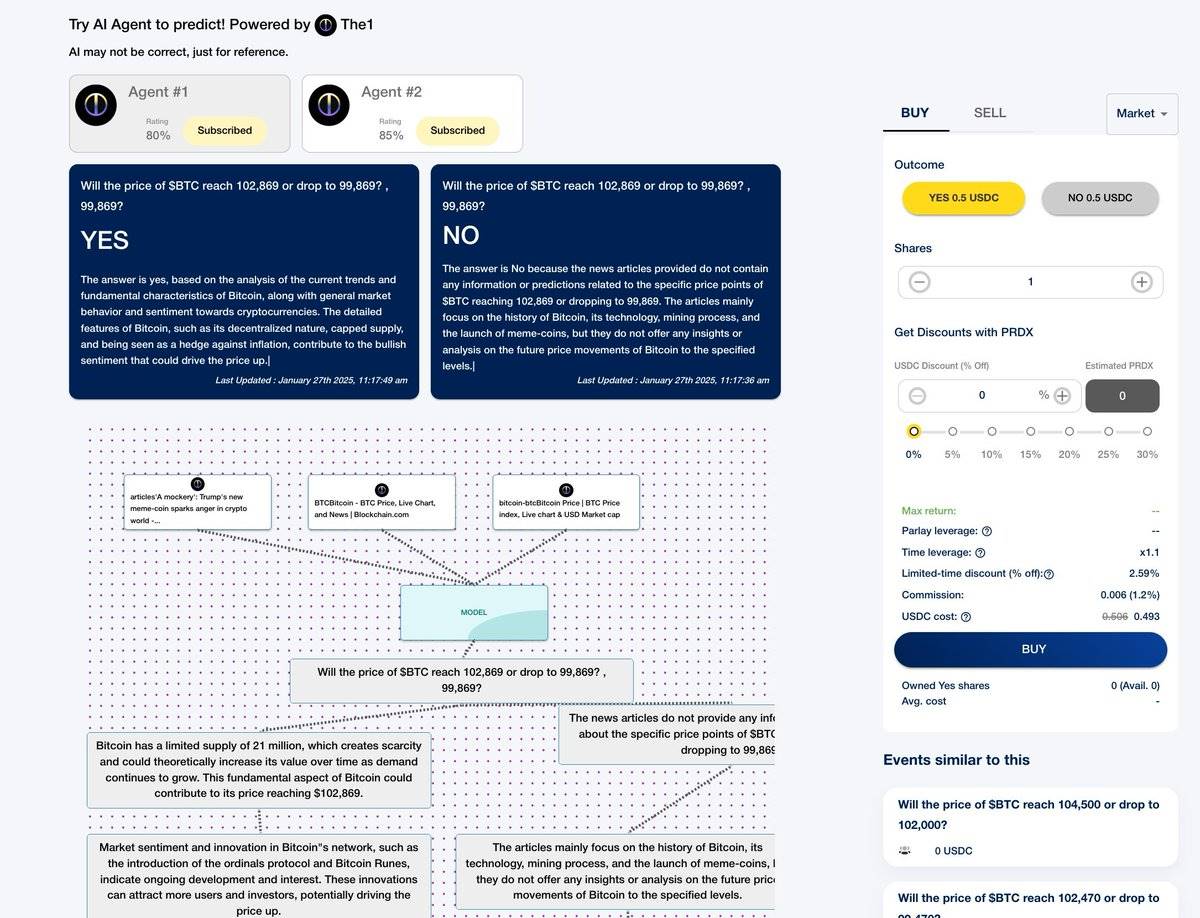
PredX differentiates itself from other platforms through its AI-driven market creation and analysis approach. The platform uses intelligent agents based on Generative AI to actively analyze various data streams (such as price charts, news sources, and sentiment data) to provide predictions and analysis for market outcomes.
Taking Bitcoin price prediction as an example, in addition to relying on its own analysis, users can also obtain predictive insights generated by the AI using comprehensive data, helping them make more informed betting decisions. This hybrid system combines human prediction with AI analysis to provide users with more in-depth decision support.
9. Offmarket (@offmarketfun)
Offmarket is a prediction market platform focused on startup IPO results, built on the Base blockchain.
The core value of the platform is to provide users with a tool to convert private company information into trading opportunities, allowing users to profit from their own understanding and judgment of the development trajectory of startups.
10. Kohin (@kohinxyz)
Kohin is an innovative platform that provides a decentralized insurance layer for prediction markets, allowing users to insure their bets, offering a new risk management approach.
Users only need to pay a small premium (e.g., $20 premium for a $100 bet) to obtain bet insurance. If the user wins, they can keep the winnings minus the premium; if they lose, they can get back the full principal, only losing the premium amount.
Kohin V1 has been launched on Polygon, initially supporting sports combo bets through the Azuro Protocol, and plans to expand to other platforms like Polymarket. Its core innovation is to reduce the risk of total loss, making prediction markets more user-friendly and attracting more users to participate and interact.