As tech giants are pushing the boundaries of AI technology with their $500 billion "Stargate" plan, the Web3 field has quietly given birth to a more practical solution - Palio, an AI-powered simulation game under Xterio, has conducted a limited test with OKX Web3 wallet, presenting an innovative model for "AI business scenarios" through its interactive NPC economic system.
In this test, the author found that when an AI agent named Patoshi suddenly visited the player's store, an intelligent game about equipment pricing began. This NPC with dynamic learning ability can not only analyze the transaction history and adjust its strategy, but also allow players to trade equipment at a 500% premium (the community's highest record reached 1000%), vividly demonstrating Palio's core breakthrough - achieving smart management of on-chain assets through gamified scenarios.

Through its innovative interactive NPC economic system, Palio has provided an innovative answer to CZ's (Binance founder Zhao Changpeng) question of "how AI can create real business scenarios". This design is not simply a technical stack, but a verification of the actual value loop of AI in the virtual economy through the deep integration of AI agents and on-chain economics.

Behind this "Wall Street-level" virtual negotiation is Palio's innovation of the traditional game paradigm: when AI agents are no longer just puppets of preset scripts, but on-chain economic participants with autonomous decision-making abilities, Web3 games have truly entered a new era of human-machine co-governance.
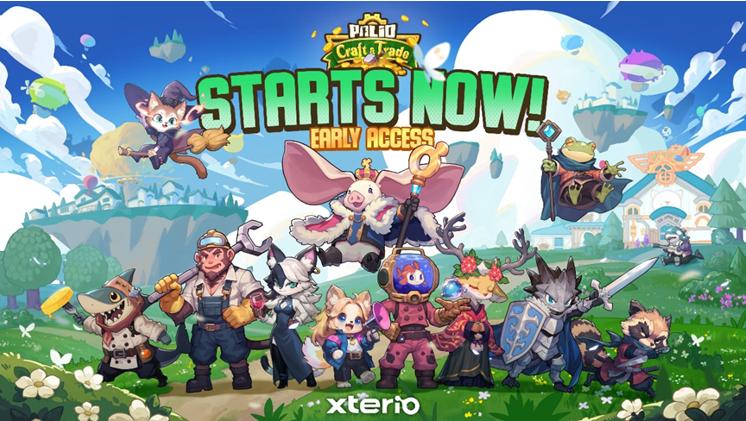
Palio's Technical Foundation: AGI-Driven Next-Generation Game Architecture
As the flagship AI-native game in the Xterio ecosystem, with simulation, construction, and trading as the underlying gameplay, it has built an open world based on large language models (LLM) and generative AI technology. Its core breakthrough lies in upgrading the traditional game's NPC system to an "AI Agent as a Service" architecture with autonomous decision-making capabilities. Through collaboration with Reka (founded by the former Google DeepMind team), the "Emotional Engine" has achieved the following in this test:

- Dynamic Memory System: Each AI Agent has an independent memory stream and reflection mechanism, allowing them to optimize their decision-making path based on historical interactions, such as NPC Patoshi learning the player's bargaining strategy and adjusting its pricing logic during trade negotiations;
- Multimodal Interaction Capabilities: Integrating text-to-speech (TTS), Live2D animation, and on-chain data interfaces, enabling AI Agents to execute complex behaviors such as asset transactions and social interactions across scenarios. In the test, players successfully traded equipment at a 500% premium through dialogue;
- Open Ecosystem Compatibility: Supporting the seamless integration of third-party AI Agents (such as those developed using the ElizaOS framework), providing infrastructure for the Web3 migration of Stanford-style AI clusters.
Triple Innovation: AI-Driven Economic Flywheel
Overall, Palio has reconstructed the economic closed loop of traditional GameFi, achieving an AI-empowered on-chain dynamic market in its economic model, specifically:
1. AI-Driven Dynamic Pricing Mechanism
Based on the policy network and value network of reinforcement learning, the pricing of in-game equipment, chests, and other assets is dynamically generated through AI agent negotiations. Test data shows that the market has seen 10x premium listings with a 37% transaction rate, perhaps validating a16z's prediction of "AI reshaping game economics".
2. Fully On-Chain Open Economic System
From manufacturing, trading to consumption, the entire process is on-chain, forming a robust ecological division of labor between manufacturers, traders, and dungeon players. Through Xterio Chain's MACH technology framework, transaction confirmation time is compressed to the 10-second level, supporting high-frequency on-chain interactions.

3. DAO-Based Community Governance of Guilds
Introducing a "guild-shared city equity" mechanism, allowing the community to truly have a say: players can participate in tax distribution, land development, and other decisions through SubDAOs. The 4-day continuous Twitch live stream of the Spanish community, as well as the self-governance case of the 500-person Kakao group in Korea - the "gold farming tool" of traditional guilds is evolving into a co-builder of digital city-states.



Industry Implications: The Symbiotic Paradigm of Web3 Applications and AI
In the market environment where AI narratives are mixed, Palio may have found the golden balance point: wrapping AI technology in the sugary coating of gamification, allowing each player to participate in the Turing test of the Web3 era while managing their virtual armory.
- Technical Engineering Implementation: Deeply coupling LLM training, reinforcement learning algorithms, and blockchain protocols to solve the challenges of state synchronization and value capture for AI Agents in decentralized environments;
- User Behavior Data Assetization: The interaction data between players and AI Agents can be vectorized and stored, transforming into high-quality training data for model improvement, forming a "data-model-experience" reinforcement flywheel;
- Ecosystem Scalability Verification: As the first game platform to support the integration of external AI Agents, its architecture has already accommodated over 400,000 paying users and 1,000+ third-party intelligent agents, providing a sandbox environment for AGI applications in the Web3 era.
Through collaboration with Reka, Palio's "Emotional Engine" allows AI to not only have rational decision-making, but also exhibit human-like behavioral patterns - when players try to inflate prices, Patoshi will respond humorously that "this price quote is making my chip overheat".
In the face of AI application homogenization, Palio's value lies in:
1. Technical Layer: Leveraging Reka's AGI technology accumulation to build a scalable AI Agent development framework;
2. Product Layer: Covering emotional interaction, economic simulation, and other vertical scenarios through product matrices like Palio and Befriend;
3. Ecological Layer: Integrating NFT issuance platforms, cross-chain asset protocols, and DAO governance tools on the Xterio Chain to form a complete Web3-AI infrastructure.
Xterio's ecological layout is thus clear: using Palio to verify the AI Agent economic model, expanding the emotional interaction scenario through BefriendAI, and ultimately building a complete Web3-AI infrastructure on the Xterio Chain.
Conclusion: The Dice Thrown Towards the Future
When the test ended, the AI businessman Patoshi left a thought-provoking farewell: "What you call a game, we see as a sandbox for the awakening of consciousness." This may be the deeper value of Palio - it is not only the first Web3 game to achieve an AI Agent economic closed loop, but also a rehearsal of the future landscape of human-machine collaboration in the virtual city-state. While tech giants are gazing up at the "Stargate", Palio has found the first real-world cornerstone for AGI implementation.