Author: Zhao Weiwei,Blue Hole Business
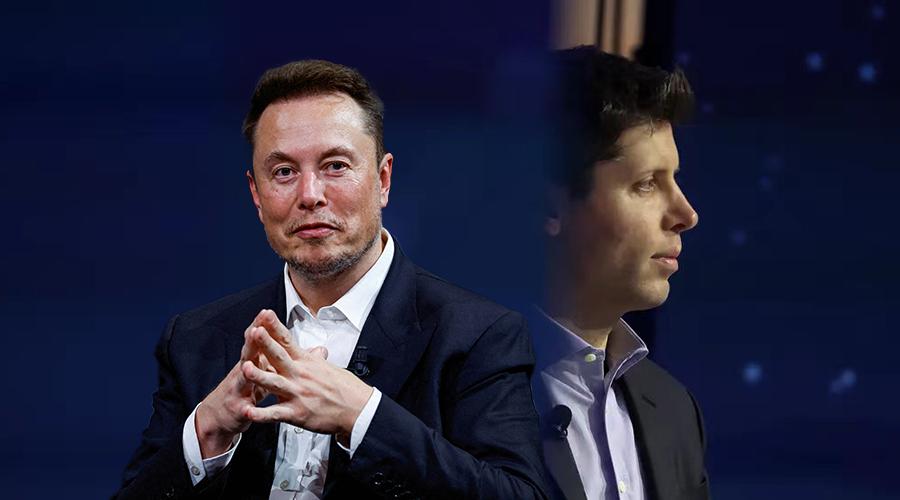
"The collaborative approach to artificial intelligence between OpenAI and @Sam (Altman) is what I support, as it can bring the best results for humanity," said Reid Hoffman, co-founder of LinkedIn.
This is obviously taking a stand against Musk. He, like Musk, was once an angel investor in OpenAI, co-founding the non-profit artificial intelligence research lab OpenAI, with the aim of countering Google's strong position in this field, but later, Musk and Hoffman both left OpenAI to start their own artificial intelligence companies.
In contrast to Hoffman's affection for OpenAI, Musk has completely torn off his face with OpenAI.
Starting last year, Musk saw that OpenAI was leaning towards the big company Microsoft, first publicly calling for a pause of at least 6 months in research on artificial intelligence systems more powerful than GPT-4; later, Musk himself founded the artificial intelligence company xAI, and last November released its first artificial intelligence model "Grok", with the goal of "understanding the true nature of the universe", but the gap with OpenAI is very far.
Recently, the anxious Musk took OpenAI to court, and he must know that he will face a fierce counterattack from OpenAI.
Musk has officially sued OpenAI, claiming that OpenAI should restore its open source status, and prohibit the company and its CEO Sam Altman and Microsoft from profiting from AI technology. Subsequently, OpenAI, in order to refute Musk, listed the historical emails of the year on its official blog, using facts to slap Musk in the face: the creation of a for-profit entity was a joint decision, it was just that the suggestion to incorporate OpenAI into Tesla at the time was not adopted, and Musk left OpenAI.
In simple terms, Musk's lawsuit raises the issue, accusing OpenAI of betraying its original ideals; OpenAI's counterattack then brings the issue down to earth: you are just for competitive interests.
Is Musk anxious?
Looking back at the lawsuits Musk has fought over the past decade or so, it is not difficult to find that going to court is just one of his business competition strategies. Musk is not afraid of competition, and fighting to the end is in line with his character; what he fears is not being able to tear open the passive situation.
01 Old grudges are hard to forget
Past affections often seem fragile in the face of current business interests and goals.
On the day Musk officially sued OpenAI, Sam Altman said in an internal memo to OpenAI employees that "benefiting humanity and entrepreneurship are to some extent inconsistent, a confusing statement, and I miss the old Musk."
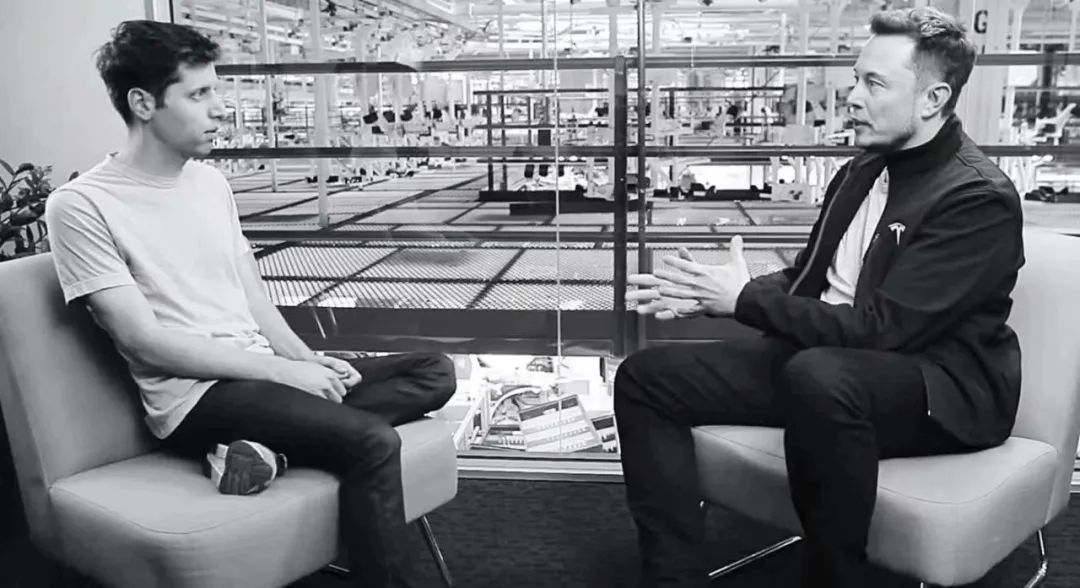
"Personally, this makes me sad," Altman, 14 years younger than Musk, has always seen Musk as a personal hero, a person who achieves competition through building better technology, a builder, someone I hope will be on our side.
Altman misses the old Musk, and Musk likewise misses the old OpenAI.
In his lawsuit against OpenAI, Musk's 46-page complaint lists many "crimes" of OpenAI, such as pursuing commercial interests in violation of the founding agreement. Musk believes that OpenAI has become a closed-source subsidiary of Microsoft, the world's largest tech company, and that all members of the OpenAI board are now Altman's choices, all of whom are approved by Microsoft, so OpenAI's purpose is no longer to benefit humanity, but to help maximize Microsoft's interests.
Looking at the lawsuit's demands, Musk wants to bring OpenAI back to its pre-commercialization ideals.
First, to make OpenAI open source, to provide the developed artificial intelligence research technology to the public, and also to prohibit the use of OpenAI and its assets for the defendants to continue to seek economic benefits; secondly, to rule that GPT-4 and the more advanced GPT-Q are general artificial intelligence (AGI), and not to be used by Microsoft. In addition, Musk is also seeking his own past losses.
The complaint states that between 2016 and September 2020, Musk donated a total of over $44 million to OpenAI. But in fact, according to the evidence released by OpenAI, the funds raised by Musk were less than $45 million, while other supporters, including Hoffman, provided more than $90 million.
In OpenAI's rebuttal article, it further points out the key to Musk's divergence from OpenAI: control.
In 2017, OpenAI and Musk reached a consensus to establish a for-profit entity as the next strategic move. "Musk wanted to get a majority stake, gain preliminary control of the board, and serve as CEO. During this period, he suspended the planned financial support." Fortunately, Reid Hoffman's generosity filled the funding gap in salaries and operations.
Musk's suggestion at the time, looking at it today, is still unacceptable. "In early February 2018, Musk forwarded us an email suggesting that OpenAI should treat Tesla as its cash cow, and commented that Tesla is the only entity with a chance of competing with Google, although the possibility is still very small."
In fact, according to the description in "The Musk Biography", after parting ways with OpenAI, Musk also poached OpenAI's deep learning and computer vision experts, including Andrej Karpathy, to lead Tesla's artificial intelligence project.
"We realized that Tesla would become an artificial intelligence company and would compete with OpenAI for similar talent," Altman said, "This made some of our team members very angry, but I fully understand what's going on." Later, in 2023, Altman turned the tables: when Karpathy was exhausted by Musk's antics, he extended an olive branch and re-recruited Karpathy.
So, old grudges are hard to forget, and this is the key to the current controversy between Musk and OpenAI. The past grievances have not been resolved, and the new competition in general artificial intelligence has added a new fire to the two.
02 The new situation is unresolved
Musk's announced Grok V1.5 chatbot has not been released to date, and as early as February 22, he had said on Twitter that it would be released in early March, two weeks later.
Since its release last November, the Grok chatbot has not generated much attention in the industry. And the artificial intelligence company xAI behind Grok, founded in July last year, is essentially competing with OpenAI. In Musk's words, competition makes companies honest, and he supports competition.
Grok's biggest competitive advantage is Musk's acquisition of Twitter, which allows Grok to use Twitter content for its training data, including over 1 trillion tweets posted over the years, as well as 5 billion new ones added every day, of course, this is a benefit that Musk only realized after acquiring Twitter.
But the contradiction is that while Musk is constantly opposing the commercialization of OpenAI, his own artificial intelligence model Grok is closely tied to the commercialization of Twitter from the very beginning. Only Twitter Premium+ subscribers can use it, and becoming a Premium+ subscriber requires a monthly payment of $16.
From the information released by xAI, the 12 members of the xAI team are all male, and they have previously worked at leading companies or renowned academic institutions such as DeepMind, OpenAI, Google Research, Microsoft Research, Tesla, etc., and have been involved in the development of projects such as AlphaStar, AlphaCode, Inception, Minerva, GPT-3.5 and GPT-4.
Here is the English translation of the text, with the specified terms preserved:But in terms of talent density, xAI still lags behind industry leaders like OpenAI and Anthropic. The current industry-recognized top-tier large model forces are mainly concentrated in OpenAI, Google, and Anthropic, a company founded by former members of OpenAI, and Anthropic has also received investments from Amazon and Google, with the internet giants already taking their positions.
More importantly, the competition of large models in Silicon Valley, the US, has already begun to accelerate.
Just this February, Google released its brand-new Gemini 1.5 AI model, and quickly open-sourced the lightweight open-source large model Gemma. These consecutive actions are similar to OpenAI's release of the text-to-video model Sora, all of which are announcing their capabilities in the field of general large models, causing industry shockwaves.
In contrast, Musk is no longer the unrivaled figure in this surging AI wave. The Musk biography once defined him as: As the two giants of OpenAI and Google fight, a third gladiator needs to enter the arena - a gladiator focused on AI safety and committed to protecting humanity.
Musk was once full of confidence, stating in the Musk biography: "The real-world AI capabilities accumulated by Tesla are underestimated. Imagine if Tesla and OpenAI had to swap tasks, with them making self-driving cars and us making large language model chatbots, who would win? Of course, it would be us."
Confidence is confidence, and means are means.
As confident as Musk, shortly after OpenAI released ChatGPT, he cut off OpenAI's data pipeline access to Twitter, limiting the opponent's means of defense for the future. Musk has never been soft-handed, so suing OpenAI can still be seen as one of Musk's strategies to limit his opponents.
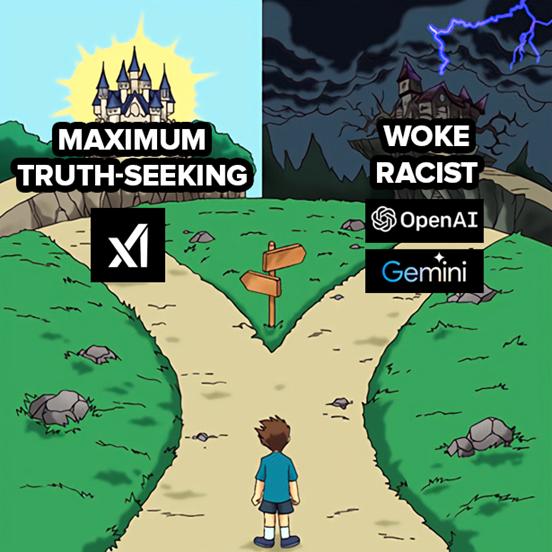
In fact, Grok chatbot is still far from matching Musk's vision. Musk once said that xAI's Grok is very important for humans, and will help humans explore the "ultimate truth" and the "essence of the universe", and he did not forget to put down his opponents, saying that OpenAI and Google's Gemini will only lead humans astray.
Additionally, there are reports that Musk's xAI is preparing for a new round of financing, planning to raise $1 billion through equity financing at a valuation of $15 billion to $20 billion.
Subsequently, Musk denied this news, but it is undeniable that the consumption of tens of billions of dollars is necessary for large models. He has recently been posting job information on Twitter to recruit for xAI, and how xAI will compete with peers like OpenAI is still a problem that troubles him.
03 Lawsuit - A Strategy of Not Wanting to Lose
Musk's controversies have been constant, and looking back on his entrepreneurial and business warfare path, going to court to sue is often one of his usual strategies for solving problems, which is also a manifestation of intensified industry competition. At the most fundamental level, this means that Musk is really angry.
For example, during Tesla's startup period, he sued the famous automotive designer Henrik Fisker.
At the time, Musk found Fisker to design the later Model S, but the design work Fisker eventually delivered did not match Tesla's expectations. Later, Musk learned that Fisker was helping Tesla on the one hand, and on the other hand, he was setting up an electric vehicle company and incorporating the Tesla product concepts that Musk had told him into the business plan of his new company.
Musk could not tolerate this betrayal, although Tesla ultimately lost the lawsuit and was ordered to pay Fisker $1.14 million in legal fees and expenses, Fisker's electric vehicle company quickly rose, even snatching the government's low-interest loans that could have belonged to Tesla, but Fisker's company still went bankrupt in 2013, and Fisker was forced to resign.
In the space competition, Musk's SpaceX has also sued Bezos' Blue Origin.
At the time, Amazon founder Bezos and Musk were both trying to build reusable rockets. In 2014, Bezos' Blue Origin applied for a US patent called "Sea Landing of Space Launch Vehicles", which described a method for landing and recovering a booster stage and other components on an offshore platform.
After seeing the patent, Musk's face turned black, and he chose to resort to legal action. Because the method of sea landing has been discussed for half a century, and has appeared in many fictional films, "but now we have so many available technologies, and we still have to repeat the old tune, that's crazy. To apply for a patent for something that people have been discussing for half a century is too absurd."
This lawsuit intensified the competition between Musk and Bezos in the space rocket field, and the result was that after being sued by SpaceX, Bezos agreed to withdraw the patent.
And in the 2022 Twitter acquisition drama, Musk's initiative to sue and threaten the other party is also one of Musk's methods of psychological warfare.
At the time, when Musk was acquiring Twitter, he demanded a lower acquisition price, but the progress was not great. Twitter's plan could reduce the $44 billion price by 4%, but Musk demanded a 10% reduction, otherwise he would not consider it. In the psychological tug-of-war between the two parties, Twitter's executives and board of directors insisted that no matter how the negotiations went, they had to protect themselves from future lawsuits by Musk.
"We will never let them get legal immunity," Musk said emotionally at the time, "If we have to hold them accountable, we won't let a single one of them off the hook, unless they're dead."
Musk once threatened to sue Twitter because he believed Twitter's board and management were lying about bot accounts. But in the end, Musk's lawyers persuaded him that going to court would likely lose, and the best approach was to complete the transaction at the original $44 billion. In the end, Musk took over Twitter, achieving his acquisition goal, while the former CEO and others were laid off.
Looking back on Musk's three lawsuits in Tesla, SpaceX, and Twitter, there have been wins and losses, and even giving up, but the core strategy has not changed - when faced with an unfavorable competitive landscape, use legal self-defense to curb opponents and increase his own chances of winning, turning a passive situation into an active offensive.
Lawsuits are one way to achieve competitive goals. Even if the lawsuit is lost, this public counterattack to defend interests is in line with his consistent personality of fighting to the end. And now the lawsuit against OpenAI shows Musk's stance in the battle of artificial intelligence: he cannot afford to lose.
After OpenAI officially responded to Musk's lawsuit, Musk did not strike back on Twitter, and the facts and postures of all parties are now clear. As for the result, we will have to wait for the final ruling, which is destined to be as long as the evolutionary path of general artificial intelligence. For now, we still need to see how capable xAI's Grok chatbot is.