Author: shushu, BlockBeats
Yesterday, Virtuals Protocol announced that the VIRTUAL token can now be traded on the Solana mainnet, and its official LP has been launched on Meteora, and preparations have been made for the Launchpad of Virtual Protocol on the Solana mainnet. At the same time, Nansen CEO Alex Svanevik tweeted asking when Aave can be used on Solana, and tagged Aave team members and Solana founders.
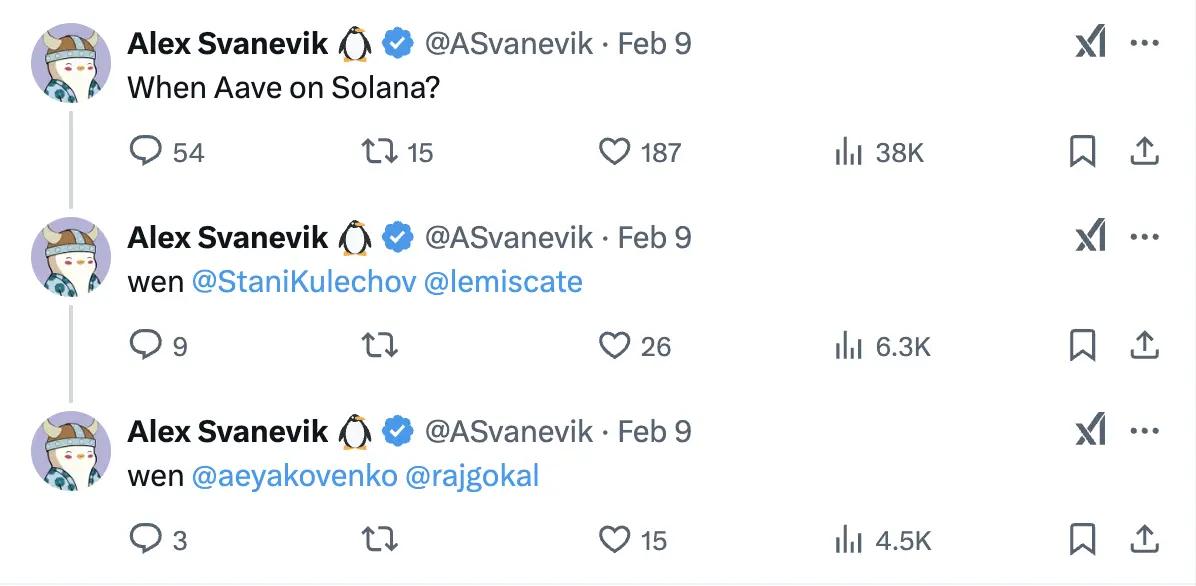
However, the comment section of this tweet has turned into a debate between Solana supporters and Aave enthusiasts, and more broadly, this is a battle for market share between the Ethereum ecosystem and the Solana ecosystem in specific application areas.
A "war of words" about lending protocols
Solana's "milk king" Multicoin partner Kyle Samani commented on this tweet about Kamino, a DeFi lending protocol in the Solana ecosystem, intending to suggest that Kamino is Aave for the Solana ecosystem.
Svanevik replied that Aave's scale is 10 times larger than Kamino, "If Aave users can easily switch chains, it will be a huge TVL release."
However, Solana's founder toly and Foundation Chairman Lily Liu do not think so. Lily said Kamino's product is better, and proudly said "Today's metrics don't represent tomorrow's performance." toly said it is wiser to support a local team focused on the Solana mainnet as a long-term investment than to support a multi-chain team that is distracted, which directly extinguished the possibility of Aave coming to Solana.
Under the sharp criticism of the Solana ecosystem, the supporters of Aave and the Ethereum ecosystem are also unwilling to fall behind.
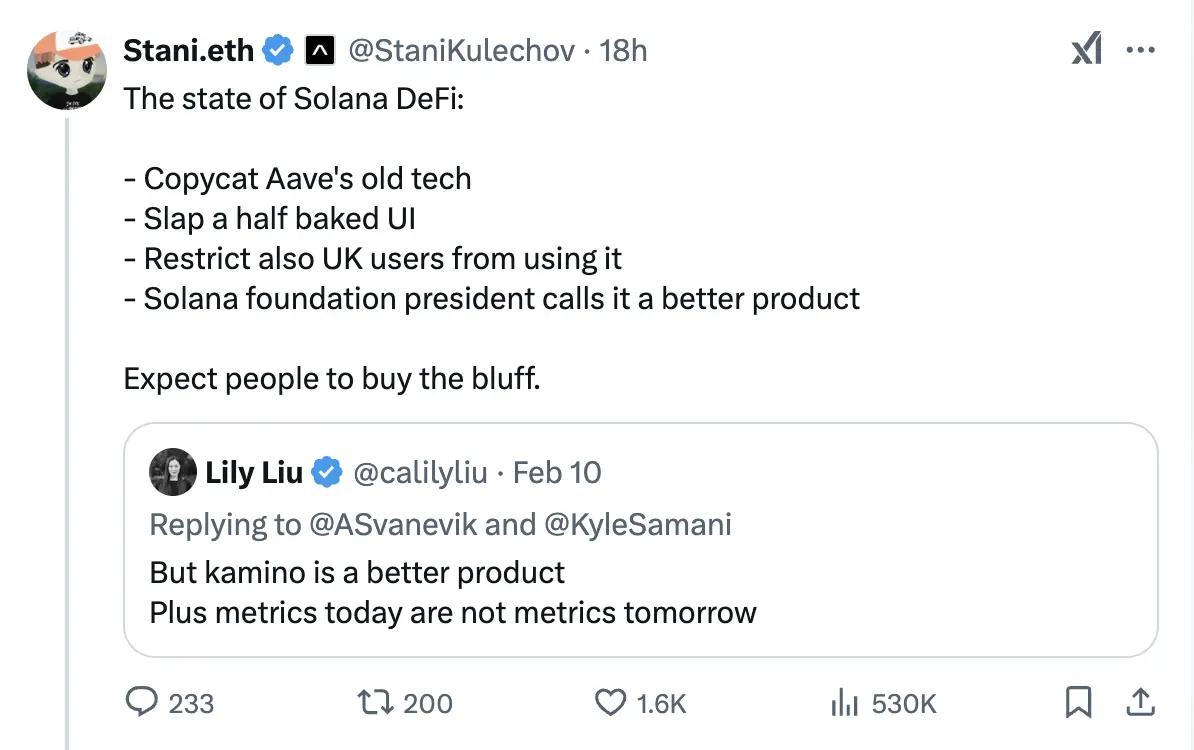
Aave founder Stani directly opened fire, saying that the current state of Solana DeFi is to copy Aave's old technology, paste a half-finished UI, and restrict British users from using it. Although Stani was talking about Solana DeFi, insiders know he was targeting Kamino, which is also a lending protocol.
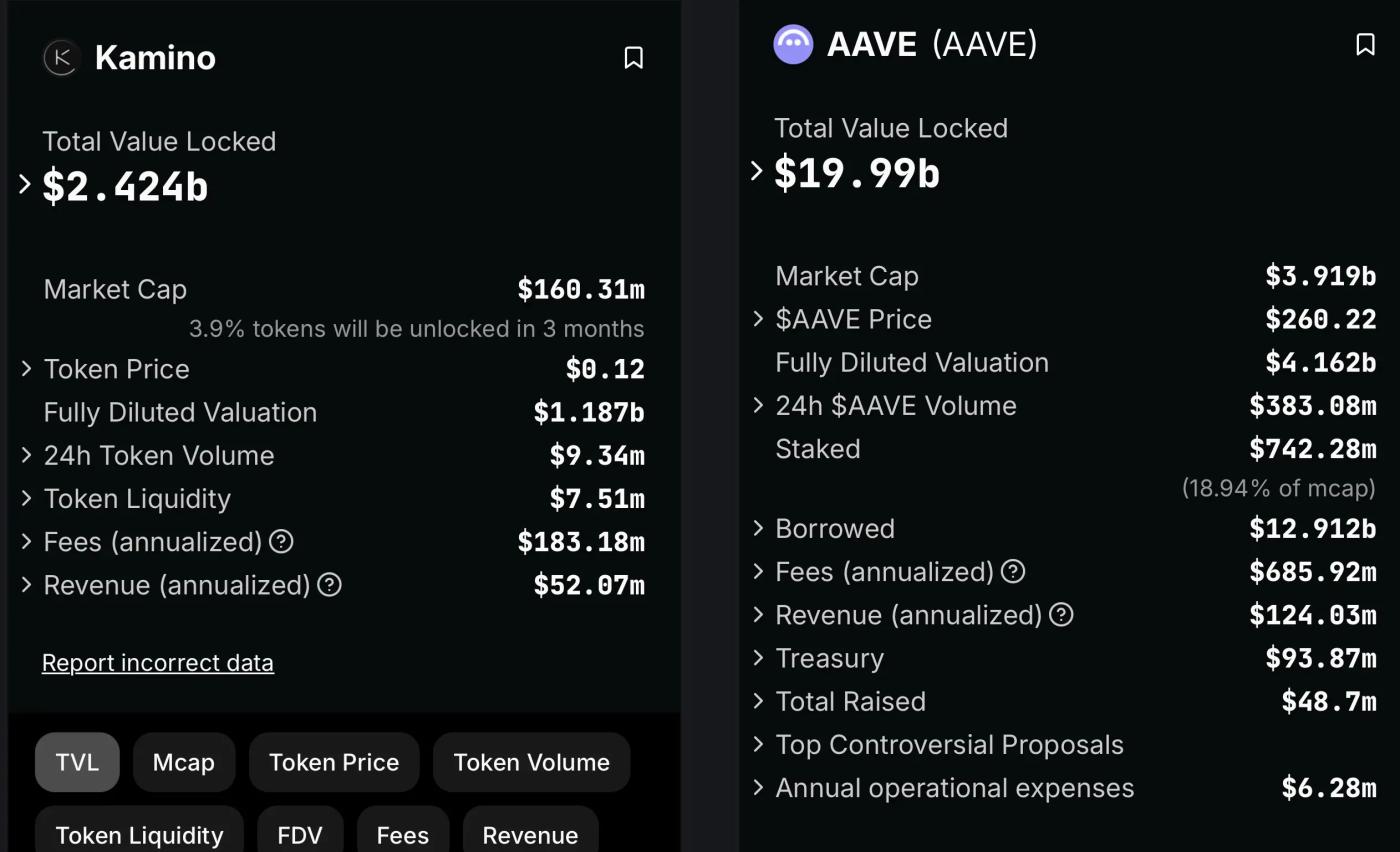
So toly posted the DeFiLlama interface of Aave and Kamino, saying that Kamino's TVL is 1/8 of Aave's, but its revenue is only 1/2.5 of Aave's. "I don't understand why Aave would be a better product if it can't squeeze out more revenue, TVL is just a cost."
Stani also sharply replied that Kamino's USDC reserve factor (the percentage extracted from each transaction or liquidity pool) is 15%, while Aave's is only 10%, meaning it extracts higher fees from user liquidity pools. Stani believes this reflects the current lack of competition in the Solana ecosystem, resulting in weaker bargaining power for users when choosing DeFi platforms, and higher fees ultimately paid by users.
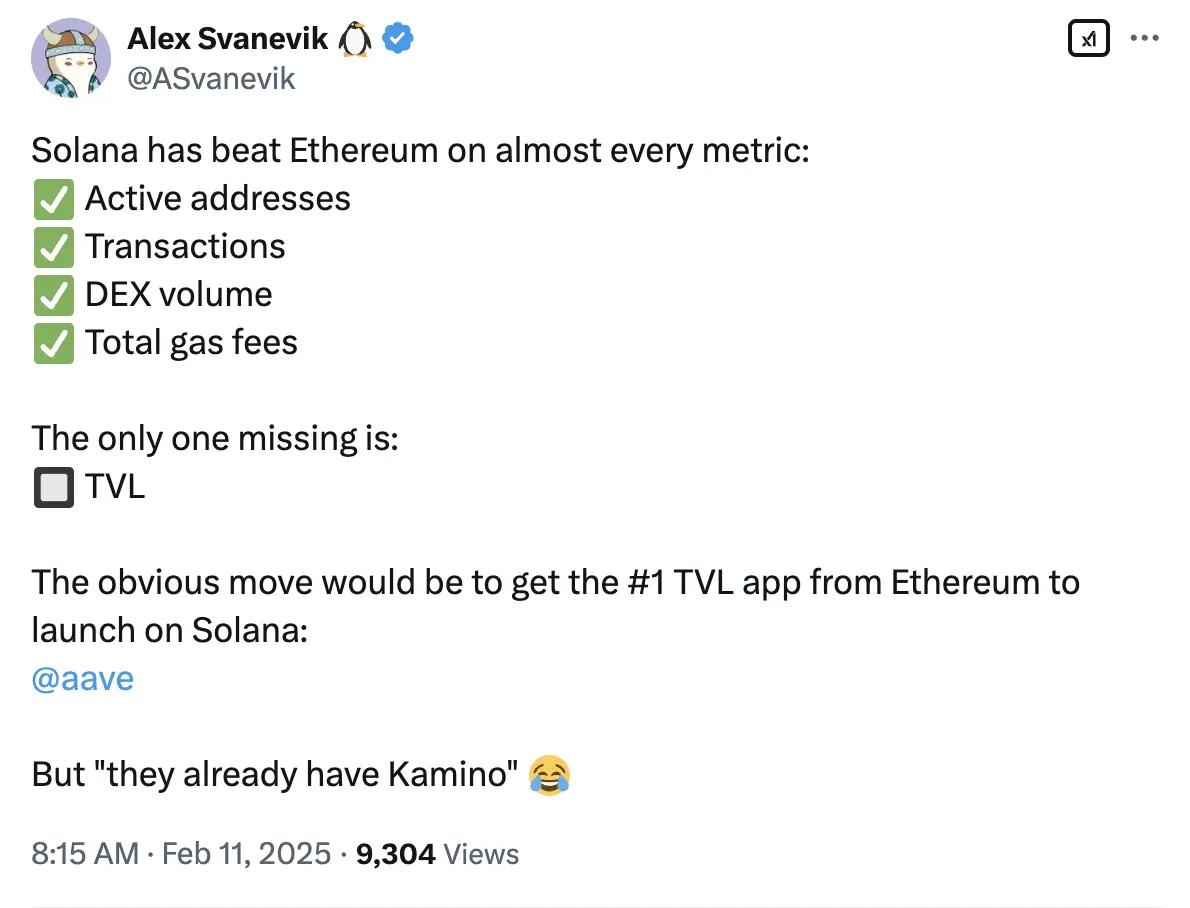
The main character who sparked this "war of words", Alex Svanevik, also came to add fuel to the fire, saying that Solana has already surpassed Ethereum in several key metrics, including active addresses, transaction volume, DEX trading volume, and total Gas fee revenue. However, in terms of TVL, Solana has not yet surpassed Ethereum. Given this, the most direct strategy is to attract Aave, the #1 TVL application on Ethereum, to deploy on Solana, thereby further enhancing the competitiveness of its DeFi ecosystem.
Some commenters questioned this view as unreasonable, because the deployment of Aave on Solana would not create TVL out of thin air. Svanevik explained that for Aave's deployment to not bring any TVL growth to Solana, two conditions must be met simultaneously:
1. None of Aave's current TVL has migrated to Solana;
2. There is no new TVL entering Aave on Solana.
However, Aave has already attracted $20 billion in TVL, so Svanevik believes Aave should migrate to Solana, making it difficult to tell whether Svanevik is an Ethereum maxi or a Solana maxi.
Trust cost above all else
Undoubtedly, Aave is a core DeFi application in the Ethereum ecosystem, along with Uniswap, Lido and others, forming the core pattern of Ethereum DeFi, and the community also questions why the top DeFi applications on Ethereum will miss the Solana ecosystem with infinite potential. Putting aside factors like code and technology, the reasons why an application chooses not to migrate to a new ecosystem and the reasons why it chooses to expand the ecosystem are the same - to achieve incremental development.
Virtuals Protocol's expansion to Solana has given it a broader user and liquidity base, and Aave's decision not to go to Solana is likely also based on considerations of the competitive landscape. Solana's DeFi sector is already becoming more complete, with multiple late-stage teams competing for market share in the lending protocol space alone, such as Kamino, marginfi, and Save, and Aave's expansion costs will be higher than imagined.
More importantly, Aave's existing brand image will also be subject to variables due to expansion. As the community has pointed out, "If someone's funds are in the tens or hundreds of millions of dollars and they want to earn higher returns than off-chain while ensuring safety, 10 out of 10 times they will recommend Aave on Ethereum, not DeFi on Solana, TRON, Celestia, etc."
Security is the foundation of a lending product, and only with sufficient security audits, experience in dealing with hacker attacks, and mature contract design can large capital holders and ordinary users choose to park their assets there. Therefore, the reason why Aave has become one of the most influential lending platforms on Ethereum is inseparable from the long-accumulated developer ecosystem, security audit cases, and the huge and mature liquidity pool on Ethereum.
The financial nature of DeFi determines that "the longer you run, the stickier you become". This stickiness is rooted in the profound trust in the security and stability of the product contracts. And this "trust cost" is not just about considering the speed, performance and transaction fees of a new chain, but also includes the completeness of the infrastructure, the coverage of audit companies, the community's awareness of potential security vulnerabilities, and the ecosystem's ability to respond and compensate in extreme conditions.
Looking back on the development of Ethereum DeFi in recent years, many projects have experienced major vulnerabilities or security incidents, even suffering losses of hundreds of millions of dollars. It is through repeated responses and iterations that the security barrier of Ethereum DeFi has been gradually built up. The reason why Aave is so well-received is that it relies on this layer of security moat, making it the preferred choice for large capital users, especially institutional players. In other words, most people see Aave as a synonym for "lower risk and higher returns", especially for users with funds ranging from millions to tens of millions of dollars, where security and stability always take precedence over incremental returns.
In contrast, as a high-performance Layer1 blockchain, Solana does have certain advantages in terms of transaction speed and Gas fees. But from the perspective of lending protocols, the core of financial applications lies in the "risk-return ratio". Fast speed and low fees are certainly important, but without a long-proven track record of security and resistance to attacks, such advantages are often not enough to support the long-term migration of large liquidity in the DeFi arena. Especially for lending business, it has to face multiple risk factors such as liquidation, interest rate fluctuations, contract audits, and hacker attacks; if problems occur, the brand image and trust built up over the years by the platform will be instantly shattered, and this "trust cost" is far more expensive than the technology itself.
Furthermore, even if Aave chooses to expand to Solana, it does not necessarily mean "creating TVL out of thin air". Capital is rational and profit-seeking, and the $200-300 billion in TVL that Aave has accumulated on the Ethereum mainnet is not willing to automatically split and migrate to another chain. On the contrary, due to the huge differences in underlying technology stacks, development languages, and even community cultures between chains, Aave will have to invest a lot of time and resources to adapt and audit, which in itself means extremely high expansion costs and management risks. Moreover, the native lending protocols on Solana are also becoming increasingly mature, and Aave does not have the first-mover advantage to dominate.
Therefore, with the triple moat of security barriers, brand, and capital scale, it may not be the wisest choice for Aave to expand on a large scale to Solana. After all, in the long DeFi marathon, winning the trust and security perception of users is the most unshakable core barrier.