Author: Nian Qing, ChainCatcher
Have you noticed that in the past few days, when scrolling through X, many of the KOLs you follow have started Yapping. What are they all Yapping about?
Yaps is an integral system launched by the AI-driven crypto data analysis and social incentive platform Kaito. X users can earn Yap points by posting high-quality crypto content (tweets, interactions). Recently, Berachain airdropped to Yappers, and today Kaito also announced that the first 1,000 ANIME (an Azuki anime project token) Yappers and Kaito Genesis NFT holders can claim ANIME tokens. In addition, projects like Story Protocol, Movement Labs, and MegaETH have partnered with Kaito, further fueling the hype around "projects that can be airdropped on Kaito".
Similar to the flywheel trajectory of past Web3 social platforms, KOLs and celebrities with existing influence are thriving in the Yaps point system, tirelessly outputting articles on X and forming matrices with other ICT members. The upside is that discussions about crypto and hot projects have increased, but the downside is also gradually emerging, such as the proliferation of low-quality content, the harassment KOLs face from excessive interactions, and deeper issues like influence monopolization. Kaito has also recently announced the upcoming implementation of Shadow Ban to improve the current chaos through technical means, but controversies and doubts continue.
In 2024, fundamental analysis in the crypto field is facing a complete collapse, and the current market is increasingly proving the saying "Attention in crypto is everything". If Meme is a result of the attention economy, then Kaito is more like the upstream business of the attention economy, i.e., how to manage and distribute attention. But the essence of the attention economy is that the next one is always better. As a product of this era, can Kaito overcome short-term behavior and become a sustainable and practical product?
What is Kaito?
Kaito is an AI-driven crypto data analysis and social incentive platform. According to the RootData page, Kaito completed two rounds of financing in 2023, raising $5.3 million in seed funding and $5.5 million in Series A, with investors including Superscrypt, Spartan, Dragonfly, Sequoia China, and Jane Street.
Founder and CEO Yu Hu graduated from the University of Cambridge and has worked at traditional finance companies like Citadel and Deutsche Bank. In a recent podcast, Yu Hu revealed that he grew up in China, studied in the UK, and then started businesses in the US and Singapore. Yu Hu is not a tech geek but is very skilled in trading and believes trading is the closest to the market.
Kaito's core functions include:
- Crypto social data analysis: By capturing social data (such as interactions, follow graphs, content propagation) from platforms like Twitter (X), Kaito builds KOL influence scoring models to provide quantitative marketing decision support for projects. Currently, some of Kaito's functions are paid, with an annual subscription for Kaito Pro individuals priced at $833/month or $1,099/month.
Related reading: "In-depth Analysis of Kaito: How did the Yap campaign ignite the social flywheel?"
- Yaps point system: Users can earn Yap points by posting high-quality crypto content (tweets, interactions). Kaito emphasizes that to prevent sybil and manipulation, earning Yap points is not easy and does not depend on quantity. The total daily Yap allocation is only 25,000, but the user base has already exceeded 250,000 (January data), so the scarcity is evident, and the difficulty of "Yap to earn" increases exponentially as users grow rapidly.
The Yaps algorithm mechanism ensures that KOLs/big Vs in the core circle of influence will "get stronger and stronger", while ordinary users will find it difficult to break even in the short term. This is because the evaluation mechanism relies on reputation-weighted influence rather than raw impressions or engagement, so if the cumulative qualified social engagement of a tweet does not reach a specific threshold, no points may be awarded.
The core principles of Yap point distribution are:
- Quality > Quantity: Junk content (repetitive, no analysis) will be filtered out by the system, and points will be zeroed.
- Trend-oriented: Provide in-depth analysis around projects recommended on the Kaito dashboard (such as Berachain, Monad, Xion).
- High-quality interaction: Interacting with big Vs on the content itself (commenting, liking) is more effective than just posting.
In summary, content with heat, high quality, value, and the ability to truly stimulate crypto industry discussions has a chance to earn points. In addition, bringing in new users will also earn point rewards, but the condition is that the users you bring in earn Yap points.
- KOL scoring and leaderboard: Based on AI algorithms, Kaito dynamically ranks KOLs, forming a "Yapper Leaderboard" that serves as a reference standard for projects to select collaboration targets.
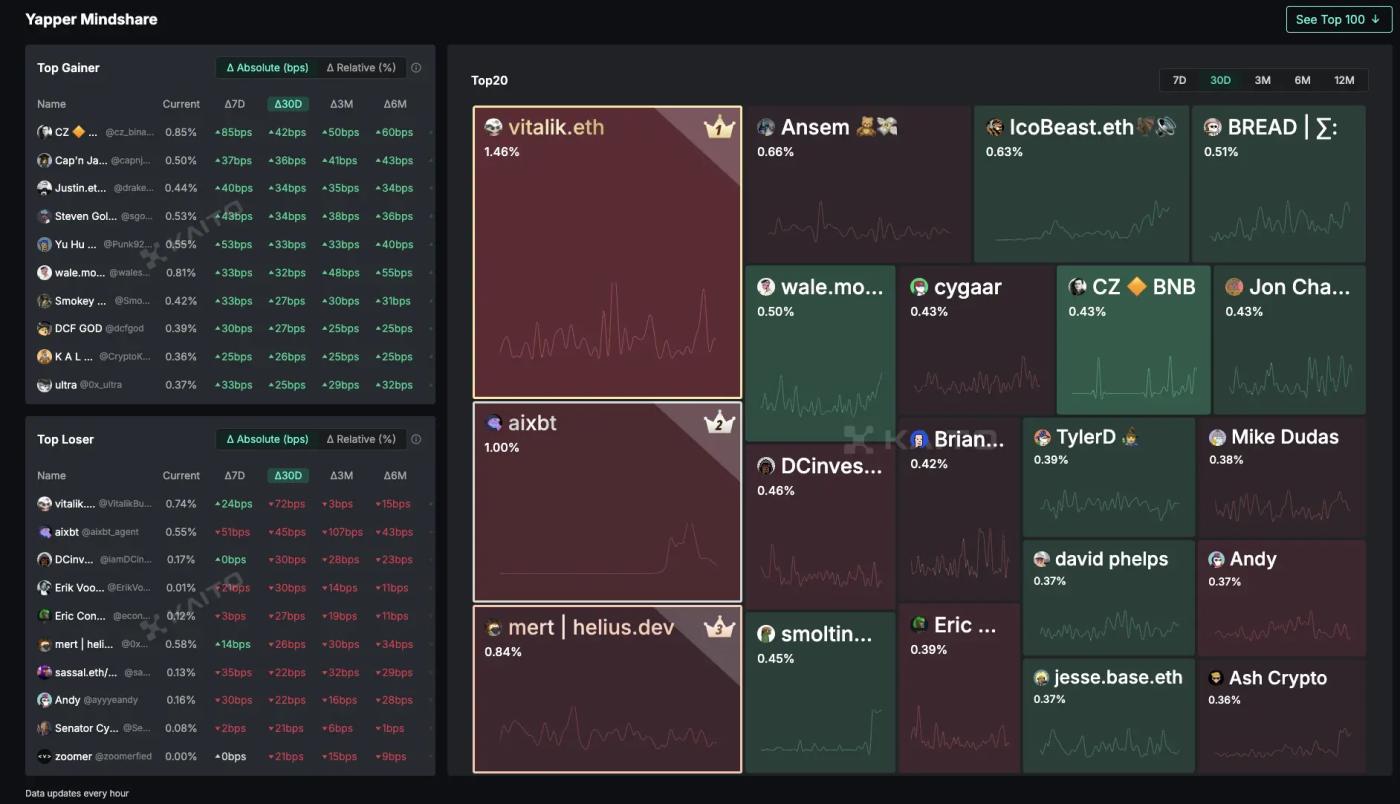
One thing Kaito does well is to filter out "smart followers" from the potentially inflated follower lists on X, reducing the interference of water armies. This function essentially has strong commercial capabilities, largely solving the pain points of KOL marketing, and providing a quantitative standard for projects through its own AI scoring mechanism. Based on the Yap point leaderboard, high-scoring users are matched with project needs, forming an "influence as a service" model, where projects can purchase the "influence" of top-ranked users, which is more transparent than traditional KOL paid endorsements.
4. Yapper Launchpad: Yapper Launchpad, launched by Kaito in January, aims to use community voting to determine the next Yapper Leaderboard project. The Launchpad targets pre-token projects, where users can participate in voting through Yaps, smart followers, and soon-to-be-launched on-chain assets to decide which projects will be included in the leaderboard. Users can then Yap around these listed projects to earn points.
Kaito's Explosive Growth and the Attention Economy
In 2024, fundamental analysis in the crypto field is facing a complete collapse, and the current market is increasingly proving the saying "Attention in crypto is everything".
If Meme is a result of the attention economy, then Kaito is more like the upstream business of the attention economy, i.e., how to manage and distribute attention.
We can specifically divide the participants in the attention economy into:
Attention creators
Attention consumers
Attention distributors
Strictly speaking, Kaito is not a simple crypto data analysis platform, but more like an attention distributor, aiming to create a better network to efficiently allocate information, attention, and capital. Kaito founder Yu Hu has also made two judgments: 1) Personal branding will become increasingly important in the attention economy era; 2) In the AI era, people will value human-to-human connections more.
And Yap is the tokenization of this "attention", the Yap to Earn model, which fits the crypto industry's strong demand for traffic and community participation. This is also the biggest difference between Kaito and Friend.tech's "direct monetization of influence" - Kaito's definition of influence is more refined and granular. As mentioned earlier, the scarcity of Yap points set at the beginning directly determines the influence of content in this space.
Of course, Kaito's sudden popularity is also inseparable from the wealth effect, and more importantly, the events that constitute Kaito's wealth effect are not one-time or short-term. As an influence-based launch platform, Kaito's mechanism can largely help early-stage, unissued projects expand consensus. Recently, Bearchain has airdropped to Kaito Yapper, and well-known projects such as Story Protocol, Movement Labs, Eclipse, and MegaETH have launched on the Kaito launch platform, promising to include Yap points in their airdrop or incentive plans, thereby attracting more users.
In addition, the valuation of Yap points is also given a higher valuation due to their scarcity and difficulty in obtaining. Kaito not only uses its own tokens to reward creators, but by participating in its ecosystem, users can also farm multiple airdrop rewards from leading projects.
But the essence of the attention economy is "the next one is better", and Kaito itself may also be difficult to escape this fate
The other side of the wealth effect is speculation. Kaito's Yap competition has indeed provided creators and content producers with the motivation to create, but it has also led to the proliferation of low-quality content, with many KOLs complaining that the Twitter information flow has been polluted by Yap, even vowing to "block one whenever I see one". Although Kaito is about to launch a Shadow Ban to limit low-quality content, I think Kaito should do more in community education, constantly emphasizing the rules of Yap.
In addition, Kaito Yap's algorithm is a black box, and the scoring criteria, although they exist, are very vague. Furthermore, the current algorithm is obviously biased towards KOLs, because there is a mechanism for measuring Smart Followers, and the core influence circle has monopolized the vast majority of Yap points, making it extremely difficult for ordinary users to break through. @Tang Huaban Zhu once wrote that Kaito is not a credible Twitter X rating system, at best it is just a KOL matrix platform. The so-called screening of high-quality content has essentially become "to get points, you have to keep hard-feeding the hot projects on Kaito". This has also led to an excessive concentration of chips in the hands of the top Yappers.
Yu Hu once mentioned in an interview that his goal is to financialize everything through Kaito and let market forces decide, such as letting users vote on which projects to launch on the Launchpad. But is the market force absolutely right?
KOL @Xiao Xiong Bingqin.eth believes that Kaito's popularity will decline. He mentioned that because the Kaito project voting mechanism has gradually evolved into a "queue to launch" situation, without a survival of the fittest mechanism, there is a lack of "vote-buying" motivation, leading to a decline in Yap players' attention to the Kaito Launchpad projects. In addition, the current algorithm is already not friendly to ordinary users, so Kaito may lack the motivation for long-term development.
The attention economy itself is destined to be a short-term behavior, and history tells us that once it loses the support of the fundamentals, the narrative of the crypto market will completely degenerate into "the next one is better". Kaito may be able to become a sustainable business model, but its true meaning to the crypto market, is it an accomplice to short-term speculation or a driver of greater interaction and consensus in the crypto market? As the wealth effect declines and attention shifts, how should Kaito avoid the old path of Web3 social like Friend.Tech?
Kaito founder Yu Hu has a great ideal, he hopes that Kaito's ultimate goal is to let users forget the existence of the Yaps system and make expressing opinions a habit. Perhaps this is the true value of a product.