The market remains sluggish, and Hong Kong, which has long been overlooked, has also attracted new attention.
On February 8, Hong Kong certified public accountant clementsiu revealed on social media that the Hong Kong Investment Promotion Agency had approved an investment immigration application using Ethereum as proof of HK$30 million in assets, and he also said that in October last year, the first case in Hong Kong of using Bitcoin as proof of assets for investment immigration had been successfully handled.
At first glance, it seems ordinary, but for crypto holders, especially large holders, the threshold for overseas immigration has been significantly lowered, as HK$30 million is not a huge fortune in the crypto-obsessed circle, and emigrating to Hong Kong is also a natural direction for the Chinese.
But is investment immigration really that simple? Is Hong Kong really a crypto utopia? Different people have different answers in their hearts. In fact, regardless of whether it includes cryptocurrencies, the investment immigration policy belongs to the new Capital Investment Entrant Scheme (CIES) proposed by the Hong Kong government in 2023. This scheme is open to qualified investors, and by introducing external investors and capital, it further strengthens Hong Kong's position as an international asset and wealth management center.
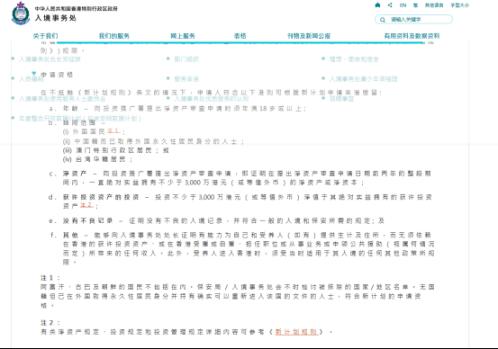
According to the scheme, qualified investors who invest HK$30 million in Hong Kong and are allowed to hold the assets can obtain a stay visa, and after residing for 7 years, they will have the opportunity to apply for permanent Hong Kong residency. The plan is not complicated, but when it comes to implementation, there are still many details to be concerned about.
First, the applicant needs to hire a Hong Kong professional accountant at their own expense to issue a capital verification certificate proving that they have net assets of HK$30 million. In this step, the location of the assets is not restricted, and the composition of the assets is also not restricted, as long as the applicant can prove that they have had net assets or net capital of not less than HK$30 million in absolute beneficial ownership during the entire period of 6 months prior to the date of application for the net asset review, which is worth noting that the original period was 2 years, and the Hong Kong government has subsequently optimized it to 6 months.
Of course, having assets is not enough, the ultimate goal of the Hong Kong government is to have the assets flow into Hong Kong. Within 6 months before submitting the application or within 6 months after approval, the applicant needs to invest not less than HK$30 million in the designated permitted investment asset categories. The Hong Kong government has made quite clear regulations on the investable targets: qualified investors need to invest HK$27 million in the financial asset category (all denominated in HKD/RMB), which includes stocks of listed companies on the Hong Kong Stock Exchange, debt securities, certificates of deposit, subordinated bonds; qualified collective investment schemes, including funds, REITs, open-ended funds and life insurance plans issued by SFC Type 9 institutions; private limited partnerships registered in Hong Kong; non-residential real estate for commercial or industrial use (including pre-sale properties but excluding land), but the investment in this category is capped at HK$10 million.
The remaining HK$3 million is a mandatory target, which needs to be invested in the "Capital Investment Entrant Scheme Investment Portfolio" established by the Hong Kong Investment Management Limited, and this investment portfolio will invest in companies or projects related to Hong Kong to support the innovation and technology industry and other key industries that contribute to Hong Kong's long-term economic development. The specific operation is to deposit HK$3 million in the designated account of the financial intermediary, and it will be managed by four fund management companies and related service agencies such as Betatron Venture Group, Inno Angel Fund, Concept Capital, and Wise Tech Ventures.
After completing the above investment, the Hong Kong Immigration Department will issue a 2-year stay visa, which needs to be renewed later, and the renewal is generally in the form of 3+3, but each year the applicant needs to hire a professional accountant to provide a capital verification report to prove that the total investment amount is still not less than HK$30 million and has not been transferred or used for other purposes, but this total investment amount is not related to the previous investment losses, even if the investment has lost money and the current investment amount has not reached HK$30 million, as long as the investment scale at the time of application reached HK$30 million, no additional investment is required, and the interest or other profits from the investment can be freely disposed of. After residing for 7 years, the applicant can replace it with a Hong Kong permanent resident, and at that time the investment amount will no longer be restricted, and the applicant can also freely dispose of it.
The overall process is as above, and the participation of cryptocurrencies this time is concentrated in the initial capital verification stage, that is, cryptocurrencies such as Bitcoin and Ethereum can also be used as proof of assets, and cryptocurrency assets can be placed in cold wallets or proven through platforms like Binance. It is worth noting that although the existing Bitcoin and Ethereum have been recognized, whether other cryptocurrencies can be used for this proof cannot be generalized, and only cryptocurrencies that are relatively stable in value, have large circulation, and are legal in Hong Kong can be applicable.
In addition, whether the subsequent HK$30 million investment can be invested in cryptocurrency ETFs is still to be discussed. According to Xiao Yaohe, deputy managing partner of Mazars, the possibility is relatively small, but it can be tried by setting up a limited partnership fund to purchase, and whether it can be directly invested still needs to be verified later.
In fact, from the perspective of asset proof alone, there have been precedents of using cryptocurrencies as asset proof in places like the US and Singapore, but for cryptocurrency holders, the most difficult thing is never to come up with the money, but where the money comes from? When using cryptocurrencies as asset proof, the relevant institutions and accountants will require the client to submit proof of the source of funds.
Proof usually involves the original source of funds for purchasing cryptocurrencies and the place and low point of purchasing cryptocurrency assets. It is obvious that for the cryptocurrency field, which has huge ups and downs and has an indescribable anonymity, the above problems are undoubtedly extremely difficult to answer. And this is the real difficulty of cryptocurrency asset immigration, the historical baggage is heavy, and the holders must leave a trace in everything to solve it.
In any case, the first use of cryptocurrencies in Hong Kong's investment immigration reflects Hong Kong's high degree of openness and also reaffirms the Hong Kong government's tolerant attitude towards cryptocurrencies, which still has a certain appeal to the Chinese crypto circle, and the increase in the use of cryptocurrencies can further enhance Hong Kong's position in the crypto field. In the long run, it can form an agglomeration effect from the two directions of talent and capital, promoting the prosperous development of Hong Kong's Web3 industry.
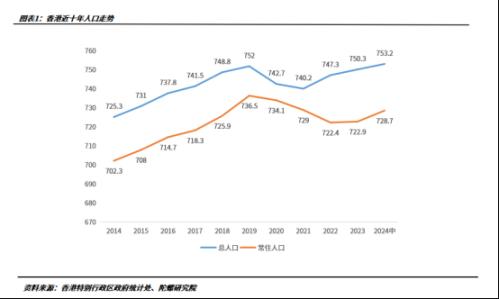
Looking at Hong Kong's planning in recent years, in addition to the new capital immigration, since the end of 2022, the Hong Kong SAR government has successively issued a number of measures to attract foreign talents to come to Hong Kong, including optimizing the existing talent entry plan policies such as the Talent Scheme and the newly launched Top Talent Pass Scheme, and a series of measures to diversify the recruitment of talents and enrich Hong Kong's talent pool. The reason for launching these is very simple - too many people are leaving Hong Kong. Before 2022, Hong Kong's resident population has been declining for 5 consecutive years, from 7.365 million in 2019 to 7.224 million in 2022, and the data on people leaving Hong Kong is even more obvious. From July 2020 to June 2023, 6.33 million Hong Kong residents have left through the airport, of which only 5.8 million have returned. In other words, Hong Kong's net outflow of people in three years has reached 530,000, which is almost 7% of the resident population.
From the current perspective, the introduction of the plan has achieved remarkable results. According to the summary of the Hong Kong Immigration Department, nearly 140,000 various talent entry plan visa applications were successfully approved in 2024, an increase of 4,000 compared to 2023. As of January 2, since the launch of the "New Capital Investment Entrant Scheme", Hong Kong has successfully received over 750 applications, with an estimated total investment of over HK$22 billion. However, it is regrettable that at this stage, only 2 applicants involve the use of .
In addition, against the backdrop of recent contraction, Hong Kong's domestic economy has also been impacted. According to a report by the Hong Kong Economic Journal, Hong Kong's retail sales in December last year were HK$32.8 billion, a year-on-year decrease of 9.7%, marking the 10th consecutive month of decline. The report also mentioned that has become one of the external pillars of the local consumption market, gaining popularity among the younger generation.
Against this backdrop, Hong Kong's attention to the Web3 field has not diminished but rather increased. Just in the past year, Hong Kong's window characteristics have become increasingly prominent, with a balanced approach of regulation and inclusiveness in the virtual asset sector, presenting a situation of policy improvement and ecosystem support, with significant progress in product innovation, platform licensing, and regulatory framework extension.
In terms of products, in 2024, Hong Kong approved the issuance of 6 Hong Kong spot ETFs by Huaxia Fund (Hong Kong), Bosera International, and Harvest International, greatly improving the convenience for investors and promoting the compliance and productization of . As of now, the three spot ETFs hold a total of 4,330 with a total net asset value of $4.25 billion, and the spot ETF holds 2,083 with a net asset value of $0.56 billion.
In terms of exchanges, the new regulations have been in place for one and a half years, and as of now, 9 trading platforms have been approved in Hong Kong, with over 31 brokers upgraded to Type 1 licenses and over 36 asset managers upgraded to Type 9 licenses. In the highly anticipated Payfi field, the Hong Kong Monetary Authority not only launched the Ensemble project to explore RWA and CBDC, but also continued to extend the regulatory framework from platforms to derivative institutions.
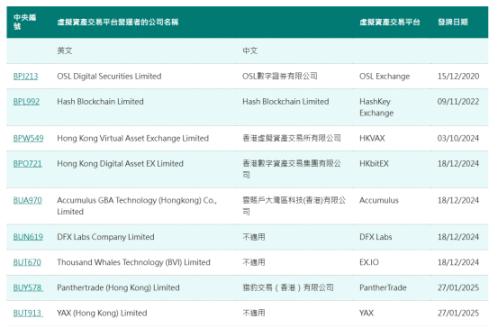
While the environment favorable for Web3 development is being solidified, from a market perspective, given the limited market size and high costs, Hong Kong ultimately faces challenges in becoming a global hub for Web3 development, with minimal influence on the global market, as evidenced by the significant gap between Hong Kong's ETF net assets and the over $111.8 billion in the US. Even for the recent immigration policy, some practitioners have expressed that the high price and low cost-effectiveness, stating that "HK$30 million to go to Hong Kong is not as good as going to Singapore or Australia, and the golden visa in Dubai only costs HK$4.24 million."
However, as mentioned earlier, Hong Kong's plan is not to compete for a share of the market, but to try to build a new decentralized financial system on the foundation of traditional finance, to fill the void of and solidify its position as a traditional financial center, while also connecting to the future era of digital asset trading through innovation. This is also the reason why Hong Kong is currently focusing on regulating trading platforms while also emphasizing the , fields. Despite the fact that Hong Kong is not the most active region, the "small government, large market" approach still means safety and stability, and from the perspective of traditional capital, safety is far more important than other factors.