Memecoins are redefining the importance of the cryptocurrency market, driving exchange strategy adjustments and the rise of the DEX market.
Research Summary
1. Memecoins have evolved from being purely speculative assets to becoming a dominant force in trading, attracting significant liquidity and reshaping the capital flow patterns in the crypto market.
2. Platforms like Pump.fun have driven the rise of decentralized exchanges (DEXs), attracting liquidity and active traders, thereby weakening the early price discovery capabilities of centralized exchanges (CEXs).
3. Exchanges like MEXC that have quickly adapted to Memecoins trading have performed strongly, while slower platforms like Binance face challenges in terms of liquidity and market influence.
1. The New Battlefield for Exchanges
Memecoins are redefining the cryptocurrency market. Starting from an initial speculative trend, they have now become a significant trading asset for major exchanges, driving massive trading volumes.
To adapt to this trend, exchanges are adjusting their strategies. Gate.io and MEXC have captured market share by quickly listing Memecoins, while Binance has launched "Binance Alpha" to focus on the early listing of Memecoins and provide a smooth transition. In the DEX market, Raydium, based on Solana, has successfully surpassed Uniswap, based on Ethereum, to become the market leader. This change demonstrates the powerful driving force of Memecoins in the market.
As the importance of Memecoins in exchanges continues to rise, their broader impact is also worth noting. Will the trading of Memecoins lead to a lasting market transformation, or is it just a temporary cyclical phenomenon? Additionally, how will changes in regulatory policies affect the sustainability of Memecoins as a mainstream asset? These questions will determine the future development of retail trading and exchanges.
2. DEX Breakthrough: Raydium Surpasses Uniswap
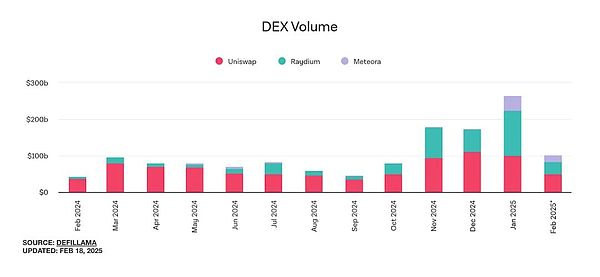
The Memecoins frenzy has driven the rapid rise of Raydium. As of January 2025, Raydium has captured 27% of the DEX market, becoming the platform of choice for retail investors. Raydium's success is inseparable from the technical advantages of the Solana chain, which provides lower fees and faster transaction speeds compared to the Ethereum chain. These features have made Raydium a core platform for Memecoins trading.
Meanwhile, Uniswap's market share has declined from 34.5% in December 2024 to 22% in January 2025, losing its dominant position in the DEX market. The high Ethereum Gas fees have become a major obstacle for Memecoins traders, causing many cost-sensitive retail investors to turn to other platforms. If Ethereum-based DEXs fail to innovate in a timely manner, they will face increasing pressure from liquidity outflows.
Although the Memecoins trading has clearly driven Raydium's growth, the sustainability of this trend remains to be observed. Some analysts believe that as the speculative demand subsides, the Memecoins trading frenzy may gradually fade. However, Raydium has become a familiar platform for users thanks to Memecoins trading. If it can seize this trend, Raydium has the potential to further consolidate its market position by strengthening liquidity pools, optimizing the user experience, and building an efficient trading system. These efforts will help Raydium maintain a long-term advantage in the competition between DEXs and CEXs.
3. CEX's Response: Can They Keep Up with the Rise of DEXs?
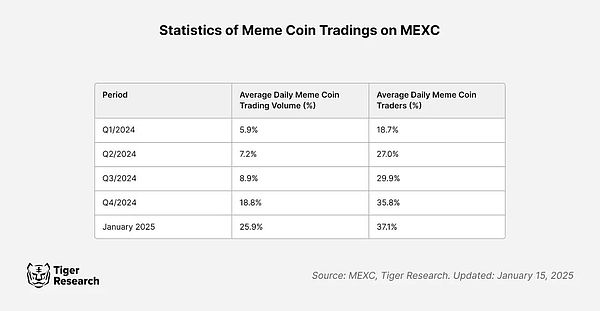
Gate.io and MEXC have successfully attracted a large number of retail investors interested in speculative assets through their focus on Memecoins listing strategies. Among them, MEXC has become a leader in this trend with its rapid Memecoins listing policy. For example, they opened trading on the day of the Memecoins Official Trump ($TRUMP) listing, which directly led to a record-breaking trading volume and user growth.
These strategies have produced significant results. MEXC's daily Memecoins trading volume has soared from 5.9% in the first quarter of 2024 to 25.9% in January 2025. Meanwhile, the proportion of Memecoins traders has increased from 18.7% to 37.1%.

As the world's largest cryptocurrency exchange, Binance is also actively expanding its Memecoins listings to attract retail liquidity. Recently, Binance has focused more on speculative assets, trying to seize the opportunities in the "attention economy." However, as a centralized exchange (CEX), Binance is inevitably constrained by its internal review processes. These processes often result in Memecoins being listed when the market hype has already subsided or shifted to new trends.
While Binance provides ample liquidity to protect investors, this liquidity has become an exit for early holders to sell their Memecoins. Due to the limited impact of these sell-offs on market prices, many newly listed Memecoins have seen their prices drop by more than 75% in the short term, causing significant losses for many investors. This not only damages Binance's long-term reputation but also raises questions about its listing review process.
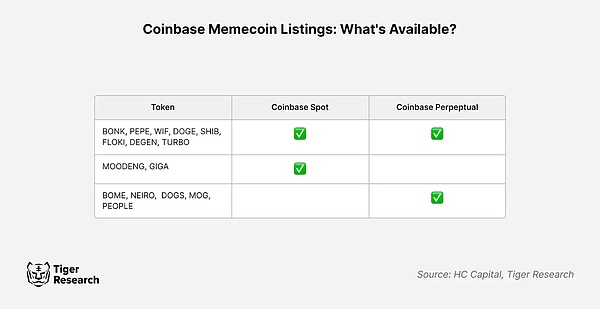
Compared to Binance, major centralized exchanges like Coinbase, Kraken, and Upbit have adopted a more conservative strategy, focusing on verified cryptocurrencies rather than Memecoins. While this strategy cannot capture the short-term high-yield market opportunities, it helps maintain platform stability and reduce regulatory risks.
The core challenge for CEXs is how to balance attracting short-term trading activity and maintaining long-term platform stability, while retaining the trust of institutional investors and effectively attracting more retail investors.
4. Strategic Summary and Future Prospects
Memecoins have evolved from being purely speculative tools to becoming an important trading asset in the cryptocurrency market. The significant growth in Memecoins trading on decentralized exchanges (DEXs) has brought new opportunities and challenges to the crypto industry.
In the recent bull market, Memecoins on DEXs have performed significantly better than assets listed on centralized exchanges (CEXs), prompting more investors to turn to DEXs. Platforms like Pump.fun have optimized the issuance and trading processes of Memecoins, allowing new tokens to experience explosive growth even without a CEX listing.
To adapt to this change, market makers, liquidity providers, and project teams are adjusting their strategies. They are no longer solely focused on CEX listings but are also paying attention to the DEX environment. They have established liquidity pools on multiple platforms, improving the accessibility and flexibility of trading.
However, the Memecoins market still faces various risks. Unethical behaviors such as rug pulls, group manipulation, and malicious trading have severely harmed investors' interests. Due to the lack of effective regulation in the market, these problems are commonplace. For example, the Libra ($LIBRA) scandal in Argentina exposed these potential risks, leading to widespread skepticism about Memecoins and a significant decline in Solana DEX trading volumes.
Nevertheless, Memecoins have demonstrated their potential in the crypto domain. They are gradually becoming representative assets for certain entities and groups. Examples include the relationship between Elon Musk and Dogecoin, the association between Trump and the Official Trump Token, and the cases of Memecoins issued by startups and countries, all of which indicate that cryptocurrencies are capturing real economic and social value. This trend is similar to the securitization process in traditional financial markets and may evolve into a new cultural phenomenon.
Faced with this change, CEX must quickly adjust its strategy. Investors no longer wait for CEX to list before trading promising assets. To attract more users and maintain competitiveness, the exchange needs to integrate on-chain functions and DeFi elements, while ensuring the stability and compliance of the platform. This flexible and innovative strategy will be the key to driving the crypto market into the next growth phase.