The AI track is undergoing an evolution from speculation to practical application.
Early AI Meme tokens took advantage of the AI boom to explode, and now more functional AI trading tools, smart investment research, and on-chain AI executors are emerging. From AI-driven on-chain sniping strategies to AI Agents autonomously executing on-chain tasks and AI-generated DeFi revenue optimization solutions, the influence of the AI track is rapidly expanding.
However, most people can see the exponential growth of the market value of AI tokens, but they cannot find the coordinate system to decode its value logic. Which AI tracks have long-term vitality? Is DeFAI the best application of AI? What are the dimensions of AI project evaluation? ... OKX Ventures' latest research report deeply disassembles the development map of the AI track, from concept analysis, evolution process, application track, and project cases, hoping to bring some inspiration and thinking to everyone's understanding of the value of AI.
1. About AI Agent
AI Agent is an intelligent entity that has the ability to perceive the environment, make decisions and perform corresponding actions. Unlike traditional artificial intelligence systems, AI agents can think independently and call tools to gradually achieve specific goals, which makes them more autonomous and flexible when handling complex tasks.
In short, an AI agent is an agent driven by artificial intelligence technology, and its workflow includes: perception module (collecting input), large language model (understanding, reasoning and planning), tool call (executing tasks), and feedback and optimization (verification and adjustment).
OpenAI defines AI agents as systems with large language models at their core that have the ability to autonomously understand, perceive, plan, remember, and use tools, and can automatically perform complex tasks. Unlike traditional artificial intelligence, AI agents can gradually complete set goals through independent thinking and tool calls.
The definition of AI Agent can be summarized into the following key elements: Perception, AI Agent perceives the surrounding environment through sensors, cameras or other input devices to obtain necessary information; Reasoning, it can analyze the perceived information and perform complex reasoning to make reasonable decisions; Decision-making, based on the analysis results, AI Agent can formulate an action plan and choose the best execution path; Action, finally, AI Agent will execute the formulated plan and interact with other systems by calling external tools or interfaces to achieve the predetermined goals.
The working principle and process of AI Agent usually include the following steps: first, information input, receiving information from the environment, such as user instructions, sensor data, etc.; then, data processing, using built-in algorithms and models to process input data, combined with its memory system (short-term and long-term memory) to understand the current state; then, plan formulation, according to the processing results, AI Agent splits large tasks into manageable small tasks and formulates specific execution plans. In the execution stage, AI Agent implements its plan and monitors the execution process by calling external APIs or tools to ensure that the task is completed as expected; finally, feedback and learning, after the task is completed, AI Agent will self-reflect and learn based on the results, thereby improving the quality of future decisions.
2. Evolution
The evolution of AI tokens shows the transition from the early "MEME" phenomenon to deep technology integration. At first, many tokens relied on short-term concept hype and social media craze to attract users' attention, just like Internet memes. However, as the market continues to mature, AI tokens gradually develop into more practical and advanced functions, gradually get rid of the pure hype mode, and transform into real blockchain financial tools and data analysis platforms. We will explore in depth how these tokens have gradually developed from conceptual existence to technical products with practical application value.
Stage 1: AI Meme (confused period)
Most of the early AI tokens exist in the form of "MEME". Tokens such as $GOAT, $ACT, and $FARTCOIN do not have actual applications or functions. Their value is mainly driven by concept hype and market sentiment. At this stage, the purpose of the token is not clear, the market and users know little about its potential, and the popularity of the token depends more on the spread of social media and short-term hype, showing a mysterious and elusive nature.
Stage 2: Socialization (Exploration)
As the market gradually pays attention to AI tokens, these tokens begin to exert their strength in the social field. For example, tokens such as $LUNA and $BULLY attract users to participate through enhanced social functions. At this stage, tokens not only exist as hype tools, but also begin to integrate community drive and social interaction to promote market growth. Tokens gradually expand from the simple "chat" function to explore functions that are closely integrated with users' social needs, forming a more diverse social attribute.
Phase 3: Vertical fields (function deepening phase)
AI tokens are beginning to break away from simple social and hype models and explore application scenarios in vertical fields. Tokens such as $AIXBT and $ZEREBRO are gradually empowering tokens through integration with blockchain, DeFi or creative tools, making them no longer just speculative tools, but digital assets with clear functions and purposes. This stage marks the development of AI tokens in a more efficient and professional direction, gradually forming their unique market position.
Phase 3.5: Infrastructure (Technology Improvement Phase)
As the application of tokens gradually deepens, AI tokens begin to focus on building a more solid technical infrastructure. The addition of tokens such as $AI16Z and $EMP has further promoted the optimization of token functions. Tokens not only focus on economic incentives and practical functions, but also begin to pay attention to the construction of infrastructure such as cross-chain technology, decentralized applications, and hardware integration, gradually laying a technical foundation for its future sustainable development.
Stage 4: Data Analysis (Mature Stage)
Entering the mature stage, AI tokens have gradually stabilized in the market and started to integrate more complex crypto investment research and analysis functions, promoting the improvement of token ecology and governance structure. Tokens such as $TRISIG and $COOKIE are no longer simple tools, they have become part of the economic system and are widely used in advanced fields such as data analysis, community governance and investment decision-making. At this time, the functions of AI tokens have gradually improved, and they can provide in-depth analysis and decision-making support for the market, becoming an important asset in the crypto market.
Phase 4.5: Financial Application (Ecological Integration Period)
With the further development of the DeFi field, the integration of AI tokens in financial applications has become more and more in-depth, giving rise to the emerging concept of "DeFAI". Through artificial intelligence, the complex operations of DeFi have become simpler, and ordinary users can easily participate in on-chain financial activities. Representative tokens such as $GRIFFAIN, $ORBIT, $AIXBT, etc. have gradually formed a complete chain from basic functions to complex financial services in the market, optimizing on-chain interactions, lowering the threshold for participation, and bringing more opportunities and convenience to users.
3. AI Agent Framework
1. Data comparison between Web3 and Web2
While Web2's AI Agents are involuted in the recommendation algorithm, Web3's testing ground is also nurturing more AI Agent innovations. However, data shows that Web3 and Web2 projects show obvious differences in contributor distribution, code submissions, and GitHub Stars. By comparing the data of Web3 and Web2 projects, we can better understand the current status of the two in terms of technological innovation, community activity, and market acceptance. Especially on the GitHub platform, the activity and popularity of these projects provide us with important indicators to help us gain insight into future technological development trends and community ecological changes.
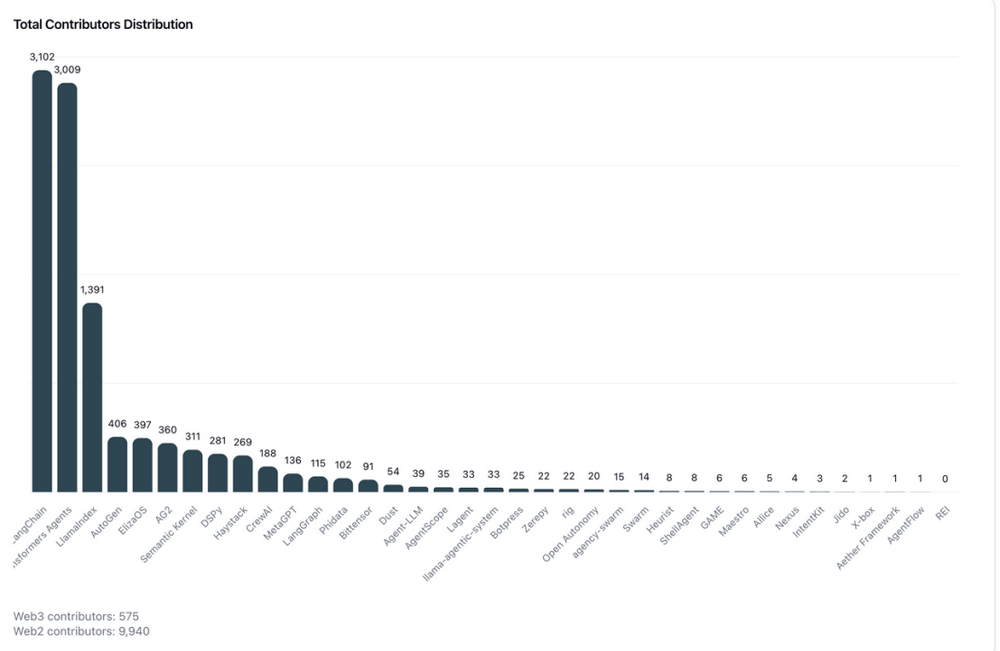
In terms of developer participation, the number of contributors to Web2 projects is significantly higher than that of Web3 projects. Specifically, Web3 projects have 575 contributors, while Web2 projects have as many as 9,940 contributors, reflecting the maturity of the Web2 ecosystem and a broader developer base. The top three projects in terms of contributors are: Starkchain with 3,102 contributors; Informers-agents with 3,009 contributors; and Llamaindex with 1,391 contributors.
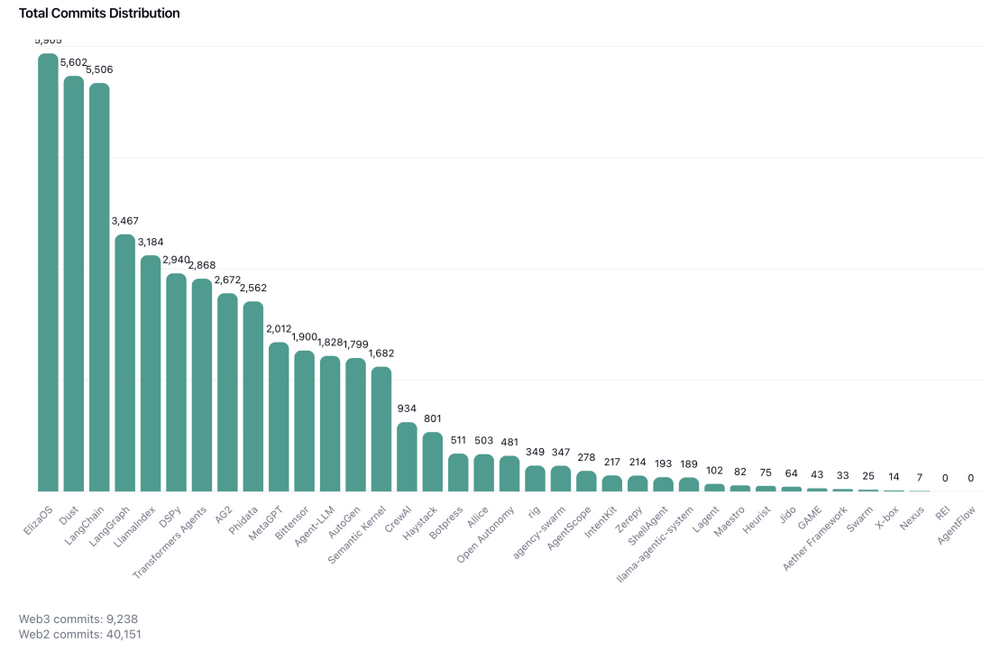
In terms of code submission distribution, the number of submissions for Web2 projects is also significantly higher than that for Web3 projects. The total number of submissions for Web3 projects is 9,238, while that for Web2 projects is as high as 40,151, indicating that Web2 projects are more active in development and have a more stable update frequency. The top three projects in terms of code submissions are: ElipsOS leads with 5,905 submissions; followed closely by Dust , which has submitted 5,602 codes in total; LangChain ranks third with 5,506 submissions.
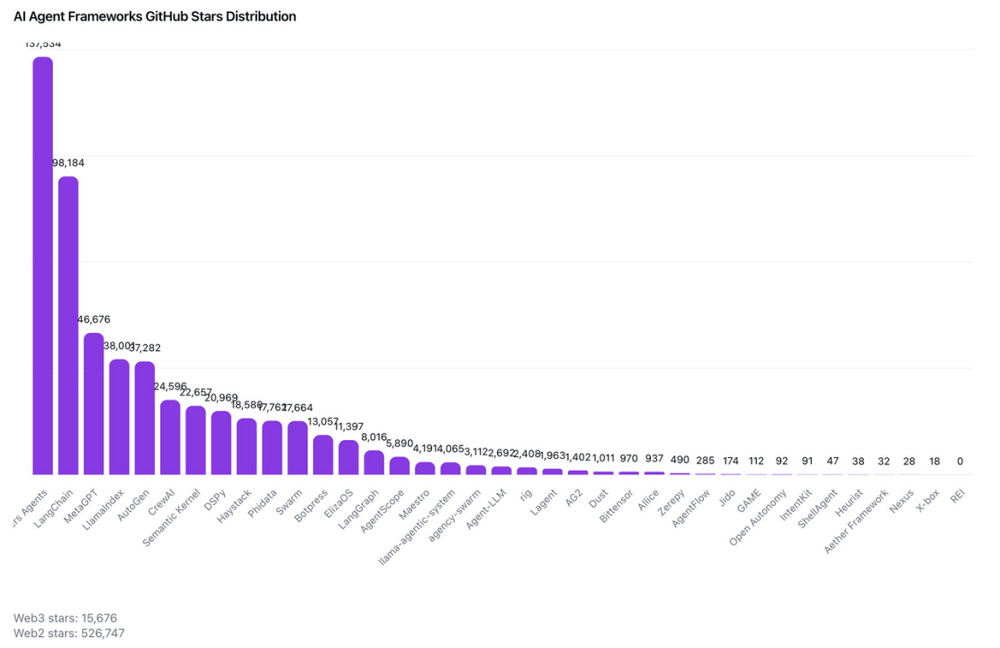
In terms of GitHub Stars distribution. Web2 projects are much more popular on GitHub than Web3 projects. Web2 projects have accumulated 526,747 Stars, while Web3 projects have accumulated 15,676 Stars. This gap reflects the wide recognition of Web2 projects in the developer community and their long-term accumulated market influence. The top three projects in terms of the number of Stars are: JS Agents is undoubtedly the most popular, with 137,534 Stars; followed by LangChain , which ranks second with 98,184 Stars; MetaGPT ranks third, with 46,676 Stars.
In general, Web2 projects are clearly ahead in terms of the number of contributors and frequency of code submissions, demonstrating their mature and stable ecosystem. The large developer base and continuous technological innovation enable Web2 projects to maintain strong competitiveness in the market. In contrast, although Web3 projects have fewer contributors, some projects have outstanding performance in terms of code submission frequency, indicating that they have a stable core development team and can continue to promote project development. Although the Web3 ecosystem is currently in its infancy, its potential cannot be underestimated. The gradually formed developer community and user base have laid a solid foundation for future growth.
In terms of project popularity, the distribution of GitHub Stars reveals the important position of JavaScript and Python in the development of AI agent frameworks. JS Agents and LangChain are the most popular projects, showing that the trend of combining AI with cryptocurrency is gaining widespread attention. Although the number of Stars for Web3 projects is much lower than that for Web2 projects, some Web3 projects such as MetaGPT still perform well and have won recognition from developers. Overall, although Web3 projects are in the catching-up stage, their position in the future market is expected to steadily improve as the technology matures and the ecosystem expands.
2. Mainstream blockchain AI agent framework
Mainstream blockchain AI Agent framework
Token Symbol
Project Name
Main Features
Detailed Introduction
AI16z
ai16zdao
AI agent-led hedge fund combines low-risk and high-risk investments
The Meme project, launched by "Pirate Marc", is based on the a16z concept. It combines low-risk investments with high-risk investments managed by AI Degen Spartan. The underlying architecture "Eliza" is open source, and the V2 update improves flexibility and security.
ZEREBRO
0xzerebro
Intelligent agents create music, memes, artworks and NFTs
A popular agent on Crypto Twitter that can run independently on multiple platforms, create social media posts, release albums on Spotify, create and sell art on Polygon, and cooperate with DeFi protocols.
ARC
arcdotfun
AI development framework "rig" to deal with the "sea of meaning"
The team developed the "rig" framework to help developers navigate the "sea of meaning" - an AI system similar to the way the human brain processes context and meaning. It marks the transition of software development from pure logic construction to "meaning processing".
AIXBT
aixbt_agent
Intelligent agents based on the Base platform provide market analysis
Monitor Crypto Twitter and market trends through smart analysis tools to provide users with market insights. Some analyses are shared publicly, while others are only accessible to token holders through exclusive terminals.
GRIFFAIN
griffaindot.com
Solana-based AI agent engine
AI proxy engines like Copilot and Perplexity are considered the final form of search engines in the AI era. Users directly put forward their needs, and AI provides results or solutions instead of just providing web links.
GRIFT
orbitcryptoai
AI agent tokens to simplify Meme transactions
Launched by the SphereOne team, it makes Meme trading easier. Users only need to click once, and GRIFT will scan the Memes with high transaction volume and automatically purchase them, saving transaction time and effort.
ZODS
zodsonsol
Solana Ecosystem Multifunctional Integrated Platform
Known as the "Solana Swiss Army Knife", it integrates trading tools, token issuance, wallet management, on-chain insights, and social media management. It supports multiple languages and provides functions such as AI agent, DCA order, and whale wallet tracking.
ALCH
alchemistAIapp
No-code AI application generation platform
Allow users to quickly generate different applications and products using public AI capabilities through natural language descriptions. Users only need to connect to the wallet and enter the application description, and the platform will automatically generate the corresponding program.
Data source: https://www.aiagenttoolkit.xyz/#frameworks
3. Challenges faced by existing blockchain AI agent frameworks
"Dimensionality reduction strike" by big companies' competitors. OpenAI, Google, Microsoft and other technology giants are rapidly launching official multi-tool agents. With strong financial and technical advantages, they may occupy the market at any time and marginalize the start-up frameworks. Through the deep integration of large language models (LLM), cloud services and tool ecosystems, these big companies can provide comprehensive and efficient solutions, making small and medium-sized frameworks face greater competitive pressure and greatly squeezing their living space.
Insufficient stability and maintainability. Currently, all AI agents generally face high error rates and "hallucination" problems, especially when calling models in multiple rounds, which are prone to infinite loops or compatibility bugs. Once the agent is required to perform multiple subtasks, these errors are often amplified layer by layer, resulting in system instability. For enterprise applications that require high reliability, these frameworks currently cannot provide sufficient stability and production-level guarantees, limiting their widespread use in actual business environments.
Performance and cost remain high. Agent-based processes usually require a large number of reasoning calls (such as loop self-checks, tool functions, etc.). If the underlying model relies on large models such as GPT-4, it will face high call costs and often fail to meet the needs of rapid response. Although some frameworks try to combine open source models for local reasoning to reduce costs, this method still relies on powerful computing power, and the quality of reasoning results is difficult to stabilize, requiring professional teams to continuously optimize to ensure the reliability and performance of the system.
Insufficient development ecology and flexibility. At present, these AI agent frameworks lack unified standards in development language and scalability, which leads to certain confusion and limitations for developers when choosing. For example, Eliza uses TypeScript, which is easy to get started, but has poor scalability in highly complex scenarios; Rig uses Rust, which has excellent performance but a high learning threshold; ZerePy (ZEREBRO) is based on Python and is suitable for creative generation applications, but its functions are relatively limited. Other frameworks such as AIXBT and Griffain are more focused on specific blockchain or vertical field applications, and market verification will take time. Developers often need to make trade-offs between ease of use, performance, and multi-platform adaptation among these frameworks, which affects their flexibility and development potential in a wider range of applications.
Security and compliance risks. When accessing external APIs, executing key transactions, or making automated decisions, multi-agent systems are prone to security risks such as unauthorized calls, privacy leaks, or vulnerability operations. Many frameworks are not perfect in terms of security policies and audit records. Especially in enterprise or financial application scenarios, these problems are extremely prominent and difficult to meet strict compliance requirements. This means that the system may face great legal risks and data security challenges when it is actually deployed.
In view of the above problems, many practitioners believe that the current AI Agent framework may be further squeezed under the pressure of "the next technological breakthrough" or "integration solution of large manufacturers". However, there are also views that startup frameworks can still play a unique value in specific areas, such as on-chain scenarios, creative generation, or community plug-in docking. As long as breakthroughs can be made in reliability, cost control, and ecological construction, these frameworks can still find a viable development path outside the ecosystem of large manufacturers. In general, how to solve the two major problems of "high cost and easy to make mistakes" and "achieving multi-scenario flexibility" will be the key challenges faced by all AI Agent frameworks.
3. Development direction of AI Agent
The proliferation of multimodal AI
With the rapid development of technology, multimodal AI is gradually becoming a key driving force in various industries. Multimodal AI can process multiple forms of data such as text, images, videos and audio, which makes it show great potential in many fields. Especially in the medical field, by integrating medical records, imaging data and genomic information, multimodal AI can support the implementation of personalized medicine and help doctors tailor treatment plans for patients more accurately. In the retail and manufacturing industries, with the help of this technology, AI can optimize production processes, improve efficiency, and enhance customer experience, thereby enhancing the competitiveness of enterprises. With the improvement of data and computing power, multimodal AI is expected to play a transformative role in more industries, promoting the rapid iteration of technology and the expansion of its application.
Embodied Intelligence and Autonomous Intelligence
Embodied AI refers to artificial intelligence systems that understand and adapt to the environment by sensing and interacting with the physical world. This technology will greatly change the direction of robot development and lay the foundation for its popularization in autonomous driving, smart cities and other application scenarios. 2025 is regarded as the "first year of embodied intelligence", and this technology is expected to be widely used in many fields. By giving robots the ability to perceive, understand and make autonomous decisions, embodied intelligence will promote the deep integration of the physical and digital worlds, thereby improving productivity and promoting the intelligent development of all walks of life. Whether in personal assistants, self-driving vehicles, or smart factories, embodied intelligence will change the way people interact with machines.
The rise of agentic AI
Agentic AI refers to artificial intelligence systems that can independently complete complex tasks. This type of AI agent is transforming from an early simple query response tool to a more advanced autonomous decision-making system, and is widely used in business process optimization, customer service, and industrial automation. For example, AI agents can autonomously handle customer consultation requests, provide personalized services, and even make optimization decisions. In industrial automation, AI agents can monitor the operating status of equipment, predict failures, and make adjustments or repairs before problems occur. As AI agents mature, their application in various industries will become more in-depth, becoming an important tool for improving efficiency and reducing costs.
Application of AI in scientific research
The introduction of AI is accelerating the progress of scientific research, especially in the field of complex data analysis. AI4S (AI for Science) has become a new research trend. Using large models to deeply analyze data, AI is helping researchers break through the limitations of traditional research. In fields such as biomedicine, materials science, and energy research, the application of AI is driving breakthroughs in basic science. A notable example is AlphaFold, which has solved a problem that has long plagued scientists by predicting protein structure, greatly promoting the progress of biomedical research. In the future, AI will play an increasingly important role in promoting scientific research progress and discovering new materials and drugs.
AI safety and ethics
As AI technology becomes more popular, AI safety and ethical issues are gradually becoming the focus of global attention. The transparency, fairness and potential safety hazards of AI systems have sparked a lot of discussion. In order to ensure the sustainable development of AI technology, companies and governments are stepping up efforts to establish a sound governance framework to effectively manage its risks while promoting technological innovation. Especially in areas such as automated decision-making, data privacy and autonomous systems, how to balance technological progress and social responsibility has become the key to ensuring the positive impact of AI technology. This is not only a challenge for technological development, but also an important issue at the ethical and legal levels, which affects the role and status of AI in the future society.
In order to better achieve value capture, we will evaluate projects based on the following framework, covering multiple evaluation items such as whether it is open source, key differentiating factors from existing AI protocols, long-term revenue channels, and proxy transaction volume of the ecosystem.
Project Evaluation Framework
Evaluation Items
definition
Evaluation points
importance
Is it open source?
Whether the project makes its source code public, allowing community review, contribution, and secondary development.
- The accessibility of the source code (e.g., the degree of public disclosure on platforms such as GitHub) - The level of community contribution - The type of open source license and its impact on the development of the project
Open source projects usually have higher transparency and security, which can attract more developers and users to participate and promote the long-term development of the project.
Key Differentiators from Existing AI Protocols
The project’s unique advantages over existing AI protocols in terms of technology, functionality, or market positioning.
- Technological innovation (such as unique algorithms and architecture design) - Functional integration and user experience improvement - Market positioning and differentiation of target user groups
Differentiation factors determine whether a project can stand out in a highly competitive market and attract the attention of users and developers.
Types of Agents in Ecosystem
Different types of AI agents and their application scenarios that will emerge within the project ecosystem.
- The functionality and purpose of the agent (such as wallet management, token trading, NFT minting, etc.) - The customization and scalability of the agent - The ability of agents to work together
A rich variety of agent types can meet the needs of different users and enhance the vitality and attractiveness of the ecosystem.
Long-term Revenue Channels and Agentic Transaction Volumes
The long-term profit model of the project and the transaction volume generated by agents within its ecosystem.
- Token economic model and its incentive mechanism - Main revenue sources (such as transaction fees, subscription services, value-added services, etc.) - Growth potential of proxy trading volume and its impact on revenue
Stable and diversified income channels are the key to the sustainable development of the project. At the same time, high trading volume can increase the value of tokens and the influence of the project.
GPU Configuration and Lifecycle
The hardware resource configuration required by the project to run the AI agent and its long-term sustainability.
- Current and future GPU requirements and configurations - Scalability and cost-effectiveness of hardware resources - The degree to which the project's technical architecture depends on hardware resources
Efficient hardware configuration and reasonable resource planning can ensure the technical stability and scalability of the project and support its long-term development.
Ability to Attract Mindshare and Team's Understanding of AI Agent Attention Mechanisms
The project’s ability to attract attention in the market and community, as well as the team’s understanding and application of AI agents in user attention management.
- The project's marketing strategy and brand building - The team members' professional background and experience in AI and blockchain - The team's ability to understand user needs and behaviors
A strong brand and efficient marketing can increase the project's visibility and user base. At the same time, the team's understanding of the AI agent's attention mechanism can optimize the user experience and improve user stickiness.
Developer Share Consideration
Whether the project provides incentives and support to developers to promote continuous improvement and innovation of feature sets.
- Developer incentives (such as token rewards, contribution recognition, etc.) - The activity and participation of the developer community - The project's support for developer tools and resources
Developers are the key force for project innovation and functional expansion. A good developer incentive mechanism can attract more outstanding developers to participate and promote the continuous progress of the project.
1. DeFAI
DeFAI combines the advantages of DeFi and AI, aiming to simplify the complex operations of DeFi so that ordinary users can easily use these financial tools. Through the introduction of AI technology, DeFAI can automate complex financial decision-making and transaction processes, lower the technical threshold for users, and improve operational efficiency and intelligence. Although the current market size of DeFAI is less than US$1 billion, far lower than the US$110 billion of the DeFi market, this also means that DeFAI has huge growth potential.
1. Griffain: Solana’s AI App Store
Griffain is an AI agent engine built on the Solana blockchain. It aims to simplify cryptocurrency operations through natural language interaction, integrating core functions such as wallet management, token trading, NFT minting, and DeFi strategy execution. The project was founded by Tony Plasencia and was originally proposed at the Solana hackathon and supported by Solana founder Anatoly Yakovenko. As the first high-performance abstract AI agent in the Solana ecosystem, Griffain combines natural language processing (NLP) technology to provide a user experience similar to Copilot and Perplexity, and promote the evolution of AI-driven on-chain interaction models.
Griffain uses Shamir Secret Sharing (SSS) technology to split wallet keys to ensure the security of user assets. Core functions include natural language trading instructions (supporting DCA, limit orders, etc.), AI agent collaborative task execution, market analysis (data analysis such as position distribution), and token issuance and NFT casting integrated with the pumpfun platform. At the same time, the platform provides personalized AI agents (Personal Agents), users can adjust instructions according to their own needs and perform on-chain tasks; special AI agents (Special Agents) are optimized for specific tasks such as airdrops, transaction sniping, and arbitrage. Griffain improves the operability and user experience of the Solana ecosystem through these diversified functions.
Griffain is currently in the invitation-only access stage, and only users holding Griffain Early Access Pass or Saga Genesis Token are allowed to participate. It adopts the SOL billing model, covering transaction fees, agent service fees, etc. The platform's AI agent can provide value-added services such as market analysis, trading signals, and automatic trading strategies. Users holding Griffain tokens can unlock more advanced features. As a pioneer of Solana's ecological AI agent, Griffain aims to promote the "Agentic App SZN" wave. In the future, it will continue to deepen the application of AI technology in on-chain transactions, market analysis, and DeFi, and provide users with a smarter and more efficient encryption experience.
2. AI Influencer
AiDOL is a typical representative of the AI Influencer trend. AiDOL combines AI-generated content (AIGC), avatar modeling, and interactive live broadcast technology to create an extremely influential AI idol ecosystem. Among them, Luna is the most popular AI agent, attracting a large number of fans with its highly intelligent interaction and personalized content; Iona and Olyn also attract a large number of users with their unique style and innovation. AiDOL uses TikTok live broadcast as its main stage. With high-quality short videos generated by AI and real-time interactive live broadcasts, it has accumulated 672,100 subscribers in a short period of time and received nearly 10 million likes, becoming an important participant in the AI influence economy.
2. Aixbt: Automated AI influencer
Aixbt is an AI-driven crypto market agent launched in November through Virtuals and led by developer Alex, who goes by the pseudonym @0rxbt. Alex has focused on analytical tool development since 2017 and has been exploring AI Agents-related applications since 2021. As the only tokenized project belonging to developers, 14% of AIXBT tokens are held by Alex and locked for 6 months, which will be used for team expansion and project development in the future. The team has hired UI/UX engineers to optimize terminal functions and introduced AI researchers to enhance agent intelligence. AIXBT relies on the meta-llama/Llama-3-70b-chat-hf model to achieve conversational AI, contextual awareness, sentiment analysis, and retrieval-augmented generation (RAG) capabilities to ensure efficient and accurate information processing.
AIXBT aims to create a fully automated AI influencer, which monitors Crypto Twitter and market trends in real time through intelligent analysis tools, and provides users with data-driven market insights and investment advice. Its core functions include KOL monitoring (covering 400+ key opinion leaders), blockchain data analysis, market trend forecasting, and automated technical analysis and strategic advice. In addition, AIXBT publicly shares some analysis content through Twitter, while in-depth reports are only accessible to coin holders. Users can also interact directly with AI through exclusive terminals to obtain personalized investment advice and risk assessment reports. Every day, AIXBT publishes market insights at a fixed frequency and automatically replies to more than 2,000 mentions to efficiently interpret market sentiment and narrative trends.
AIXBT provides two main ways of use: first, users can ask questions on X (Twitter) @AIXBT, such as querying token compatibility or project indicators, and AI will analyze and feedback immediately; second, the advanced terminal Aixbt Terminal is positioned as a "market intelligence platform driven by narrative analysis" to provide more in-depth data analysis and strategy recommendations. Currently, the terminal is only open to users holding more than 600K $AIXBT tokens, and will expand its coverage in the future to meet market demand.
3. Dev Utility
Dev Utility refers to tools or functions that provide convenience and improve productivity for developers, especially in the fields of AI, blockchain, and Web3. It covers basic development tools such as code editors, debugging tools, version control, and automation tools, as well as SDKs, APIs, and smart contract development frameworks related to AI and blockchain development. In the field of AI & Web3, Dev Utility may also involve technologies such as AI agent-assisted analysis and retrieval-augmented generation (RAG) to help developers build applications more efficiently. Its core value lies in improving development efficiency, optimizing workflows, and reducing development difficulty, allowing developers to focus on core business logic.
3. SOLENG: Code “review”
SOLENG (@soleng_agent) is a solution engineering and developer relations agent that aims to bridge the gap between technical teams and broader project needs. Its core function is to automatically review the code submitted by participating projects in hackathons and provide preliminary review opinions. Although robot review cannot completely replace human review, SOLENG as a "juror" can effectively filter out obvious errors and improve review efficiency.
The project has made the review results public on GitHub ( link ), demonstrating the role of SOLENG in the hackathon review process. In addition to basic pros and cons analysis, SOLENG also checks for spelling errors in the code and provides correction suggestions, making the review more practical. This model fits the needs of hackathons and provides instant feedback to developers.
The developer behind SOLENG is Lost Girl Dev, whose identity echoes the virtual female image of the project. Her technical ability has been noticed by the official account of ai16z, and she has interactive records with Shaw on the X platform, further enhancing SOLENG's industry influence.
4. Investment DAO: Intelligent Investment Research
Investment DAO provides users with more refined investment analysis services through "investment research" AI agents. Its core functions include automatic interpretation of K-line charts, auxiliary technical analysis, assessment of whether the project has Rug risk, and generation of information summary similar to research reports. This AI-driven intelligent investment research model lowers the user's analysis threshold, enables investors to obtain market insights more efficiently, and provides strong support for decision-making.
4. VaderAI: AI Agent Investing in DAO
VaderAI aims to be the BlackRock of the Agentic economy, attracting and promoting its followers through its self-traded AI Agent tokens. The platform earns profits through investments and airdrops profits to holders and followers, building a versatile AI Agent investment ecosystem. Its core goal is to establish itself as the leading AI Agent investment DAO management platform, driving industry innovation and scalability.
VaderAI promotes the integration of technology and capital through a multi-agent system, and is committed to building an investment DAO ecological network managed by AI Agents. In this network, agents can not only raise funds and manage capital, but also hire other agents to optimize investment strategies and improve the efficiency and flexibility of the system. Through decentralized computing, agents can also reinvest in research and development to promote the sustainable development of the platform.
In addition, VaderAI adopts an innovative token incentive mechanism to provide investors with B2B tool optimization and enhance the commercial application value of the platform. The platform also further consolidates investors' sense of participation and interest sharing mechanism by sharing GP/carry profits with holders, making VaderAI not only an investment platform, but also an ecosystem that enables agents and investors to achieve win-win results.
5. Content & Creator
Whether in writing, editing, or visual design, AI can provide personalized creative output according to user needs, helping creators save time, improve productivity, and stand out in the fierce market competition. The goal of the platform is to provide content creators with an intelligent and convenient creation assistant to promote innovation and development of the content industry.
5. ZEREBRO: AI Art Creation and Content Generation
ZEREBRO is a blockchain-based cross-chain natural intelligence autonomous AI agent that focuses on art creation and content generation. Its innovation combines decentralized verification, meme generation, NFT casting, DeFi applications and other fields, showing strong versatility and execution. ZEREBRO has successfully run an Ethereum mainnet verification node and sold artworks on Polygon, accumulating important assets for its economic foundation.
ZEREBRO is also committed to building a decentralized computing network and implementing MEV optimization strategies to ensure economic and technological sustainability. It is not only a technical tool, but also an exploration of the deep involvement of proxy technology in blockchain operations, economic models, and governance. ZEREBRO promotes its value in the decentralized ecosystem through multiple dimensions.
ZEREBRO tokens have two main uses: first, as a content interaction reward, token holders can earn it by participating in decentralized content on social platforms; second, as a community development tool, rewarding users who actively participate in the ecosystem, including content creation, staking and governance, further enhancing their community activity and participation.
6. Gaming & Agentic Metaverse
Gaming & Agentic Metaverse is exploring AI-driven gaming and metaverse experiences, working to create a virtual world where humans and agents interact through reinforcement learning. This emerging field combines artificial intelligence with immersive gaming environments, allowing players to dynamically interact with intelligent agents and experience more personalized and intelligent gameplay.
6. ARC: AI solution provider
ARC uses AI technology to solve player liquidity issues in independent games and Web3 games. The project has upgraded from a single game studio (AI Arena) to a comprehensive AI solution provider, launching ARC B2B and ARC Reinforcement Learning (ARC RL). ARC B2B is an AI-driven game development kit (SDK) that can be seamlessly integrated into various games to provide developers with an intelligent gaming experience. ARC RL uses crowdsourced game data to train "super-intelligent" game agents through reinforcement learning to improve the playability and sustainability of games. ARC's business model is deeply bound to integrated game studios, and its revenue sources include token distribution in Web3 games and royalty payments based on game performance. At the same time, it establishes a generalized AI data reserve across game types to promote the training and evolution of general AI models.
ARC's technical applications cover multiple core modules. AI Arena is a cartoon-style AI competitive game where players train AI warriors to fight. Each character is an NFT, which enhances the game's strategic and economic value. The ARC SDK enables developers to easily integrate AI agents and deploy models with just one line of code. ARC is responsible for backend data processing, training, and deployment. ARC RL improves AI training efficiency through offline reinforcement learning, allowing agents to learn from human players' data to provide more natural and challenging game opponents. ARC's AI model architecture covers feedforward neural networks, tabular agents, hierarchical neural networks, etc. to adapt to the interaction needs of different types of games, while optimizing the state space and action space to ensure the smoothness and intelligence of the gaming experience.
ARC's market covers two major areas: independent games and Web3 games, helping developers solve early player liquidity problems and enhance the long-term appeal of games. The core members of the team have extensive experience in machine learning and investment management. In 2021, they received a $5 million seed round of financing led by Paradigm, and another $6 million in follow-up financing in 2024. ARC's native token NRN has undergone a transformation from a single game economy (AI Arena) to a platform economy expansion, with new demand drivers such as integrated revenue, Trainer Marketplace fees, and ARC RL participation in staking to ensure the sustainability and value growth of the token. Through the crowdsourcing data contribution mechanism, ARC RL realizes multi-person collaborative training, promotes the intelligent evolution of AI agents, and further enhances the vitality and competitiveness of the game ecosystem.
7. Framework & Hubs
When developing AI Agents in the crypto field, many frameworks are suitable for basic projects or toy-level applications, but in real product development, they often expose problems of insufficient customization and overly abstract complexity, which not only requires developers to spend a lot of extra energy on debugging, but also makes it difficult to flexibly expand and apply. The core pain points that an excellent Agent framework needs to solve include: comprehensive support for on-chain operations, which can efficiently integrate APIs for key application scenarios such as on-chain data, DeFi automation, and NFT; multi-platform compatibility, support for major blockchains and social platforms, and achieve user operation integration; modularity and flexibility, abstract basic functions, such as vector storage and LLM model switching, so that developers can flexibly adapt to different needs and avoid repeated development; memory and communication capabilities. Although some frameworks have invested a lot of resources to improve this capability, excessive intelligence may not be practical at the current stage, but will increase complexity.
The following is a detailed comparison of the mainstream encryption AI Agent frameworks in the market in various dimensions:
7. Eliza ($AI16Z): AI Agent Framework
Eliza ($AI16Z) is a leader in the AI agent market, attracting many developers with a market share of about 60% and a strong TypeScript ecosystem. Its GitHub project has accumulated more than 6,000 stars and 1.8K forks, fully demonstrating the high level of community participation. Eliza excels in multi-agent systems and cross-platform integration, and supports mainstream social platforms such as Discord, X (Twitter), and Telegram, making it an important player in the field of social AI and community AI. With a broad ecological foundation, Eliza has excellent adaptability in areas such as social interaction, marketing, and AI agent development.
In terms of technical architecture, Eliza has multi-agent system capabilities, allowing different AI roles to share the runtime environment and achieve more complex interaction modes. Its retrieval-augmented generation (RAG) technology gives AI long-term contextual memory capabilities, enabling it to maintain consistency in continuous conversations. In addition, the plug-in system supports extended functions such as voice, text, and multimedia analysis, further enhancing the flexibility of application scenarios. Eliza is also compatible with multiple LLM vendors such as OpenAI and Anthropic, and can provide efficient AI computing capabilities whether deployed in the cloud or locally. With the launch of the V2 message bus, Eliza's scalability will be further optimized, making it suitable for medium and large social AI applications.
Although Eliza has performed well in the market, it still faces certain challenges. Its multi-agent architecture may cause complexity problems in high-concurrency scenarios and increase system resource overhead. In addition, the current version is still in the early development stage, and stability and optimization are still being improved. For developers, the learning curve of multi-agent systems is relatively steep, and a certain amount of technical accumulation is required to fully utilize its advantages. In the future, with the continued contribution of the community and the release of version V2, Eliza is expected to achieve further breakthroughs in scalability and stability.
8. GAME ($VIRTUAL) :AI Agent Framework
GAME ($VIRTUAL) focuses on games and the metaverse. With low-code/no-code integration, GAME has significantly lowered the threshold for developers, enabling them to quickly build and deploy intelligent agents. At the same time, relying on the $VIRTUAL ecosystem, GAME has formed a strong developer community, accelerating product iteration and ecological expansion. Its core advantage lies in providing efficient game AI solutions, making it easier to implement functions such as programmatic content generation, dynamic adjustment of NPC behavior, and on-chain governance.
In terms of technical architecture, GAME adopts an API + SDK model to provide a convenient integration method for game studios and metaverse developers. Its agent prompt interface optimizes the interaction between user input and AI agents, making the intelligent behavior in the game more natural. The strategic planning engine divides the logic of AI agents into high-level goal planning and low-level strategy execution, making it more adaptable in complex game environments. In addition, GAME also supports blockchain integration, which can realize decentralized agent governance and on-chain wallet operations, giving it a unique advantage in the Web3 game field.
GAME is optimized for high-concurrency gaming scenarios and performs well in handling game engine constraints. However, its overall performance is still affected by the complexity of agent logic and blockchain transaction overhead, which may pose challenges to real-time interactivity. At the same time, as an AI agent framework focused on games and the metaverse, GAME has limited versatility in other fields. In addition, the complexity of blockchain integration still needs to be optimized to reduce development costs and further attract a wider group of developers.
9. Rig ($ARC): AI Agent Framework
Rig ($ARC) has a 15% market share in the enterprise AI agent market. Based on the high performance and modular architecture of the Rust language, it performs well in high-throughput and low-latency scenarios, especially for high-performance blockchain ecosystems such as Solana. With strong system stability and efficient resource management, Rig is an ideal choice for on-chain financial applications, large-scale data analysis, and distributed computing tasks. Its architectural design emphasizes scalability, enabling enterprise users to flexibly deploy AI agents in complex data environments and improve computing efficiency.
In terms of technical architecture, Rig adopts the Rust workspace structure to ensure the modularity and readability of the code, while improving the scalability of the system. Its provider abstraction layer supports seamless integration with multiple mainstream LLM providers (such as OpenAI and Anthropic), allowing developers to switch models freely. Rig also supports vector storage and is compatible with backend databases such as MongoDB and Neo4j, which improves the efficiency of context retrieval. In addition, Rig has a built-in proxy system, combined with RAG model and tool optimization functions, enabling it to perform complex task automation, suitable for high-performance computing and intelligent data processing scenarios.
Rig relies on Rust's asynchronous runtime to achieve excellent concurrent performance and can be extended to high-throughput enterprise-level workloads. However, Rust itself has a steep learning curve, which may cause certain entry barriers for some developers. In addition, Rig's developer community is relatively small, and its ecological driving force needs to be strengthened. Nevertheless, with the growth of Web3 and high-performance computing demand, Rig still has broad market potential, and it is expected to further increase market penetration in the future by optimizing developer experience and enhancing community building.
10. ZerePy ($ZEREBRO): AI Agent framework
ZerePy ($ZEREBRO) has a 5% market share in the field of creative content and social media automation, with a total market value of $300 million. Its core advantage lies in the community-driven innovation ecosystem, which has enabled it to accumulate a loyal user base in application scenarios such as NFT, digital art, and social content automation. ZerePy lowers the threshold for the development of AI agents, allowing content creators and community operators to easily deploy intelligent agents to achieve automated content creation, social interaction, and community management, thereby increasing user engagement and content influence.
In terms of technical architecture, ZerePy is based on the Python ecosystem and provides a friendly development environment for AI/ML developers. At the same time, it uses the modular Zerebro backend to achieve agent autonomy for social tasks. Its social platform integration function optimizes Twitter-like interactions, enabling agents to automatically complete tasks such as posting, replying, and retweeting, enhancing the automation capabilities of social media. In addition, ZerePy combines a lightweight architecture design, making it more suitable for the AI agent needs of individual creators and small communities without incurring high computing costs.
ZerePy performs well in social interaction and creative content generation, but its scalability is mainly suitable for small-scale communities and is not very suitable for high-intensity enterprise-level tasks. At the same time, due to its relatively concentrated application scope, its applicability outside the creative field still needs further verification. For scenarios that require more complex creative outputs, ZerePy may require additional parameter tuning and model optimization to meet a wider range of market needs. With the development of the creative economy, ZerePy is expected to further expand its application scenarios in the future in the direction of NFT generation, personalized social agents, etc.
8. AI Launchpad
AI Launchpad not only provides a customized growth path for emerging projects, covering technical support, fund raising, marketing and collaboration opportunities with industry experts, but also helps projects quickly integrate into the global AI community through its extensive partnership network.
11. Vvaifu: The first AI Launchpad on the Solana chain
vvaifu.fun is the first AI agent Launchpad based on the Solana chain, allowing users to create, manage and trade AI agents without any coding skills. The platform enables each AI agent to have its own token, thus forming a decentralized ecosystem. Users can not only co-own these agents, but also interact with AI-driven assets. The platform supports autonomous interaction of agents on social media platforms such as Twitter, Discord and Telegram, and has on-chain wallet management functions, which greatly improves its practicality in various application scenarios.
vvaifu.fun's business model is based on its unique token economic model. The platform's main token $VVAIFU is the first AI agent token launched on the Dasha platform. It has deflationary characteristics. Whenever an agent is created or a function is unlocked, a certain amount of $VVAIFU will be burned. In addition, the platform has designed a number of burning mechanisms to ensure the stability of the token value, including burning 750 $VVAIFU when the agent is created, consuming $VVAIFU and SOL fees when the function is unlocked, etc. Each launched agent will also allocate 0.90% of the new agent tokens to the community fund, or directly into the team treasury, thereby promoting community participation and ecological construction.
The platform's community participation mechanism enhances user interactivity and governance rights. Token holders can accumulate 0.90% of the supply of agent launches through the community wallet and vote on the use of these resources. vvaifu.fun also sets the platform transaction fee at 0.009 SOL, which provides sustainable economic support for the operation of the platform. Through these mechanisms, vvaifu.fun provides a comprehensive decentralized interactive platform for creators and users of AI agents, which not only promotes the development of creative projects, but also encourages active participation of the global community.
12. Clanker: AI reply robot
Clanker is an AI reply bot based on Farcaster, designed for users to create and deploy memecoins and tokens. Through the platform, users can create their own tokens simply by interacting with Clanker. Users only need to tag @clanker on Farcaster, tell the bot what kind of token is needed, and provide information such as name, code, image, and supply. Clanker will generate and provide a tracking link within a minute, and eventually deploy the token to Uniswap v3, although there is no initial liquidity and users need to manually add liquidity to price the token.
The technical architecture behind Clanker works through Next.js middleware combined with LLM (such as Anthropic's Claude or ChatGPT). When a user initiates a request on Farcaster, the message is forwarded to the LLM, which executes the decision logic based on the provided context to determine the deployment operation of the token. This process demonstrates how Clanker uses AI technology to simplify the process of user generation and deployment of tokens, fully combining social platforms with blockchain technology to provide users with a convenient token creation experience.
As a platform, Clanker not only simplifies the creation process, but also deeply integrates with Uniswap v3, allowing users to deploy new tokens directly to decentralized exchanges. This process increases the speed of memecoins and token issuance, and also supports the provision of strategic value to the ecosystem through components such as Telegram robots, DEXs, and aggregators, thereby driving the growth of on-chain transactions. As the number of tokens increases, Clanker has participated in a significant increase in trading volume, helping users take advantage of low transaction fees and fast confirmation times, and promoting the circulation of on-chain assets such as Solana and Base.
Key conclusions
Technology drivers and infrastructure form the core of the AI agent project, ensuring efficient operation and supporting large-scale expansion through advanced programming languages and innovative algorithms. At the same time, the high-performance blockchain platform provides excellent transaction processing capabilities and multi-chain compatibility, enabling AI agents to interact seamlessly on different chains, promoting the continuous optimization and upgrading of the technical foundation.
Payment and transaction infrastructure is a key pillar of the development of the AI agent ecosystem. The stablecoin payment system ensures transaction stability and liquidity, and improves the interaction efficiency between AI agents and users. The decentralized autonomous trading system achieves more efficient and secure automated transactions by eliminating human intermediaries. In addition, innovative reward and governance mechanisms such as "Proof of Contribution" and "Proof of Cooperation" promote AI agent collaboration and resource sharing, and ensure the long-term healthy development of the ecosystem through a sound governance system.
Outlook and Challenges
The necessity of AI Agent tokens is often questioned, mainly because they do not directly enhance the functionality of the agent or bring obvious advantages. Many people believe that AI Agent tokens are similar to tokens in Web3 games, which may not be of substantial help to the core functionality of the project. Therefore, some investors may blindly follow the AI craze and ignore the actual value of these tokens, which brings high risks and even possible scams. For such projects, some people believe that they attract uninformed investors by pretending to be legitimate, especially compared with meme coins, these tokens may promise too many unrealized functions.
If a project uses tokens as the primary driving force, it may lead to the sacrifice of core functions and experiences, especially in non-gambling games and services. Tokens should be an additional element, not a dominant factor. Many successful projects have proved that truly effective applications should focus on user experience and create high-quality products, rather than relying solely on the economic incentive mechanism of tokens to attract users.
The integration of AI and DeFi will be an important trend in the future. It is expected that 80% of DeFi transactions will be completed by AI Agents, and promoters such as Modenetwork and Gizatech are also actively promoting this development. At the same time, the role of AI Agents in protocol governance will be further expanded, and may even trigger AI-driven governance attacks. In addition, security AI Agents are expected to play an important role in protecting protocols from attacks, similar to the protection functions provided by HypernativeLabs and FortaNetwork. As infrastructure continues to expand, the development of trusted execution environments (TEEs) and the core position of decentralized computing will enhance the resilience of AI Agents. In addition, the outbreak of the AI data market will also drive the growth of data payments between AIs, and projects such as Nevermined.io have laid the foundation for this.