


In the recent primary market, the public chain Sonic led by the "DeFi Godfather" Andre Cronje has defied the market's sluggishness and created a thriving ecosystem through new projects, new activities, and new wealth-creating effects. Under AC's leadership, the DeFi protocols on the Sonic chain are thriving, and many protocols in the ecosystem are attracting users through innovative mechanisms or high-yield benefits. Among them, the DeFi protocol Shadow Exchange has directly launched the enhanced version of the ve(3,3) mechanism, x(3,3), successfully attracting market attention.
What is Ve(3,3)?
Before understanding x(3,3), we need to first understand its predecessor ve(3,3). Ve(3,3) was first proposed by the legendary DeFi developer Andre Cronje in 2021. The main goal of ve(3,3) is to solve the distribution and management problems of DeFi tokens by combining Curve's "Ve-Token" and Olympus' "3,3" concept.
The main ideas are:
- The token issuance volume is adjusted based on the locked token amount
- Longer locking periods also generate higher APR, incentivizing long-term locking
- The holding ratio of ve tokens changes with the issuance volume adjustment
- Holders of locked tokens can convert their positions into NFTs and trade them on the secondary market
From these ideas, we can see that ve(3,3) has an obvious drawback, which is that its exit liquidity mechanism is not efficient enough, and the NFT is essentially just packaging the debt claims.
Can the evolved x(3,3) perfectly solve the Blockchain Trilemma of DEX?
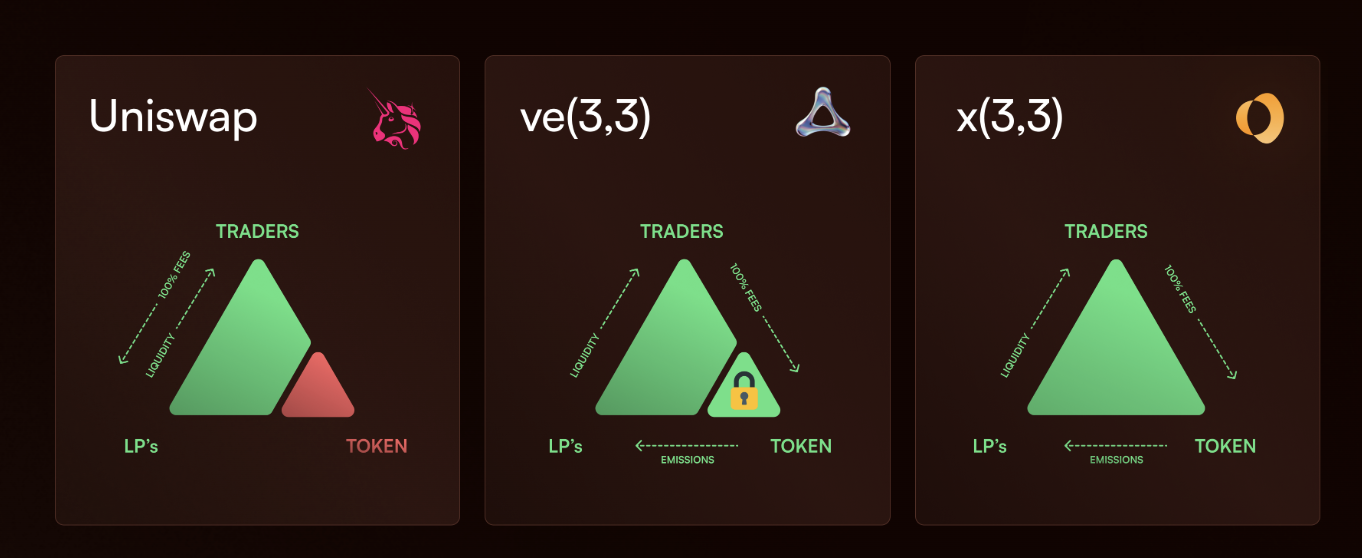
Looking back on the history of DeFi, the "three-body problem of DEX" has also plagued many protocols, and this triangle includes "traders", "liquidity providers (LPs)", and "token holders", whose incentives are difficult to balance.
Andre Cronje's ve(3,3) theoretically solves this problem, but at the same time, due to the model's requirement for long-term locking, it indirectly reduces the overall willingness to participate.
- First-generation Uniswap: Focuses on the interests of traders and LPs, ignoring the rights of token holders, making the ecosystem easy to be drained by other protocols.
- Second-generation ve(3,3): Balances the interests of the three parties by adjusting the rights of token holders, but the mandatory participation and lack of exit mechanism reduce user willingness to participate.
- Third-generation x(3,3): Based on ve(3,3), adds a mechanism for users to exit at any time, and replaces the locking period with an incentive mechanism.
Shadow Exchange Operating Principle
Based on the new x(3,3) mechanism, how does Shadow Exchange use its functions to address the shortcomings of traditional DEXes? Here are the main features of Shadow Exchange:
Three-Token Mechanism
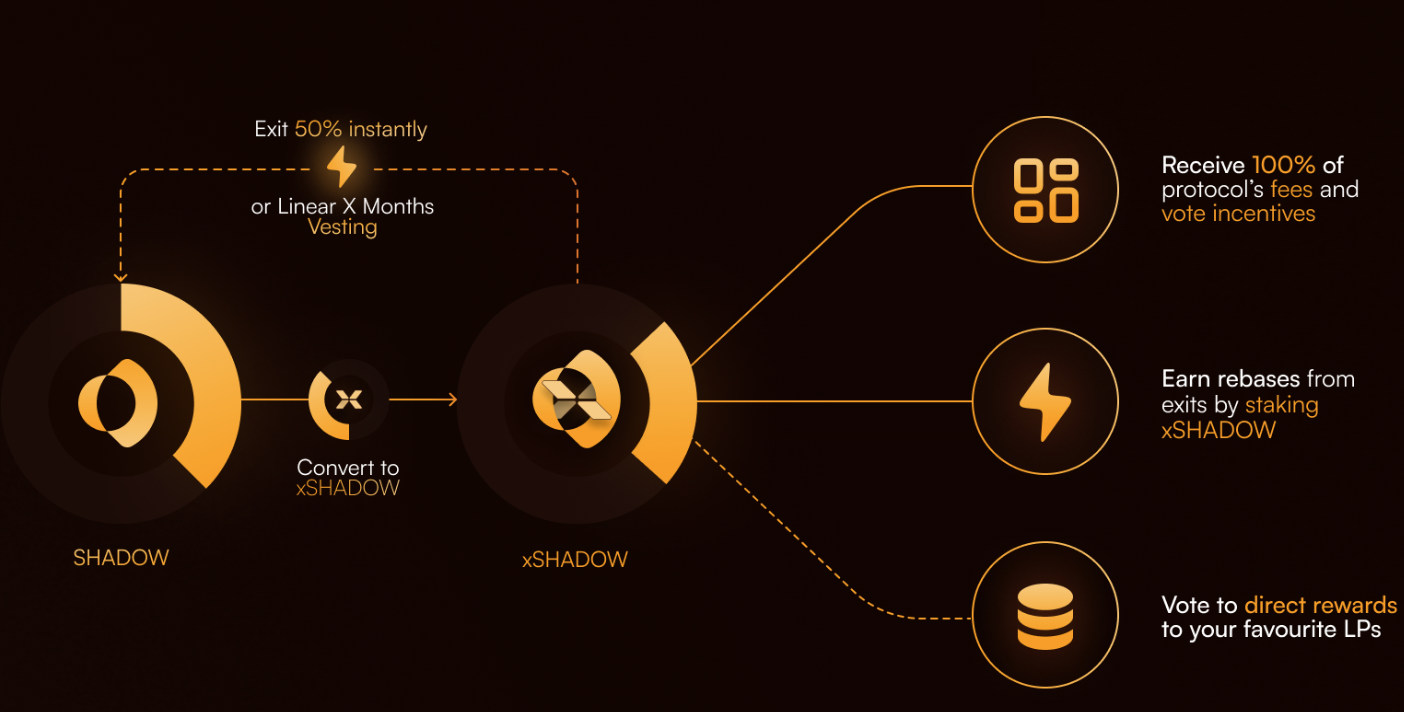
Shadow establishes the x(3,3) mechanism through three tokens: Shadow, xShadow, and x33.
- $Shadow: The native token of the protocol, which can be traded on the market
- $xShadow: Through the custody and exchange of Shadow, xShadow can be staked and voted to receive rewards, and can also be used to exit liquidity through the "exit mechanism".
- $x33: x33 is the liquid version of xShadow, which can be freely traded on the market
PVP rebase
In the previous ve(3,3) model, its core model is to use rebase to readjust the weight of the locked positions, preventing the locked users from being diluted in subsequent token releases.
Shadow Exchange adopts the PVP rebase mechanism, which not only solves the dilution problem, but also serves as an additional revenue source. This is achieved through two mechanisms:
- xShadow can obtain part of the rewards from users who choose the "liquidity option" through the "Emission Exits" mechanism. In simple terms, when the protocol distributes new tokens, they will be divided into "liquidity option Shadow" and "non-liquidity option xShadow", and users who choose Shadow rewards will transfer part of their tokens to other stakers, while those who choose xShadow can enjoy additional APR rewards.
- The exit mechanism of xShadow will confiscate a certain proportion of Shadow, and the confiscated tokens will be returned to the stakers.
User Exit
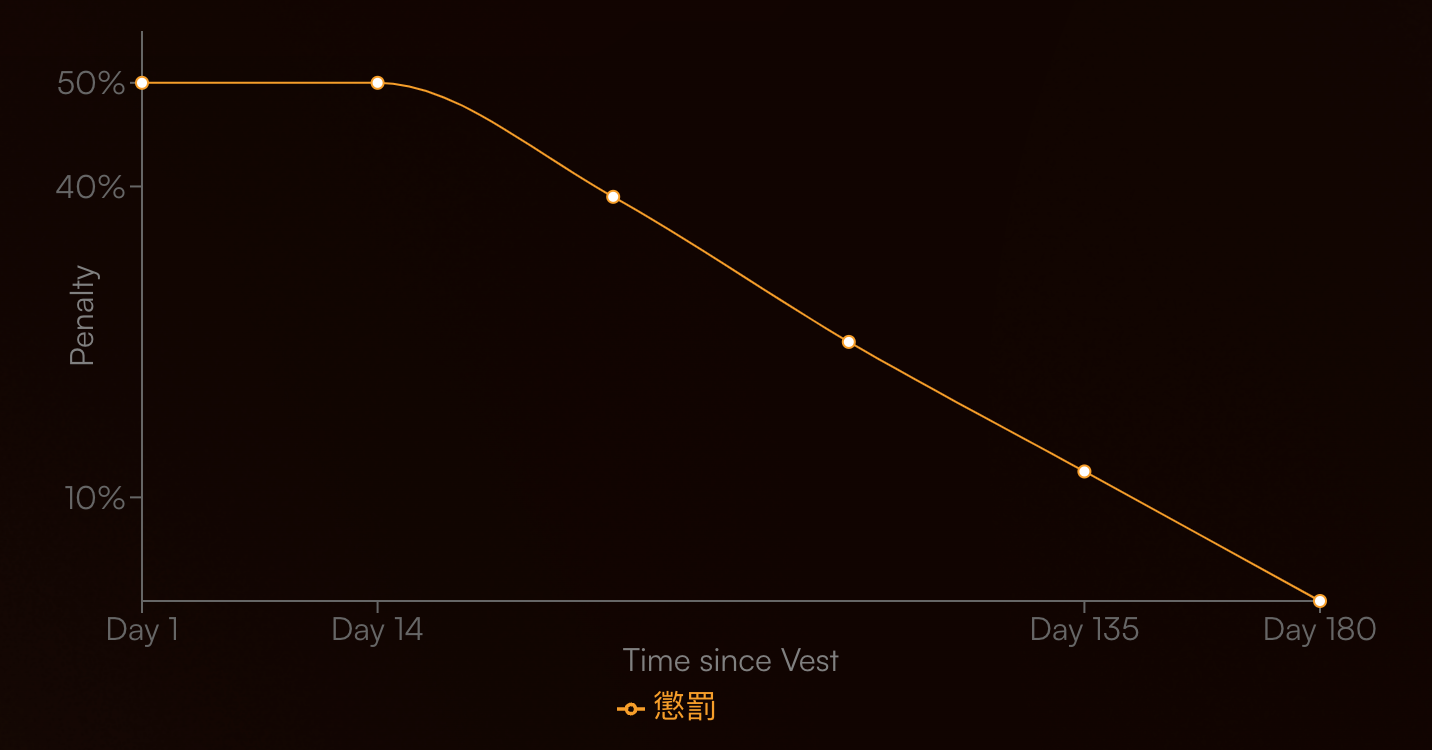
User exit, as the name suggests, allows xShadow holders to freely enter and exit the market without being constrained by the locking period. However, this exit method will inevitably have a penalty mechanism. The exit mechanism is as follows:
- Immediate exit will incur a 50% penalty
- Exiting after a partial period will be penalized proportionally (e.g., exiting after 3 months will incur a 27% penalty)
- Choosing a 6-month exit can get 1:1 liquidity
Additionally, the cancellation of the exit can only be done within the first 14 days, and after that, the user cannot cancel the exit. It's worth noting that xShadow in the exit period can no longer participate in voting and rebase.
xshadow and x33 Incentive Mechanism
Next is the incentive mechanism. Currently, xShadow has three layers of yield incentives:
- The first layer is that by staking xShadow, users can receive 100% of the protocol's transaction fees.
- The second layer is the "active staking" where users can receive additional rebase rewards, which is currently 120.56%.
- The third layer is the voting rights, where stakers can vote for their preferred LPs, and rewards will be distributed at the end of each Epoch (every Thursday), with the current LP APR ranging from 120% to 190%.
As for x33, being the liquidity version of xShadow, it has the ability to auto-vote, auto-compound rewards, and free trading, but these features also significantly reduce its functionality compared to xShadow:
- Firstly, the voting weight of x33 is reduced compared to xShadow, currently at 29.07%.
- Secondly, due to the increasing exchange ratio between x33 and xShadow with each Epoch, there may be a loss when converting x33 back to xShadow.
Is Shadow Worth Investing in?
Before discussing whether Shadow is worth investing in, the author believes that the first thing to consider is whether the Sonic ecosystem can maintain long-term market attention, as the inflow of users and capital is what determines how far a DEX can go.
Next, by looking at Shadow's TVL and trading volume, it can be seen that Shadow's TVL growth is impressive, and the trading volume has also continued the trend from last week, rather than being a one-time occurrence.
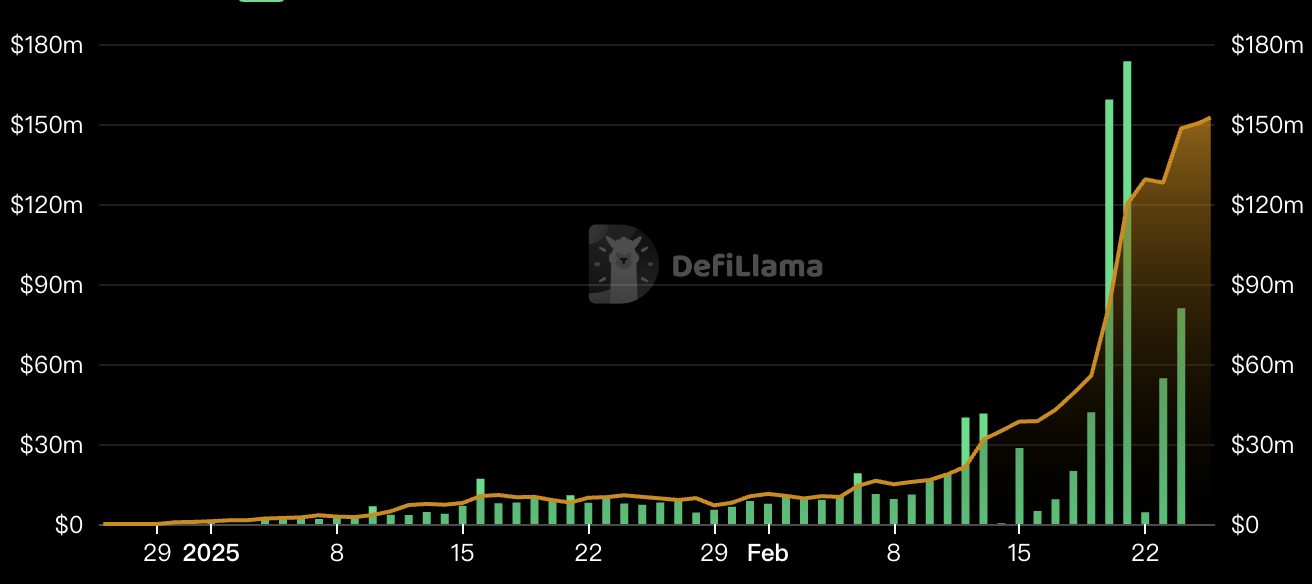
Additionally, Sonic provides additional ecosystem airdrop incentives, and Shadow's new "exit mechanism" allows users to replenish a portion of their staked Shadow when they exit, resulting in excellent APR performance for users. These advantages may continue to attract market investors until the APR drops to an appropriate level.
With the emerging Sonic ecosystem and the innovative x(3,3) mechanism, the author believes that Shadow is worth putting on the observation list, but users still need to be aware of price and project team risks, and always do their own research.





