



Author:Angelo.sui
Compiled by: TechFlow
Sui vs Aptos: The Ultimate Showdown of Move Blockchains
The two blockchains, although both originating from Meta's Diem project, have vastly different goals and technical paths. Only one is truly designed for large-scale user adoption.
Who will win between Sui and Aptos?

Core Difference: Execution Model
On the surface, Sui and Aptos have many similarities:
Both are built on the Move programming language;
Both promise high scalability;
Both have large-scale Web3 applications as their target.
However, their transaction processing methods are completely different, and this is the key to $SUI's victory.
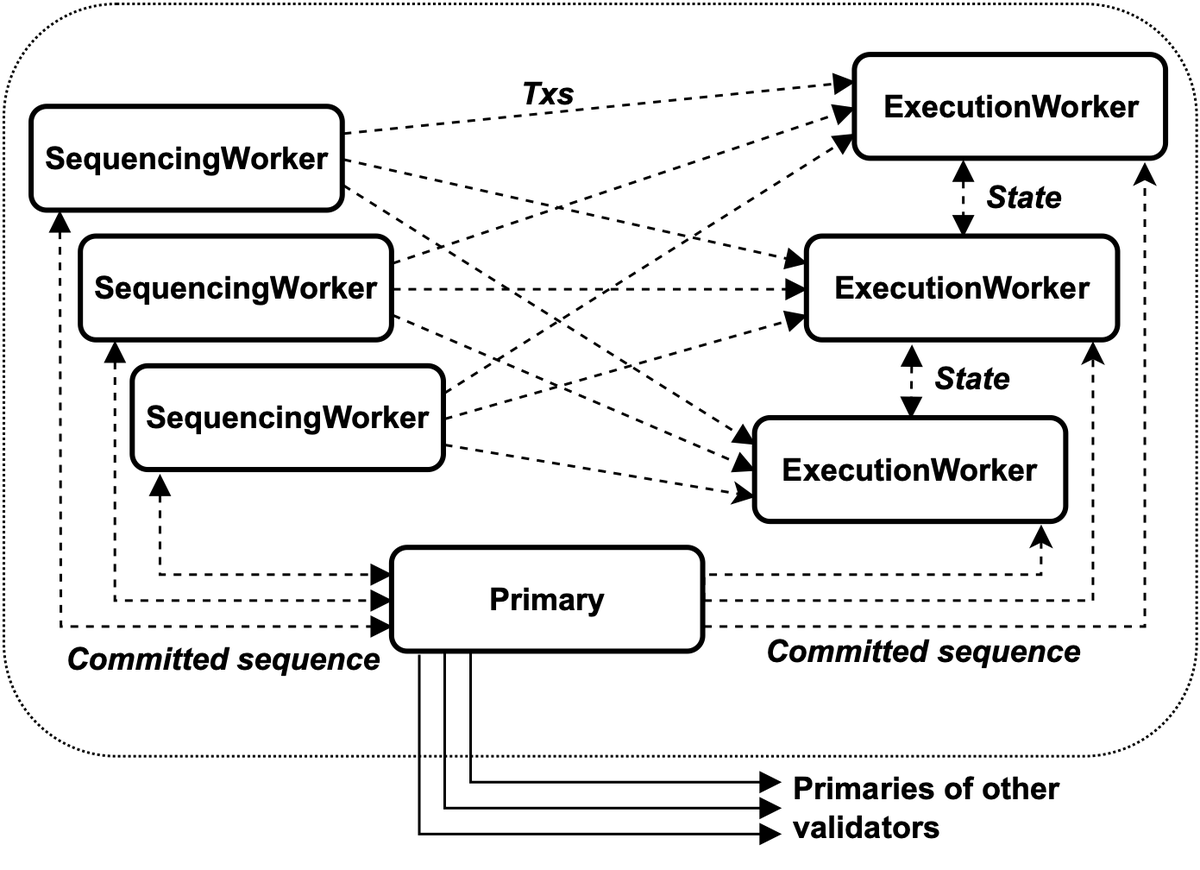
Parallel Execution vs. Sequential Execution
Sui: Adopts a true parallel execution model, which means it can process thousands of transactions simultaneously, avoiding network congestion issues.
Aptos: Uses Block-STM technology, which, although attempting to achieve parallel processing, still requires sequential verification of transactions, which inadvertently slows down the overall processing speed.
Therefore, $SUI is inherently designed for speed, while $APT still relies on the traditional transaction ordering mechanism.
Sui's Bottleneck-Free Design
In the transaction execution process, Aptos relies on packaging transactions into blocks for processing, a mechanism that is prone to performance bottlenecks.
In contrast, $SUI completely abandons the concept of global ordering, allowing transactions with no interdependencies to execute independently.
No bottlenecks, no unnecessary delays, just faster speed.
Sui is smarter. $SUI introduces a dynamic Gas pricing mechanism, which allows users to avoid paying high fees to compete for priority transactions.
In contrast, $APT still uses the traditional Gas model, and when the network is congested, users need to pay higher fees to ensure transaction priority.
Sui's Move programming language has more advantages. Although both Sui and Aptos are built on Move, $SUI has deeply customized Move, making it an object-based model. This improvement brings the following advantages:
More intuitive for developers, reducing the learning curve;
Improved execution efficiency of smart contracts;
Inherently more focused on security, reducing the risk of vulnerabilities.
In comparison, Aptos still uses the original version of Move, lacking targeted optimization, which gives Sui an edge in usability.
NFT and Gaming Domains
For NFT and gaming scenarios, fast, low-cost, and high-throughput are core requirements.
Sui's object-centric model can achieve instant asset ownership changes without complex smart contract logic.
On Aptos, each asset transfer requires more on-chain computation, making NFT interactions slower and more expensive.
Therefore, in the NFT and gaming domains, $SUI's technical design is more aligned with actual needs.

Ecosystem: $SUI's Organic Growth
Although $APT experienced rapid growth at launch due to strong venture capital support, its user adoption rate is gradually slowing down.
In contrast, $SUI's growth is more natural, mainly due to the following factors:
Gaming and Non-Fungible Token (NFT) projects are more inclined to choose Sui over Aptos;
DeFi ecosystem adoption is steadily increasing;
Developer activity has increased significantly, and the ecosystem is constantly expanding.
Real-world application trumps venture capital hype, and this is the key to $SUI's sustainable development.
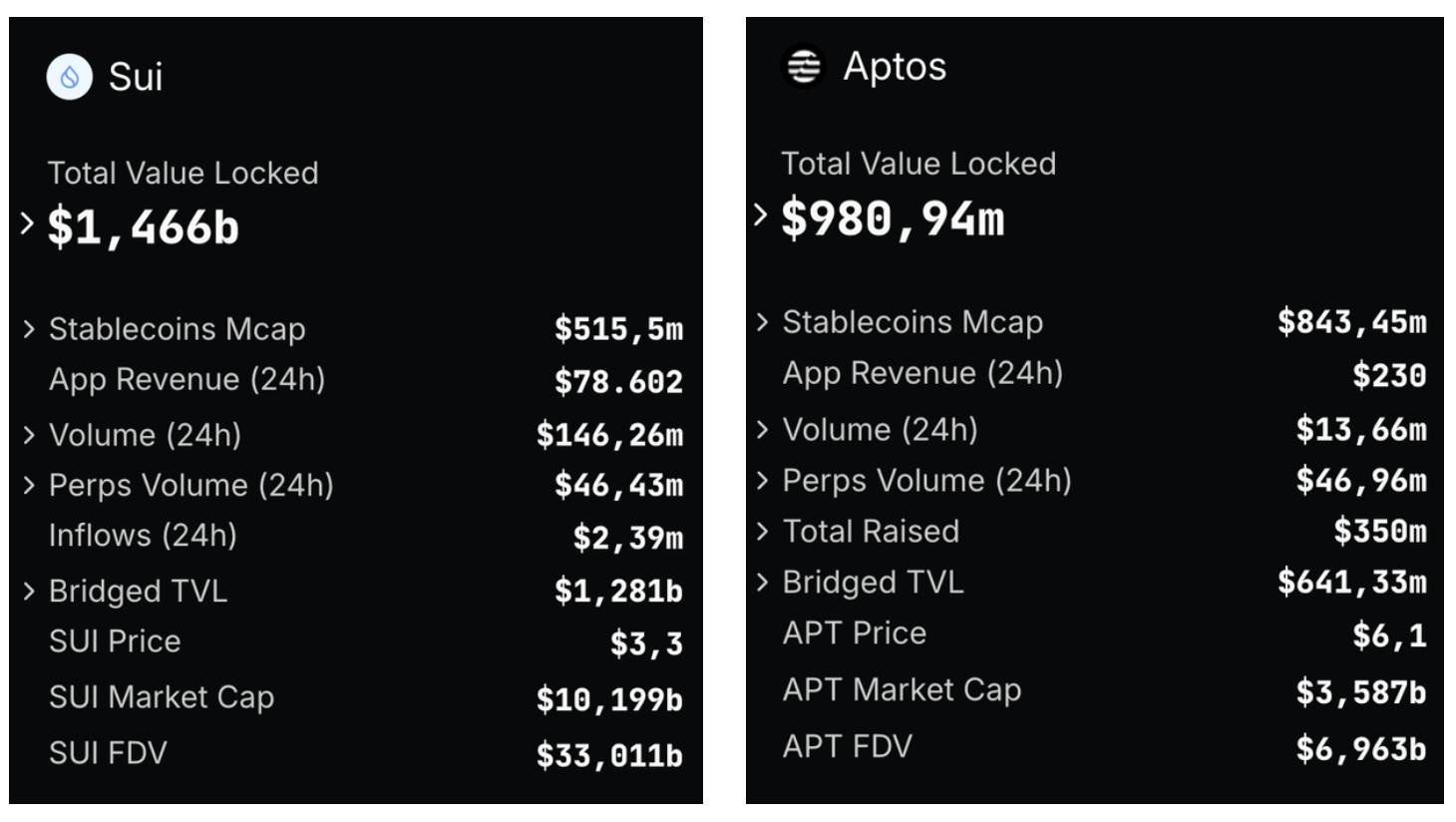
Source:@DefiLlama
Network Activity: $SUI's Comprehensive Lead
Although $APT had a higher market capitalization in the early stages, $SUI has already surpassed it in core metrics such as daily transaction volume and user engagement:
Has more real users;
Attracts more developers;
Network activity is more active.
The data doesn't lie, and $SUI's performance proves its strong potential in real-world applications.
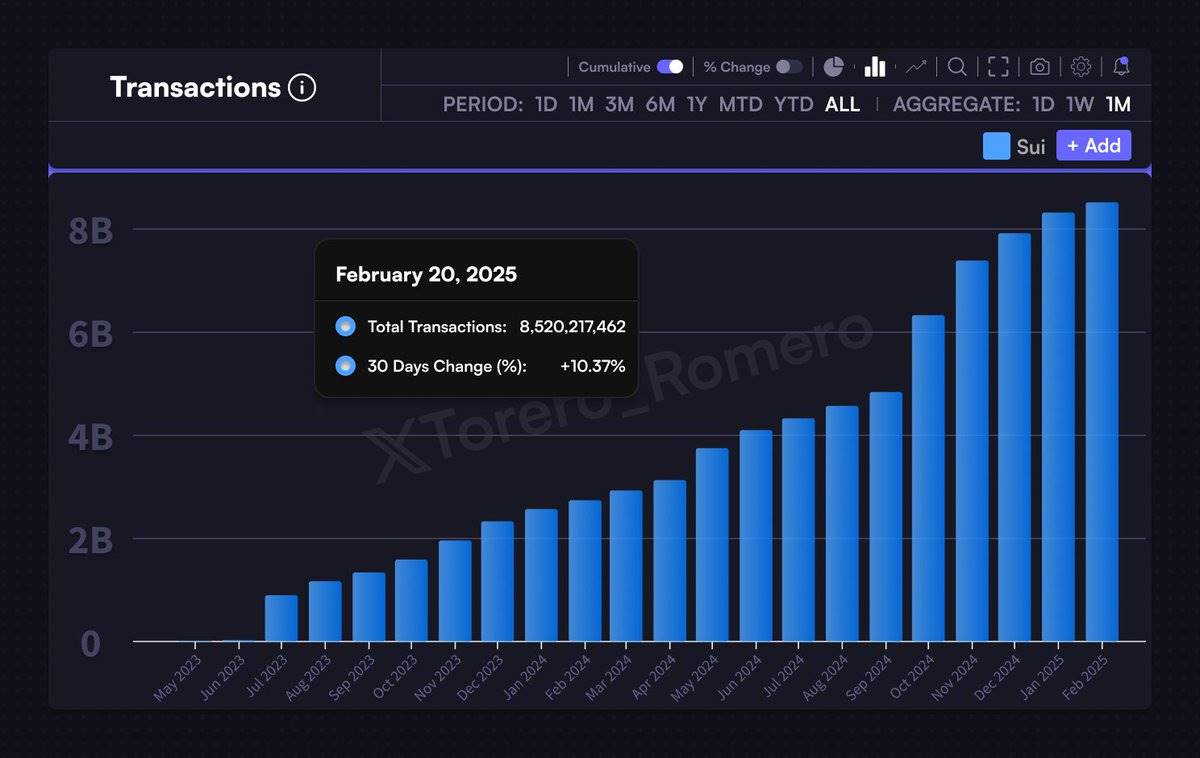
Source:@Torero_Romero
The Clash of Innovation and Imitation
Sui is not just another Move-based blockchain; it has achieved a qualitative leap in its design:
Horizontal Scalability: Supports unlimited growth to meet future large-scale demands;
Native Support for Games and High-Frequency Transactions: Provides the best support for high-performance scenarios;
Optimized Fee Structure and User Experience: Makes it easy for users and developers to participate.
Aptos, on the other hand, has chosen a more conservative path, still relying on traditional L1 mechanisms, with only partial optimizations.
Conclusion: Sui is the Future of Blockchains
Aptos chose a prudent approach, while Sui redesigned the Move programming language to make it more suitable for large-scale user adoption.
If you focus on the following key points:
Speed and Scalability: Sui is the winner;
Sustainable Gas Fees: Sui has the edge;
Gaming and NFT Applications: Sui has more advantages;
Genuine Ecosystem Growth: Sui's performance is more impressive.
Although $APT has performed well, $SUI's architecture and design are completely different, with stronger potential.
Don't Underestimate Sui's Potential
While the market is still debating transaction per second (TPS) data, $SUI has already taken the lead in multiple areas:
Daily transaction volume has already surpassed @Aptos;
Attracted more top-tier developers and quality projects;
Fully demonstrated the potential of the Move programming language, exceeding expectations.
Currently, the market has not yet fully recognized the true value of Sui.
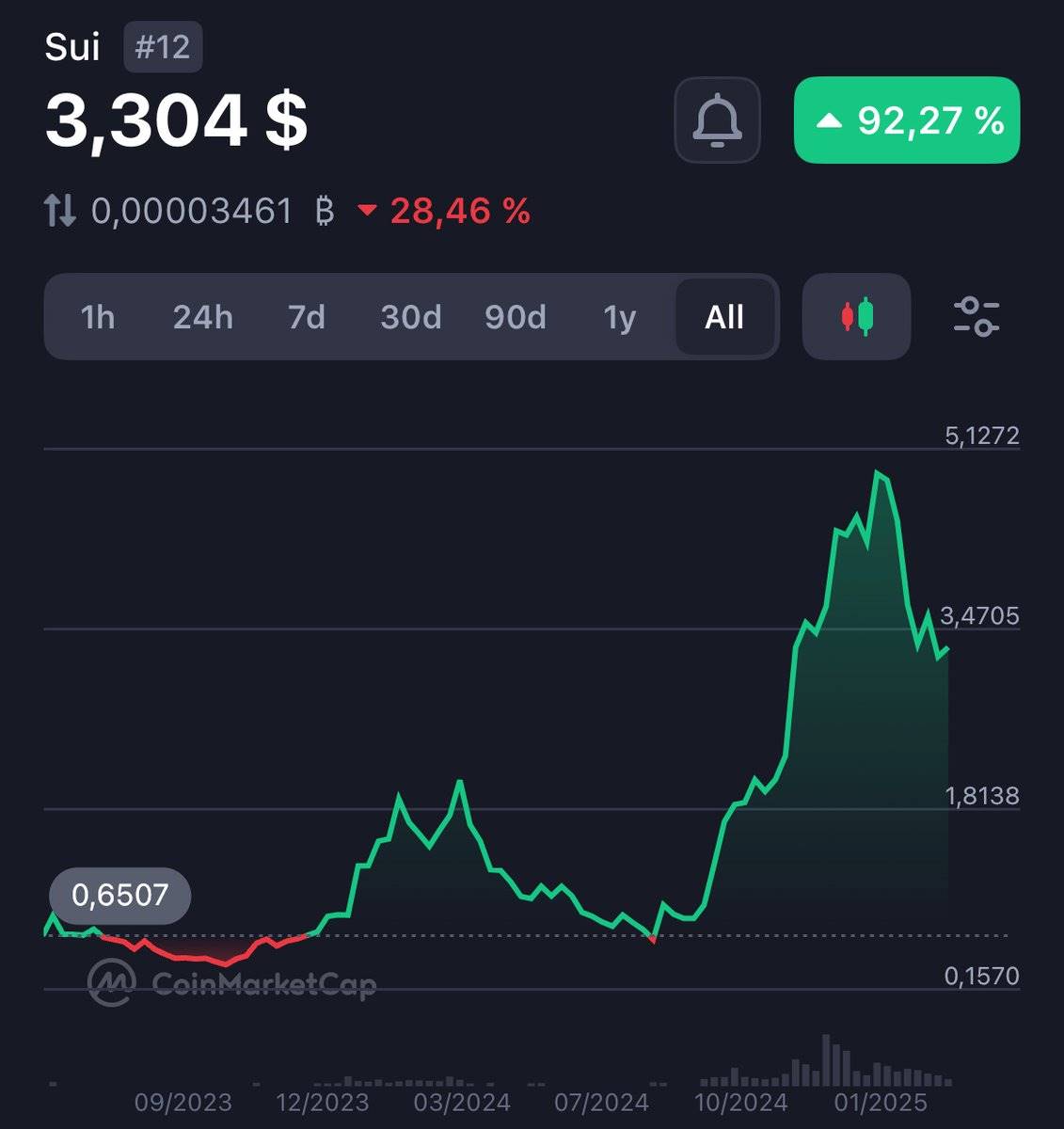
Key Question: How Will You Choose?
Are you still clinging to the Aptos narrative, or have you already turned your attention to true technological innovation?
$SUI is the most advanced Move-based blockchain to date, and this fact will soon be recognized by more people.






