


Author: YBB Capital Researcher Ac-Core
I. How to Solve the Fragmentation Problem of Ethereum
Source: @ethereumfndn
With the rise of different L2s and various DeFi projects, the issue of liquidity fragmentation in Ethereum has gradually emerged, mainly manifested in the difficulty of unifying the asset liquidity in the ecosystem, which has been divided into multiple small pieces by L1 and various L2s. The competition for TVL among different L2s has led to the dispersion of assets and transactions across multiple decentralized platforms and protocols, but these platforms lack effective connection and interoperability, and the liquidity on each chain can only operate within its own independent "small circle", which has exacerbated the fragmentation cost problem of Ethereum as a whole.
There will be more than 100 new Ethereum chains launched just in 2024, which is like entering a shopping mall where we see a dazzling array of goods but need to use different national currencies to settle. On February 20th this year, the Ethereum Foundation announced the opening of the Open Intents Framework, which allows Ethereum to have a seamless transaction experience like a "single chain", and has gained the support of more than 50 protocols in just a few days.
According to the content on openintents.xyz, the Open Intents Framework consists of three core components (see Expansion Link 1):
Open-source Resolver: The framework provides an open-source resolver written in TypeScript that can monitor on-chain events and handle intents. Unlike resolvers that depend on specific infrastructure, the shared reference resolver has protocol independence, supporting features such as indexing, transaction submission, and rebalancing, allowing developers to customize and adjust it according to their own needs;
Composable Smart Contracts: The framework provides a series of pre-built smart contracts, but these contracts are based on the ERC-7683 standard, which defines the logic of how to interpret, execute, and settle intents. It supports limit order trading and Hyperlane ISM settlement by default;
UI Templates: The framework also provides a pre-built, customizable user interface template, aimed at making intent products more accessible to end-users.
II. The Core ERC-7683 of the Open Intents Framework
Source: @KanishkKhurana_
ERC-7683 is a universal standard for cross-chain intents on Ethereum, co-led by Across (@AcrossProtocol) and Uniswap Labs (@Uniswap), which aims to standardize cross-chain operations to enable intents. It aims to provide a unified, standardized framework for Ethereum and other blockchains to express and execute cross-chain operations, especially between multiple L2 solutions and sidechains.
The core content and components of ERC-7683:
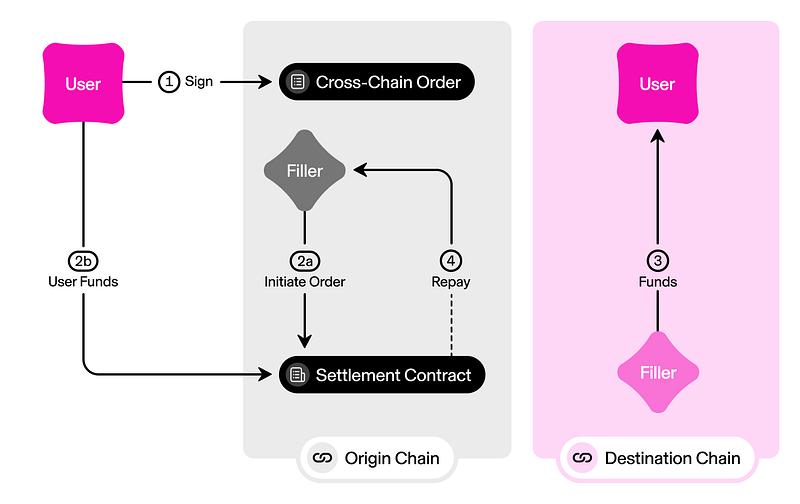
Cross-Chain Order Structure: Defines the format of cross-chain orders to ensure consistency across different blockchains and platforms. It standardizes the composition of cross-chain transactions, allowing operations on different chains to be interoperable;
ISettlementContract Interface: Standardizes the processing of the settlement process. ERC-7683 defines through this interface how to handle the settlement of transactions between different chains, allowing cross-chain transactions to be flexibly executed on different platforms and supporting customized transaction workflows;
Fulfil: ERC-7683 introduces a "Fulfil" mechanism, allowing participants to compete to complete cross-chain intents in a shared network. Participants can reduce costs and improve efficiency by providing services (such as executing orders) in these networks, allowing cross-chain transactions to be completed more efficiently and optimizing the user experience;
Fill Deadline: This is a Uni X timestamp that marks the expiration time of the cross-chain intent. If the intent is not completed within the specified time, it will expire, thereby avoiding long-term invalid transaction waiting;
Order Data Type: Uses EIP-712 type hashing to specify the structure and format of intent data. Through this type hash, developers and platforms can clearly understand how the data is formatted for transmission and interpretation across different chains;
Order Data: Order data contains the core parameters of the cross-chain transaction (such as tokens, quantities, chains, recipients), which define the expected outcome of the cross-chain transaction. It ensures that the transaction participants can accurately understand and execute the cross-chain operation.
One of the biggest advantages of ERC-7683 is that it can achieve seamless cross-chain interaction. By standardizing the expression of cross-chain intents, users can execute operations between different blockchains, such as token swaps or NFT transfers, without complex setup, simplifying the standardized framework of the operation process and greatly reducing the technical threshold of cross-chain operations, allowing users to conduct cross-chain transactions more conveniently.
Secondly, ERC-7683 also enhances governance capabilities. It simplifies the governance process between different blockchains, especially for decentralized autonomous organizations (DAOs), allowing them to more easily manage proposals and decisions on multiple chains. The uniformity of ERC-7683 makes DAO cross-chain governance more efficient, enhancing the flexibility and transparency of governance.
III. Where is the End of the "Abstraction" of Intent and DeFAI?

Source: Self-made
Whether it's Intent or DeFAI, they are essentially derivatives of the financial attributes of DeFi, but the only two problems that DeFi really needs to solve are scalability and liquidity. Intent seems to have more practical significance in aggregating liquidity through UNI and ERC-7683, while DeFAI has become more interesting with the wave of AI narratives and the automation of AI trading achieved by Hey Anon (@HeyAnonai). The main focus of Intent and DeFAI's respective solutions is to improve the user experience of DeFi, optimize transaction execution, and enhance the stability and security of protocols, but they also have differences:
The core goal of Intent is to simplify the user interaction process through the "intent-driven transaction" mechanism. Users can set the intent and strategy of the transaction, and the system will automatically execute it without the need for manual intervention at each step. This not only improves the usability of DeFi, but also optimizes strategy execution and improves transaction efficiency. In addition, Intent may also solve the liquidity bottleneck in DeFi through cross-chain technology. By enhancing cross-chain liquidity, Intent can help break down the barriers between different chains, optimize liquidity pools, and improve the market depth and transaction efficiency of decentralized exchanges.
DeFAI, as a decentralized finance protocol based on artificial intelligence, focuses on solving the compliance and risk control issues in DeFi. DeFAI uses AI technology to analyze and predict market trends, helping the protocol identify potential risks, thereby ensuring the stability of the protocol while reducing operational risks. AI can process a large amount of market data and provide users with more accurate decision support, optimizing market operations and risk management.
To solve the problem of liquidity fragmentation, we have gone from account abstraction, chain abstraction, to intent and DeFAI. After all, abstraction is endless, and the needs of technology and the market are also driving the birth of more abstract layers. We need abstraction, but also moderation. The problem of liquidity fragmentation itself is more like an "ecosystem integration problem", which not only depends on the increase of abstract layers, but more on how to optimize the existing protocols.
IV. Why Only Uniswap Can Truly Drive the Development of ERC-7683
Source: @Uniswap
Although "intent" is a grand narrative concept, in my personal opinion, the core support for ERC-7683 can only rely on Uniswap to drive its realization. The reason is that whether it's Intent or DeFAI, they are both essentially aimed at better serving DeFi, and the key factor in maintaining the healthy development of DeFi is the liquidity of the market, and this dependence relationship needs to be established on the two conditions of "efficient liquidity supply" and "deeply integrated liquidity".
1. Uniswap V4's Liquidity Advantage
The introduction of Uniswap V4 has made liquidity pool management more flexible and efficient, especially for concentrated liquidity provision for different price ranges. This mechanism optimizes capital efficiency, making cross-chain transactions smoother. In the V3 version, each new pool required the deployment of a separate smart contract, leading to high Gas fees, but V4 replaces this with a single PoolManager contract, reducing deployment costs by 99% and lowering exchange costs, while Hooks also allow for the customization of AMM pools, enabling the ERC-7683 protocol to be adjusted according to different market needs and better match different trading pairs and asset liquidity.
2. The Potential of Uniswap X
Uni X is expected to further enhance cross-chain interoperability, and it may incorporate new cross-chain bridge mechanisms or integrate deeply with ERC-7683 to provide more efficient cross-chain asset exchange channels. If Uni X can provide cross-chain liquidity solutions, it will become an important platform for ERC-7683 to execute cross-chain intentions. Therefore, by leveraging Uni X's liquidity pools and technological optimizations, ERC-7683 can achieve seamless cross-chain transactions on a larger scale.
3. The Dependence of Cross-Chain Protocols
Since ERC-7683 relies on standardized cross-chain transaction structures and settlement mechanisms, and Uniswap holds a pivotal position in the decentralized exchange market, the protocol is likely to depend on the liquidity pools, automated market making, and cross-chain transaction capabilities provided by Uniswap, especially the support of Uniswap X and Unichain. Uniswap not only can support the efficient execution of ERC-7683, but more importantly, it can ensure the stability and security of its cross-chain and multi-asset transactions.
V. What is the Actual Meaning of Intent?
When we set aside the abstract definition of "intent," it can be understood as a clear transaction target or driving force. The concept of intent can be traced back to the article "Intent-Based Architectures and Their Risks" published by Paradigm on June 1, 2023, which explained the interpretation of the intent concept. However, it has remained at the conceptual stage, and the problems of fragmented liquidity and the solution path of solvers have not been solved. Nevertheless, the launch of ERC-7683 seems to have shed light on a better solution to the problem of fragmented liquidity.
The ultimate goal is to inject new vitality into Uniswap, hoping to trigger a new round of DeFi craze. So intent and ERC-7683 are not just about continuing L2 scaling, but about achieving more efficient transactions, creating richer functionalities and stronger cross-chain interoperability through Uniswap, and even introducing new incentive mechanisms or trading models to attract more users and liquidity.
If Uniswap V4 or Uniswap X introduces some new smart contract logic or trading models at the protocol level, through ERC-7683, Uniswap can further improve cross-chain liquidity, reduce transaction costs, and add more trading pairs and liquidity pools on the basis of the existing AMM model. This will make Uniswap no longer just a decentralized AMM with fragmented liquidity, and these improvements will also become an important part of the "intent."
Extended Links:






