Author: Kevin, the Researcher at BlockBooster
TL;DR
Bittensor has changed the allocation of subnet rewards from a fixed ratio to being determined by the staking weight through dTAO, with 50% injected into the liquidity pool, aiming to promote the development of high-quality subnets through decentralized evaluation.
Early high volatility, APY traps, and adverse selection coexist, requiring a balance between miner quality screening, user cognitive thresholds, and market heat mismatch.
Among the current TOP10 subnets, only 1 requires miners to submit open-source models, and the rest of the subnets generally have defects such as anonymous teams and lack of product anchoring, exposing the bottleneck of the Web3 AI infrastructure.
The final verification depends on the positive feedback loop established between the TAO price and the practical value of the subnet, and failure may lead to the continuous transformation of the Web3 AI track towards lightweight.
Background Review
The introduction of dTAO reshapes the rules for daily release of Bittensor:
Previous rules: Subnet rewards were distributed in a fixed ratio - 41% to validators, 41% to miners, and 18% to subnet owners. The TAO release volume of the subnet was determined by validator voting.
After dTAO: Now, 50% of the newly issued dTAO tokens will be added to the liquidity pool, and the remaining 50% will be distributed among the validators, miners, and subnet owners based on the decisions of the subnet participants. The TAO release volume of the subnet is determined by the subnet staking weight.
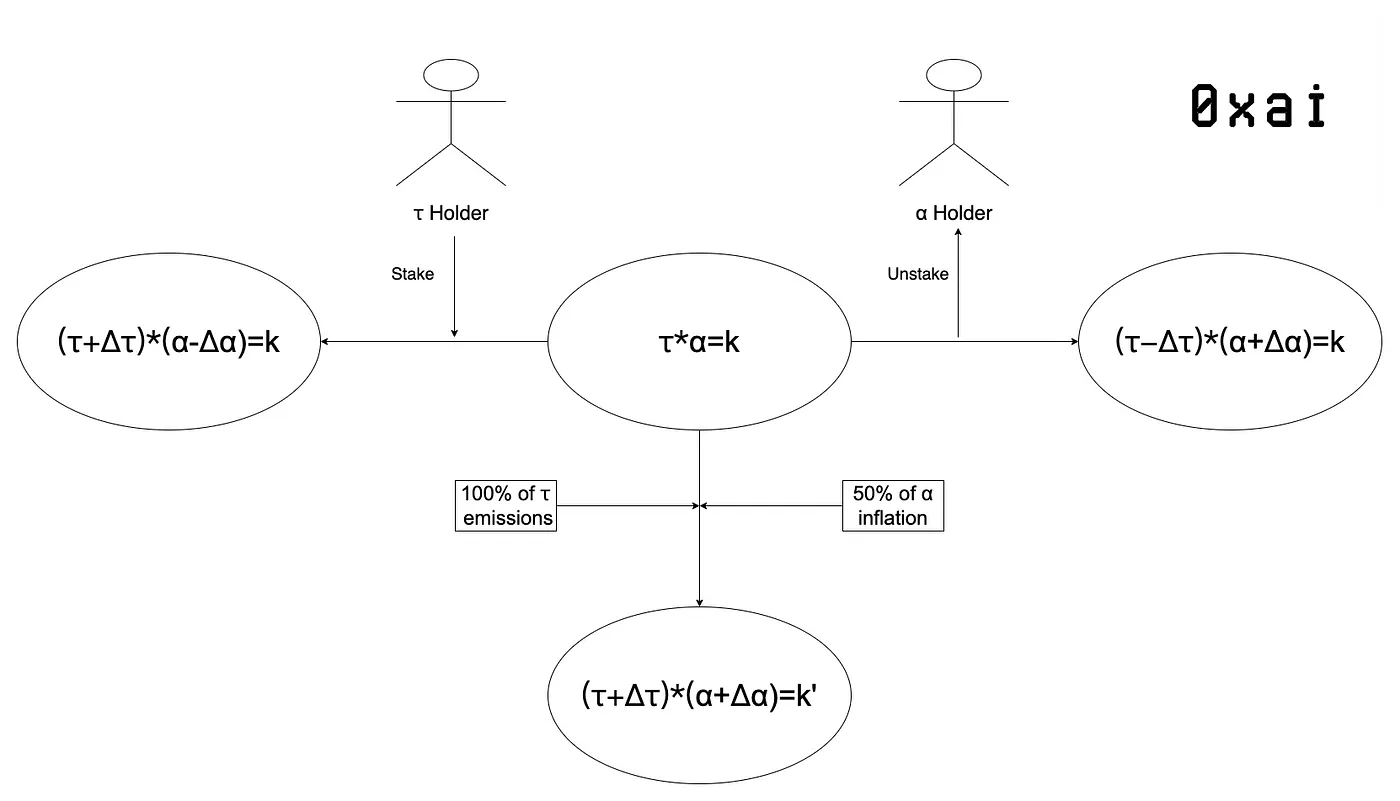
The design goals of dTAO:
The main goal of dTAO is to promote the development of subnets with real income potential, stimulate the birth of real-use case applications, and ensure that these applications are correctly evaluated.
Decentralized subnet evaluation: No longer relying on a few validators, the dynamic pricing of the dTAO pool will determine the allocation of TAO issuance. TAO holders can support the subnets they believe in by staking TAO.
Increase subnet capacity: Removing the subnet cap promotes competition and innovation in the ecosystem.
Encourage early participation: Able to incentivize users to pay attention to new subnets and incentivize the entire ecosystem to evaluate new subnets. Because validators who migrate to new subnets earlier may receive higher rewards. Early migration to a new subnet means buying the subnet's dTAO at a lower price, increasing the possibility of obtaining more TAO in the future.
Encourage miners and validators to focus on high-quality subnets: Further stimulate miners and validators to find high-quality new subnets. Miners' models are placed off-chain, and validators' verification is also off-chain. The Bittensor network only rewards miners based on the evaluation of the validators. Therefore, for different types or all types of AI applications that fit the miner-validator architecture, Bittensor can correctly evaluate them. Bittensor has extremely high inclusiveness for AI applications, allowing participants at every stage to receive incentives and thus feed back into the value of Bittensor.
Three Scenario Analysis Affecting the Price Trend of dTAO
Basic Mechanism Review
The daily fixed release of TAO and an equal amount of dTAO injected into the liquidity pool constitute the new liquidity pool parameters (k value). 50% of the dTAO enters the liquidity pool, and the remaining 50% is allocated to subnet owners, validators, and miners according to the weight. The higher the weight of a subnet, the greater the proportion of TAO allocation it receives.
Scenario One: Positive Feedback Loop of Increased Staking
When the TAO delegated to validators continues to increase, the subnet weight will rise accordingly, and the miner reward allocation proportion will also expand. There are two types of motivations for validators to massively purchase subnet tokens:
1. Short-term arbitrage behavior
Subnet owners as validators can raise the coin price by staking TAO (continuing the old release model). But the dTAO mechanism weakens the certainty of this strategy:
When the proportion of irrational staking users is higher than quality-focused users, short-term arbitrage can be sustainable
Conversely, it may lead to the rapid devaluation of the hoarded tokens, coupled with the limited acquisition of chips due to the uniform release mechanism, and they may be eliminated by high-quality subnets in the long run
2. Value capture logic
Subnets with real application scenarios attract users through real yield, and stakers not only obtain leveraged dTAO returns but also additional staking rewards, forming a sustainable growth loop.
Scenario Two: The Dilemma of Relative Growth Stagnation
When the subnet staking volume maintains growth but lags behind the leading projects, the market capitalization steadily increases but it is difficult to maximize returns. At this time, the focus should be on:
Miner quality determines the ceiling: TAO as an open-source model incentive platform (not a training platform), its value comes from the output and application of high-quality models. The strategic direction chosen by the subnet owners and the quality of the models submitted by the miners jointly constitute the development ceiling
Team capability mapping: Top miners often come from the subnet development team, and the quality of miners essentially reflects the technical strength of the team
Scenario Three: The Death Spiral of Staking Loss
When the subnet staking volume declines, it is easy to trigger a vicious cycle (reduced staking → reduced returns → further loss). The specific causes include:
Competitive elimination: Although the subnet has practical value, the product quality lags behind, and the weight decline leads to elimination. This is the ideal state of ecological health development, but so far there is no sign of the value of TAO as the "Web3 application incubation shovel" becoming apparent
Expectation collapse effect: Market pessimism about the subnet's prospects leads to the withdrawal of speculative staking. When the daily release volume begins to decline, non-core miners accelerate the loss, ultimately forming an irreversible downward trend
Potential Risks and Investment Strategies
High volatility window period: In the early stage of dTAO, the total release volume is large but the daily release is constant, which may lead to violent fluctuations in the first few weeks. At this time, staking on the root network becomes a risk mitigation strategy, which can stably obtain basic returns
APY trap: The short-term temptation of high APY may mask the long-term risks of insufficient liquidity and lack of subnet competitiveness
Weight game mechanism: The validator weight is jointly determined by the subnet dTAO value and the root network TAO staking (compound weight model). In the 100 days before the subnet goes online, the root network staking still has the advantage of return certainty

Meme-like trading characteristics: At the current stage, the subnet staking behavior has similar risk attributes to Memecoin speculation
Value Investment and Market Mismatch
Paradox of ecosystem building: The dTAO mechanism aims to cultivate practical subnets, but the value investment characteristics lead to:
High market education cost: It is necessary to continuously evaluate miner quality/application scenarios/team background/profit model, which poses a cognitive threshold for non-AI professional investors
Slow conversion of heat: In contrast to Agent tokens, subnet tokens have not yet formed a similar scale of market consensus
Systemic Risks of Irrational Staking
Repetition of historical dilemmas: If users continue to blindly follow the release volume indicator, it will lead to:
Validator rent-seeking: Repeat the subnet self-voting flaws under the old mechanism
Mechanism upgrade failure: Violating the quality screening function of the dTAO design
Cognitive threshold requirement: Investors need to have the ability to evaluate subnet quality, and the current market maturity and mechanism requirements have a gap
The Dilemma of Investment Timing Game
Best entry window: The investment window should be postponed to a few months after the subnet goes online (the stage where team capabilities/network potential are visible), but facing: