Original | Odaily (@OdailyChina)
Author | Golem (@web3_golem)
After the hype around Solana's pump.fun gradually subsided, many new projects are still enthusiastically improving on the pump model for their startups, such as time.fun, Super.exchange, and takes.fun.
Recently, the Bitcoin ecosystem has also seen the emergence of a Runes asset issuance and trading platform with the same core as pump.fun - Odin.Fun, and the heat has been gradually increasing over the past month. According to official disclosure, in the past 30 days, the trading volume of the Odin Fun platform has exceeded 1,000 BTC (about $84 million), the number of platform addresses has exceeded 37,000, and the market cap of the leading Rune ODINDOG•ID•YTTL•ODIN has peaked at over $35 million.
Can the emergence of Odin.Fun inject new vitality into the long-stagnant Bitcoin ecosystem? Odaily will briefly introduce the gameplay and currently popular tokens of Odin.Fun in this article for readers' reference.
Introduction to Odin Fun: pump.fun + Rune AMM
Odin.Fun officially launched on February 3rd, and essentially it is an asset issuance platform that hopes to use the pump model to enhance the liquidity of Runes, led by Bitcoin ecosystem OG and serial entrepreneur BoB.
Therefore, Odin.Fun also has an internal and external market, users can spend 3,333 sats (about $2.8) to create internal Runes, with a total supply of 21 million, and when the joint curve progress reaches 100% (the Rune market value reaches 1 BTC), the Runes created by users will be truly engraved on the Bitcoin mainnet, and are called Ascend on the Odin.fun platform.
But unlike pump.fun, which only thought of building its own AMM until now, Odin.Fun has built an AMM pool on the platform from the beginning. When the internal Runes are launched, 20% of the token supply and 0.2B TC will be deposited into the AMM pool for trading. At this point, the token price will trade along the AMM curve (k = X * Y) rather than the joint curve (y = e^x). For the Runes that have been launched, users can choose to add liquidity to the corresponding pool to earn transaction fees.
The existence of Rune AMM on the Odin.Fun platform has greatly improved the liquidity of the Runes, and users can trade Runes and add/remove liquidity within seconds. Meanwhile, Odin.Fun also adopts different fee strategies, if the Runes are still in the internal market, Odin.Fun charges 1% of all transactions (similar to pump.fun), if the Runes have been successfully engraved, Odin.Fun charges 0.5% of the AMM Swap fee (of which 0.3% goes to the liquidity providers).
How is the security of user assets?
Recently, the community has had a lot of debate about the security of user assets on the Odin.Fun platform, and some users believe that Odin.Fun has the risk of devouring users' BTC principal. The reason is that Odin.Fun is not built on the Bitcoin mainnet, but on a behind-the-scenes network called Valhalla, so users need to deposit BTC into the Odin.Fun platform to participate in new token launches and trading. According to the information provided by Odin.Fun, Valhalla supports 2-second finality, provides decentralized Bitcoin deposits and withdrawals (TSS), and waives all gas fees.
Regarding the security of BTC deposits, Odin.Fun stated that it uses a threshold signature (TSS) mechanism similar to ICP, and the deposited tokens are protected by a special multi-party computation (MPC). This means that there is a group of decentralized entities, each with a unique private key share, and they can receive and send assets together at any time.
Previously, community player @Real 0x Jason stated that the BTC held by users on Odin.Fun is essentially ckBTC existing on the ICP public chain, and the ultimate security guarantee comes from the ICP public chain, and there is no need for a cross-chain bridge between ICP and the Bitcoin mainnet, as ICP's chain fusion encryption technology allows its smart contracts to interact directly with other networks, so the security is higher than the generally wrapped BTC generated through cross-chain bridges on L2.
But these are just speculations made by the community based on limited information, and BOB has not yet fully responded to the security of user deposits, but he has previously stated that if L2 is redefined as anything that builds seamless Bitcoin products, then Odin is an application chain or L2.
Specific Gameplay
Even though the debate about the security of Odin.Fun is still ongoing, actively participating in experiencing new things in the ever-changing crypto world is always worthwhile. The main gameplay of Odin.Fun can be divided into new token launches and adding liquidity, with specific tutorials as follows.
New Token Launches
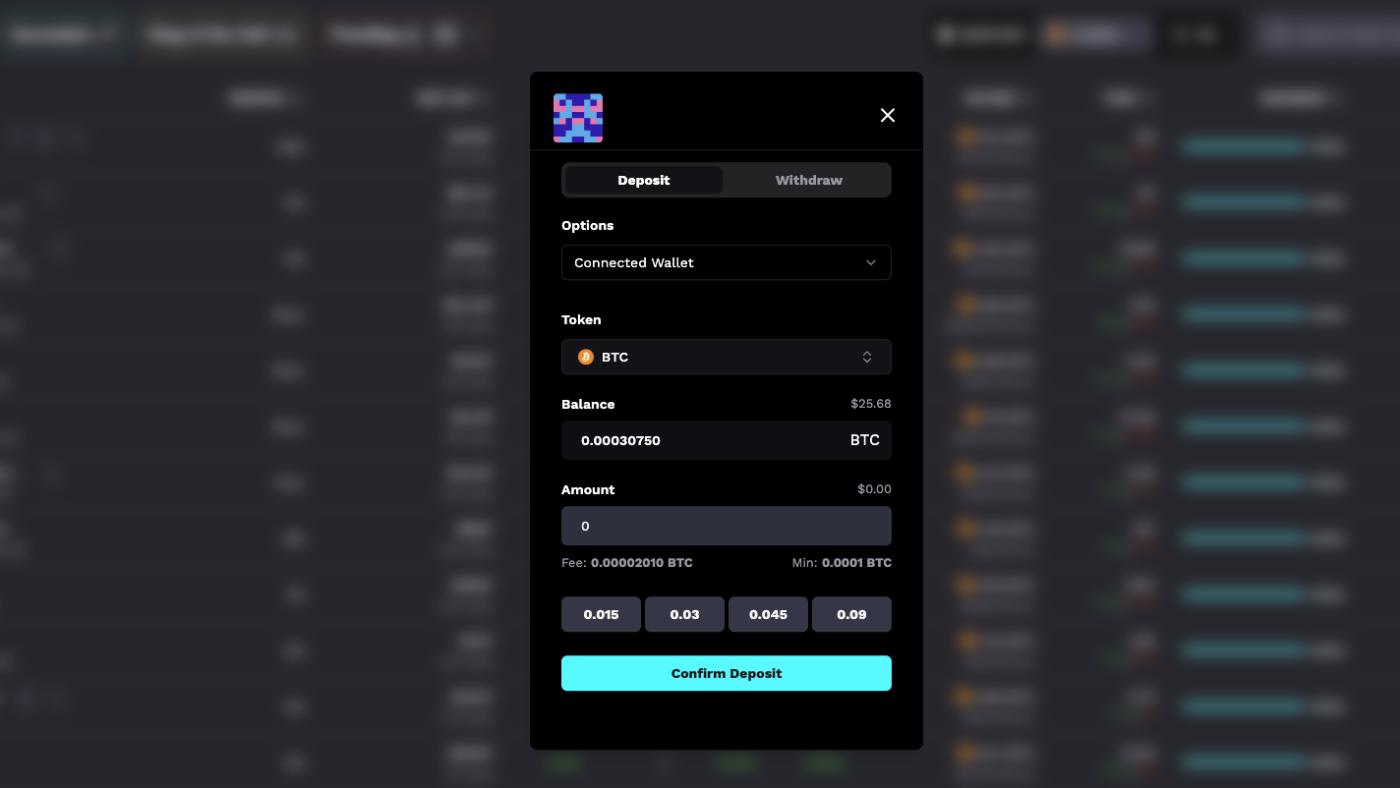
First, you need to deposit BTC into the platform, enter Odin.Fun, click the wallet link in the top right corner, and then click the BTC balance in the top right corner to make a deposit, as shown in the image below. You can choose to deposit Bitcoin from the linked wallet, or you can choose to transfer from an external address to the corresponding address for deposit, but do not use BTC UTXO containing other BRC 20 or Rune assets. At the same time, the tokens currently supported for deposit are not limited to BTC, users can also deposit popular Rune assets such as ODINDOG, ODINCAT, and SATOSHI into the platform.
After the BTC is deposited, click "TOKENS" at the top of the homepage, and you can filter and purchase Runes here. You can re-sort the list by metrics such as market cap, trading volume, or creation time, and if you re-sort by creation time, the newly created tokens will be pushed out first. You can also click "Filter" to filter the tokens more precisely, as shown in the image below, you can customize the filter to select Runes that have been launched, within a certain market cap range, or trading volume range.
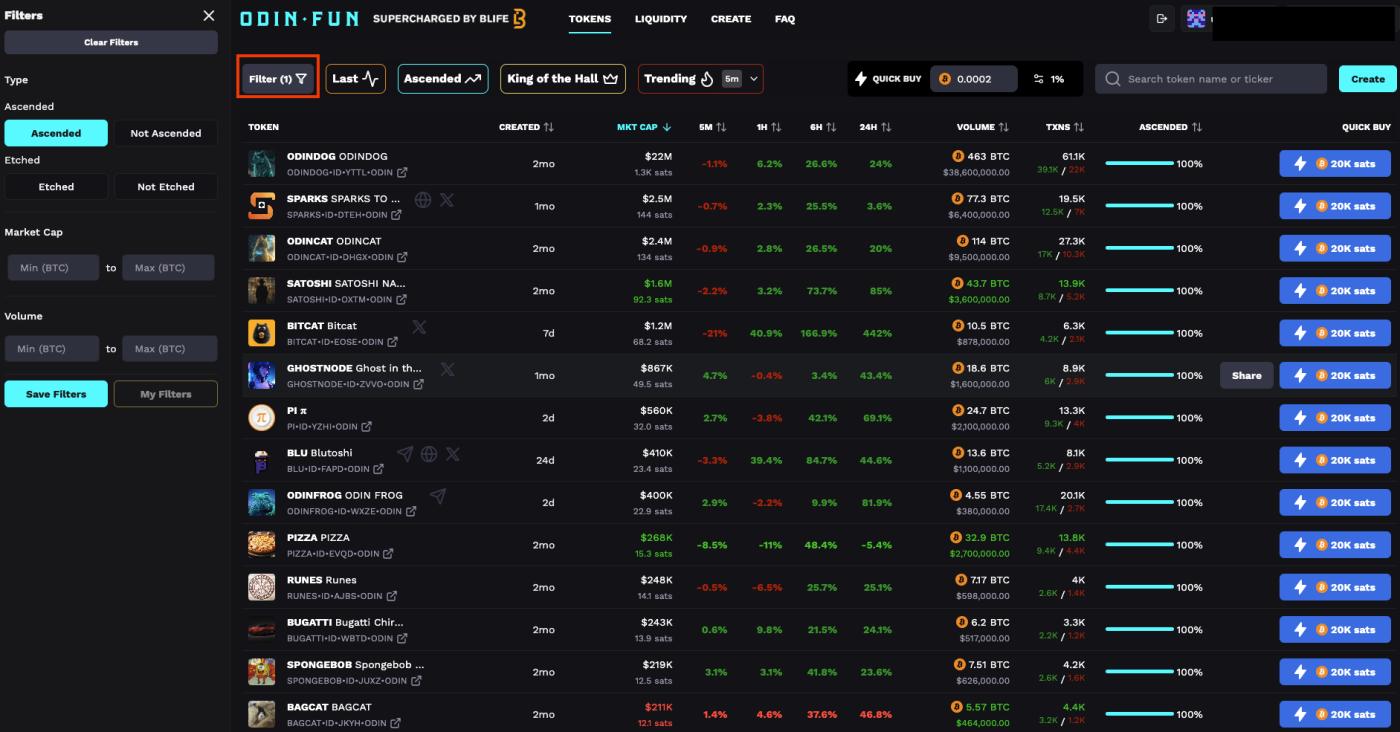
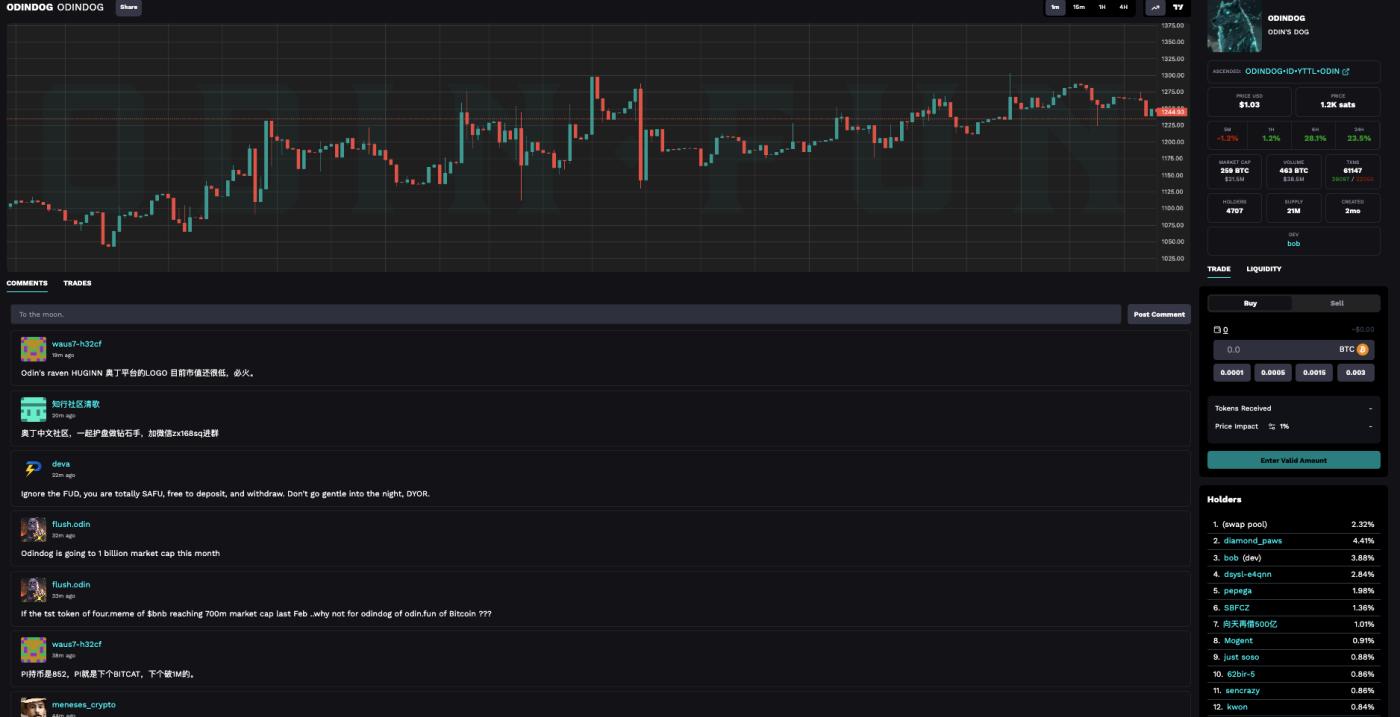
The Odin.Fun platform also supports quick purchases, in the "QUICK BUY" section above, enter the amount for each quick purchase, and click the blue button on the right side of the token to make a quick purchase. Users can also click into the token page to make a purchase, as shown in the image below, similar to pump.fun, the top right shows the basic information of the token, including price, market cap, trading volume, holders, dev, etc., and the bottom right shows the holder's chip distribution.
Adding Liquidity
Odin.Fun is not only an asset issuance platform, but also has established an AMM pool for each launched Rune. Click "LIQUIDITY" at the top, and you can see all the liquidity pools here, as shown in the image below, users can also sort by creation time, fee income, market cap, and total trading volume.
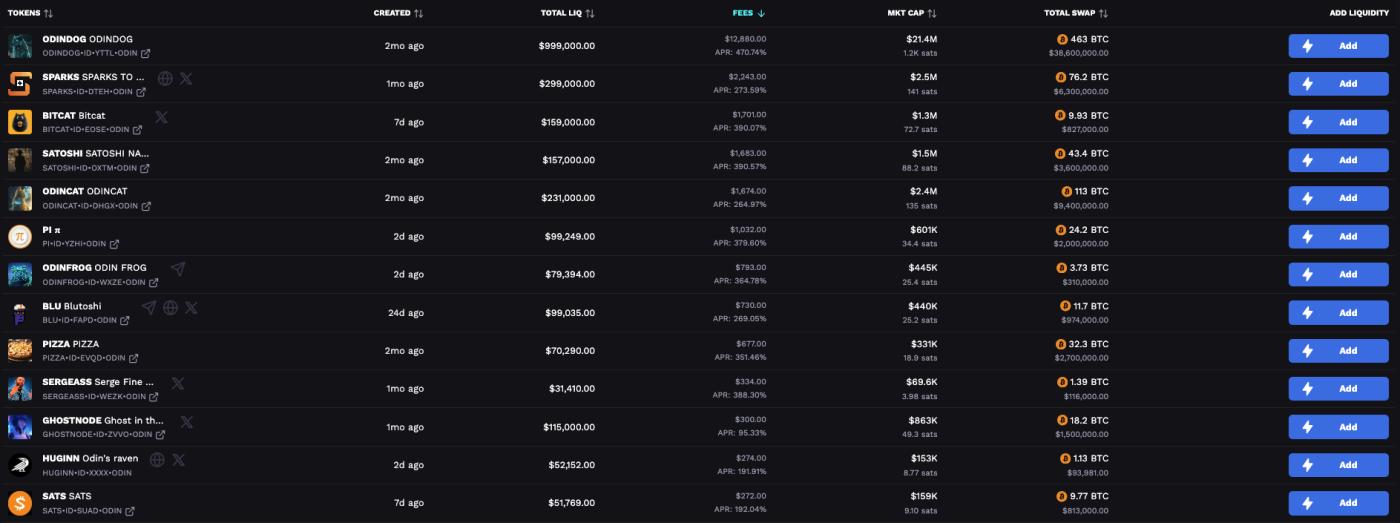
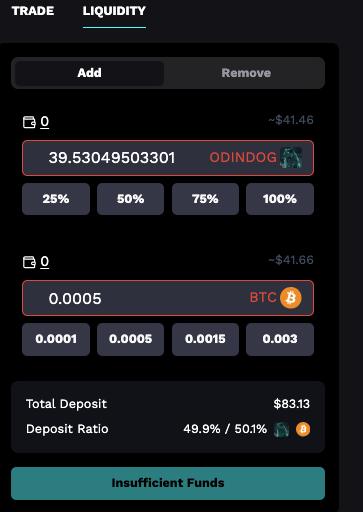
Users can add liquidity for the tokens they hold, currently the ODINDOG pool seems to be the most popular, with accumulated fees of $12,891, click "Add" on the right to add liquidity for it, but Odin.Fun only supports adding 50% of each side of the liquidity.
Popular Rune Overview
Although the Odin.Fun platform is still in its early stages, the market has already formed some consensus, and the following is an introduction to the popular Runes.
ODINDOG (ODINDOG•ID•YTTL•ODIN)
Market Cap: $26 million
Platform Holding Addresses: 4,711
ODINDOG is currently the flagship token on the Odin.Fun platform, deployed by BOB, and is also the first Rune issued on the Odin.Fun platform.
ODINCAT (ODINCAT•ID•DHGX•ODIN)
Market Cap: $2.5 million
Platform Holding Addresses: 2,059
ODINCAT is the second token deployed by BOB on the Odin.Fun platform.
SPARKS (SPARKS•ID•DTEH•ODIN)
Market cap: $2.4 million
Platform-held addresses: 1653
The token was issued by the Sparks project, which previously issued 111 NFTs on the Bitcoin mainnet, claiming to be supported by Darewise Entertainment, a subsidiary of Animoca Brands, with the aim of building a token-based metaverse on Bitcoin. The members include BRC 20 founder domo and Taproot Wizards founder Udi.
SATOSHI (SATOSHI•ID•OXTM•ODIN)
Market cap: $1.8 million
Platform-held addresses: 1269
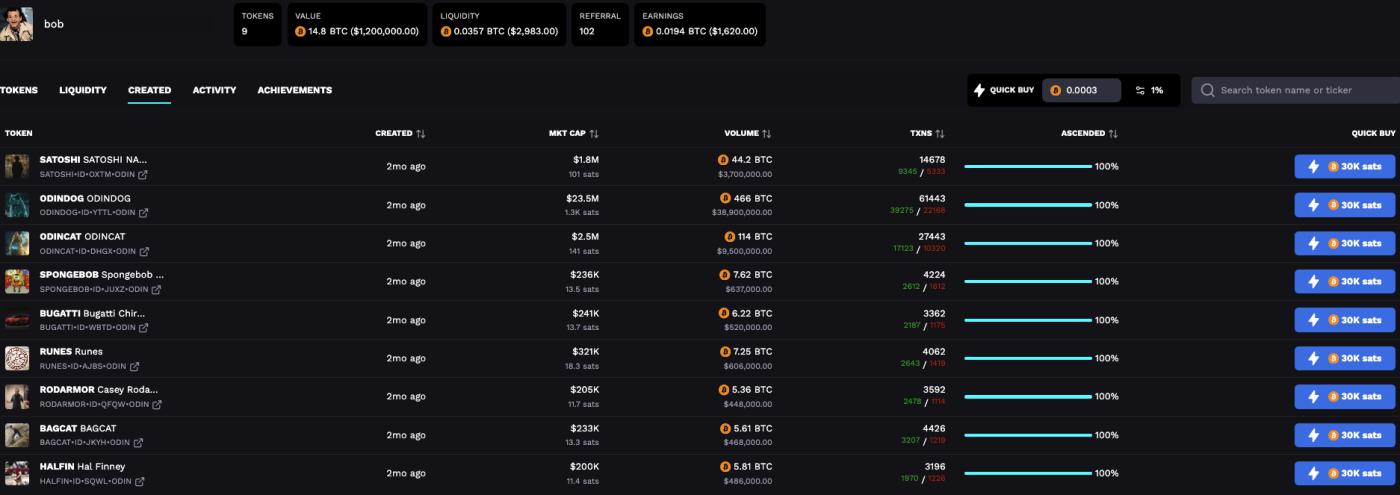
SATOSHI is the third token deployed by BOB on the Odin.Fun platform. BOB has actually deployed 9 tokens on the Odin.Fun platform, as shown in the image below.
BITCAT (BITCAT•ID•EOSE•ODIN)
Market cap: $1.3 million
Platform-held addresses: 460
Bitcat is the Bitcoin mascot, initially released by an X account that creates daily Bitcoin Meme images, and later hyped during the Solana mascot concept Meme craze.