


Author: Ice Frog
I. Good Direction, Good Timing: Reshaping the AI Economic Ecosystem, Now is the Right Time to Join
A good direction is the prerequisite for project success
Algorithms, computing power, and data are the three pillars of generative artificial intelligence. Due to the dazzling brilliance of Nvidia and OpenAI, computing power and algorithms have already seen rapid development. However, as the Scaling Law of large models continues to take effect, data has transformed from being cost-driven to becoming a higher-value asset type. Consequently, the scarcity of high-value data and data privacy security issues are now receiving high attention from the industry. However, an even more obvious overlooked fact is: while projects similar to large models enjoy the capital dividends brought by data, the interests of data creators, owners, and model feedback providers in this ecosystem have been ignored.
In the AI track, public data is not particularly difficult to obtain, and the entire data market also lacks unified standards. Additionally, as the bottom-layer data providers, users do not have significant returns. How to enable users to enjoy the due benefits of data provision, while also meeting the high-quality data needs of model parties, is the original starting point of the Sahara AI project. It aims at the key pain point that has been widely overlooked in the current AI ecosystem due to rapid development - the core proposition of AI asset-ization.
As AI agents are about to experience an explosion, and the AI industry is transitioning from 1 to 100, the supply of high-quality data that can also achieve privacy protection will become increasingly important, as AI is moving from generalization to a more vertical, distinctive, and personalized era. The transparency, security, and trustworthiness of blockchain provide an excellent support for the realization of this concept. On the one hand, blockchain technology can be used to allow each participant in the AI supply and demand parties to clearly measure their value contribution and receive reasonable benefit distribution; on the other hand, the decentralized nature of blockchain can effectively connect the supply and demand parties, and efficiently establish more customized and personalized AI products, which is an inevitable stage in the development of AI after general artificial intelligence.
Understanding the above content, we can roughly glimpse the foresight in Sahara AI's choice of direction. The project's chosen direction directly points to the key issues and bottlenecks in the development of AI, and it does not attempt to make huge innovations in blockchain technology itself, but rather uses blockchain technology to enable better development of AI. From the perspective of pain points, the pain point of AI ecosystem benefit distribution not only truly exists, but will also become the core pain point hindering market development as AI continues to commercialize, as people's demands for fairness, transparency, security, and interests have not changed regardless of how the times develop. In terms of scale ceiling, the AI scale ceiling will be several orders of magnitude larger than the blockchain scale, and Sahara is connecting a trillion-dollar-level large market.
Good timing ensures the project can grow continuously
A good project direction is important, but hitting the right timing is equally important. Good timing is neither too early nor too late, it is the triple resonance of industry, market, and cognition.
Imagine a scenario where ChatGPT has not yet emerged and large models cannot yet astonish the world. At this time, proposing the issue of data interest distribution would obviously be too far ahead, and it would be difficult to gain market recognition. However, if we wait until these industry issues have become an obvious and highly heated problem, by then there may already be many mature solutions in the market.
Looking at Sahara AI's current situation, the technological trends in the AI industry are no longer disputed, and large models have already passed the original 0-1 stage. Whether on the enterprise side or the user side, people's understanding and acceptance of AI are being strengthened. People have already moved from "what is AI" to the second stage of "how to use AI well". At this stage, commercialization will generate more discussions, and people will naturally become increasingly aware of the importance of data. Therefore, data asset-ization, or even AI asset-ization, will be most quickly recognized by the market.
Whether it's industry trends, market applications, or customer awareness, at least in terms of timing, for Sahara AI, it is indeed just the right time, not too early or too late.
II. Good Team, Strong Capital: A Triumvirate of an Excellent Team, Traditional + Crypto Top-Tier VCs' Support
Systematic collaboration of technology, operations, and ecosystem, combining technical vision and entrepreneurial pragmatism
From the description of direction and opportunity, we can roughly infer that the team capable of launching this project at such a favorable time with such an innovative concept must first have a deep insight into the AI industry, and also possess top-level blockchain expertise. The team's background proves this point.
Sean Ren (Co-founder & CEO): Before founding Sahara, he has been a tenured professor in the Computer Science Department at the University of Southern California (USC) for 7 years, focusing his research on AI and NLP. During his PhD studies at the University of Illinois at Urbana-Champaign, he already had successful entrepreneurial experience, with his startup StylePuzzle (a fashion recommendation e-commerce platform) successfully securing Series C funding from Plug and Play. He has also served as a data science consultant at Snap and a visiting scientist at the Allen Institute for AI, and was awarded the Samsung Annual AI Researcher. From the founder's background, it is not difficult to see that he not only has a deep understanding of AI, but also has impressive business experience, ensuring an overall grasp of the project's foresight and pragmatism.
Tyler Zhou (Co-founder & COO): The project's COO graduated from UC Berkeley and previously worked in investment banking and PE firms. In 2022, he joined Binance Labs as an investment director, mainly responsible for investments in the US market. Tyler Zhou's background not only provides more assurance for the project's investments, but also, due to his experience at Binance Labs, it can be foreseen that the overall operation of the project will have more commercial attributes.
Lara Avedissian (Ecosystem Lead): Graduated from UCLA and Columbia University, she previously served as the chief of staff at Comm and is also the ecosystem lead at Stability AI. This means that Lara Avedissian's addition will allow the Sahara project to reach the broadest projects in both the crypto industry and the AI industry.
Guang Han (VP of Engineering): Previously an engineer at Microsoft and the CTO and co-founder of a startup, his technical background is very rich.
Looking at the four core executive team members, in addition to the standard configuration of top-tier university graduates and big tech experience, the most critical point is that the project founders all have successful entrepreneurial experience in their respective fields. This means that the project team not only has a deep grasp of industry development trends, but also has a more pragmatic approach to project implementation, which undoubtedly enhances the chances of success.
Top-tier capital, not limited to crypto VCs, a super luxurious advisory team
Sahara AI's investment team is undoubtedly rare in the industry, with the most obvious feature being that it not only has top-tier crypto VCs known for investing in the crypto industry, but also top-tier traditional VCs known for traditional investments. The main investment institutions are as follows:
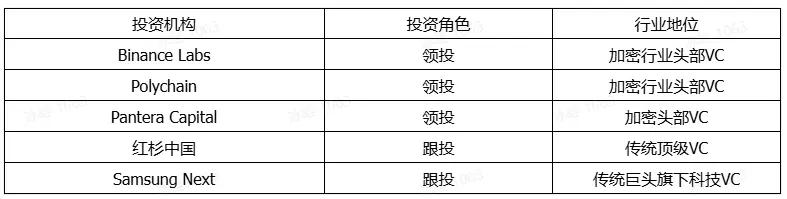
In addition to the above top-tier institutions, there are also follow-on investments from a host of industry-leading investment firms, as well as the endorsement of industry luminaries such as Sandeep Nailwal (co-founder of Polygon).
Another rare additional element is the super luxurious advisory team, including: Laksh Vaaman Sehgal (Vice Chairman of Motherson Group), Rohan Taori (Human Research Scientist), Teknium (Co-founder of Nous Research), Vipul Prakash (CEO of Together AI), Elvis Zhang (Founding Member of Midjourney), etc.
From the team to the capital to the advisors, they are all top-tier configurations in the industry. This not only means the strength of the team, but also represents the vast resources behind the team, capital, and advisors. From a commercial reality perspective, it must be acknowledged that the success probability of such projects is indeed higher.
III. Technology and Achievements: Solid and Clear Development Roadmap, Top-Tier Partner Trust
Technical implementation demonstrates strategic foresight
From the previous content, we can clearly see that the project team has demonstrated the qualities of a top-class project in terms of direction selection, timing, capital and team support. Further examination of the actual implementation can reveal the disruptive aspects and broad prospects of the project.
As mentioned at the beginning, Sahara AI mainly uses blockchain technology and related privacy protection measures to empower the entire AI field. In terms of specific product construction, its developed Sahara AI platform covers almost all one-stop development needs throughout the AI lifecycle, while using blockchain technology to ensure the ownership of contributors' assets.
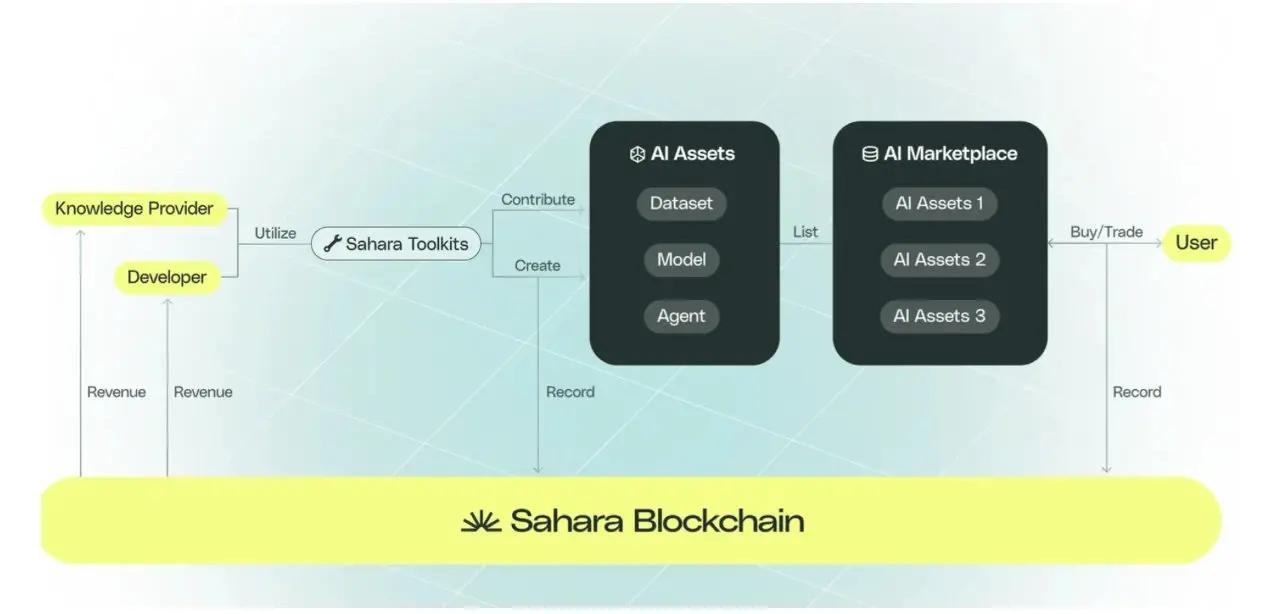
As shown in the above figure, the logic of implementation is not complicated. The development tools, asset creation and transactions of developers/knowledge/data contributors will be recorded on the mainnet, and corresponding fair rewards will be given.
From the core logic of this product framework, the platform mainly relies on three pillars:
Emphasizing sovereignty and provenance: This means that the collection, annotation, model deployment, and application of data will all run on the mainnet, with high transparency and inclusiveness. It not only prevents the monopoly of Web2, but also ensures that all stakeholders have a voice and share the benefits according to their contributions.
Providing AI tools: In addition to supporting the latest AI paradigms, it also provides users with a full set of highly available toolkits, as well as the most advanced security measures and privacy protection.
Sharing economy: Rewards are given proportionally according to the contributions in the entire AI development process, whether it is individuals, SMEs or large enterprises, and the monetization of AI assets is also made more transparent.
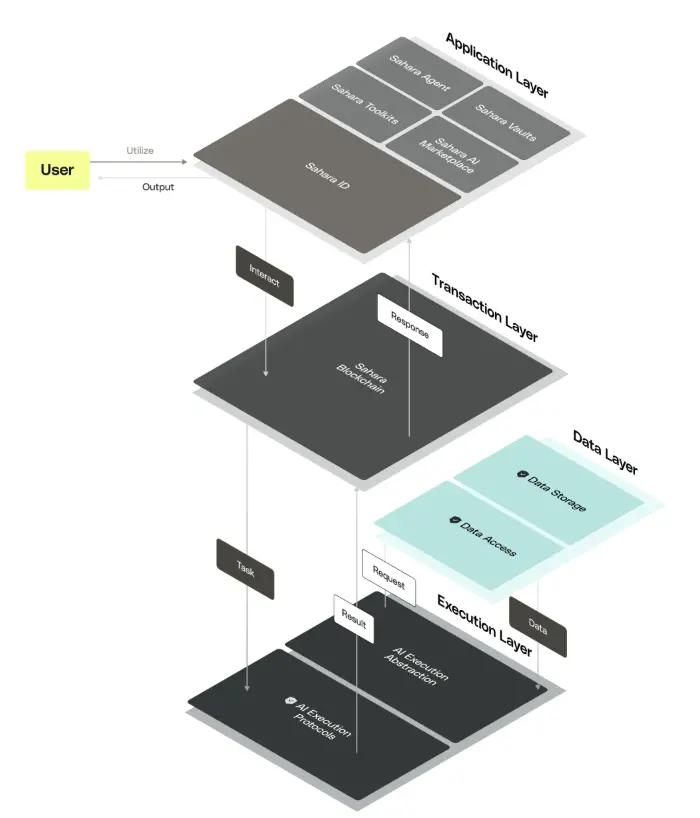
The above three pillars are interlinked, providing a solid foundation for the healthy operation of the entire platform. In terms of specific implementation, the entire platform is divided into four layers, with the main features as follows:
Application layer: Mainly the user interaction interface, used for accessing, building and monetizing AI assets.
Transaction layer: Manages all AI-related transactions (such as provenance, access control, ownership, etc.) in the mainnet.
Data layer: Abstracts and protocols for data storage, access and transmission, and also integrates on-chain and off-chain components for convenient data management throughout the lifecycle.
Execution layer: Supports AI applications and provides necessary off-chain infrastructure, including multi-functional AI computing protocols, and dynamically allocates computing resources.
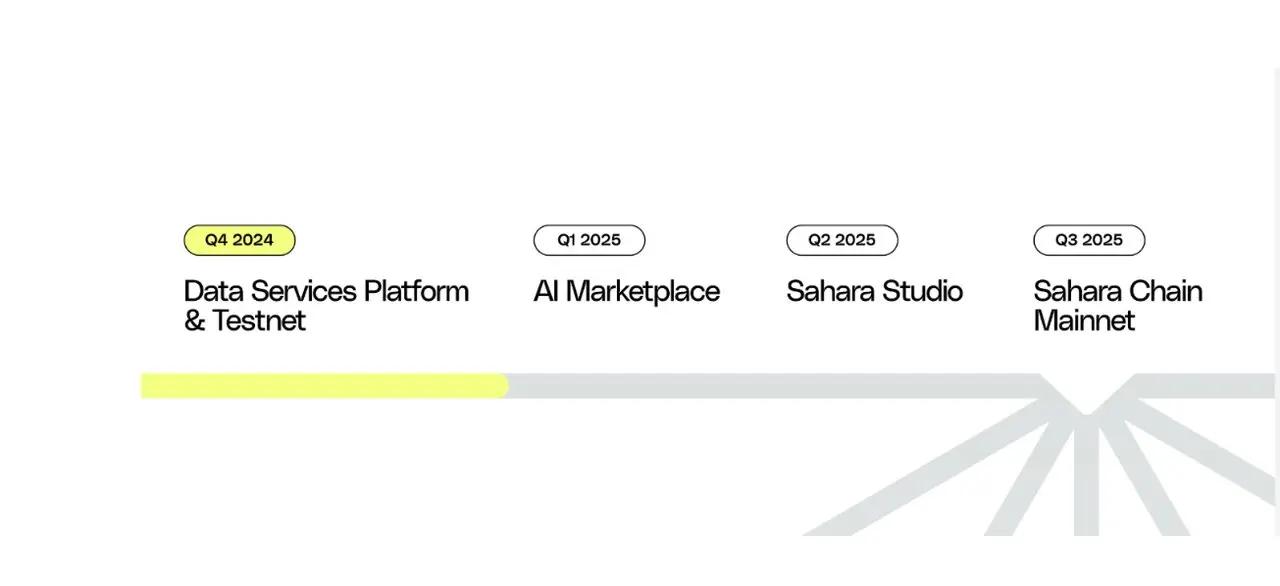
In terms of the overall progress of the project, the testnet has already launched the first product: Data Services Platform, which has attracted a lot of market attention. According to the project's roadmap, 2025 will be the most important year, with the mainnet launch and multiple products being launched simultaneously.
Top-tier partners' trust, the flywheel of growth is activated
From the ecosystem partners that have been announced so far, they are also very heavyweight. Currently, more than 35+ research institutions are using Sahara AI, including Microsoft, Amazon, Snap, MIT, UCLA, etc., using not only the Shara Data for data annotation and collection, but also the Shara Agent function for agent construction. The trust of these top-tier partners will greatly help and expand the entire ecosystem of the project.
From the opportunities, timing, team, capital, to the technical implementation and ecosystem expansion, we can see that the flywheel effect formed by Sahara AI based on Crypto×AI is rapidly starting up.
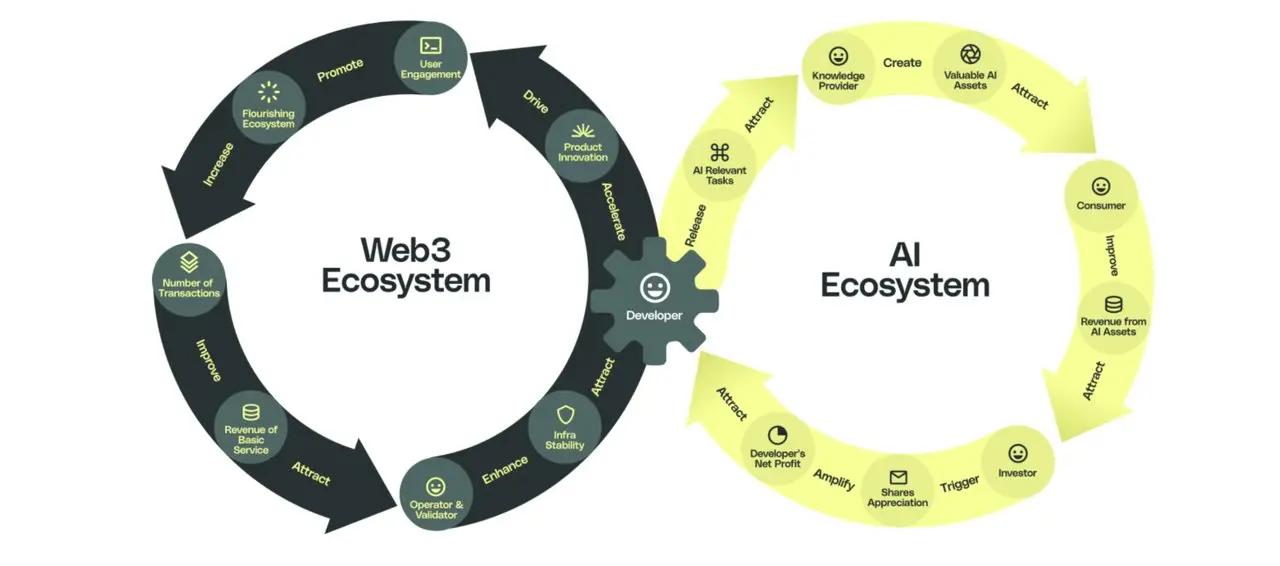
Once it enters the positive cycle, the market is more likely to see a disruptive innovator, rather than just another star project.
IV. High Heat, Strong Potential: Market Heat Soaring, Potential Returns Promising
Sahara AI is sweeping the market with an amazing momentum, and its development potential will be fully released in 2025. The successful completion of two rounds of testnet fully demonstrates the enthusiasm of the community and the attractiveness of the project:
First testnet: A total of 800,000 people submitted applications, and only 10,000 users were granted participation, with 4.5 million points distributed.
Second testnet: The number of registered applicants was about 2.2 million, 1,936,183 data points were approved, and about 19 million points were distributed.
The third round of testnet is currently in hot registration: Application link
The number of applicants in the first two seasons reached several million, with high heat, and the upcoming Siwa public testnet in April is expected to further expand its influence, attract more users to participate, and drive the dual growth of total points and market heat. Considering that this is the element year of AI, the potential returns of Sahara AI are worth looking forward to.
Financing and market recognition: Significant financing, market capitalization will not be low
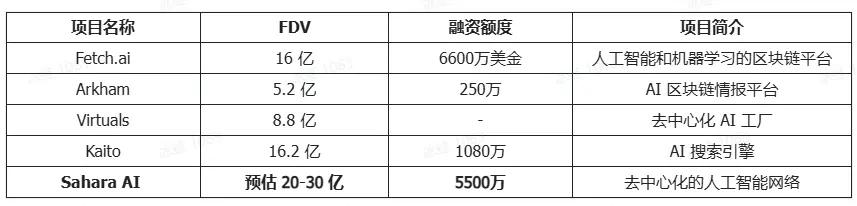
From several benchmark projects, it is known that Sahara AI has raised as much as $55 million, which is at a relatively high level among similar projects. This fully demonstrates that the capital market is very optimistic about its development prospects, and it is estimated that the FDV after Sahara TGE will be at least around $2 billion. The key factors supporting this estimate are as follows:
Potential of the track and unique positioning: In terms of the potential of the track and the project's positioning, the current AI track is still in the initial stage, and Sahara's positioning as an AI model data service provider fills a market gap. The current mainstream AI models (such as GPT-4, Claude) are facing the problem of training data depletion, and research shows that high-quality corpus will be exhausted by 2026. As a data service provider, Sahara AI is just filling this market gap, and the urgency of market demand brings it huge potential, which is a key factor supporting the high valuation.
First-mover advantage and leading premium: Higher valuation ceiling In the AI data collection-related projects, Sahara has not yet seen a leading player emerge. Given its leading position in many aspects, it has already become the leader in this track. Track leaders often have premium space in valuation, as can be seen from Grass, which has a $2.5 billion FDV with only $4.5 million in financing. Sahara's positioning is more practical, and its valuation naturally will not be low.
Future growth potential: Ecosystem expansion and market trends The AI industry is in a period of rapid growth, and as a data service provider, Sahara AI will directly benefit from the industry expansion. With technological progress and market maturity, its business scale is expected to achieve exponential growth, and the scarcity of high-quality data will drive up its value, further enhancing its profitability and valuation space. A $20-30 billion FDV may even underestimate its long-term potential.
Potential Return Estimate
Since its launch, Sahara has launched two testnet tasks and one Odyssey task, both of which have clear rewards and may be related to airdrops:
- Testnet task points, a total of 23.5 million points distributed in two rounds, users accumulate points by participating in tasks.
- Sahara Odyssey task, through different tasks to synthesize a final NFT, the task deadline is May 2.
- The public testnet will be launched in April, and combined with the currently ongoing third internal testnet, it is estimated that an additional 50 million points may be released, so the total points will be about 75 million.
- The Odyssey NFT task has a long deadline and only part of the tasks have been opened, so the airdrop ratio is estimated to be around 2%. The following calculation is based only on the testnet whitelist task points, and the potential return per point.
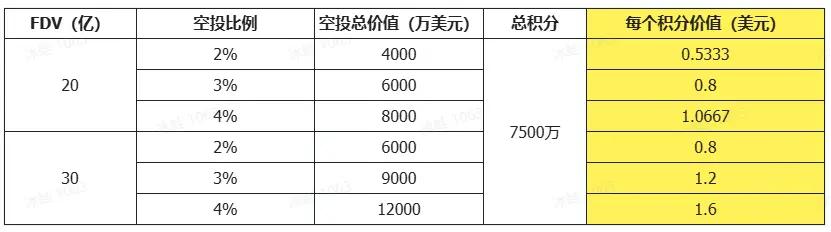
Under different FDV scenarios, the estimated value per point is about $0.53-$1.6. The above estimate is based on a forecast of 75 million points, and the total points will increase with subsequent testnet and tasks, so the value per point will certainly be diluted. This data is for reference only.
Conclusion
At the beginning of the year, the wave of AI and cryptocurrency integration has swept the entire market with one wealth myth after another, but when the hype subsides, the integration of AI and the cryptocurrency industry is still an inevitable path issue. Many projects are aimed at empowering blockchain with AI, which is easier to achieve and catch people's attention, after all, it is essentially using AI as a tool. Sahara has chosen to empower AI with blockchain, it wants to participate in the grand narrative of the entire AI development, the difference in perspective and route not only makes Sahara's ecological imagination and market have a ceiling far beyond the previous ones, in the long run, this may also be the correct way for blockchain to break through the circle and enter Web2, and this may also be the reason why top investment institutions such as Binance, Polychain, Samsung, and Zhongwei are willing to provide huge investments.
From the overall design of the platform, its modular design based on blockchain has cleverly unified the technical stack of the full life cycle of AI and the benefit distribution of various participants, not only is it the only project currently providing this technical solution, but it also clearly demonstrates that the future vision of AI must be fair, democratic, secure and easily accessible. This is not only Sahara AI's insight into the entire AI industry, but also reflects that empowering AI from the perspective of blockchain is a broader and more promising field.
The market potential of Sahara AI is being released at an accelerating pace, and the current stage is the public beta test registration stage, it is recommended to continue to pay attention to the subsequent participation opportunities.






