Here is the English translation of the text, with the specified terms retained:
On March 9, 2025, the ruling Liberal Party of Canada announced that Mark Carney was elected as the new party leader by an overwhelming majority. Carney will replace the current Prime Minister Trudeau as the Liberal Party leader and form a new cabinet, becoming the first unelected Prime Minister in Canadian history.
The career of Canada's new Prime Minister, Mark Carney, has always been closely connected to the financial system - from a senior executive at Goldman Sachs to the governor of the central banks of Canada and the UK, and then to the UN Special Envoy for Climate Action, each of his milestones has been accompanied by deep reflections on global economic and financial innovation.
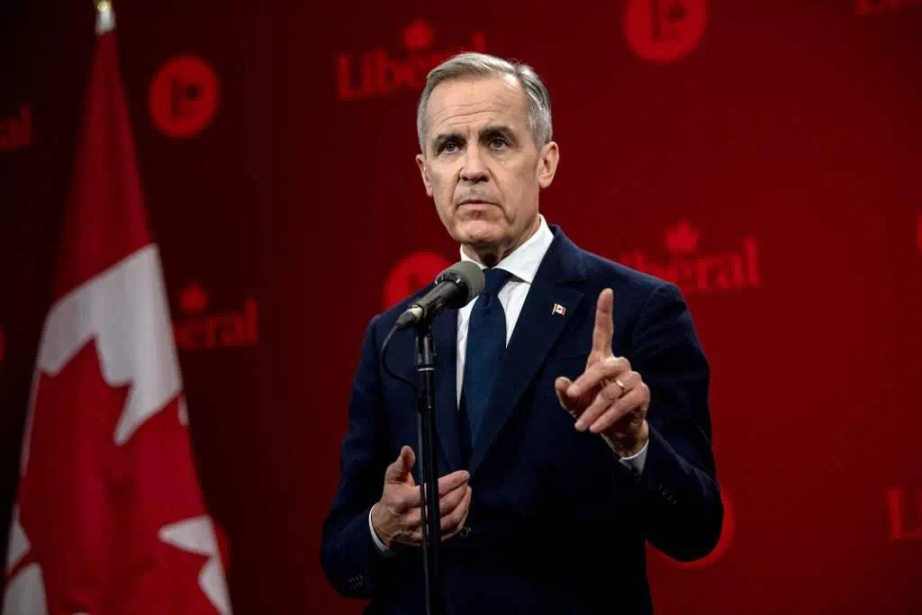 Image: Mark Carney, Source: Visual China
**Early Stance: Questioning BITCOIN, but Embracing BLOCKCHAIN**
Carney's first public discussion of cryptocurrencies can be traced back to December 2017. At the time, the price of BITCOIN surged to a historical high, triggering a global speculative frenzy. In a testimony on financial stability at the UK Parliament in London, Carney, as the Governor of the Bank of England, clearly stated that "BITCOIN is not a threat to financial stability", believing that it has limited connection with the traditional financial system, but warned of the risks of ICOs (Initial Coin Offerings) evading regulations. This stance laid the groundwork for his subsequent position, which is to distinguish the speculative nature of cryptocurrencies from the potential of their underlying technology.
In February 2018, Carney openly stated at the Regent's University London that BITCOIN "has almost failed the traditional definition of money". He further pointed out that the fixed supply of 21 million BITCOINS has a "serious flaw", and that mechanically mimicking the gold standard is a "criminal act of monetary amnesia" - this design, while attempting to combat inflation, leads to violent price fluctuations, making it a "poor short-term store of value". He even gave an example to warn: "If ordinary households borrow in BITCOIN to pay for daily expenses, they may fall into a debt abyss due to the plunge in its value." However, he also emphasized that BLOCKCHAIN technology is a "revolutionary verification of decentralized financial transactions", and revealed that the Bank of England is exploring the application of Distributed Ledger Technology (DLT) to real-time settlement systems to improve efficiency and security.
This "denying speculation, affirming technology" dichotomy has become the core of his early attitude towards cryptocurrencies.
**Regulatory Logic: Cracking Down on Illegal Activities, Supporting Compliant Innovations**
Carney's regulatory proposals for cryptocurrencies have always revolved around two keywords: transparency and accountability. He has repeatedly pointed out that anonymous transactions are a breeding ground for money laundering and illegal activities, calling for the inclusion of cryptocurrency exchanges in the same regulatory framework as traditional financial institutions. In his support for Central Bank Digital Currencies (CBDCs), he particularly emphasizes their potential for counter-terrorism and anti-economic crime - by tracing transaction records, the black market's living space can be compressed. During the G20 Summit in January 2018, he pushed for the cryptocurrency issue to be put on the agenda, advocating international cooperation to regulate its exchange mechanism with fiat currencies.
Regarding digital currency projects initiated by private institutions, Carney has shown a rare open attitude. When Facebook launched the stablecoin Libra (later renamed Diem) in June 2019, he did not completely reject it, but rather said it was an innovative attempt that "could potentially reduce global payment costs", while emphasizing that "the highest standards of regulation must be established in advance". He even proposed that a "synthetic hegemonic currency" (SHC) supported by multiple central banks could potentially replace the US dollar as the international reserve currency, to address the imbalances in the financial system brought about by globalization. Although this idea has not been widely adopted, it reflects his profound insight into how digital currencies could reshape the international financial order.
**Climate Perspective: Energy Controversy and the Priority of CBDC**
In 2021, at an event at Stanford University, Carney, in his capacity as the UN Special Envoy for Climate Change, discussed his impressions of cryptocurrencies. He criticized the high energy consumption of BITCOIN mining and the rationality of China's mining ban, bluntly stating that "climate change is a survival challenge, and we don't need technologies that make the problem more complex."
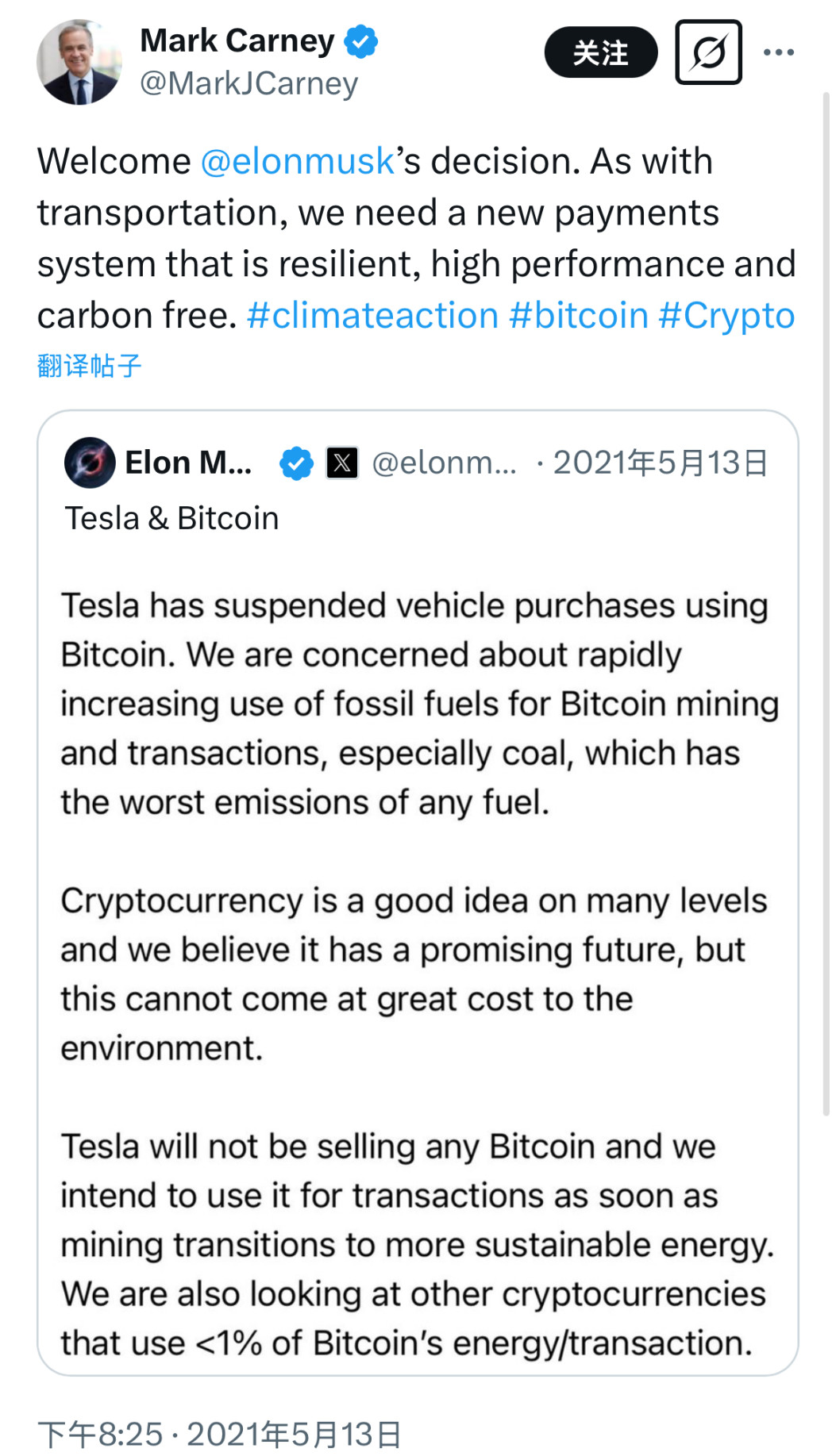
On May 13 of the same year, he retweeted Musk's post about BITCOIN payments, calling for the establishment of a "resilient, high-performance and carbon-free payment system" - this seemingly contradictory move actually aligns with his policy priorities: he supports a sustainable technological path, rather than a specific cryptocurrency.
At the same time, he publicly emphasized the advantages of Central Bank Digital Currencies (CBDCs) in terms of security and sustainability. This stance is consistent with his long-term advocacy for CBDCs. As early as 2017, Carney led the Bank of England to test a digital currency prototype, believing it could "restructure the liquidity risk of the banking industry", but also warned of the need to balance innovation and financial stability. On the eve of his departure as the Governor of the Bank of England in 2020, he reiterated that the design of CBDCs needs to maintain a prudent attitude to avoid disrupting the existing monetary system.
This persistent exploration of "public digital currencies" contrasts sharply with his reserved attitude towards private cryptocurrencies - in Carney's vision, the core of the future financial system should be anchored by sovereign-backed digital currencies, rather than decentralized cryptocurrencies.
**Promoting the Adoption of Crypto Payments**
In 2021, Carney joined the board of the American payment giant Stripe. Although the company had abandoned BITCOIN payments in 2018, during his tenure (2021 to 2025), Stripe gradually rolled out cryptocurrency payment solutions between 2022 and 2024, including support for stablecoin settlement and Web3 wallet integration. In April 2024, Stripe resumed accepting cryptocurrency payments, and in October of the same year, it acquired the stablecoin platform Bridge for $1.1 billion, which is the largest acquisition case in the history of the cryptocurrency industry based on public reports.
Stripe's strategic transformation is in line with Carney's pursuit of an "efficient and compliant payment system", which is to embrace the efficiency of BLOCKCHAIN while avoiding the uncertainty of regulations.