Author: Zuoye
EigenLayer's proof of the need for the Ethereum security space ≠ the monetization of the Ethereum security space. Babylon's real competitor is the BTC Spot ETF, whose promise of security and returns is less than that of the off-chain.
After a year of intense heat and mid-course collapse, we have finally reached a consensus that the demand for BTC is the demand for BTC itself, and cannot be extended to BTC pledged assets, BTC L2 and BTC-based DeFi.
Replicating the Success and Failure of Ethereum
Babylon is not a new project, it has just been unable to complete financing for a long time and has remained in the academic research field.
Solv is not the initial startup direction either, it is a timely move after multiple adjustments, soaring straight to Binance.
Are Bitlayer/BEVM/Merlin and other BTC L2 new projects? We can only say that there is a 50% chance. Most of them were established at the same time as WBTC, and the fact is that there have been no miracles in the second attempt on the roads that have not been successful.
Even Runes has not replicated the miracle of Runes, and has finally cooled people's hearts, but says that the autumn is cool.
Caption: BTC etf, image source: @sosovalue
In Q1 2025, only the BTC Spot ETF will be successful, and apart from Bitcoin itself, the ETF is the most reliable investment tool, in stark contrast to the ETH ETF, with the on-chain ecosystem of Ethereum flourishing, and the off-chain trading of BTC bustling.
We have to admit that BTC does not need the scenarios of L2 and pledging to reinvent the wheel, and the lack of smart contracts is not the market space of Babylon, but the inevitable choice of robustness.
Although people are currently mocking Vitalik and Ethereum, most of the innovations of BTC and Solana are imitations and transformations of Ethereum, with Solana taking away DeFi and Meme, and BTC taking away the pledge system and income scenarios, playing the RWA of digital gold.
But at least Solana has achieved stage success, while BTC itself is strong, with $80,000 calling a pullback, and SOL starting with 100 is heartbreaking, and even more painful is the stage-wise falsification of BTCFi.
ETH L2 is not a failure, at least it has cultivated successors like Base, and the failure of price does not mean the lack of practical scenarios, but the BTCFi pledge layer, L2 and DeFi have only failure and more failure.
In short, BTCFi has not replicated the success of Ethereum, but has instead followed all the failures of Ethereum.
The Tragedy of Mainnet Security Monetization
As mentioned earlier, Eigenlayer hopes to monetize the security space of Ethereum, and then divide it into partitions to rent out to projects with security needs. Essentially, Eigenlayer does not provide security, but is just a carrier of security.
Why can't this set be migrated to other public chains?
Projects like LSD/LRT, Meme, DEX, etc. can all be learned by various public chains and do not show symptoms of being unsuitable for the local environment. Only BTC cannot be replicated?
In fact, each chain tends to lean towards one model: asset issuance products, whether they are packaged as L2 or pledge/re-pledge systems.
If everyone is also fond of the SVM L2 track, we can predict in advance that the 100 billion market value scale of Solana cannot support the suburban economy, Beijing needs a sub-center, and Tongliao obviously does not need it.
BTC is the same, the trillion-dollar Bitcoin ecosystem has only one product, which is BTC itself. If we rely on BTC to do some marginal arbitrage, such as WBTC and ETF, it will enhance the market value of BTC and be recognized and rewarded by the market.
But one step beyond the thunder pool, the hope of transferring the value of BTC to its own tokens will face an eternal problem: how to get people to exchange their BTC for your Token, which is 100 levels more difficult than getting people to exchange USDT for USDD.
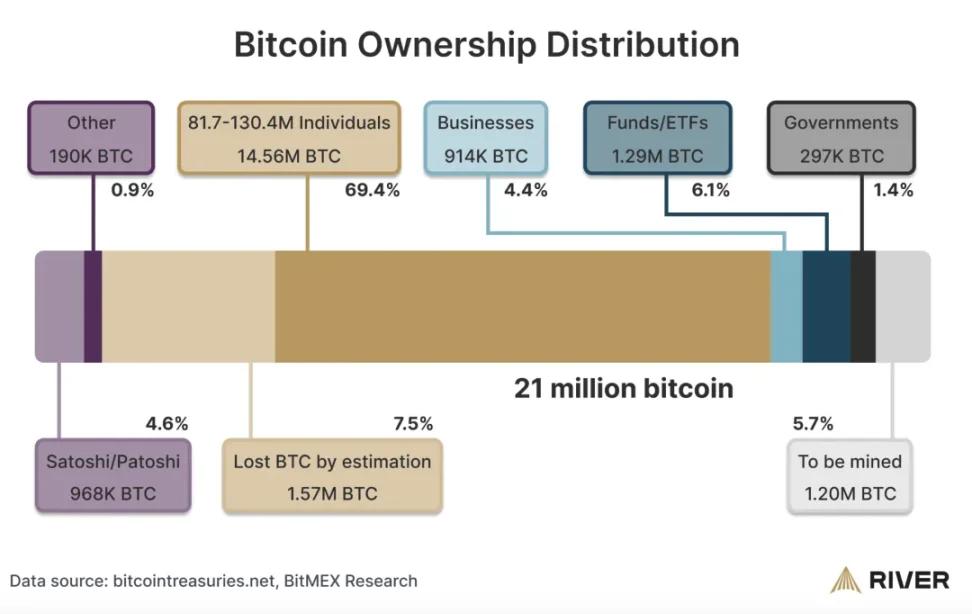
Caption: BTC holder distribution, image source: River.com
Various BTC pledge protocols are bustling, but the majority of BTC is distributed among exchanges and asset management companies globally, and the BTC on-chain pledge system is just a concept, and it is difficult to be called a substantive entity.
Fundamentally, the BTC pledge system cannot be equivalent to the sense of security that comes from holding BTC, and if the pledge system cannot be established, then BTC L2 and BTC DeFi cannot be established either.
The Two Dragons Never Meet
The ETH L1 is congested, and has carried out large-scale L2 infrastructure, which was eventually stolen by Pump Fun, this is the whole story of the crypto circle in the past half year.
Recently, if it were not for the BTC L2 starting to hype up the token issuance, the fast-paced crypto circle people might have already forgotten this ancient memory. In my personal opinion, the only winner is the rapid token issuance + long-term operation of Merlin Chain.
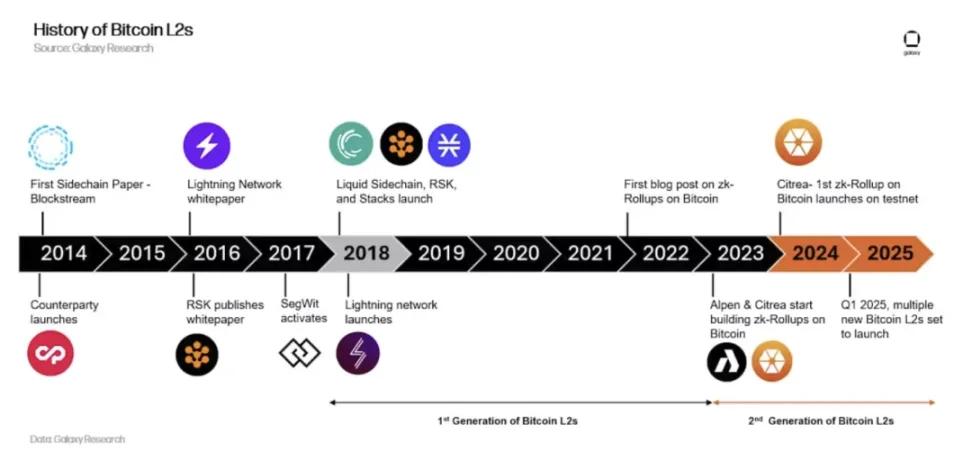
Caption: History of BTC L2s, image source: Galaxy Research
The earlier the token issuance, the more it damages one's reputation, and the later the token issuance, the harder it is to control the plate. If you are destined to be cursed by the retail investors, it is better to choose the way to make more money, this is the whole story of the BTC L2 in the past year.
In comparison, ETH itself needs L2 to share the traffic, and the current game is just an adjustment of the fiscal relationship between the central and local governments, and has little to do with the weakness of the EVM ecosystem and the L2s. Even if Ethereum collects more taxes from the L2s, the retail investors will not return to the EVM ecosystem.
SVM L2 is the same, Pump Fun has entered the end of the profit curve, and the way it has chosen to extend its life is to grab the cash flow of the AMM DEX. If it were in the Ethereum ecosystem, it would most likely be the emergence of Pump Fun Chain.
BTC L2 is the most embarrassing, compared to the support and guidance of Vitalik and the Ethereum Foundation, the technical solutions of BTC L2 are chaotic and disorderly, with both imitation monsters following the ZK/OP route, and those who are focused on patching the existing opcodes, as well as the reformists who want to complete the Bitcoin script function.
Compared to the decentralization of SVM L2, BTC L2 seems to have a stronger "project party + VC" collusion color, after all, the public chain co-creator Anatoly and the Solana Foundation's attitude towards SVM L2 is "not support, not oppose, not encourage, not refuse", and it is surprising that the long-term "server room chain" Solana is the real crypto OG that embodies the decentralization concept.
And so it goes, living this way for 365 days, until entering the post-VC, post-market maker era of the Listing node, in the incomprehension and shock of the surrounding audience, the BTC L2 one by one announced their airdrop plans and token economic mechanisms.
Only BTC itself chooses not to be bothered by these troubles, whether it's $80,000 or $1, digital gold or the savior of US debt, they are all external to me.
Conclusion
Since the birth of BTC, people have developed a large-scale wallet, mining, wrapped asset and other industries, laying the foundation for the Ethereum ecosystem, and even Vitalik himself was a seed cultivated by Bitcoin Magazine.
But BTC is too special, compared to the many competitors facing Mass Adaption and externalities, Bitcoin itself has no leading personnel, and does not need to go on a political system offensive like the successors such as Movement.
Just like the internal mechanism of AI, this absurd world has no explainability, BTC chooses not to explain, and BTCFi hopes to explore a new path, but the result proves that the old path is more robust.