The competition in the blockchain field is becoming increasingly fierce, with projects such as Ethereum, Solana, Avalanche, and Binance Smart Chain vying for a dominant position. Each network has proposed unique solutions to address the blockchain trilemma - scalability, decentralization, and security. As an emerging project, the Quai Network, through its multi-chain modular architecture, solves these challenges in an innovative way. So, how does Quai compare to these mature blockchains in terms of scalability and decentralization? Here is an in-depth analysis.
Scalability: High Throughput and Modular Design
Scalability is one of the main challenges for blockchains, i.e., how to process a large number of transactions quickly and efficiently.
- Ethereum: Ethereum's single-chain architecture limits it to around 15-30 transactions per second (TPS). Although Ethereum 2.0 introduces sharding technology to improve scalability, its deployment process is slow, and high transaction fees are still a problem during network congestion.
- Solana: Solana achieves a throughput of up to 65,000 TPS through its Proof-of-History (PoH) consensus mechanism. However, this scalability comes at the cost of decentralization, as the validator nodes require high-end hardware.
- Quai Network: Quai's multi-chain architecture inherently solves the scalability issue. By dividing the network into a Prime chain, Region chains, and Zone chains, it allows multiple chains to process transactions in parallel. This modular design supports thousands of transactions per second while maintaining decentralization.
Conclusion: The Quai Network performs exceptionally well in scalability, surpassing Ethereum's limited capacity and matching Solana's speed, without the same centralization issues.
Decentralization: Preserving the Core Spirit of Blockchains
Decentralization is the foundation of blockchains, ensuring that the network is not controlled by a single entity.
- Ethereum: As one of the most decentralized networks, Ethereum has over 7,000 nodes globally. However, the high gas fees often deter small participants, raising questions about economic accessibility.
- Solana: Solana has sacrificed decentralization for performance. Its high hardware requirements mean that validator nodes are concentrated in regions with cheap electricity, creating a high barrier to entry for regular users.
- Quai Network: Quai ensures decentralization by distributing mining rewards across its modular chains. This structure encourages miners of different scales to participate, preventing centralization of computing power. Additionally, Quai avoids Solana's high hardware threshold, promoting a more inclusive ecosystem.
Conclusion: The Quai Network has achieved a better balance between scalability and decentralization, being more decentralized than Solana while more user-friendly in terms of fees compared to Ethereum.
Consensus Mechanism: Proof-of-Work and Other Modes
- Ethereum: Ethereum is transitioning to Proof-of-Stake (PoS) with Ethereum 2.0 to address energy concerns and scalability. However, PoS has been criticized for potentially leading to the concentration of validation power among the wealthier participants.
- Solana: Solana combines PoH with PoS, providing high performance, but the centralization of validator nodes and network outages have been controversial issues.
- Quai Network: Quai retains a redesigned Proof-of-Work (PoW) mechanism while introducing a multi-chain architecture, eliminating the inefficiencies of PoW. This hybrid model preserves the security advantages of PoW while enhancing scalability and decentralization.
Conclusion: Quai Network's hybrid PoW model finds a unique balance between Ethereum's PoS and Solana's PoH.
Security: Prioritizing Network Integrity
Security is crucial for blockchain networks handling billions of dollars in transactions and data.
- Ethereum: Ethereum, with its long history and large developer community, is one of the most secure blockchains. However, its transition to PoS introduces new attack risks, such as the "rich get richer" problem.
- Solana: Solana's high-speed network has experienced multiple outages, raising concerns about its reliability and security under high load.
- Quai Network: Quai's cross-chain consensus requires coordination among multiple chains, making it more difficult to attack the network. Additionally, its PoW foundation ensures the ability to withstand external threats.
Conclusion: Quai Network's security design is highly robust, combining the proven PoW principles and multi-chain resilience, outperforming Solana's reliability issues.
Ecosystem Growth and Developer Support
- Ethereum: Ethereum is far ahead in ecosystem maturity, with thousands of decentralized applications (dApps), DeFi projects, and NFT platforms built on its network. Its developer tools are unparalleled.
- Solana: Solana's ecosystem is growing rapidly, especially in the DeFi and NFT domains. However, compared to Ethereum, its ecosystem is still relatively young.
- Quai Network: Quai is currently in the early stages, with the community of developers and miners preparing for the mainnet launch. Its modular design makes it an ideal platform for building scalable dApps in DeFi, gaming, and supply chain.
Conclusion: While Ethereum has the largest ecosystem, Quai's innovative architecture provides a powerful alternative for developers to build scalable dApps at low cost.
Summary: A Formidable Contender in the Blockchain Arena
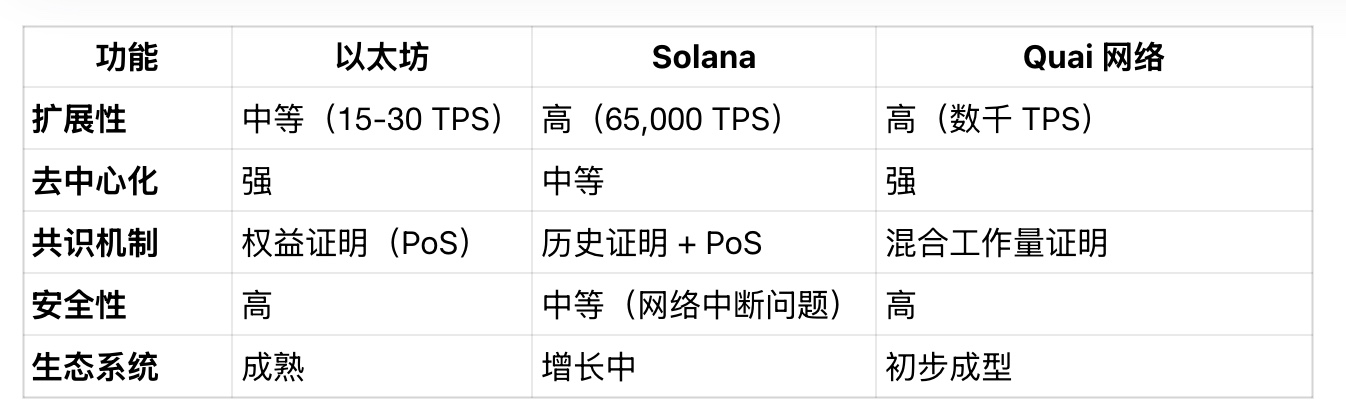
FeatureEthereumSolanaQuai NetworkScalabilityModerate (15-30 TPS)High (65,000 TPS)High (Thousands of TPS)DecentralizationStrongModerateStrongConsensus MechanismProof-of-Stake (PoS)Proof-of-History + PoSHybrid Proof-of-WorkSecurityHighModerate (Network Outages)HighEcosystemMatureGrowingEmergingThe Quai Network, through its innovative design in scalability, decentralization, and security, is poised to disrupt the blockchain landscape. While Ethereum and Solana excel in certain aspects, Quai's innovative architecture makes it a strong contender for developers, miners, and users seeking the next-generation blockchain solution. If you are looking for a blockchain that can balance performance and principles, the Quai Network is worth a deeper exploration.