Author: Scof, ChainCatcher
Editor: TB, ChainCatcher
On March 10, Andre Cronje, the founder of Sonic Labs, Yearn Finance, and Keep3rV1, updated his personal social media profile to include the title "founder of flyingtulip".

As a competitor to Hyperliquid, FlyingTulip has attracted a lot of attention since its launch. It uses an adaptive curve AMM, providing lower capital fees, better lending ratios, and higher LP returns, and leverages SonicLabs to achieve higher TPS.
Andre Cronje: The "Madman" and Disruptor of the DeFi Realm
To introduce FlyingTulip, we must first introduce its legendary founder, Andre Cronje.
Andre Cronje, a legendary figure in the DeFi world, is a name that can quickly heat up the market sentiment whenever it appears. Unlike traditional programmers, Cronje originally studied law, graduating from the University of Stellenbosch in South Africa.
However, fate played a trick on him, leading him to accidentally encounter computer science, and he became a self-taught expert, even becoming a lecturer. This leapfrogging growth trajectory has also laid the foundation for his style in the DeFi field - unconventional, highly creative, and a touch of madness.
After entering the crypto world, Cronje quickly demonstrated his technical talent and extreme execution. His representative work, Yearn Finance (YFI), emerged in 2020, and with its fair launch (no pre-mining, no team allocation) concept, it quickly became one of the most influential projects in DeFi history. Subsequently, he has led or participated in several well-known projects such as Keep3r Network, Solidly, and Fantom, igniting market sentiment time and again.
Now, FlyingTulip has become his bold attempt in the derivatives trading protocol domain. Facing this developer who embodies both "genius" and "madman", the market is still waiting for the answer: Can he once again trigger a DeFi revolution?
What is FlyingTulip?
FlyingTulip is a DeFi integrated platform based on an Automated Market Maker (AMM), combining functions such as trading, liquidity provision, and lending. Its core feature is to eliminate liquidity fragmentation, allowing users to perform spot trading, leveraged trading, perpetual contracts, and other operations within the same AMM system, without the need to switch funds between multiple protocols. This one-stop liquidity solution improves capital utilization, enhances the trading experience, and reduces transaction costs.
In terms of lending functionality, FlyingTulip adopts a dynamic LTV (Loan-to-Value) model based on AMM, which not only considers the collateral price but also adjusts in real-time based on market depth and volatility, ensuring a balance between loan safety and capital efficiency, compared to traditional DeFi lending protocols.
Adaptive Curve AMM: Simplifying Liquidity Management
The traditional AMM model, such as Uniswap V2, uses the constant product formula X * Y = k. While this mechanism is simple, it leads to liquidity being evenly distributed across all price ranges, when in reality, most trading is concentrated in certain specific price ranges. As a result, liquidity is often not efficiently utilized. Uniswap V3 introduced concentrated liquidity, allowing LPs (Liquidity Providers) to choose specific price ranges to provide funds, but this method requires higher financial knowledge and is more complex for regular users, and LPs may face severe Impermanent Loss when prices fluctuate significantly.
FlyingTulip solves this problem through a dynamic AMM mechanism. It can automatically adjust the curve shape based on market volatility, allowing liquidity to intelligently match market demand:
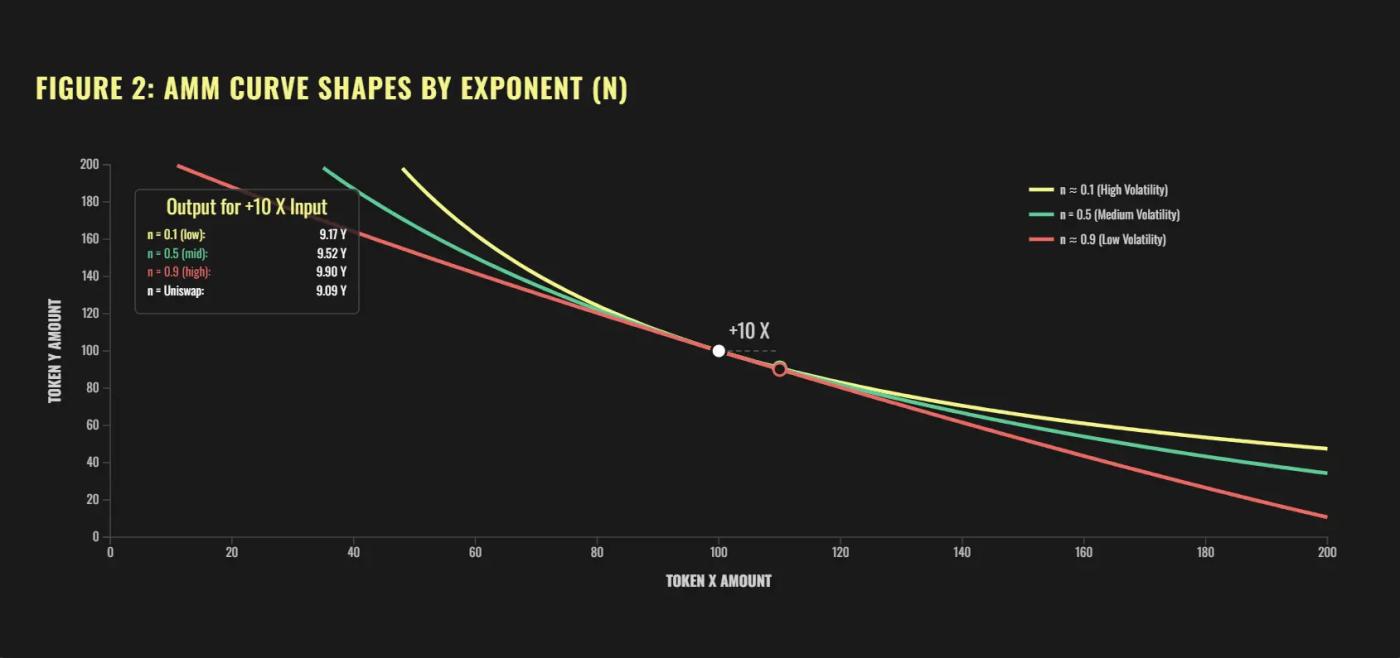
- When the market is stable (low volatility), liquidity will automatically concentrate around the current price, similar to the "constant sum curve" form of X + Y = K, which can improve capital utilization and reduce transaction costs.
- When the market is highly volatile, liquidity will automatically disperse, approaching the "constant product curve" of X * Y = K, to accommodate potential large price changes and reduce losses due to unidirectional market fluctuations.
FlyingTulip continuously monitors the real-time volatility (rVOL) and implied volatility (IV) of the market through oracles, and dynamically adjusts the liquidity distribution based on these data. LPs do not need to manually set complex price ranges, they only need to provide liquidity, and the system will automatically optimize the allocation, allowing them to obtain the best return rate in different market conditions, while significantly reducing Impermanent Loss.
This mechanism makes FlyingTulip a more user-friendly DeFi platform for regular users - even if you are not familiar with the LP mechanism, you can easily provide liquidity without worrying about complex operations or potential losses.
Dynamic LTV Model Based on AMM: More Flexible Lending
In traditional DeFi lending protocols, the LTV (Loan-to-Value) is a fixed value, usually set based on the risk level of the token. For example, if a token is considered medium-risk, users can only borrow up to 70% of the collateral value. However, this fixed LTV ignores two key factors:
- Market depth - If the borrowing amount is too large, it may significantly impact the token price, leading to a sudden drop in market liquidity.
- Real-time volatility - When the market is highly volatile, a fixed LTV may cause assets to quickly fall below the liquidation threshold, increasing liquidation risk.
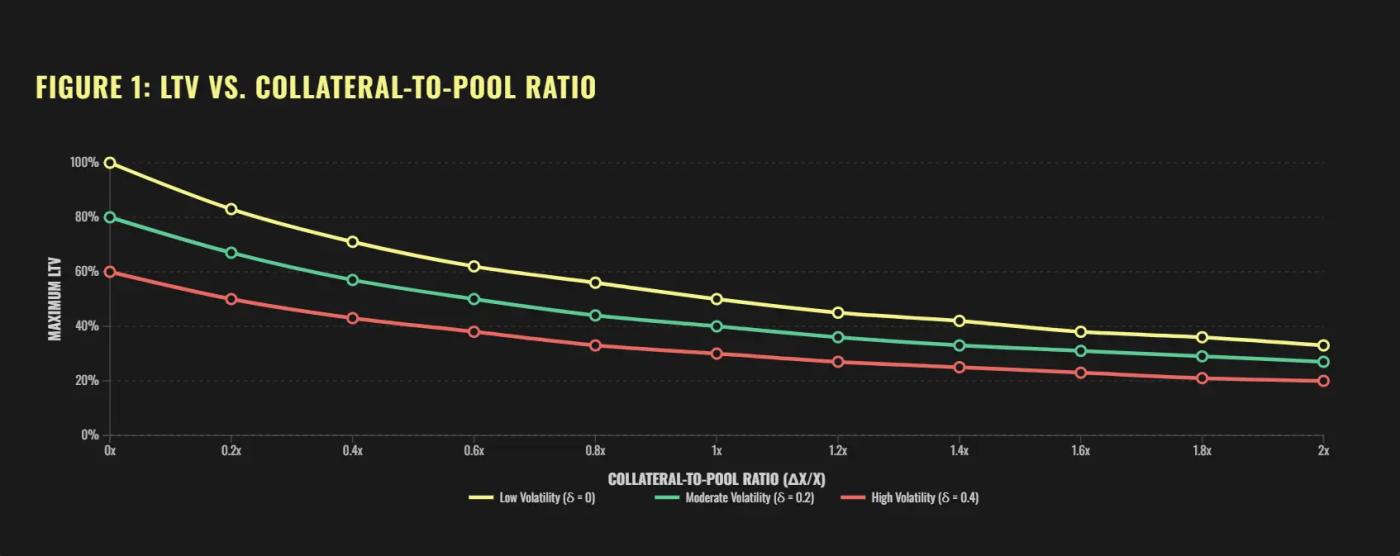
FlyingTulip solves this problem through its adaptive AMM mechanism, creating a dynamic LTV model that can adjust the borrowing limit in real-time based on market conditions. For example:
- When the market is stable (low volatility, ample liquidity): Users can obtain a higher LTV, such as 80%, meaning they can borrow $1,600 if they deposit $2,000 worth of ETH.
- When the market is turbulent (volatility increases): The LTV will automatically decrease to 50%, so the same $2,000 ETH can only borrow $1,000, to reduce liquidation risk.
- When the collateral is too large (occupying a high proportion of market liquidity): The LTV may further decrease to 45%, ensuring that large-scale borrowing does not have an excessive impact on market prices.
This dynamic LTV adjustment makes lending more flexible, and users do not need to constantly monitor market changes or frequently adjust their positions, as the system will automatically optimize the borrowing limit based on market conditions. This not only reduces the risk of large-scale liquidations causing market crashes, but also creates a safer environment for both borrowers and liquidity providers in the entire DeFi ecosystem.
Opportunities and Risks Coexist, Market Frenzy or Deep Pit?
As the market begins to speculate on whether FlyingTulip will issue a token, the discussion on X has become increasingly heated. Reviewing AC's past projects, almost all of them have relied on token incentives and community momentum to rise rapidly, so the launch of a "Tulip token" by FlyingTulip seems to be just a matter of time. Currently, various rumors about the TGE, such as public offering prices and private placement discounts, are constantly circulating in the community.
However, AC's projects have always been a combination of high returns and high risks. The YFI project, for example, skyrocketed to a thousand-fold after its fair launch, but EMN (Eminence Finance) once suffered a zero-value incident due to vulnerabilities. Amidst the market frenzy, how to balance the speculative impulse and risk management is the problem that rational players need to consider.
In addition, AC has continued his "mysterious marketing" style this time, without making explicit promotions, but rather through subtle actions to let the market become restless on its own. For example, he recently liked a tweet about the Magpie Protocol (another related DEX project) on X, immediately sparking all kinds of speculation. The KOLs in the Chinese-speaking community have also started to pay attention to and discuss FlyingTulip, driving up market sentiment.
The charm of DeFi lies in the coexistence of high risk and high returns, and in the past impression, AC has always been able to bring new imagination to this field. But whether FlyingTulip can replicate the brilliance of YFI, perhaps only the market will give the answer.