


Jessy (@susanliu33), Jinse Finance
Recently, Coinbase CEO Brian Armstrong stated on X that Coinbase is actively exploring the possibility of tokenizing the company's stock. It is reported that Coinbase has had preliminary communication with the U.S. Securities and Exchange Commission (SEC) and is studying how token holders can enjoy the same rights as traditional stock holders.
Coinbase's move has once again made the tokenization of real-world assets (RWA) a hot topic in the crypto market. According to data from RWA.xyz, as of March 2025, excluding stablecoins, the total market value of RWA products globally has reached $17.93 billion.
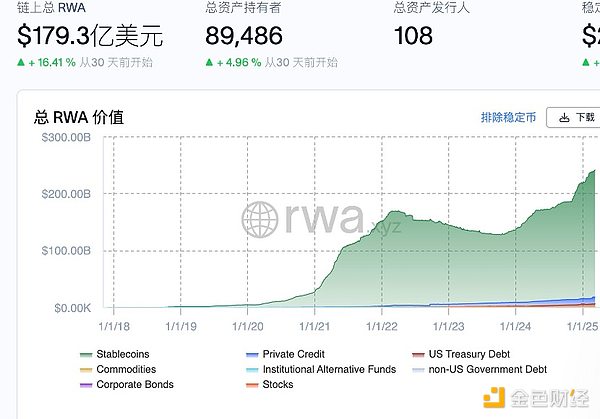
According to research by Boston Consulting Group (BCG), the market size of the RWA sector is expected to reach $16 trillion by 2030, far exceeding the current total market value of the entire crypto market.
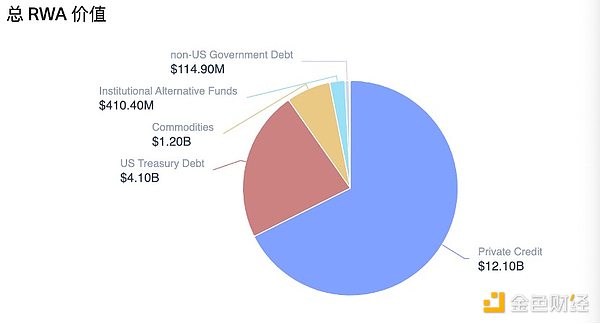
Excluding stablecoins, in the current RWA sector, private credit has the largest market value, U.S. Treasuries rank second, while stocks have a negligible market value. This may be because the tokenization of stocks has been relatively slow due to the more complex issues involved, such as dividend calculation and distribution, as well as regulation.
Nowadays, the trend of crypto asset compliance is becoming increasingly evident, especially since the Trump administration, the U.S. is rapidly advancing the development of crypto compliance. In this context, as the world's first crypto exchange to be listed on the Nasdaq, Coinbase is proactively exploring the integration of traditional finance and crypto innovation, starting from its own stock. If successful, it will certainly have a significant demonstration effect.
However, there are many issues that need to be resolved in this process, such as regulation, blockchain technology, and the internal structure of the companies behind the stocks involved. A more important issue is that if the problem of token-stock parity is not solved, stock tokenization may always be a pseudo-demand.
Crypto accelerates compliance, U.S. Treasuries on-chain are hot, stock tokenization is brought up again
Traditional finance's enthusiasm for crypto is increasing year by year, with financial giants such as BlackRock, Fidelity, and JPMorgan Chase successively launching crypto-related products. Particularly, the on-chain of U.S. Treasuries has become the hottest sub-sector in the RWA track in the past two years.
The heat of on-chain Treasuries benefits from the macroeconomic environment this year. Since 2022, the Federal Reserve has raised interest rates repeatedly to curb high inflation, leading to tightening global liquidity. In the high-interest rate environment, investors' risk appetite has decreased, and the traditional financial market has been impacted, causing capital to flow more into low-risk, high-yield asset classes. This has prompted investors to pay attention to assets such as Treasuries, gold, and real estate, and the tokenization of these assets has become an important growth point in the RWA track.
Although there have been attempts to tokenize stocks, they have not gained much traction in the RWA track boom. Previously, exchanges like FTX and Binance had launched stock tokenization trading services and related products, but the practice was relatively short-lived. In 2021, shortly after Binance launched stock tokens, financial regulators in the UK and Germany successively warned that these products might violate securities regulations. In less than three months, Binance announced the delisting of all stock tokens.
It seems that compliance is the biggest challenge facing stock tokenization. Coinbase's plan for stock tokenization is made against the backdrop of the U.S. government's gradual clarification of crypto regulation after the Trump administration took office. This may help avoid the biggest pitfalls encountered in previous stock tokenization practices.
As the largest compliant exchange in the industry, Coinbase's entry into stock tokenization will bring many benefits to itself. First, stock tokenization will attract more traditional financial investors to the crypto space, while providing existing crypto investors with a new channel to access traditional financial assets. For Coinbase's native Base chain, this will also significantly increase its value and the development of its ecosystem.
For the traditional financial market, stock tokenization can significantly improve trading settlement efficiency and lower the participation threshold for retail investors. On the other hand, tokenized stocks can serve as the underlying assets for various innovative financial products, such as automatic dividend distribution based on smart contracts and real-time equity registration, significantly expanding the functional boundaries of traditional securities.
For the crypto industry, the tokenization of stocks by well-known public companies will drive the entire crypto industry to accelerate the compliance process, establish a more mature regulatory framework and industry standards. Stock tokenization will attract a large amount of traditional financial capital to enter the crypto market, improving the overall liquidity of the industry. The on-chain of stocks also provides a high-value, large-scale application scenario for blockchain technology. To support stock tokenization, the crypto ecosystem will develop more comprehensive custody, settlement, and risk management services, which will also enhance the professionalism and maturity of the entire industry.
However, in the specific practice of stock on-chain, although regulation is gradually becoming clearer, there are still many new situations that regulation needs to adapt to, such as increased cross-border transactions and 24/7 trading.
If token-stock parity cannot be achieved, the significance of stock tokenization will not be great
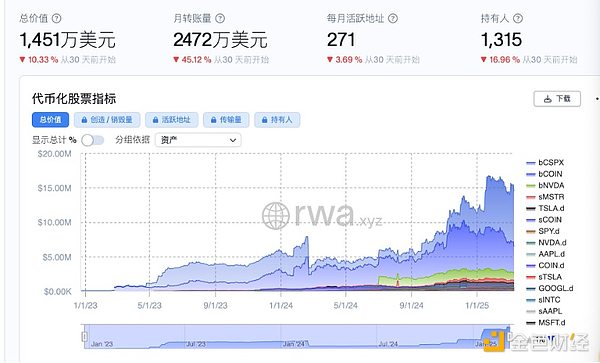
Stock tokenization is not a new thing, although there have been practical attempts, the market has always been very small. According to data from rwa.xyz, the current market value of on-chain stocks is only $14.51 million, while the total market value of RWA products, excluding stablecoins, is $17.93 billion.
For stock investors, if these on-chain stocks cannot provide more convenient and accessible trading than their off-chain counterparts, why would they buy the on-chain versions? A more realistic reason is that the holders of these on-chain stocks often find it difficult to enjoy the same rights as the holders of physical stocks.
Currently, Coinbase has not disclosed the details of how it plans to tokenize its stock, but there is already an unofficial tokenized version of Coinbase stock. On March 8, real asset tokenization issuer Backed announced on X that it has launched a tokenized Coinbase stock wbCOIN on the Base network. Users can exchange it through CoWSwap, with liquidity provided by Aerodrome.
According to the product information disclosed on its official website, this product was launched as early as 2022, initially deployed on Ethereum. The product was approved by the Liechtenstein Financial Market Authority (FMA) on May 9, 2022 and by BX Swiss AG on May 23, 2022. However, according to the official information, the investors of this tokenized stock cannot enjoy the same dividend distribution as Coinbase's stock holders.
According to Coingecko data, the trading volume of this token in the past 24 hours was only $114, indicating that the token product has not been recognized by the market.
For investors holding tokenized stocks, the most concerning issue is the "token-stock parity".
"Token-stock parity" means that the tokenized stock has exactly the same rights as the traditional stock, including voting rights, dividend rights, information rights, and all other shareholder rights. This not only includes equal economic rights, but also completely equivalent governance rights, where token holders can participate in shareholder meetings, receive company notices, and access relevant documents just like traditional shareholders.
If the issue of token-stock parity cannot be solved, the value of the tokenized stock will be greatly impaired, and it may even become disconnected from the price of the traditional stock. The on-chain Coinbase stock product from Backed does not seem to have achieved token-stock parity, which is likely the main reason for its extremely low actual trading volume.
Here is the English translation:The biggest challenge in achieving token-share parity is still the legal issue, as the company laws of most countries do not explicitly recognize the shareholder status of token holders. In terms of regulation, the global trading of tokenized stocks increases the difficulty of regulatory coordination. At the technical level, how to integrate the blockchain system with the traditional shareholder registration and voting system, as well as the structure of corporate governance, also need to be adjusted accordingly.
Coinbase's entry is undoubtedly a good thing for the advancement of token-share parity. Large institutions have more say in formulating rules together with regulators. It is expected that under clear regulation, the realization of token-share parity, at which time the tokenized stocks will be able to better utilize the advantages of blockchain technology compared to traditional stocks.






