


Author: Luke, Mars Finance
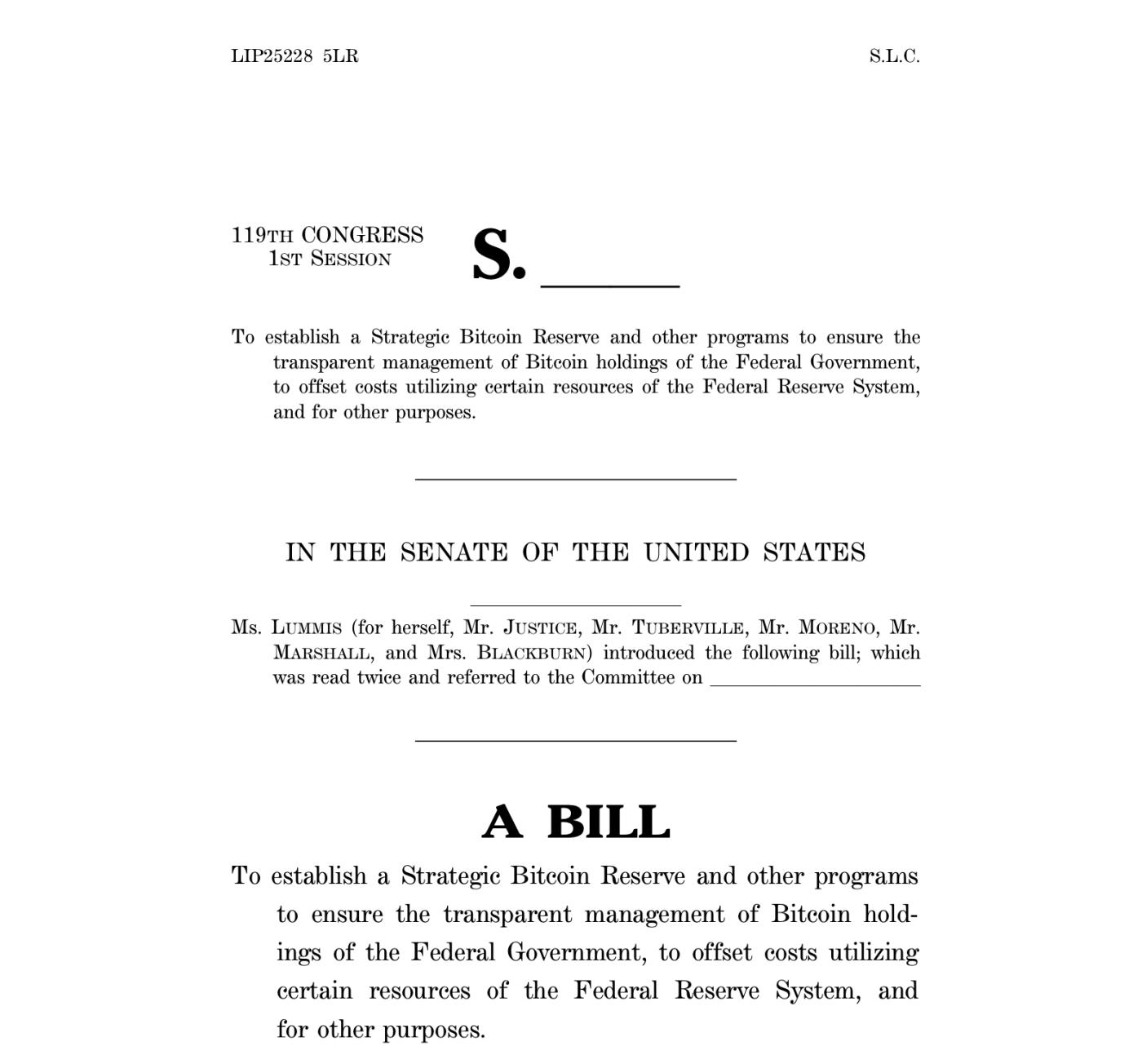
In March 2025, U.S. Senator Cynthia Lummis resubmitted the BITCOIN Act to the Senate, attempting to establish a strategic BTC reserve through legislation. This move not only continued her original intention from 2024, but also made key adjustments to the details, sparking widespread discussion and market enthusiasm. This article will delve into the historical background of the bill, the changes in the new version, and the far-reaching impact the annual purchase of 200,000 BTC may have on the BTC price.
Bill History, What Are the Changes in the New Version
As a Republican Senator from Wyoming, Cynthia Lummis has been an active proponent of BTC policy since 2024. In July 2024, she first proposed the BITCOIN Act of 2024, aiming to establish a "Strategic BTC Reserve" similar to the Strategic Petroleum Reserve through government purchases of BTC. The goal of this proposal was to position BTC as "digital gold" and enhance the United States' competitive advantage in the global financial system, while also providing a new solution for national debt. The bill proposed to purchase 1 million BTC (approximately 5% of the total BTC supply at the time) over five years, to be funded by redirecting Federal Reserve System earnings and the revaluation of gold. However, the 2024 version of the bill was blocked in congressional committees and ultimately "expired" at the end of the 2023-2024 session, failing to pass.
In March 2025, Lummis resubmitted the bill, introducing the 2025 version of the BITCOIN Act. The new version retains the core objective - purchasing 1 million BTC over five years - but makes several key modifications to the details. These modifications aim to address previous criticisms, strengthen the implementation, and align with the executive order signed by President Trump in March 2025 to establish a strategic BTC reserve. The following are the main changes in the new version:
- More Stringent Purchase Plan: The 2024 version allowed for "up to 200,000 BTC per year", while the 2025 version explicitly requires the "purchase of 200,000 BTC per year", totaling 1 million BTC over five years. This change from "flexible" to "mandatory" demonstrates the legislators' determination to ensure the execution of the plan.
- Strengthened Holding Requirement: The 2024 version allowed the sale of BTC to repay federal debt instruments within a minimum holding period of 20 years, but the 2025 version has removed this exception, prohibiting the sale, exchange, or disposal of BTC for any purpose within the 20-year period. This strengthens the "HODL" strategic intent.
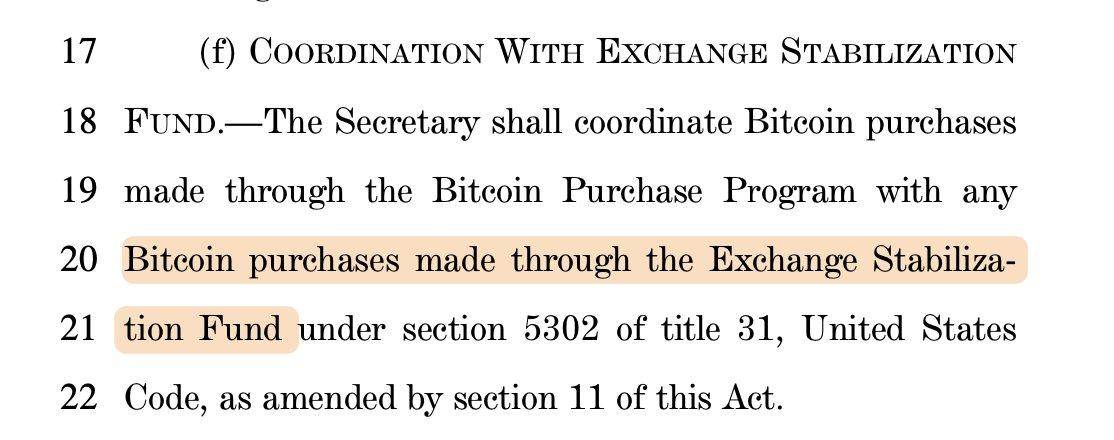
- New Coordination with the Exchange Stabilization Fund (ESF): The 2025 version adds a provision to coordinate with the Exchange Stabilization Fund (ESF), allowing the utilization of this approximately $39 billion reserve fund to support BTC purchases. This clause was not mentioned in the 2024 version, reflecting the new version's diversification of funding sources.
- Use of Gold Revaluation Gains: The 2024 version included the gains from the revaluation of the Federal Reserve's gold reserves in the general fund, while the 2025 version specifically earmarks these gains (potentially up to $747.3 billion) for the BTC purchase program. This is a significant policy adjustment, highlighting the emphasis on BTC as a strategic asset.
These modifications not only reflect Lummis' support for BTC policy, but also strategic adjustments made in the current context of high enthusiasm for BTC in the U.S. political arena (such as Trump's support and the positive response from the community).
Detailed Interpretation of the New Bill
To better understand the changes in the 2025 version of the BITCOIN Act, let's analyze these key modifications and their underlying logic and impact.
More Stringent Purchase Plan: From "Up to" to "Shall"
The 2024 version of the BTC purchase plan set a limit of "up to" 200,000 BTC per year, providing the Treasury Department with flexibility to adjust the purchase volume based on market conditions. However, this flexibility could also lead to a lack of diligence or delays in implementation. The 2025 version has changed this clause to "shall purchase" 200,000 BTC per year, totaling 1 million BTC over five years. This change indicates that the legislators aim to ensure the government executes the establishment of the strategic BTC reserve through a legally binding requirement.
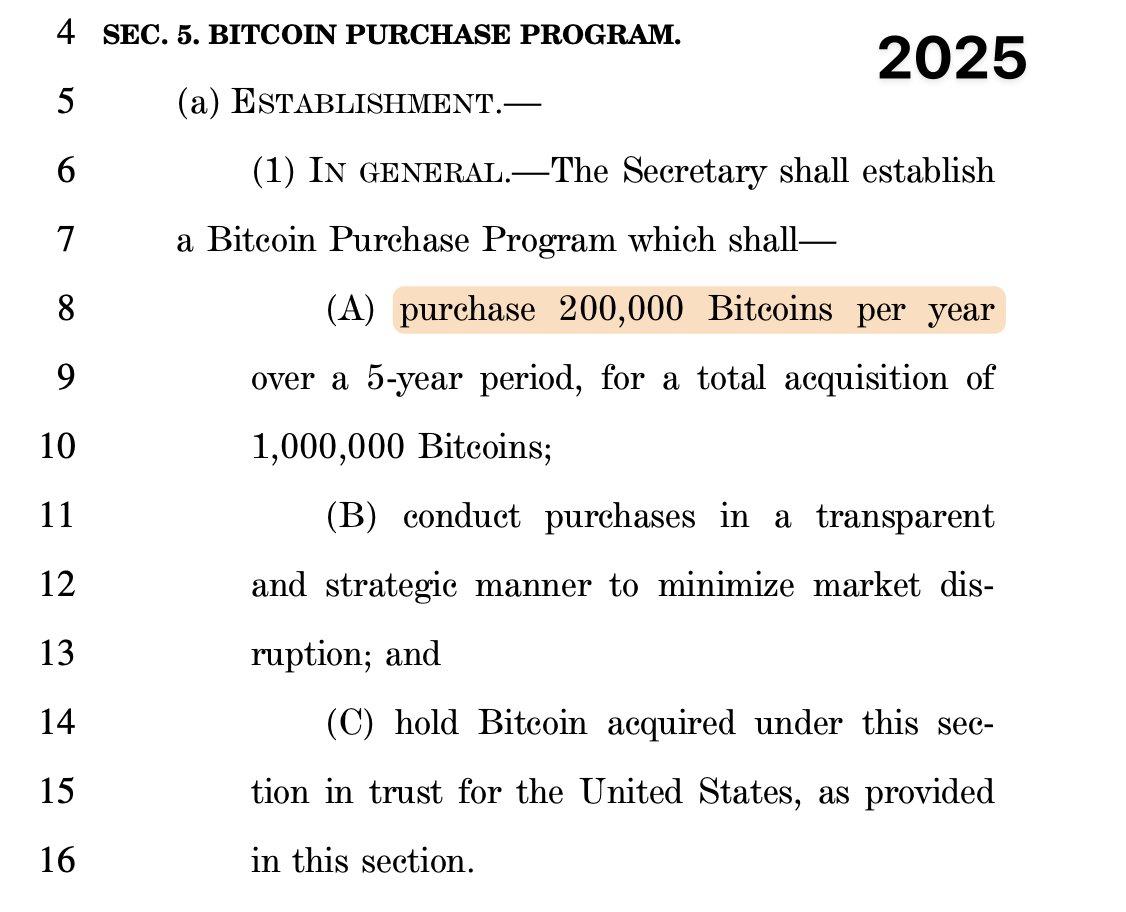
This modification is intended to avoid delays and market uncertainty, ensuring the rapid realization of the strategic BTC reserve. The annual purchase of 200,000 BTC represents approximately 1.04% of the current total BTC supply (around 19.2 million BTC), and the total of 1 million BTC accounts for 5.19%. This scale matches the U.S. gold reserves (approximately 8,133.5 tons, nearly a quarter of global gold reserves), reflecting the strategic intent to position BTC as "digital gold". However, the mandatory purchases may put pressure on market liquidity, and a transparent and strategic approach (such as staggered purchases or over-the-counter transactions) will be needed to minimize disruptions.
Strengthened Holding Requirement: Removal of Debt Repayment Exception
The 2024 version allowed the sale of BTC to repay federal debt instruments within the minimum 20-year holding period, providing the government with flexibility but also weakening the commitment to long-term BTC holding as a strategic asset. The 2025 version has removed this clause, explicitly prohibiting the sale, exchange, auction, or disposal of BTC for any purpose within the 20-year period.

This change strengthens the positioning of BTC as a "long-term value store", consistent with the "digital gold" concept. The 20-year holding period aims to ensure the long-term appreciation potential of BTC, providing a stable strategic asset for the U.S. economy. However, this strict requirement may be controversial, as it limits the government's flexibility to use BTC in economic crises, such as for debt repayment or emergency response.
New Coordination with the Exchange Stabilization Fund (ESF)
The 2025 version adds a new clause to coordinate with the Exchange Stabilization Fund (ESF), allowing the utilization of this reserve fund (approximately $39 billion) to support BTC purchases. The ESF is an emergency reserve fund used by the Treasury Department to stabilize exchange rates and financial markets, typically for foreign exchange market interventions or support of international financial stability.
This modification expands the funding channels, providing additional fiscal support for BTC purchases. The inclusion of the ESF suggests that the government plans to view BTC as part of the national financial strategy, potentially making direct BTC purchases through executive orders or market operations. However, this move may raise controversies regarding the use of the ESF, as its original purpose was not for cryptocurrency investments, but rather for addressing financial crises.
Adjustment of the Use of Gold Revaluation Gains
The "revaluation" of the Federal Reserve's gold reserves (approximately 8,133.5 tons) refers to the adjustment of the statutory price ($42.2222 per ounce) to the current market price (around $2,900 per ounce as of March 2025). This revaluation will generate approximately $747.3 billion in accounting gains (market value of around $758.3 billion minus the book value of $11 billion).
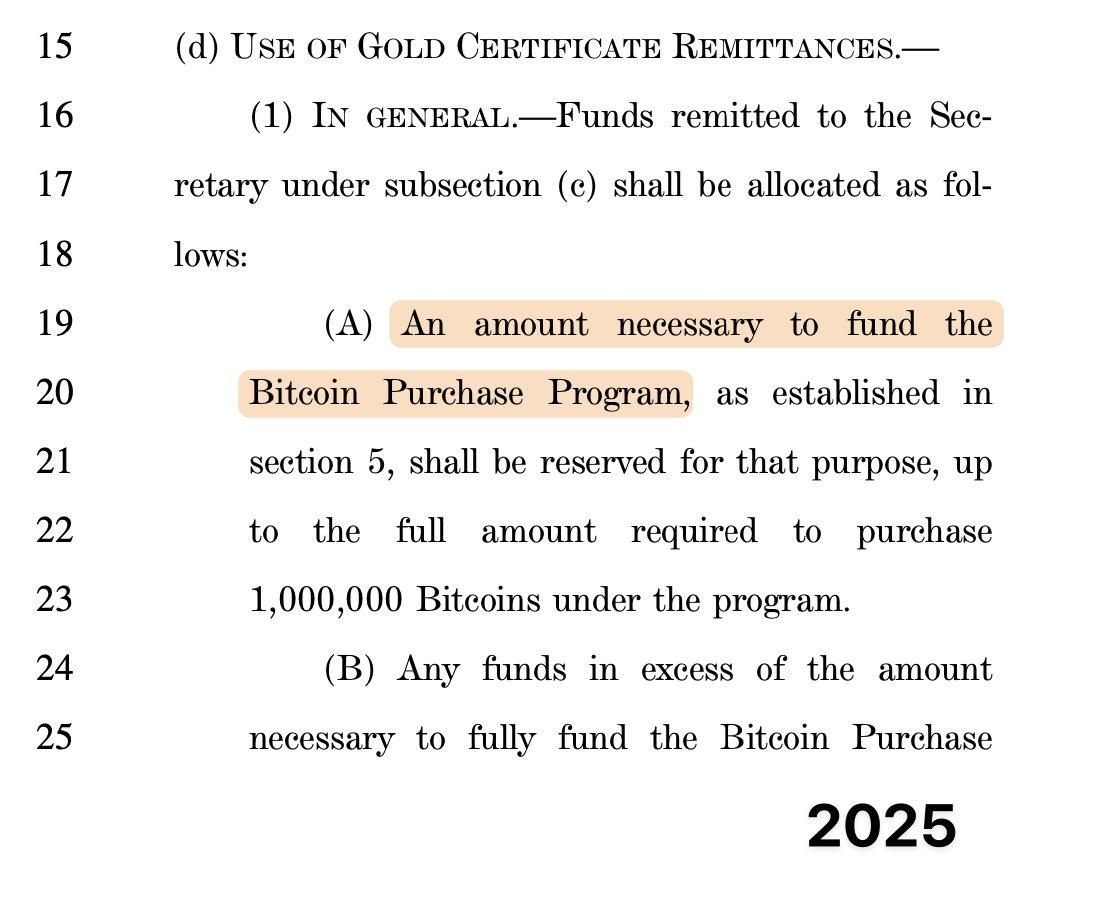
The 2024 version will include these returns in the general fund, while the 2025 version will explicitly use them for a Bit coin purchase plan. This adjustment reflects a firm support for the Bit coin strategic reserve and provides a strong financial foundation for the "budget neutrality" of the bill. However, fluctuations in the gold price (possibly rising to $3,500/ounce or falling to $2,500/ounce) may affect the final available amount, and further legislative refinement is needed.
Strictly speaking, the bill does not require the direct "sale" (disposal) of the gold reserve. Gold will remain in the Treasury's reserves as a national asset. Revaluation is only an accounting adjustment, which will re-account the market value of gold in the Treasury's balance sheet and use the appreciation part for Bit coin purchases.
However, from an economic effect perspective, this process is similar to "indirectly selling the value of gold" to purchase Bit coins, as the book appreciation of gold is converted into cash or its equivalent for Bit coin market transactions. These modifications collectively reflect the comprehensive upgrade of the 2025 version of the Bit coin Act in terms of execution intensity, strategic positioning, and funding assurance, laying a more solid foundation for establishing a strategic Bit coin reserve.
Where will the 200,000 Bit coins of annual purchases lead the Bit coin?
If the Bit coin Act is passed, the U.S. government's annual purchase of 200,000 Bit coins will have a profound impact on the Bit coin price.
As of March 2025, the circulating supply of Bit coins is about 19.2 million, with a price of $83,000/Bit coin and a total market capitalization of $1.6 trillion. The daily trading volume of Bit coin is usually between $20 billion and $50 billion (assuming $35 billion), while the purchase amount of 200,000 Bit coins per year is $200,000 × $83,000 = $16.6 billion, with a five-year total of $8.3 billion. This accounts for 1.04% (annually) or 5.19% (five years) of the total market value, which is relatively small, but the continuous purchase may trigger a chain reaction in the market.
Supply and Demand Dynamics
- Increased Demand: The annual purchase of 200,000 Bit coins accounts for about 1.04% of the total supply. If market liquidity is limited, this demand may quickly drive up the price. The supply growth of Bit coin is limited by the halving mechanism every four years (currently 6.25 BTC per 10 minutes), and most Bit coins are held long-term (HODLers), resulting in low liquidity.
- Market Reaction: Historical data (such as the legalization of Bit coin in Japan in 2017 or the institutional adoption in 2020-2021) shows that policy benefits and large-scale buy-side can lead to a short-term price increase of 10%-50%, or even more. The compulsory purchase in the 2025 version of the Act and the synergistic effect of the Trump executive order may trigger a "fear of missing out" (FOMO) effect, further driving up the price.
Price Forecast
Based on the supply-demand model and market sentiment, we can speculate on the following scenarios:
- Short-term (1-3 months): If the market reacts strongly to the passage of the Act, the price may rise 10%-33%, reaching $91,300-$110,000 per Bit coin. The daily purchase of $45.48 million (16.6 billion/365 days) accounts for 0.013% of the daily trading volume, but if concentrated, it may drive up the price of the shallow order book at high prices (above $80,000), leading to a breakthrough of $100,000.
- Medium-term (1-2 years): With the government's continued purchases and increased market confidence, the price may reach $120,000-$150,000 per Bit coin (45%-81% increase). If institutions and retail investors follow up, the price may further soar.
- Long-term (5 years): Within five years, the purchase of 1 million Bit coins (5.19% of the supply), combined with the reduction in supply and macroeconomic factors (such as inflation or dollar depreciation), the price may break through $200,000 per Bit coin, especially in a bull market cycle.
Final Outlook
After the passage of the Bit coin Act, the U.S. government's annual purchase of 200,000 Bit coins will likely push the Bit coin price to new highs, potentially breaking through $110,000 per Bit coin in the short term, reaching $150,000 per Bit coin in the medium term, and potentially exceeding $200,000 per Bit coin in the long term. However, the actual price will highly depend on market reaction, purchase strategy, and external economic environment. This initiative may not only reshape the global status of Bit coin but also have a profound impact on the U.S. leadership in the digital currency field.






