


Last week, the power struggle and split within the Yescoin team brought the spotlight back to the "TON ecosystem". It has been a while since we heard from the TON chain, and we started to reminisce about this public chain backed by Telegram, which was on the "eve of takeoff" for three years but ultimately only thrived for a few months.
At its peak, trading platforms rushed to list tokens for Telegram mini-games. In just over 4 months, the world's largest cryptocurrency exchange platform Binance listed 5 tokens from the TON ecosystem. Hundreds of mini-games emerged in a short period of time, with more than 2,000 in the pipeline. Notcoin had a monthly revenue of over $300,000, and Catizen achieved over $16 million in revenue. The TVL of the TON chain grew 70-fold. The price of TON also rose from $2 to a high of $8. The market's expectations for the TON ecosystem were pushed to the highest point, and both inside and outside the industry believed that the "traffic gold mine" of Web3 had finally found a new outlet.
However, this seemingly thriving ecosystem was just a short-lived speculative game. In the summer of 2024, the market came to a sudden halt - trading platforms stopped listing TON ecosystem tokens, the founder of Telegram was arrested, and the project teams went silent, leaving the player groups as "ghost towns". Overnight, the "traffic gold mine" track became an emptied mine, leaving behind data black boxes, an over-leveraged market, and abandoned developers.
What happened during this period? BlockBeats interviewed three former Telegram mini-game project teams to analyze the real reasons behind the "fleeting bloom" of the TON ecosystem.
False Prosperity; Black Box Traffic
"In Web3, the customer acquisition cost for a company like an exchange platform or a large chain game is around $10 to $15, but through Telegram mini-games, this cost can be far less than $1, around $0.7," said Kin, a project team member who left the Telegram mini-game sector half a year ago and is now researching the AI Agent track. She added, "In some regions, it can even be as low as $0.002 to $0.05, like in India."
This extreme compression of customer acquisition cost created a paradise for project factories, where real users became almost dispensable to them.
"Before listing, I didn't really need many real human users, the studio's volume was enough, and I could reach a scale of 200,000 to 300,000 in a very short time, which was a qualified size for a Telegram mini-game, a lightweight and medium-sized volume," said Xiaoguang, who had operated the token launches of multiple Telegram mini-games.
This model has been standardized and systematized in the industry. A few long-term collaborating studios are well-versed in it, and they even survive longer than most Web3 projects. "The project team and the studios will discuss how much volume is needed in the early stage, and how much to supplement before the TGE. If the inflated volume is still not enough, they will use 'volume exchange' to amplify the data," Xiaoguang explained.
"After reaching a volume of 200,000 to 300,000, we will do volume exchange - that is, cross-promotion between two games to reach the next level of volume," Xiaoguang added. Compared to traditional chain games, the data volume of Telegram mini-games has far exceeded most Web3 projects. But every coin has two sides, and low cost often means low quality, while data inflation also conceals the real problems in the ecosystem.
"The data of the TON ecosystem has always been a black box operation. For those VC projects in the past, most of them can be found on data platforms like Dune, with information on the number of addresses and transaction volumes, and investors will also do some due diligence. But the real data of Telegram mini-games is not public, only a few insiders know the approximate user numbers and the real user ratio," Xiaoguang said, which he believes is the natural soil environment for a project factory.
The decline in the proportion of real users further exacerbated the false prosperity of the market. "In the early games, like Hamster Kombat, the proportion of real users was relatively good, around 60%. But as the ecosystem expanded, this proportion kept declining, and 40% was considered very impressive towards the end," Xiaoguang revealed to BlockBeats.
Even within this 40%, there were still professional "airdrop farmers" whose goal was not to play the games, but to collect airdrop rewards. "When we counted the paying users, 90% of the addresses behind the remaining real users were the same group of people, who were specifically there to collect airdrops and leave after playing."
This user structure directly determined the vicious cycle of the Telegram mini-game ecosystem - in the short term, data inflation concealed the real situation, allowing investors and trading platforms to continue buying in; but in the long run, the overall user quality and stickiness of the ecosystem were extremely poor.
"If the goal is just to create monthly active user data and wallet address numbers to show to trading platforms and investors, then this low-cost traffic is enough. But if you want truly active users, users who are willing to play your games and use your applications, you absolutely cannot rely on such low acquisition costs to obtain them," said Sleepy, the founder of the Sleepy NFT project, who has decided to temporarily suspend their Telegram mini-game development this month.
In other words, the traffic is just flowing from one project to another, but the pool of water in the entire ecosystem remains stagnant, without any new inflow of fresh water.
The TON ecosystem has never truly bridged the 900 million Telegram users and the Web3 world. It seems that the TON Foundation and Telegram have not built an effective distribution channel to allow crypto applications to reach a wider user base. As Sleepy said, "Maybe they are trying, but I haven't seen the results yet."
TON and Telegram have never been the same thing.
The TON Foundation: Vacuum of Power and Uncontrolled Direction
In the past half year, when industry insiders discussed the TON Foundation, they often mentioned the "factional struggle" within it: the Russian team, the Taiwan team, and the Dubai team that obtained the Dubai financial license for TON. These three teams did not bring synergies, but instead led to an extremely unbalanced allocation of resources in the TON ecosystem - whether one could obtain support often depended on their relationship with the Russian team.
The TON Foundation was originally founded by two core members, one of whom is the current active chairman Steve Yun, and the other was Andrew Rogozov, the former CEO of VK (Telegram's predecessor, the Russian version of Facebook), who was considered a "core circle figure" by some.
But at some point, the power structure of the TON Foundation underwent subtle changes - Andrew Rogozov seemed to have faded out of the foundation's core management and founded TOP (The Open Platform), which now appears more like a true foundation or the ConsenSys of the TON ecosystem, even leading the core ecosystem building of TON.
Here is the English translation of the text, with the specified terms translated as requested:"To be honest, as a foundation, we don't get much information from Telegram. Pavel Durov and his team don't discuss anything with us at all. In fact, they only communicate with the wallet team, because the wallet is the only real integration point. And that's not our team, it's a completely different company called TOP." These were the words of Jack Booth, the Chief Marketing Officer of the TON Foundation, in an interview in July 2024, which indirectly confirmed the influence of TOP.
The influence of TOP has gradually surpassed the TON Foundation. Not only have they invested in and supported the most critical projects on TON, but they also control the infrastructure of the ecosystem - they are responsible for running the Telegram official wallet TON Space, supporting the most active TON wallet Tonkeeper, and the largest DEX Stonfi. Even the only staking protocol Tonstakers is supported by TOP. From the key nodes of the TON ecosystem, TOP has become the de facto "core builder" of TON, while the TON Foundation is more like an external publicity agency, with its power gradually being hollowed out.
Then, on January 14, 2025, the TON Foundation announced the appointment of Manuel Stotz, the founder of Kingsway Capital, as the new president, while the former president Steve Yun will continue to serve on the board of directors.
In this "power disintegration", it can also be understood why there are rumors that "the TON Foundation, which is mainly composed of Taiwanese teams, has almost no say in many affairs".
The weak position of the Chinese team in the TON Foundation in the distribution of ecological resources has become more apparent. "The Taiwanese team has little say, and the core technical decisions are still in the hands of the Russian team," Xiaoguang pointed out. "If you can get along well with the Russian team, you can get the most support, like Catizen, they have a very good relationship with Russia and have received investment and a lot of resources."
Xiaoguang's words are corroborated by TOP's investment list, which includes Pluto Studio, the game developer of Catizen.
The founder of another hit mini-game Notcoin, Sasha Plotvinov, openly stated that he has an extremely close relationship with the TON Foundation. This relationship not only gave Notcoin an advantage in the TON ecosystem, but also made it a benchmark project in the Telegram mini-game track. It is worth noting that Sasha Plotvinov is also the CEO of Open Builders, and the products under Open Builders are basically overlapping with TOP, also belonging to the "core circle".
Looking at the price trends of the three tokens (TON, NOT, and DOGS) from last August to the present, the trends are indeed very similar. In addition, on March 16, affected by the news that "Telegram founder Pavel Durov was allowed to leave France", some tokens in the TON ecosystem rose, including: TON rose 20.7% in 24 hours, currently priced at $3.53; NOT rose 18.7% in 24 hours, currently priced at $0.002543; DOGS rose 10% in 24 hours, currently priced at $0.0001475. (Prices as of March 17)
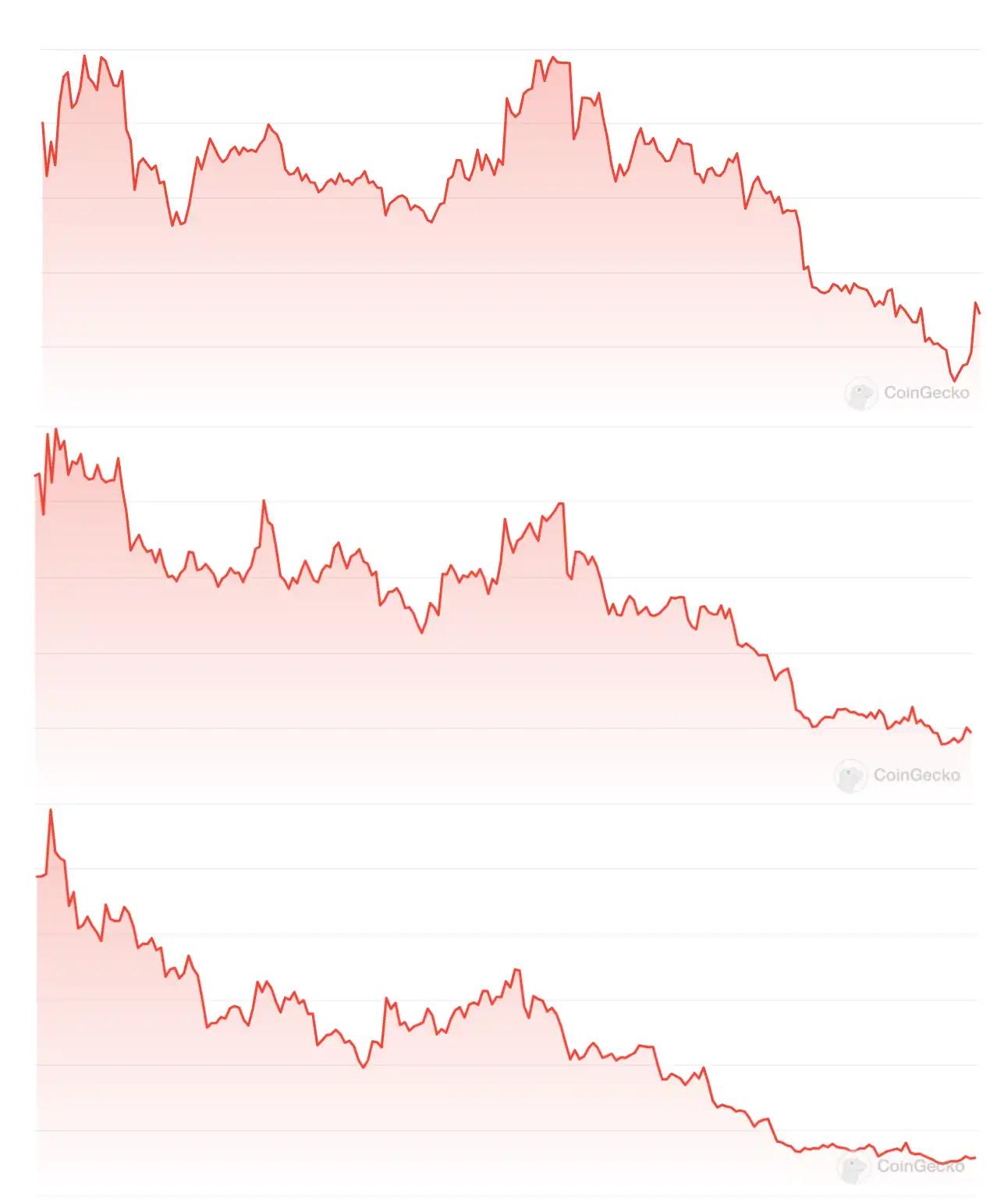
From top to bottom: TON, NOT, DOGS
The success of Catizen and Notcoin is not so much the success of the track, but the high concentration of core resources in TON. These two projects were launched nearly half a year earlier than most mini-games and received full support from the foundation. In other words, the prosperity of TON mini-games is not a true "open ecosystem", but a game of resource allocation.
Another fatal problem of the TON ecosystem is the confusion and abrupt change in strategic direction - at the level of resource support, the TON Foundation quickly shifted its focus from Telegram mini-games to DeFi, directly leading to a large number of mini-game developers being forced to abandon their projects.
"When we contacted the foundation, we could clearly feel that after a certain point in time, they basically stopped paying attention to all game projects and started frantically looking for DeFi projects," Sleepy said. "This change came too suddenly, which was a huge blow to those teams that were seriously developing products. Many developers and users have since left."
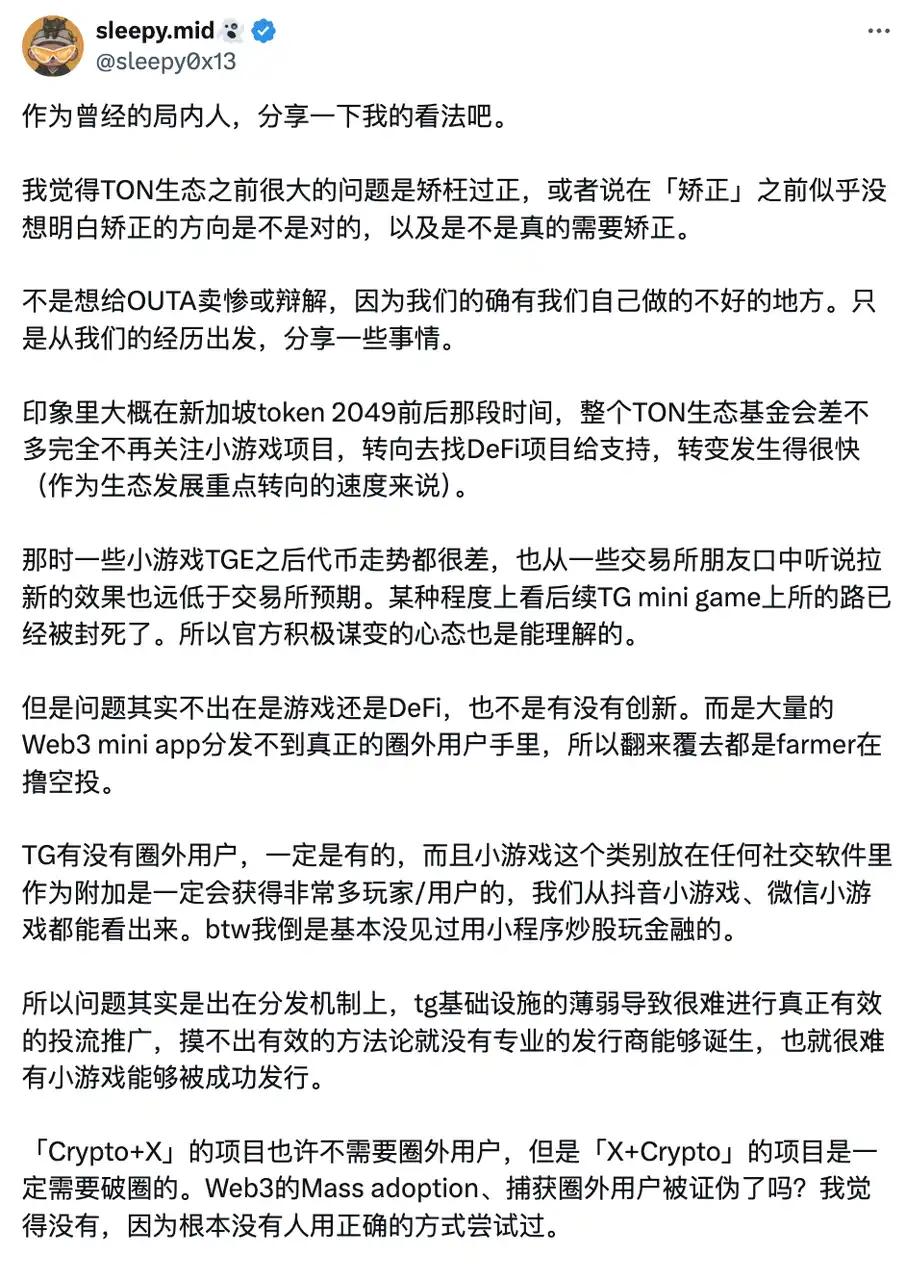
Sleepy strongly disagrees with the direction change made by the TON ecosystem: "I think TON should not copy what other public chains are doing. If it is not dependent on Telegram, TON cannot achieve the current user volume in terms of performance, language, and development difficulty. In that case, TON's future development should be planned based on the characteristics of the social platform, rather than copying other public chains."
"Our initial judgment of TON was that its ecosystem would become part of the traffic monetization of the social platform, like WeChat mini-games or Douyin mini-games." But the decisions of the TON Foundation completely deviated from this direction. "They are doing stablecoins and DeFi, which are huge mistakes, just like WeChat doing stock trading mini-programs. Would you use WeChat mini-programs to trade stocks?" Sleepy said bluntly.
This strategic mistake of the TON Foundation not only caused the ecosystem to miss the correct narrative direction, but also directly triggered a crisis - in August 2024, TON founder Pavel Durov was arrested in France. This incident dealt a huge blow to the TON ecosystem and plunged the foundation into chaos.
"The reason is actually because they added a function similar to fiat-to-stablecoin conversion, which involved compliance and political factors, especially against the backdrop of the Russia-Ukraine war," Xiaoguang told BlockBeats. Prior to this, BlockBeats had also heard similar views from other sources, that a function related to stablecoins had attracted regulatory attention.
The original TON ecosystem had already fallen into chaos due to strategic vacillation and uneven power distribution, and the founder's sudden incident deprived this ecosystem of its last support.
"Death Accelerator": Project Factories and Trading Platforms
In addition to the black box of traffic, the faction struggle within the TON Foundation, and the sudden change in resource support, project factories and trading platforms are also key factors accelerating the demise of the Telegram mini-game track. This ecosystem frenzy is essentially a short-term capital game, and true user growth has long stagnated.
In this track, the game development model is highly industrialized. Project factories mass-produce various mini-games in an assembly line manner, and try them out in the market, with a few projects able to stand out. "Like the game developer Pluto Studio behind Catizen, they launched more than a dozen games early on, and finally decided to focus on the cat-breeding model when they found it worked best," KinKin said.
In other words, Catizen's success is not accidental, but the result of intensive project experimentation and screening. This model is essentially high turnover, low cost, and fast iteration.
"The cost is actually very low," KinKin explained. "Many game companies directly go to the WeChat mini-program market to find those games that have been verified, get the game code, replace the H5 with a skin, and then wrap it with a Telegram SDK, and they can go online directly. And towards the later stage, the price of these mini-game codes becomes cheaper and cheaper."
Low cost, short cycle, and fast launch make these game projects highly speculative. More importantly, once a game model is validated by the market, it will be quickly replicated and amplified, and the head often means having "pricing power". KinKin mentioned: "When Catizen was negotiating to be listed on the trading platform, they were very strong, even leaning towards OKX, demanding a price of $500,000."
Once a project stands out, its bargaining power will increase significantly. Catizen's strong negotiation is because it has accumulated enough market experience after the failure of dozens of projects, and has also accurately found the user group willing to recharge. "Like Catizen, which has been verified through dozens of projects, the product is already mature enough, and they have managed to fleece a wave of users who are really willing to spend money," KinKin said.
The success of leading projects has also brought another problem - highly concentrated resources. "The traffic of a project like Hamster Kombat can almost match that of a medium-sized trading platform."
However, the ecosystem of Telegram mini-games has never had "fresh water" flowing in, lacking the entry of external incremental markets. The high-density "bombardment" of project factories has left little room for survival for other mini-games, let alone Web2 game developers - they have a large number of abandoned and unlisted games, with extremely low trial-and-error costs, and in this competitive environment, the Telegram mini-game track is accelerating its decline.
Another driving factor is the game-playing of trading platforms. The traffic brought by TON mini-games has made trading platforms see a new growth point, and they have frequently listed new projects in the short term, leading to an early depletion of the market. Reviewing the listing timeline of Binance, it can be found that the interval between new projects is getting shorter and shorter:
May 16: Notcoin listed;
84 days later: TON listed;
13 days later: DOGS listed;
23 days later: Catizen listed;
13 days later: Hamster Kombat listed
"When DOGS was listed, all trading platforms were scrambling for this data, even offering rewards like 'withdraw from my trading platform and I'll give you back some DOGS'. Why did they know DOGS had traffic? Because NotCoin had proven it once before, NotCoin and DOGS were made by the same team, and they went through the same path again with a different skin." KinKin told BlockBeats.
The deeper problem is that the user growth rate of this cycle has fallen far behind the previous cycle, at least before Trump's coin issuance, the market's anxiety about Web3 user growth was very obvious, and this anxiety was naturally transmitted to the trading platforms. Although the user quality of the Telegram mini-game track is uneven, at least in the early stage, the conversion of TON traffic could still bring some data growth to the trading platforms. However, this data growth is essentially unsustainable.
Ultimately, the more projects the project factory has, the faster the trading platforms list new projects, the faster the track cools down.
After a few rounds, the user growth of the trading platforms gradually dries up, and they also lose the motivation to continue listing new projects. For latecomers, the first-mover advantage has been maximized, and the survival space for later projects and coins is getting smaller and smaller. All of this makes the collapse of the Telegram mini-game ecosystem inevitable.
Is TG + Web3 really a false proposition?
"Have you ever envied those projects that can be listed on Binance?" Facing BlockBeats' question, Sleepy answered quickly, obviously he had thought about this question before.
"It depends on how you define success. Many people think being listed on a trading platform is a kind of industry recognition, but I don't feel that way. For me, issuing a coin is not the end of a project. If you treat it as the end, it will hurt a lot of people - yourself, the community, and the investors. Because everyone can see that the performance of these coins after listing is very poor, and the effect of attracting new users is also far from the expectations of the trading platforms." Sleepy said.
The "quick money logic" of the TON ecosystem has made everything simple and brutal - changing a new platform every three weeks, with the manipulators chasing quick money dominating the rhythm of the market, while the teams that really want to do games have become the "mavericks" to be eliminated. In this ecosystem, idealists ultimately have only two choices: either give up their beliefs and go with the flow, or be eliminated.
Sleepy and his team ultimately chose the latter. He cut 80% of the team, with a few core members not taking salaries, and allocated some resources to do Web2 design outsourcing business to maintain the team's survival.
"In addition, we are also talking to some public chains about grants, and we have already received the first Launch Grant, and we will continue to do some development work to complete the remaining KPIs. We have also applied for some hackathons like Monad Madness, hoping to achieve some results. The income from the past few months has already exceeded what we earned from doing games on TON." He said self-mockingly.
After the collapse of the TON ecosystem, the various characters who were once active in it have all found their own new paths.
KinKin has now turned to the AI Agent track, and she is very optimistic about the future development of the BASE chain. And that Xiaoguang who was good at making platforms is now researching meme, he knew very early that "the Telegram mini-game business is structural, and has never been a long-term and stable model, with a window period of only a few months." A former member of the TON Foundation who had worked hard to promote the ecosystem has left and is now researching the public chain Kaia, which is the merger of WeChat in South Korea and Japan.
The ecosystem that prioritizes traffic has ultimately left only the traffic itself. The TON ecosystem has not become the "future of crypto social", it is just another cyclical Web3 narrative, a market game that is shorter, faster, and more extreme in returns than the public chain and ZK tracks.
Looking back on this frenzy today, for developers, the TON ecosystem once disguised itself as the hope of "social + Web3", attracting them to enter this market, but ultimately turned them into producers of black box data; for players, the airdrops created the illusion of "overnight wealth", but the result was that $0.99 game packs became the "cyber incense money" of the new era.
Looking at the whole industry, the rise and fall of Telegram mini-games is not an independent phenomenon, it is just an extreme "microcosm" of the entire Web3 industry. In fact, whether it is public chains, ZK Rollup or Layer 2, the essence of many tracks is the same, just more "grand" in packaging, with higher costs and longer cycles. Most Web3 projects are essentially doing a large-scale Telegram mini-game, just with some having a longer life cycle and some shorter.
"Is Telegram + Web3 really a false proposition?"
Each interviewee gave their own answer, but I decided not to write them down, because dear readers, this time, I want to hear your thoughts.
This article thanks all the interviewees who provided information, and some of the interviewees' information has been blurred for privacy protection.






