According to a recent survey by CoinGecko, 2 out of 5 cryptocurrency participants are optimistic about cryptocurrency AI products and token prices in 2025.
However, while optimism is evident, a significant portion of the community remains uncertain. This well reflects the mixed sentiment towards this emerging field.
Are Crypto Participants Optimistic About the AI Future?
CoinGecko's survey was conducted from February 20 to March 10, 2025, collecting responses from 2,632 cryptocurrency enthusiasts globally. The respondents were diverse, comprising long-term investors (51%), short-term traders (26%), developers (10%), and observers (13%).
Examining the experience levels further, 53% of participants were in their first cryptocurrency cycle (0-3 years), 34% had 4-7 years of experience, and the remaining 13% had over 8 years of experience. Geographically, 93% of respondents were from Europe, Asia, North America, and Africa, providing a broad global perspective.
Importantly, the results showed that 46.9% of respondents had a positive outlook on cryptocurrency AI products. This reflects confidence in the growth potential of this field.
"Specifically, 19.9% were somewhat positive, and a further 27.0% of survey respondents were completely positive," CoinGecko reported.
Yuchan Lim, a research analyst at CoinGecko, pointed out that the increasing passion in the cryptocurrency sector, when combined with AI technology, could be associated with enhanced widespread applications of cryptocurrencies.
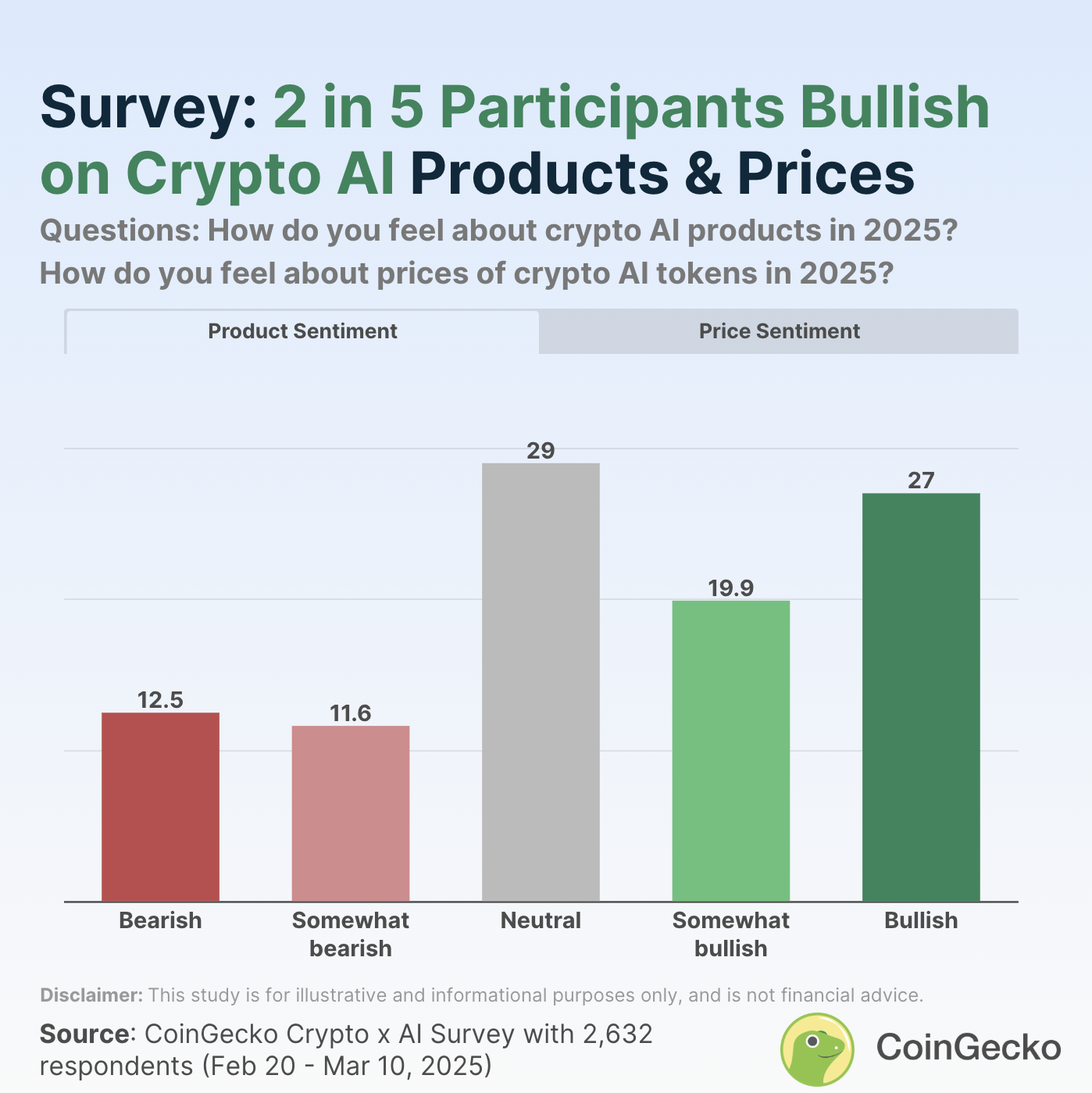
In contrast, 24.1% of respondents expressed negative sentiment, indicating skepticism about the immediate prospects of cryptocurrency AI.
"Nearly a quarter of the survey respondents are skeptical, at least in the immediate term, about the potential of cryptocurrency AI technology and its use cases," the report added.
This divided sentiment also extended to perceptions of cryptocurrency AI prices, with 44.3% being optimistic and 26.4% being pessimistic.
"This perhaps suggests that cryptocurrency participants are not distinguishing between the investment or trading potential of cryptocurrency AI and the technology itself," Lim mentioned.
She also emphasized that this market sentiment could reflect expectations that cryptocurrency AI is maturing beyond the conceptual stage into a functional domain. Despite the divide between positive and negative perspectives, a significant number of respondents maintained a neutral stance. 29.0% and 29.3% of participants chose a neutral position on the products and token prices, respectively.
In fact, the survey results showed that the neutral response category received the highest selection among the sentiment options. This suggests a wait-and-see approach as the technology matures.
Additionally, the sentiment varied greatly across different adoption groups. Despite being pioneers of the cryptocurrency AI narrative, only 46.8% of innovators were positive about cryptocurrency AI products, and similarly, 44.8% were positive about token prices. Notably, 28.9% and 30.0% were negative about the products and prices, respectively.
In contrast, early adopters and the early majority exhibited greater optimism. The late majority was noticeably less positive. The laggards showed the strongest negative sentiment, with 41.3% viewing cryptocurrency AI products negatively and 43.1% holding negative views on token prices.
"The 'laggard' group had the lowest proportion of neutral sentiment, suggesting that this group, despite being the latest to join the cryptocurrency AI narrative, holds the strongest opinions," the survey revealed.
This survey came at a challenging time for the sector. After peaking earlier this year, it has seen a significant decline.
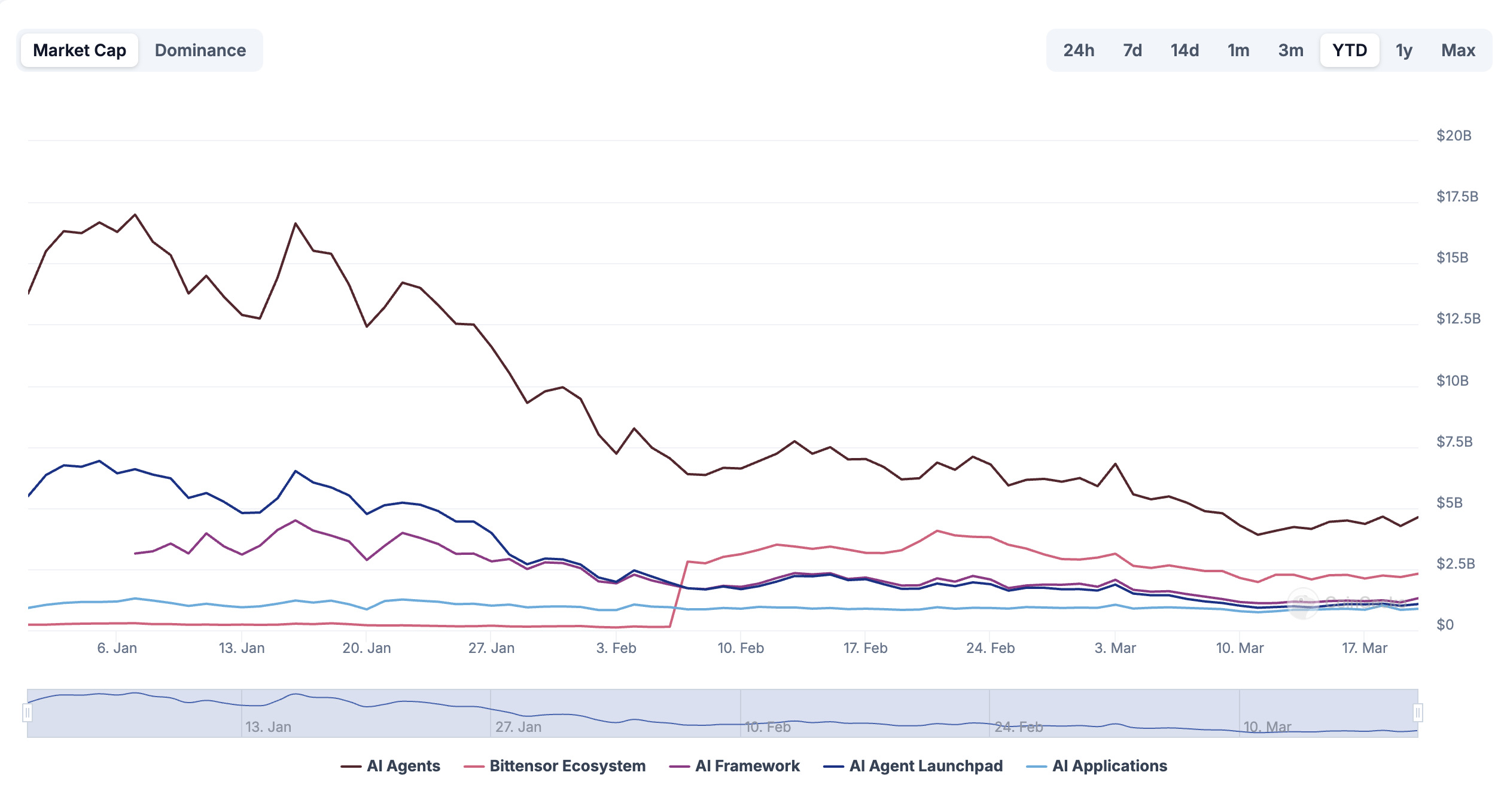
The key catalysts that previously fueled the rally have failed to generate the same momentum recently. This is evident in the decline of the AI coin market capitalization following NVIDIA's GTC conference.
Despite the downtrend, the sector has shown a slight recovery, recording a 4.3% increase over the past day. However, this recovery was not isolated, as the broader market also saw an upswing following the Federal Reserve's decision to hold U.S. interest rates.