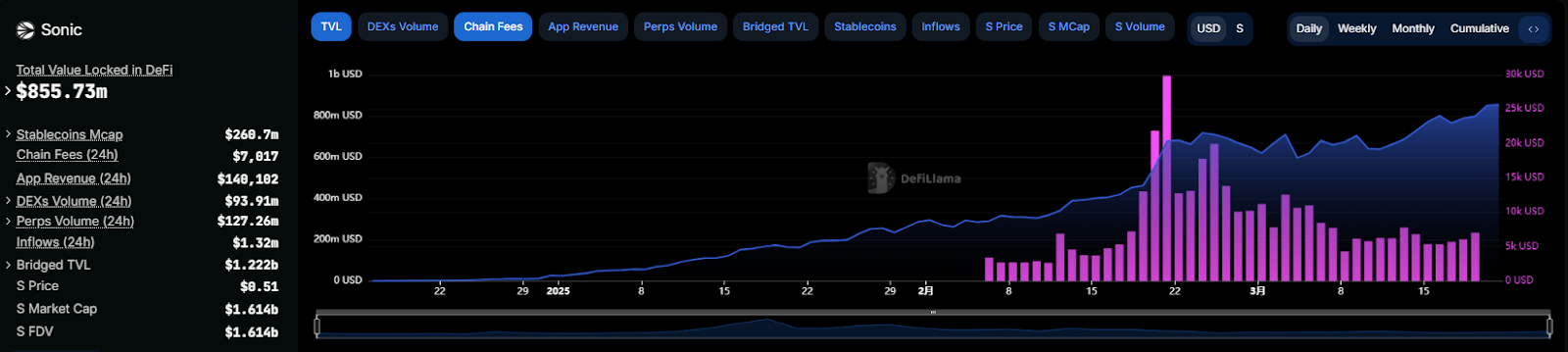
On March 21, 2025, the Sonic network reached a historic milestone: the stablecoin giant Circle announced that its native USDC and the cross-chain protocol CCTP V2 will soon be deployed, while Defillama data showed that the chain's TVL has surpassed $854 million, an increase of 83% in the past month, making it the most eye-catching growth center in the crypto bear market of the past two months. This value surge, driven by technological revolution, capital support, and ecosystem explosion, is reshaping the competitive landscape of Layer 1.
Strategic Cooperation: Circle's "Trust Vote" and On-Chain Prosperity

The native USDC and CCTP V2 cross-chain protocol are about to land on Sonic. This means:
- $1 billion-level liquidity injection: As the first high-performance chain to directly support the native USDC, Sonic can accommodate the $28 billion stablecoin inventory in the Circle ecosystem;
- Cross-chain efficiency revolution: CCTP V2 will compress the asset cross-chain time from an average of 15 minutes to 2 minutes, with a 76% reduction in Gas costs;
- Compliance upgrade: The institutional-level auditing and compliance framework of USDC paves the way for Sonic to expand into scenarios such as RWA and payments.
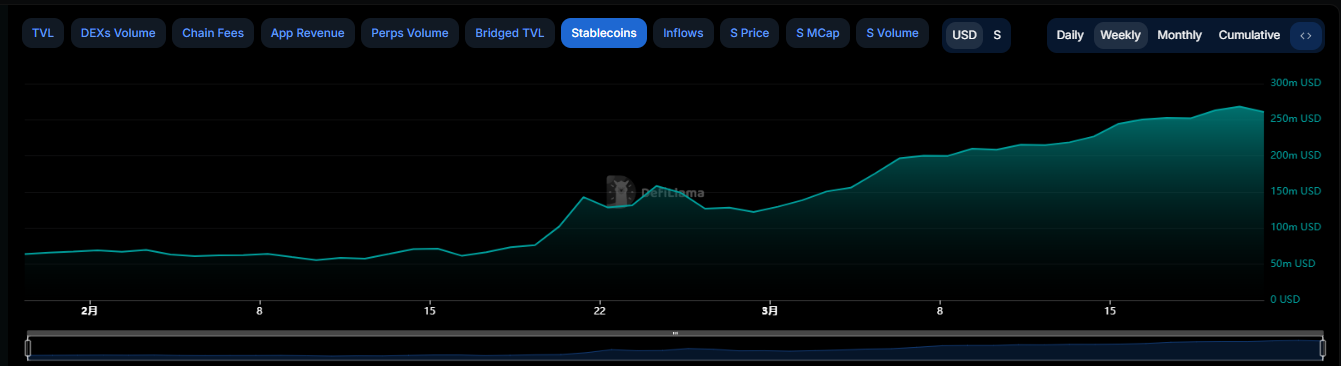
The on-chain stablecoin inventory of the Sonic chain has grown from $100 million to $260 million in the past month, an increase of over 160%, with the proportion of competitors like DAI and FRAX dropping by 22 percentage points, showing the whale capital's strong recognition of the infrastructure upgrade.
TVL Surging Against the Trend: The "Three Drivers" Behind the 83% Growth
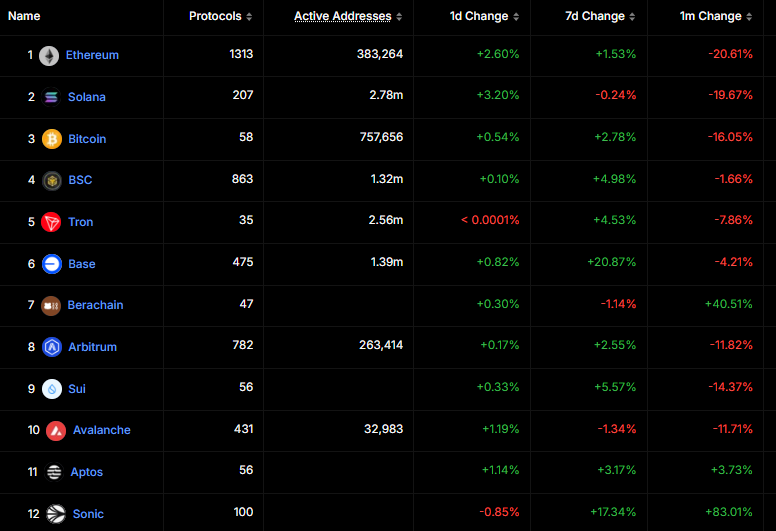
In the past month, while most public chains were stuck in TVL stagnation, Sonic has been absorbing funds at a rate of $13 million per day on average. As of the time of writing, Sonic's chain TVL has exceeded $850 million, ranking 12th on the Layer 1 leaderboard. The growth in the past month has exceeded 83%, leading all public chains.
Its growth momentum comes from three core protocols:
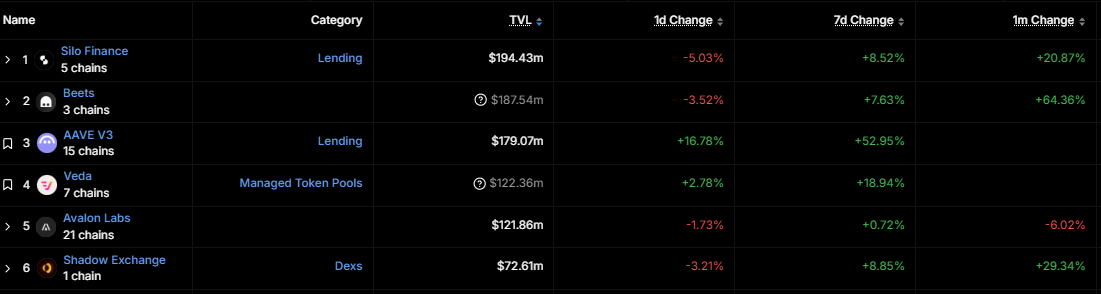
1. Silo Finance (Lending, TVL $194 million)
Adopting a risk pool isolation design, supporting over-collateralization of non-standard assets such as BTC and ETH. Its proprietary "dynamic interest rate curve" keeps the borrowing APY always below the 30% liquidation threshold, with a default rate of only 0.17%, making it the preferred choice for institutional arbitrage.
2. Beets (Liquidity Staking, TVL $187 million)
Converts staked tokens into interest-bearing assets stS, achieving a 23% annualized yield through an auto-compounding strategy. Users can re-stake $stS on Aave V3 to construct a "yield nesting" model, with an actual APY exceeding 35%.
3. Aave V3 (Lending, TVL $180 million)
On March 3, Aave deployed a lending market on the high-performance blockchain Sonic, which evolved from Fantom. This is Aave's first Layer 1 expansion this year, marking another step in its cross-blockchain expansion efforts. On the first day of launch, it triggered the supply limit, with the Sonic Foundation and Aave DAO jointly providing $15.8 million in liquidity incentives, causing the USDC deposit APY to soar to 19% at one point, with a single-day liquidation volume of only $370,000, outperforming most competitors in risk control.

Sonic co-founder Andre Cronje (AC) also retweeted that the current APY of the Sonic token S is 15.9%, and if you invest $6.28 million today, you will earn $1 million in a year. This is far higher than the returns on staking other Layer 1 tokens.
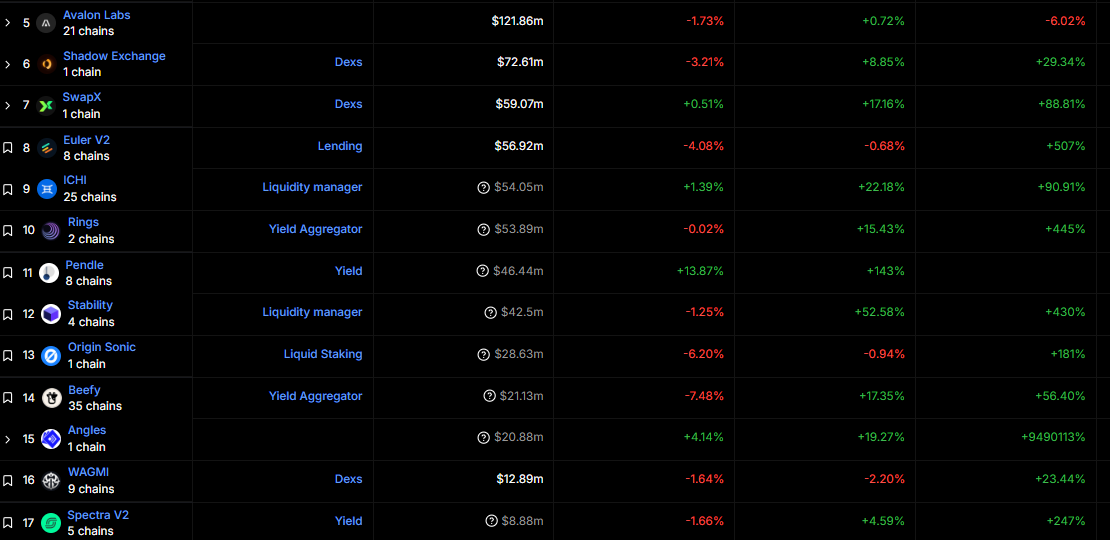
In addition, multiple new DeFi protocol stars have erupted on Sonic in the past month, with impressive data. Readers can also choose suitable projects for themselves from the perspectives of APY and risk, and achieve a decent stable income in the current crypto market turbulence.
Technological Breakthrough: Algorithmic Stablecoin Breakthrough and AC's "PTSD Dilemma"
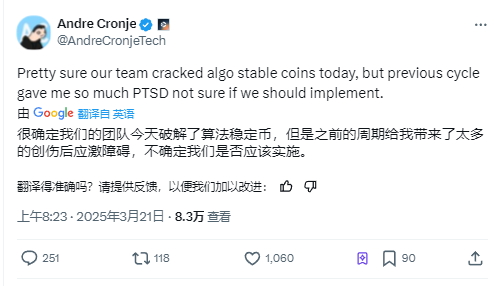
"We have cracked the algorithmic stablecoin problem, but the historical trauma makes me hesitant." In a tweet on March 21, Sonic co-founder Andre Cronje (AC) made a shocking statement. His team claims to have solved the fatal flaws of predecessors like UST through a dynamic collateral rate adjustment algorithm and a multi-tier liquidation protection mechanism. Despite the significant technical breakthrough, AC still admits that the "PTSD from the LUNA collapse has not yet subsided".
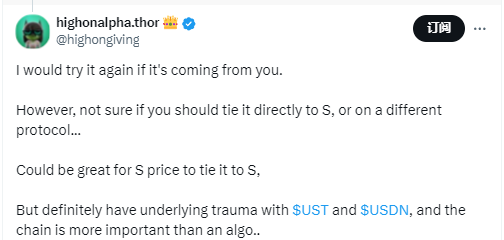
DeFi researcher highonalpha said: "I'm not sure whether it should be directly pegged to S, or pegged to different protocols... Pegging the price to S might work well, but $UST and $USDN definitely have potential trauma, and the blockchain is more important than the algorithm itself."
In addition, the following solutions have also been proposed:
- Anti-death spiral design: When the stablecoin depegs, the system prioritizes burning governance tokens over issuance, avoiding liquidity dilution;
- Three-tier interest rate model: Dynamically adjust lending and borrowing rates based on collateral ratios, keeping the APY fluctuating between -5% and +25% to suppress speculative sell-offs;
- Cross-chain circuit breaker: If the price deviates from $1 for more than 48 hours, automatically trigger cross-chain asset redemption to prevent systemic risk contagion.
The conflicting mentality of Sonic's co-founder reflects the deep-rooted dilemma in the algorithmic stablecoin arena - there is no perfect solution for algorithmic stablecoins - and the $40 billion-level wealth evaporation caused by historical collapses like UST makes market confidence restoration much harder than technological breakthroughs.
Capital Involvement: Top Institutions' "Value Vote" and Valuation Game
In May 2024, Sonic completed a $10 million strategic financing led by Hashed, with follow-on investments from institutions like SoftBank, Aave DAO, and Bitkraft. This capital was precisely allocated to three areas:
- Developer incentive pool: 30% for Gas fee sharing subsidies to DApps, driving the number of ecosystem protocols to surge from 62 to 312;
- Compliance infrastructure: 40% invested in the Sonic Pay payment system, obtaining EMI licenses in the EU and MPI permits in Singapore;
- Cross-chain security: 30% for the development of the Sonic Gateway's Fail-Safe mechanism, expanding the validator nodes from 7 to 21.
The current market capitalization of $S is $1.6 billion, with a market cap/TVL ratio of only 1.9, placing it in a value trough among mainstream Layer 1s. In comparison:
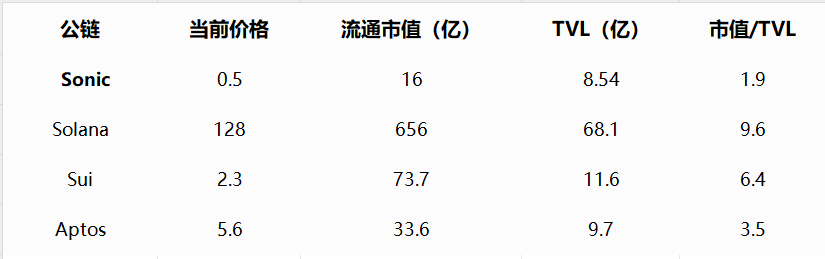
From key indicators, Sonic has formed a dual advantage in performance efficiency (TPS/Gas fee) and valuation rationality (market cap/TVL):
- Capital efficiency is 306% higher than Solana: the market cap per $1 TVL is only 32.7% of Solana;
- The staking economy is healthier: a 62% staking rate is higher than Sui and Aptos, and an annualized deflation rate of 1.8% forms value support;
- Institutional holding concentration: the top 10 addresses hold 39% of the circulating tokens, 17 percentage points higher than SUI, indicating strong market control signals
"The value of $S is still severely underestimated." UOB Ventures analyst Lucas Wong pointed out that if Sonic's TVL breaks through $2 billion this year (150% annualized growth), based on the industry average market cap/TVL ratio of 4, the token price is expected to hit $1, a 100% upside from the current $0.5.
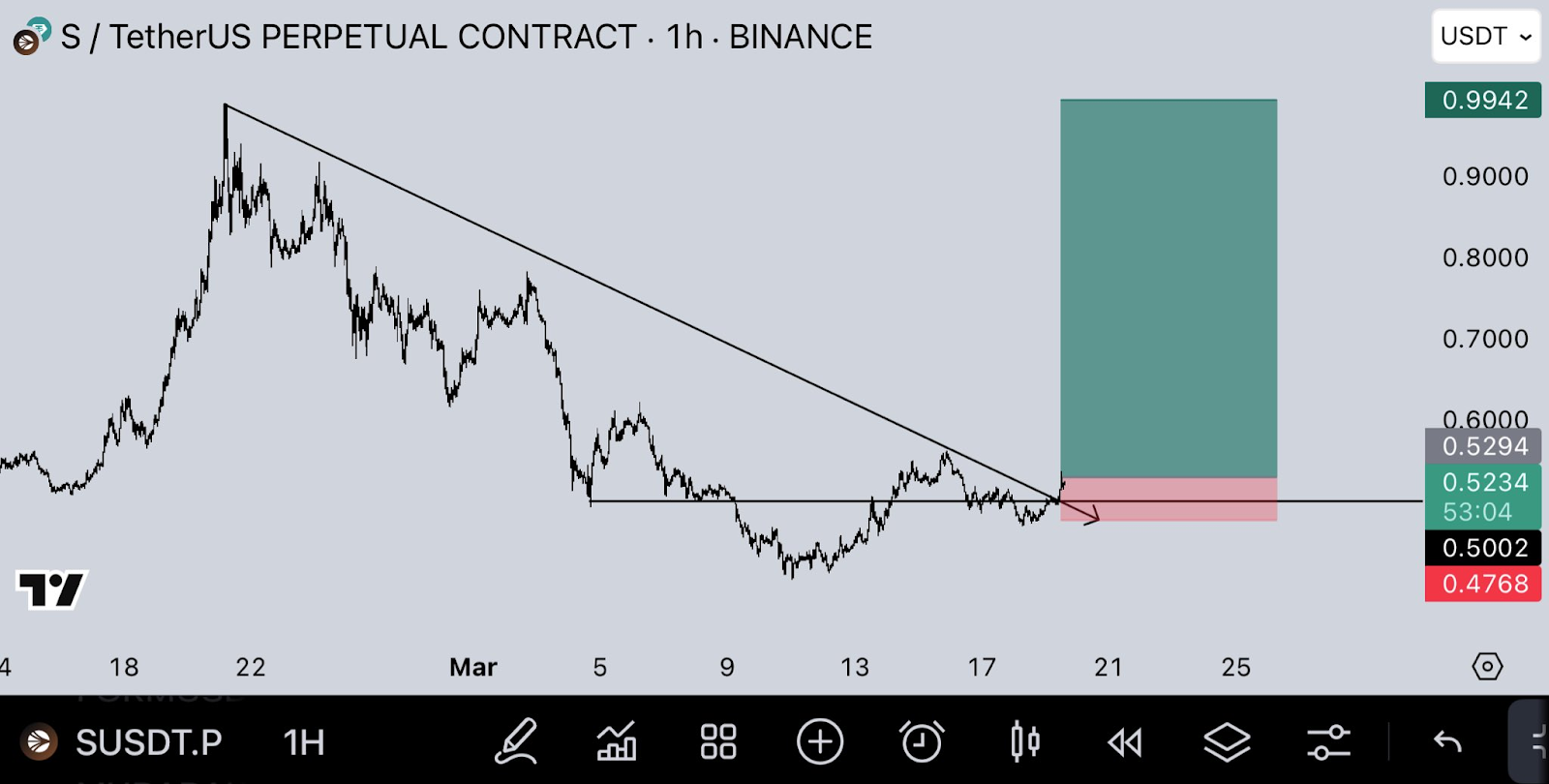
Veteran trader NihilusBTC said that S is breaking out of a descending wedge, and once reversed, it may reach a price of $0.99.
On the Eve of Ecological Outbreak: Where is the Next Wealth Code?
On February 28, Pendle has officially launched on the Sonic network, with the first batch of liquidity pools and Rings collaboration launching: stkscUSD (May 29, 2025) stkscETH (May 29, 2025) Rings Protocol is a yield-bearing stablecoin protocol. Users can use various stablecoins or ETH assets to mint scUSD/scETH. scUSD and scETH can be staked in the Veda vault (becoming stkscUSD and stkscETH) and earn yields through blue-chip DeFi protocols like Aave.
On March 19, the EVM transaction aggregator Enso announced that it has officially launched on the Sonic network. Enso Shortcuts is providing support for the Royco marketplace to earn Sonic rewards. Sonic has launched the first season of Sonic Points, allocating a portion of its approximately 200 million S tokens to its ecosystem. Royco makes earning and comparing rewards simple, while Enso handles protocol integration and deposit operations behind the scenes.
As top protocols like Pendle and Enso have successively joined, Sonic's DeFi Lego has shown unique opportunities:
1. Yield Tokenization (Pendle × Rings)
By splitting the principal and yield rights of scUSD/scETH, users can lock in 40%+ fixed APY or leverage to bet on interest rate volatility. The first batch of pools attracted $43 million in deposits within 24 hours of launch.
2. On-chain Payment (Sonic Pay)
Supports Apple/Google Pay for direct USDC consumption, with a fee of only 0.3%, 92% lower than Visa's cross-border rate. The daily transaction volume of the beta users has exceeded 12,000.
3. Meme Craze (THC, GOGLZ)
Community token weekly gains exceeded 200%, and DEX trading volume accounted for 37%, replicating the wealth effect of the early Solana ecosystem.
Investment Conclusion: The Undervalued Layer1 Alpha Opportunity
From a fundamental perspective, Sonic has built a sustainable DeFi growth flywheel through a triple innovation of technical performance, economic model, and ecological incentives. The current market cap/TVL ratio is in the bottom range of public chains, and it has a higher margin of safety compared to SUI at the same stage. If the TVL breaks through $2 billion this year (150% annualized growth),the S token price is expected to hit the $2-3 range (corresponding to a market cap of $60-90 billion), replicatingthe rally from $0.46 to $5.36 that the new public chain SUI experienced from August to December 2024.
Investment strategy recommendations:
- Long-term holding: allocate S spot and participate in staking (15.9% APY) to capture the growth dividends of the ecosystem;
- Leverage strategy:through Pendle to mint yield tokens or Shadow's x(3,3) model to amplify returns;
- Risk hedging: pay attention to the airdrop unlocking schedule and use tools like contracts to mitigate short-term volatility.
The rise of Sonic is not only the rebirth of the Fantom ecosystem, but also a benchmark case for the "efficiency revolution" in the Layer1 competition. In the 2025 narrative of DeFi's return, its valuation remodeling may become one of the core storylines of this cycle.