


I have always been fascinated by novel token economics. Observing how crypto protocols adjust their incentive mechanisms is always captivating, sometimes appearing very enticing - until they inevitably collapse. So when Bittensor launched its dynamic $TAO (dTAO) system on Valentine's Day, I was immediately drawn in.
The idea was simple: provide a new, more "fair" distribution of TAO issuance across subnets. But just a month later, problems emerged. It turned out that seemingly perfect designs do not always work as intended in a free market.
Execution Mechanism of dTAO
Here's a simplified review of how dTAO works:
Each subnet has its own subnet token ($SN), existing in the form of a native TAO-SN UniV2 type pool. Confusingly, although users "stake" TAO to receive SN, this is functionally no different from "exchanging" TAO for SN. The only difference is that users cannot add liquidity to the pool or directly trade between subnet tokens (e.g., SN1 → SN2), but can do so through TAO as an intermediary (SN1 → TAO → SN2).
TAO issuance is proportionally allocated based on the price of subnet SN tokens. To smooth price fluctuations or prevent price manipulation, the system uses a moving average price.
SN tokens themselves also have a high issuance, with a supply cap of 21 million, similar to TAO and BTC. A portion of SN is allocated to the TAO-SN liquidity pool, with the remainder distributed to subnet stakeholders (miners, validators, subnet owners). The amount of SN allocated to the TAO-SN pool is to balance TAO issuance in the pool, thereby keeping the SN price (in TAO) stable while increasing liquidity.
However, if the calculation indicates that the subnet needs more SN than the maximum issuance (based on the SN issuance curve), the SN issuance will be capped at the maximum, at which point the SN price (in TAO) will rise.
The core assumption of this mechanism is that subnets with higher market value create more value for the Bittensor network and should therefore receive more TAO issuance.
However, the reality is that in the crypto market, the highest-priced tokens are often those with the most attention, hype, Ponzi characteristics, and marketing resources. This is why L1 chains and memecoins always have relatively the highest valuations.
Although the mechanism was designed with good intentions, assuming that subnets creating value through income would use some of that income to buy back SN tokens, thereby driving up the price and obtaining more TAO issuance, this thinking is somewhat naive.
Subnets Flooded with Meme Coins and Uncontrolled Token Economics
Before dTAO's launch, I had discussed the obvious flaws in dTAO's token economics with some crypto analysts - namely, that higher market value ≠ higher income or greater value creation.
But I didn't expect this theory to be quickly validated in practice. The free market operated in a "wonderful" way.
Just before the upgrade, an anonymous person took over subnet 281 and turned it into a meme coin subnet called "TAO Accumulation Corporation" (nicknamed "LOL subnet"). This was clearly unrelated to AI.
In the now-deleted Github page, it was written:
Miners do not need to execute any code, and validators score them based on the number of subnet tokens they hold. The more tokens a miner holds, the higher the issuance they receive.
What actually happened was: Speculators buy SN28 tokens → SN28 price rises → SN28 receives more TAO issuance → If it exceeds the subnet token issuance limit, SN28 price continues to rise → SN token issuance is proportionally distributed to "miners" holding SN → People buy more SN to get more TAO → Price rises further → Ponzi loop continues.
As a result, TAO issuance officially began funding... memes! At one point, the SN28 subnet even became the seventh-ranked subnet by market cap.
But why didn't SN28 take over Bittensor? Centralization saved the day
Within just a few days, the Opentensor Foundation used its root stake to execute a custom validator code, incentivizing people to sell SN28 tokens, causing its price to crash 98% within hours.

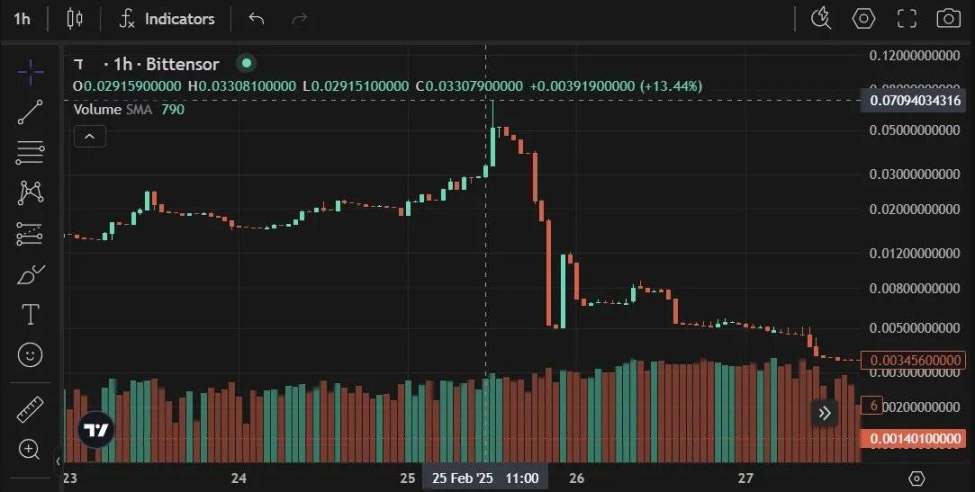
Essentially, the Opentensor Foundation played the role of a centralized entity, preventing the free market's exploitation of the dTAO mechanism. This centralized intervention is currently feasible because it is currently in a slow transition period from the old TAO issuance mechanism to the new dTAO mechanism.
From TAO's Old Mechanism to dTAO Transition
TAO's old mechanism allowed 64 validators with the most staked TAO on SN0 ("root subnet") to vote on who could receive TAO's issuance.
This mechanism itself triggered a series of incentive issues controlled by large validators such as Opentensor Foundation, DCG Yuma, Dao5, Polychain, etc. For example, they could theoretically direct TAO's issuance towards subnets they invest in or incubate, or towards subnets where they run validator nodes and receive TAO rewards.
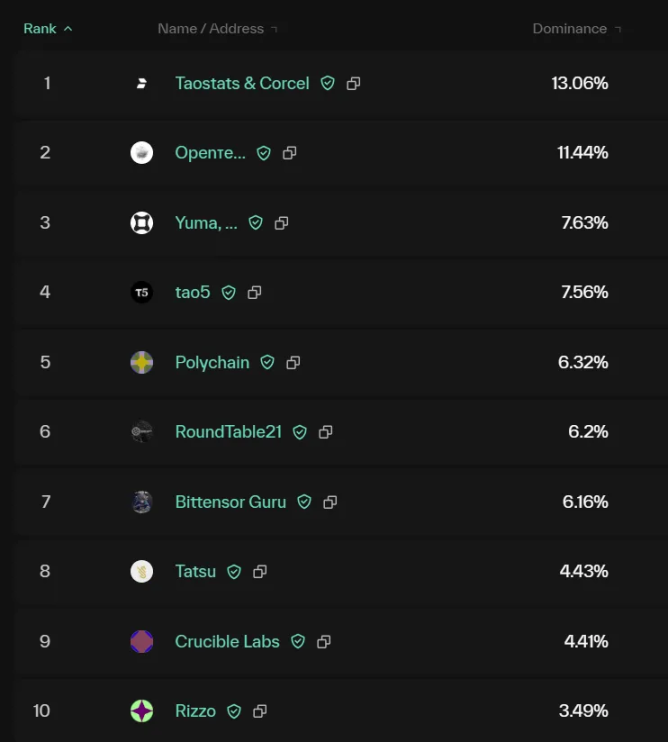
Therefore, breaking away from this mechanism is a good step towards decentralization. I appreciate the team's choice of a more decentralized reward mechanism, even if it means potentially losing some issuance.
When the SN28 event occurred, dTAO had just been launched for about a week, so SN0 (blue line in the image below) still controlled about 95% of the issuance, allowing the Opentensor Foundation to intervene.
However, after about a year, SN0's control over issuance will drop to about 20%. This means that if a similar SN28 event occurs again, intervention through SN0 will be almost impossible. In this case, Bittensor might transform from a "decentralized AI" project into a meme coin incentive network.
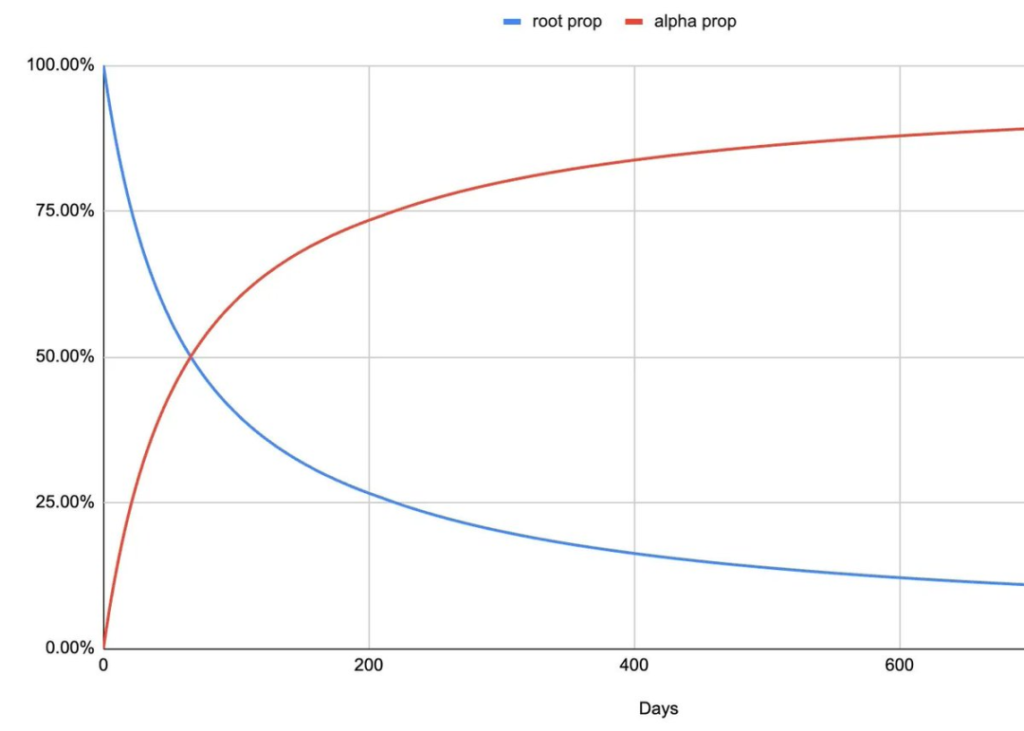
During this transition period, the power to control emissions will shift from the old mechanism (SN0 or "root attribute") to the new dTAO mechanism ("alpha attribute")
Admit It, This Is More Than Just a meme
Even if we assume people are rational enough during the bear market to not dive into meme coin hype, Bittensor could still evolve into a completely AI-unrelated universal incentive network.
Imagine a thought experiment: someone launches a subnet specifically for decentralized Bitcoin mining (though this isn't a novel idea). This subnet's goal would be to incentivize Bitcoin mining resource-efficiently, while using mined BTC as recurring income to buy back subnet tokens SN to gain more TAO issuance.
Thus, TAO transforms from a decentralized AI project into a universal incentive project, with TAO issuance merely subsidizing various random operational costs (OpEx) for enterprises, rather than moving towards a specific goal.
Technically, this could be said to align with the original intent of Yuma Consensus, which aims to reach consensus around any "subjective" work, not necessarily limited to AI. However, this lack of clear objective makes the entire system seem... meaningless.
Final Thoughts
The dTAO model has been out for just a month, and cracks are already showing.
The free market's incentive mechanism suggests that without any centralized force, Bittensor might no longer be an AI project, but an "attention network" dominated by meme coin subnets, or a "universal incentive network" led by revenue-generating enterprises that use TAO issuance to subsidize operational costs without substantially improving the Bittensor network.
I believe the network needs a true "objective function" to unify the goals of all subnets. However, finding a clear objective in AI (especially Artificial General Intelligence, AGI) is extremely difficult - as we've encountered challenges in creating fair large language model (LLM) evaluation frameworks... which is also why Yuma Consensus was built for "subjective" work.
As the saying goes: "Tell me the incentive mechanism, and I'll tell you the outcome."
In previous versions, I mentioned that TAO's issuance is proportional to market cap, which was actually proportional to price. This error has now been corrected, thanks to @nick_hotz's correction.





