


One quarter of companies in the S&P 500 may add Bitcoin to their balance sheets by 2030 – this is the latest forecast from Architect Partners, a financial consulting firm specializing in technology.
In an analysis published on March 28, Mr. Elliot Chun – Partner at Architect Partners – believes that professional pressure and market expectations are causing financial leaders to consider cryptocurrency asset strategies. "I predict that by 2030, approximately 25% of companies in the S&P 500 will hold Bitcoin as a long-term asset on their balance sheets," Mr. Chun noted.
According to him, the driving force behind this trend comes not only from Bitcoin's growth potential but also from the increasingly prevalent FOMO (fear of missing out) psychology among financial managers. "If you try and succeed, you're considered a pioneer. If you fail, at least you took action. But if you do nothing without a valid reason, your position could be threatened," Mr. Chun analyzed.
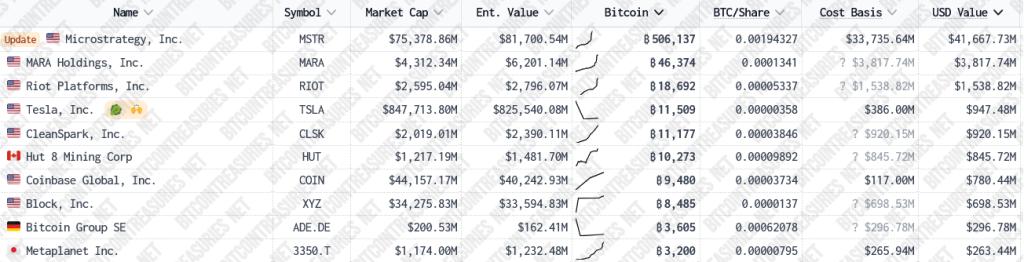
Currently, the number of S&P 500 companies publicly holding Bitcoin remains limited, with two notable names being Tesla and Block (formerly Square). Data from BitcoinTreasuries.net shows only 89 global listed companies are holding Bitcoin, with MicroStrategy (MSTR) leading in ownership volume.
This list may soon add GameStop – the company recently announced a plan to issue convertible bonds worth $1.3 billion on March 26, with the stated goal of using part of the capital to purchase Bitcoin.
For Architect Partners' prediction to become reality, at least 123 other S&P 500 companies need to start accumulating Bitcoin in the next 5 years – a significant shift from the current situation. This trend could be driven by optimistic Bitcoin price forecasts from influential industry figures like Cathie Wood (ARK Invest), Mike Novogratz (Galaxy Digital), Brian Armstrong (Coinbase), and Jack Dorsey (Block), with predicted targets ranging from $500,000 to $1 million per BTC by the end of the decade.
However, Mr. Chun notes that MicroStrategy should not be seen as a universal model. MSTR's stock has increased over 2,000% since the company began its Bitcoin accumulation strategy in August 2020 – far exceeding Bitcoin's 781.1% increase and the S&P 500's 64.8% performance during the same period.
Nevertheless, MicroStrategy's case is "unique", as most other businesses do not plan to completely restructure their entire business strategy around digital assets, but primarily view it as a risk mitigation or portfolio diversification tool.
One factor that could drive this shift is the emergence of spot Bitcoin ETFs in the US. Since the US Securities and Exchange Commission (SEC) approved these ETF funds on January 10, 2024, businesses and investment organizations have had additional options to access Bitcoin directly, instead of through holding companies like MicroStrategy.
However, using Bitcoin as a treasury asset remains a new and unproven strategy. According to Mr. Chun, Bitcoin possesses many characteristics that may be more suitable for this role than gold, such as its digital nature, easy storage and mobility, high liquidity, and recognition as a tangible asset under GAAP accounting standards.
Recently, this trend was further reflected by the launch of the Bitwise Bitcoin Standard Corporations ETF managed by Bitwise, which tracks the performance of companies holding at least 1,000 BTC in their treasury – an indicator that Bitcoin accumulation is gradually becoming a new financial credibility metric in investors' eyes.






