


On April 3rd at dawn Beijing time, the executive order signed by Trump constructed a "dual-track tariff system", marking a comprehensive shift in US trade strategy. According to the White House's detailed rules, the "base layer" requires a 10% "minimum baseline tariff" on imported goods from all countries, while the "strike layer" imposes a "semi-reciprocal tariff" (50% of the target country's tariffs on the US) on 60 "key non-compliant countries".
VX: TZ7971
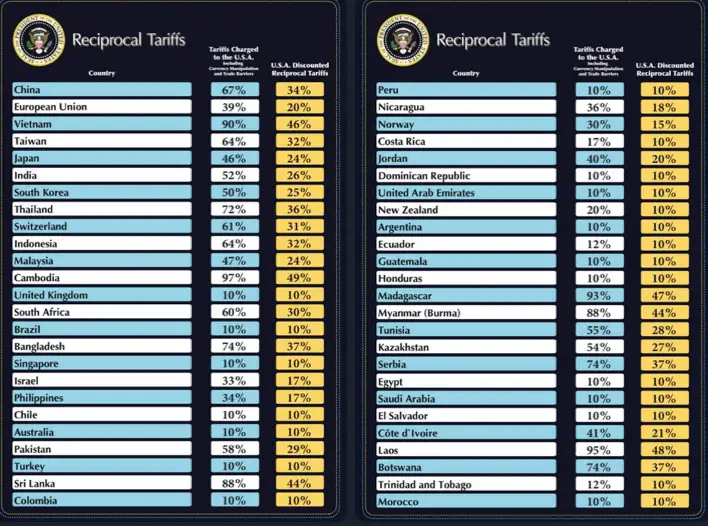
The baseline tariff will take effect on April 5th, and the reciprocal tariff will be launched on April 9th, with a negotiation window reserved to pressure trade partners to compromise.
Global Supply Chain Restructuring and Industrial Impact
The policy specially exempts goods already constrained by Section 232, such as steel, aluminum, and auto parts, but strategic industries like semiconductors and pharmaceuticals still face potential future tax increases.
This essentially establishes a tariff "whitelist" system, forcing companies to relocate core production back to the US. In the automotive industry, a 25% tariff could cause imported car prices to rise by up to $20,000, with full-size SUVs and electric vehicles most deeply affected; Tesla has already announced reducing its German factory capacity to 30% and accelerating the construction of its Mexico super factory to avoid tariffs. The chain reaction of supply chain disruption is emerging: 80% of Mexico's car exports depend on the US market, and a 25% tariff could shrink its GDP by 16%; Vietnam's textile industry faces order loss due to a 46% tariff, with some enterprises already shifting production capacity to Cambodia.
Market Nuclear Explosion Scene: Tech Stocks Precisely Struck, Epic Diversion of Safe-Haven Assets
US Stock "Black Three Minutes" and Liquidity Crisis
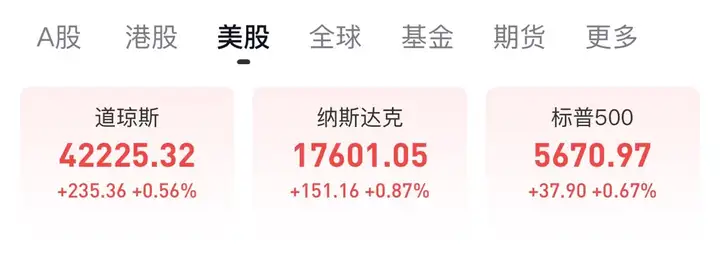
Before the policy announcement, the market still harbored a lucky mentality, with Nasdaq rising 0.87%, and Chinese concept stocks showing a false prosperity;
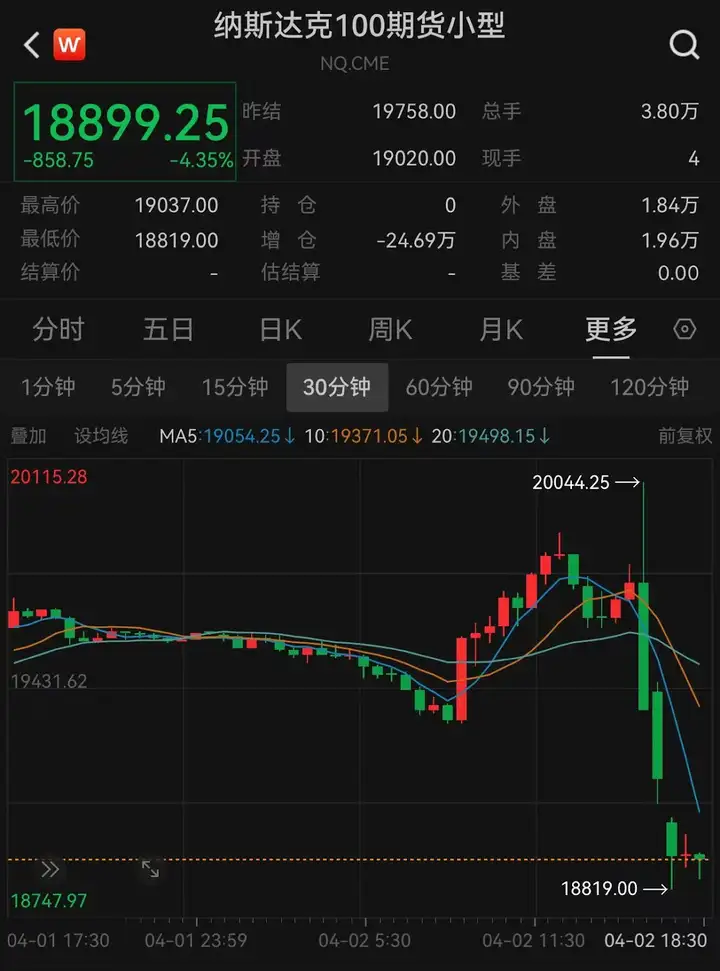
However, after the executive order was implemented, Nasdaq futures instantly plummeted 4.5%, with Apple and Tesla dropping 7% after-hours, and the semiconductor sector evaporating $320 billion in market value.
The deep logic is that tech giants have an average overseas production ratio of 68%, with tariffs directly eroding gross margins - Goldman Sachs calculates that each 1% tariff will reduce S&P 500 component stock profits by 0.8%.
Notably, hedge funds have already laid out their strategy: Goldman Sachs data shows their tech stock exposure has dropped to a five-year low, with NVIDIA, AMD, and Tesla becoming the largest short targets, and AI hardware manufacturers experiencing a concentrated sell-off of 59. The liquidity squeeze intensified market panic, with the S&P 500 volatility index (VIX) surging 42% in a single day, the largest increase since March 2020.
Divergence and Paradox of Safe-Haven Assets
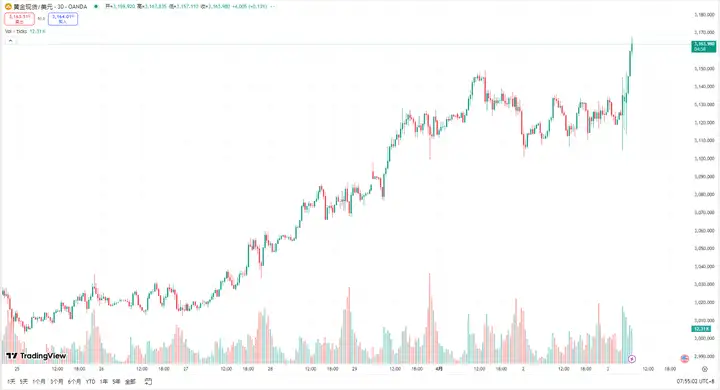
Traditional safe-haven assets showed contradictory trends: COMEX gold briefly broke through $3,200 per ounce but then fell back to $3,160, reflecting the "policy landing exhausts positive factors" characteristic; the 10-year US Treasury yield counterintuitively rebounded to 4.3%, reflecting market concerns about "tariff inflation" exceeding safe-haven demand.
Bitcoin: From Safe-Haven Darling to Liquidity Sacrifice
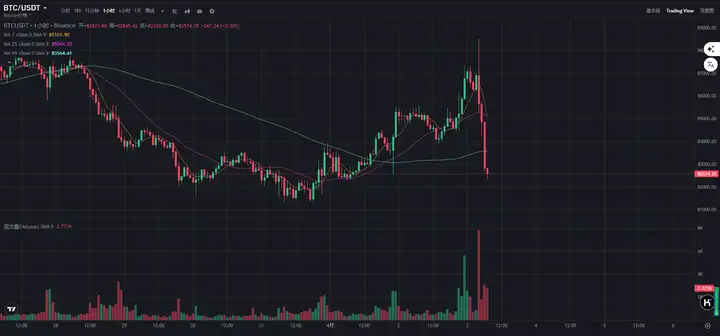
Bitcoin staged a "roller coaster market" - rising to $88,500 before the policy announcement, but then experiencing a chain liquidation due to concentrated leverage long position closures, plummeting to the current $82,500 within 4 hours.
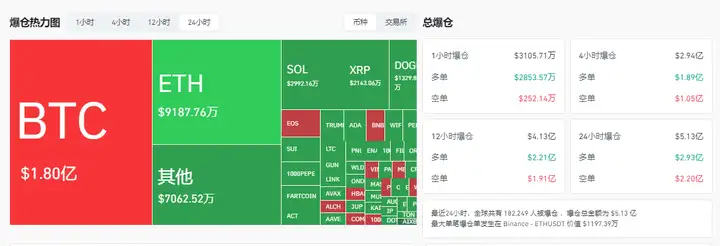
In the last 24 hours, 182,245 people globally were liquidated, with a total liquidation amount of $513 million, including a single ETH-USDT liquidation of $11.97 million.
ETH again fell below $1,800, dropping 5.31% in the past 24 hours;
SOL dropped to $117, falling 7% in the past 24 hours;
Doge dropped to $0.164, falling 5.5% in the past 24 hours;
BNB dropped to $591, falling 3.3% in the past 24 hours;
This volatility exposed the structural fragility of the cryptocurrency market.
Three-Layered Rhythm of Narrative Switching and Market Psychology
From March 31st to April 2nd, Bitcoin slowly rose from $78,000 to $85,000, reflecting geopolitical risk hedging logic;
At 6 PM Eastern Time on April 2nd, with tariff details leaked, funds rushed in and pushed it to $88,500;
After the policy implementation, the market realized that "US dollar liquidity contraction" caused by tariffs might suppress risk assets, forcing leveraged long positions to close.
On-chain data reveals institutional movements: Coinbase Premium Index (institutional buying intensity) plummeted from +1.2% to -0.8%, with whale address holdings decreasing by 120,000 coins in a single day, indicating Smart Money is withdrawing.
Regulatory Upgrade and Medium-to-Long-Term Concerns
The US Treasury plans to include "tariff avoidance" in virtual asset anti-money laundering monitoring, requiring exchanges to strengthen review of "trade-related addresses"; the EU simultaneously advances the MiCA 2.0 bill, requiring stablecoin issuers to have no more than 50% US dollar assets in their reserve funds. These policies may weaken cryptocurrencies' cross-border payment functions, with Tether (USDT) transaction volumes dropping 23% in Mexico, Vietnam, and other tariff-affected countries.
A more profound impact is that global trade fragmentation is giving birth to regional digital currency systems, with digital yuan settlement in ASEAN rising to 18%, digital euro pilot expanding to the automotive industry chain, challenging Bitcoin's "supranational currency" narrative.
Subsequent Developments and Investment Strategies
Digital Currency Regulation and Market Differentiation
The US SEC may include "tariff-related tokens" in securities regulation, strengthening scrutiny of cross-border trade settlement projects; the EU requires stablecoin issuers to hold "tariff risk reserves", increasing compliance costs for Tether and USDC. Investment opportunities exist in anti-inflationary crypto assets: Bitcoin computing power tokens benefit from energy tariffs, decentralized prediction markets (like Polymarket) bet on tariff negotiation results, with privacy coins potentially seeing increased demand in cross-border gray trade.
Structural Opportunities and Risk Warnings
In the short term, North American domestic manufacturing ETFs (like XAR, ITA), anti-inflation REITs (data centers, warehousing logistics), and computing power tokens have potential for oversold rebounds; medium-to-long term focus should be on regional free trade agreement beneficiaries (ASEAN tech stocks, Mexican consumer stocks) and tariff-exempt companies (Intel, Pfizer).
On the risk side, if countries escalate retaliatory tariffs, global trade volume might shrink by 12%, triggering a "US dollar liquidity crisis" similar to 2022, potentially causing Bitcoin to retest below $76,000.





