Compiled by: KarenZ, Foresight News
On April 9th, at the "2025 Hong Kong Web3 Carnival" ETHAsia 2025 event, Ethereum founder Vitalik Buterin delivered a keynote speech on "Ethereum L1 Future", focusing on key topics such as Ethereum L1 scalability improvements, future planning and technological upgrades, L1 and L2 collaborative development, and the impact of account abstraction on user experience.
Vitalik first analyzed Ethereum's current status. Currently, L1's throughput is 15 transactions per second (15 TPS). The Gas limit has recently been raised to 36 million, increasing about 6 times over the past 10 years. Meanwhile, L2's throughput has reached approximately 250 TPS, making significant progress in scalability.
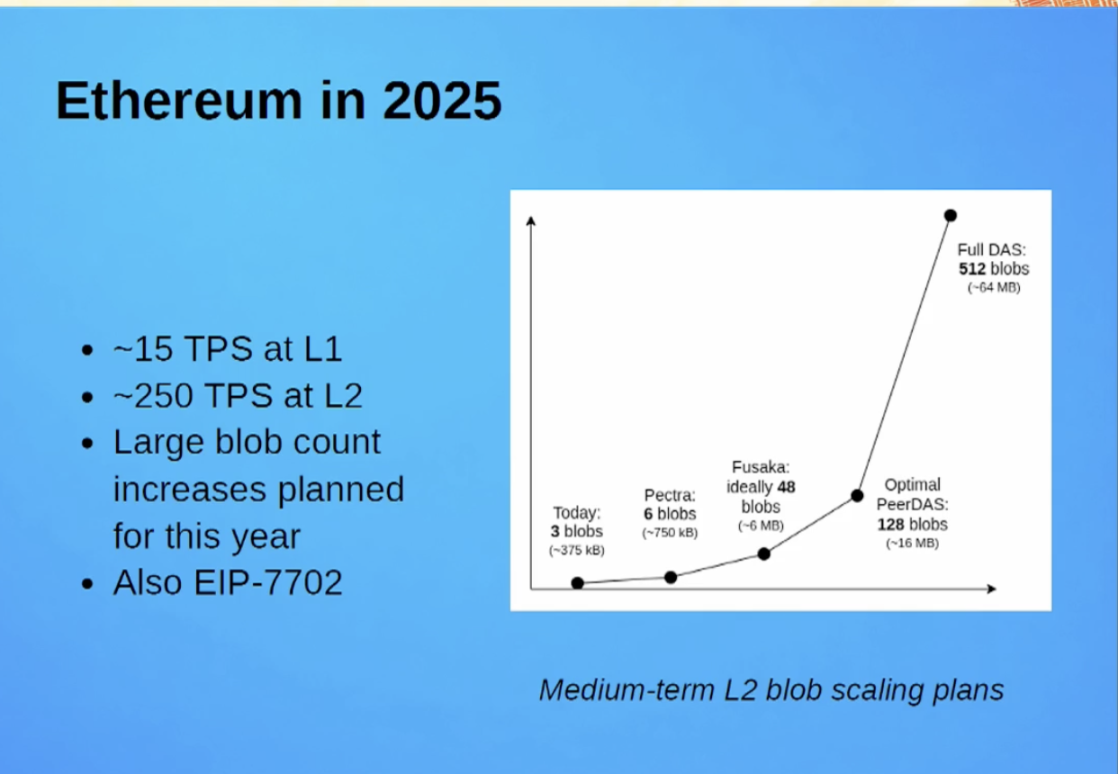
The upcoming Pectra upgrade will increase Blob capacity from 3 to 6. Currently, 3 Blobs are about 375kb, generating 375 kb of data every 12 seconds, which is approximately 20kb per second, corresponding to about 250 TPS; if Blob capacity increases to 6, TPS is expected to rise to 500. However, Blob capacity expansion largely depends on the Fusaka upgrade expected to be implemented in the third or fourth quarter of this year. In an ideal scenario, the Fusaka upgrade could increase Blob capacity to 48; if DAS is fully implemented, Blob capacity could reach 512, potentially raising L2 TPS to tens of thousands.
Additionally, EIP-7702 has made significant progress, essentially being the first step in account abstraction, which will make accounts more intelligent and secure.
Of course, Ethereum L1 expansion is equally indispensable. Even if users widely adopt L2, L1 still needs to undertake many critical functions. Especially when L2 fails, L1 needs to provide corresponding remedial measures or support large-scale exit operations for users.
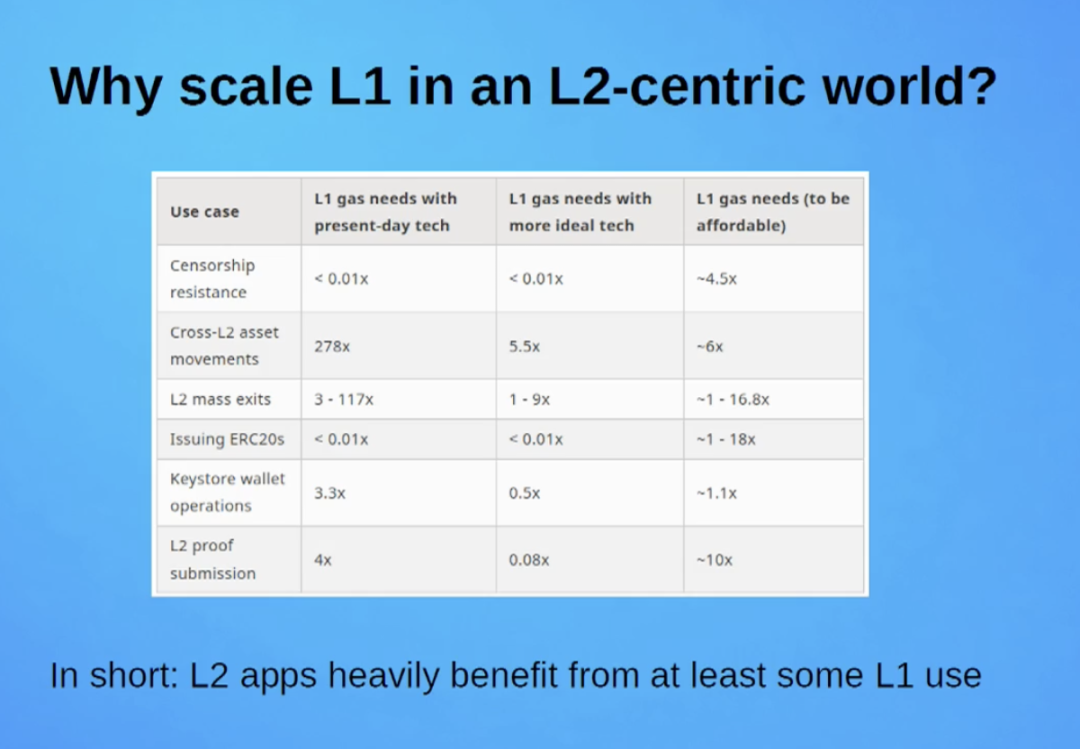
This means that despite L2's rapid development, improving L1's scalability remains crucial to achieve censorship resistance and cross-L2 asset transfers. So, what changes will further L1 expansion bring?
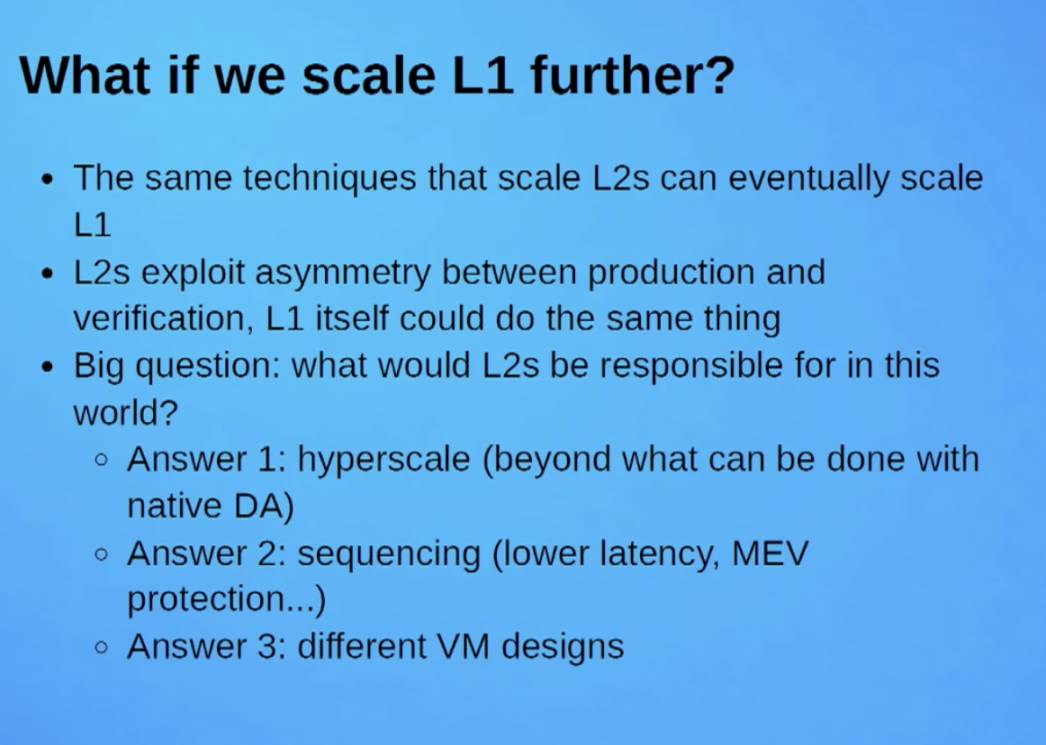
Expansion technologies applied to L2 can also be used for L1 expansion in the future;
L2 utilizes the asymmetry between production and verification, which L1 can also learn from;
In such a world, what responsibilities will L2 undertake? 1. Hyperscale (beyond native DA's capabilities); 2. Ordering (lower latency, MEV protection...); 3. Different virtual machine (VM) designs.
In other words, L1 can learn from L2's expansion technologies, while L2 continues to focus on hyperscale transaction processing and experimental application of new technologies.
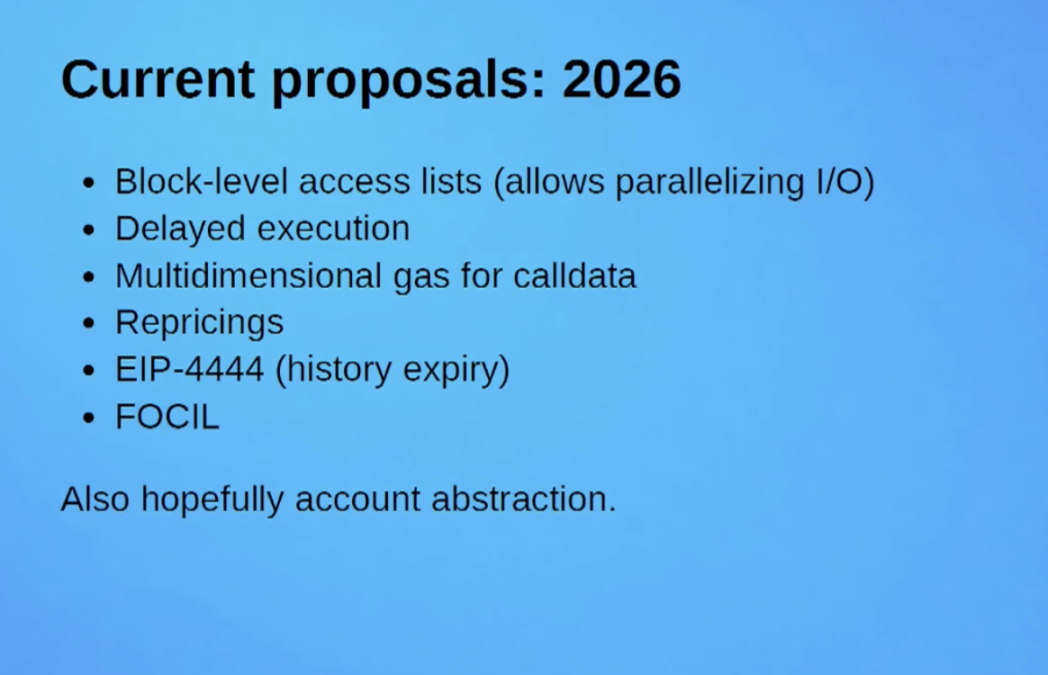
Vitalik stated that in the short-term plan, a series of proposals are expected to be implemented by 2026. Through these proposals, Ethereum hopes to significantly increase the Gas limit while safely achieving this goal without compromising node decentralization. Current proposals/suggestions for 2026 include:
Block-level access lists (allowing I/O parallelization);
Delayed execution;
Multi-dimensional calldata Gas;
Repricing;
EIP-4444 (historical data expiration): No longer requiring every Ethereum node to store Ethereum historical records, instead using peer-to-peer networks and storing historical data in a more distributed manner;
FOCIL.
Vitalik also summarized the many advantages of account abstraction, including:
Enhanced security and user experience;
Quantum attack resistance;
Paymaster: Allowing others to pay Gas fees for you or pay Gas fees with tokens other than ETH;
Supporting native use of smart contract wallets;
L1-led, L1 follow-up.
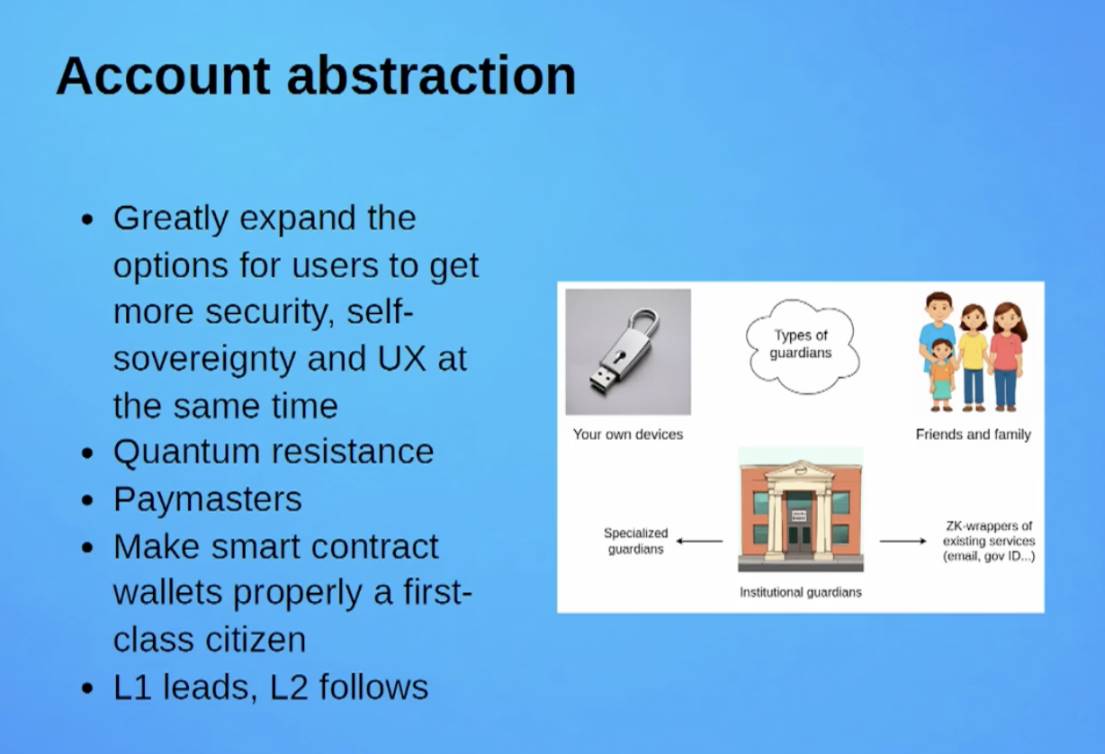
Additionally, through technologies like Social Recovery and Guardians, Ethereum will provide more decentralized identity verification and asset control solutions.

In other areas, Ethereum is actively exploring L1 privacy function enhancement, EVM upgrades, protocol cleaning/simplification, consensus layer quantum resistance improvement, protocol security attributes and simplicity optimization, and slot time reduction.
Overall, we need to improve L1, improve L2, consider Ethereum's diverse development approaches, including AI-based methods, improve the application layer, to truly promote the development of the Ethereum ecosystem. Ethereum is working hard to fully prepare for mainstream mass adoption, with the ultimate goal of building Ethereum L1 as the core of the "world computer", supporting diverse applications with high security and efficiency.