


The addition of Bitcoin to corporate treasuries has increased in the first quarter of 2025, with large corporations like Tether and Metaplanet reaching record allocations compared to the previous quarter.
However, recent US trade policy announcements have cast a shadow on further Bitcoin accumulation. BeInCrypto interviewed Max Shannon, an analyst at CoinShares, to explore the sustainability of this trend throughout the year and the likelihood of continued corporate Bitcoin adoption.
Which Companies Are Leading Bitcoin Accumulation?
As the path to Bitcoin mainstream acceptance grows stronger, many companies are expanding their BTC holdings or allocating this asset to their treasuries for the first time in 2025.
The first quarter of 2025 was highlighted by major companies making their largest Bitcoin allocations. Tether, the world's largest stablecoin issuer, has gradually purchased 8,888 BTC since January, raising their total BTC to over 100,000. In the previous quarter, the issuer only added 1,035 to their reserves.
Metaplanet has also intensified its allocation efforts. The publicly listed Japanese company first began buying Bitcoin in May 2024. By December, Metaplanet had accumulated 1,762 BTC, which increased to 4,046 in March 2025.
Although other notable companies have not broken their previous allocation records, they have significantly expanded their Bitcoin holdings.
Expanding Ranks: From MicroStrategy to GameStop
Strategy, previously known as MicroStrategy, has maintained its consistent aggressive accumulation style. So far this year, the company has purchased a large amount of 53,396 BTC.
Meanwhile, Fold Holdings, a financial services company, publicly announced that they bought 475 BTC in early March, raising their total accumulation to 1,485.
Non-Web3 corporations are also joining the Bitcoin buying trend.
Two weeks ago, video game and electronics retailer GameStop announced an update to its investment policy, revealing the addition of Bitcoin as a treasury reserve asset. Although the company did not immediately commit to buying BTC, there is speculation that they will allocate a portion of their $4.8 billion in cash to this cryptocurrency.
Factors Driving Corporate Bitcoin Adoption
Bitcoin is becoming increasingly attractive to investors seeking an asset to protect against inflation. With BTC's limited supply, it is not affected by the type of value depreciation that can impact fiat currencies.
"Companies understand that monetary inflation is the core reason behind the decline in purchasing power of their balance sheets," Shannon told BeInCrypto.
According to him, this may have led to Metaplanet accumulating record Bitcoin amounts in the first three months of 2025. Metaplanet has announced plans to accumulate 10,000 BTC by the end of the year.
"For Japanese companies facing the continuous depreciation of the yen, Bitcoin serves as a hard asset for protection. Moreover, in markets with negative real yields, BTC provides superior long-term risk-adjusted returns. Although it has no yield, it offers long-term price appreciation potential and inflation resistance when inflation rates (whether price or monetary) are higher than nominal interest rates," he said.
With growing concerns about inflation increases in the United States, Bitcoin has also become more attractive to American investors. Changes in digital currency accounting have also made them a more appealing addition to investment portfolios.
The Attractiveness of New Accounting Standards
Besides the perceived inflation-protection value, Bitcoin's appeal as a corporate investment has been further enhanced by recent modifications to accounting standards in the United States.
In January, the Financial Accounting Standards Board (FASB) issued a new rule allowing companies with BTC in their treasuries to report profits from unrealized price increases of their digital assets. Instead of waiting until they sell their assets, companies can now report that value increase as income in their financial reports.
"Selling a depreciating fiat currency to exchange for a hard digital asset like Bitcoin, which is also liquid and a 'cash equivalent' that can benefit from FASB's new accounting treatment (potentially improving income reporting) makes Bitcoin an attractive treasury asset," Shannon added.
Despite inflation stabilization potential, Bitcoin's inherent volatility can also attract higher-risk investors and companies looking to diversify their investment portfolios.
Could Bitcoin Volatility Be a Strategic Advantage?
Beta measures a stock's volatility compared to the overall market. The higher the beta, the more volatile the stock.
According to Shannon, adding a volatile asset like Bitcoin to the balance sheet will increase the stock's beta. If Bitcoin's price rises, the investor's portfolio can achieve significant returns.
"This can improve returns for investors and has been proven to be so. Stock volatility also tends to increase, which improves convertible debt interest rates, thus affecting the company's capital structure and cost of capital. Volatility also creates opportunities for options and derivative trading, which can increase stock trading volume and make it a more liquid asset," Shannon told BeInCrypto.
However, investors may face potentially higher losses in the Bitcoin bear market. For this reason, BTC as a treasury asset may be more attractive to companies seeking diversification or companies large enough to weather challenges.
Bitcoin for Specific Business Cases
Volatility and increased trading volume accompanying Bitcoin acceptance can provide strategic advantages for some companies, especially those struggling with performance or in highly competitive industries.
"Businesses performing poorly or mature in competitive markets will benefit from an asset with enhanced volatility and volume, as well as stock beta," Shannon told BeInCrypto.
GameStop is a prime example. The retailer's Q4/2024 earnings report showed a significant decline in sales volume.
Despite concerning financial reports, GameStop's stock price surged 12% after announcing they would add BTC as a treasury reserve asset. Limited cryptocurrency exposure is expected to strengthen the company's financial position in 2025.
Conversely, Tether's apparent strength may enable it to withstand significant Bitcoin price volatility.
Leveraging Profits for Bitcoin: Tether's Financial Strategy
As the largest stablecoin issuer, Tether generates substantial revenue from transaction fees and managing its massive reserves. This financial strength could provide a buffer to absorb potential losses from Bitcoin price declines.
Demonstrating this financial capability, Tether allocates 15% of its quarterly net profits to Bitcoin.
"This is similar to the medium dollar cost averaging by allocating 15% of realized net operating profits to Bitcoin. It's a relatively conservative approach as it's post-tax, so excess cash (retained earnings) can be used for higher-growth assets. In this case, there are no major downsides as the company has good capitalization with $7 billion in net capital, thus careful risk management. However, there are still black swan events where cash will be more necessary than Bitcoin," Shannon explained.
Despite inherent unpredictability, Bitcoin's long-term volatility decline in recent years has supported the rationale for including it – even in small amounts – in a well-diversified investment portfolio.
"Bitcoin has improved the risk-adjusted returns of a 60/40 portfolio since 2017. [It] still carries volatility risks that companies may not want to bear, however, volatility has historically trended downward and may continue to do so," Shannon added.
While acknowledging Bitcoin's advantages, Shannon finds it increasingly challenging to predict whether corporate asset accumulation will maintain the rapid pace seen in Q2 as earlier in the year.
Market Disruption: Will Corporate Appetite Decrease?
Only in its second week, April has proven to be a challenging month for financial markets. The cryptocurrency sector was most notably impacted.
Trump's recent Liberation Day triggered stock declines as investors prepared for upcoming uncertainty. In the two days following Trump's tariff announcement, over $1 billion in long and short positions were liquidated due to weekend volatility.
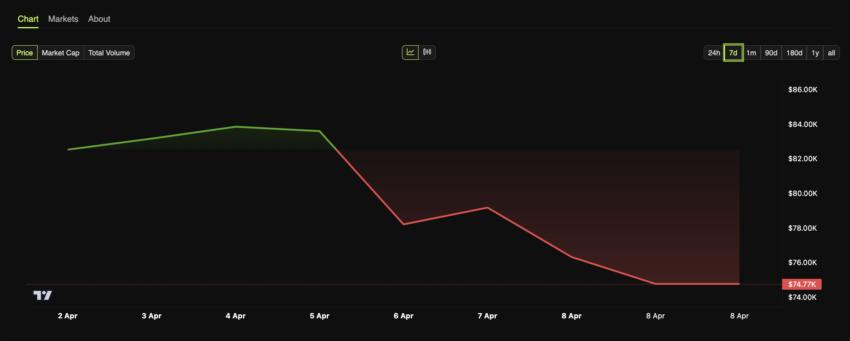 Bitcoin (BTC) price performance. Source: BeInCrypto.
Amid this new wave of anxiety, Shannon predicts companies will prioritize more urgent concerns over Bitcoin accumulation.
"Long-term trends indicate continued balance sheet accumulation, however, quarterly predictions are difficult. Based on current market volatility and tariff impacts on profit margins, I suspect operational issues will be prioritized over Bitcoin accumulation," he said.
Even after this initial uncertainty subsides, macroeconomic conditions will significantly determine companies' future Bitcoin acquisitions. Bitcoin must also maintain competitiveness to encourage these purchases.
"Higher Bitcoin prices should lead to FOMO and superiority of Bitcoin-supporting companies. For this to happen, policy trade certainty is needed (or actually a reversal through trade partner agreements) as well as lower 10-year yields and either market consolidation or stock market recovery," Shannon added.
Currently, external headwinds may override Bitcoin accumulation strategies.
An Uncertain Future
Corporate Bitcoin accumulation reached new heights in the first quarter of 2025, but recent political and economic developments may hinder future progress.
Until US trade policies and international responses become clearer, the cryptocurrency market will likely experience increased volatility. These circumstances might cause traditional investors and companies to prefer conservative strategies, directing their resources toward other priorities.
Only time will tell the outcome.






