The core stablecoin of the Synthetix ecosystem, sUSD, is currently deeply mired in a depegging quagmire. As of April 9, 2025, its price has dropped to around $0.8388, deviating by over 16% from the theoretical anchor value of $1, drawing high market attention. This crisis, which began on March 20, has persisted for over 20 days, with the depegging extent continuously expanding. Meanwhile, Synthetix's native token SNX has paradoxically risen, with a single-day increase of 7.5%, presenting a complex market sentiment. Synthetix founder Kain Warwick (@kaiynne) attributes the depegging to transitional pains from mechanism adjustments and reveals that the protocol has sold 90% of its ETH position and increased SNX holdings to respond.

Event Overview: Gradual Deterioration of Depegging
The depegging of sUSD did not happen overnight. On March 20, 2025, its price first showed a slight deviation, initially not raising widespread concern. However, as time passed, the fluctuation gradually evolved into a downward trend.
By April 9, CoinMarketCap data showed sUSD quoted at $0.8388, dropping over 16% from its anchor value. This depegging, lasting over 20 days, not only exceeded the expected timeframe but also far surpassed the market's typical tolerance for stablecoins, indicating the deep complexity of the issue.
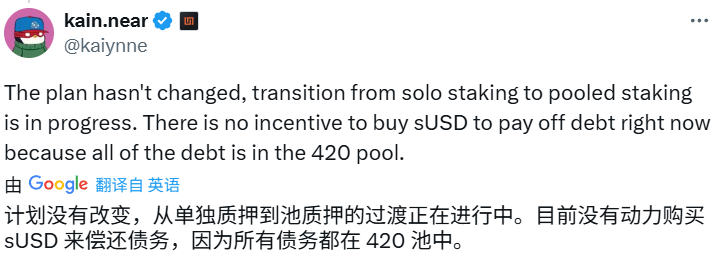
Kain Warwick explained on the X platform that the depegging is an expected side effect of implementing SIP-420. This proposal aims to optimize SNX staking mechanisms and capital efficiency by introducing a centralized debt pool (the "420 Pool"), but the transition between old and new mechanisms temporarily disabled sUSD's anchoring recovery capability. He candidly stated that at the current stage, "there are no incentives for users to buy sUSD to repay debt," with supply-demand imbalance being the direct driver of price decline. Additionally, the protocol's strategy of selling 90% of its ETH position and increasing SNX holdings, while intended to strengthen internal support, may have weakened the system's liquidity and external stability foundation, adding more uncertainty to the market.
Depegging Root Cause: Mechanism Transformation and Market Feedback Overlay
The cause of this depegging is not singular but a result of mechanism adjustments and market behaviors intertwining, presenting multi-dimensional challenges.
The implementation of SIP-420 is the core trigger of the crisis. Synthetix's stablecoin mechanism relies on SNX's over-collateralization, where users mint sUSD by staking SNX and bear the debt pool's volatility risk. Under the old mechanism, a collateralization ratio of up to 750% and debt repayment incentives jointly maintained sUSD's stability. However, SIP-420 shifts from individual staking to a centralized debt pool, attempting to enhance SNX's staking attractiveness. While theoretically injecting long-term potential into the ecosystem, this transformation disrupted the original balance. Warwick candidly admitted that the new mechanism is not yet fully mature, with the old anchoring recovery function temporarily suspended, causing sUSD to lose its self-adjustment mechanism.
Market behavior further amplified the depegging effect. X platform information shows some users concentrated on exchanging sUSD for USDT or USDC on decentralized exchanges like Curve, quickly exhausting the liquidity pool's balance. Taking Curve's DAI-USDC-USDT-sUSD pool as an example, sUSD's proportion abnormally increased, reflecting a decline in market confidence. With a market cap of only $25 million, sUSD's inherent low liquidity means any concentrated selling could trigger significant slippage, causing the price to further deviate from the anchor value.
Protocol-level adjustments also brought unexpected side effects. The decision to sell 90% of ETH and increase SNX holdings, while strengthening SNX's ecosystem dominance, reduced the system's diversified support. ETH, widely recognized as collateral, its exit might weaken external trust in sUSD, while SNX's volatility increases risk concentration. During SNX price increases, this strategy might boost confidence, but against the backdrop of persistent depegging, it instead casts a shadow on the recovery process.
Historical Comparison
This is not the first time sUSD has depegged. On May 16, 2024, sUSD dropped to $0.915 due to a whale selling sBTC-converted sUSD, with a depegging of about 8.5%. At that time, insufficient Curve pool liquidity combined with MEV arbitrage bot attacks caused a brief price loss of control. Synthetix quickly acted by adding ETH, BTC, USDC, and other collaterals to boost confidence and provide liquidity incentives on Velodrome and Curve, successfully re-anchoring to $1 within 11 days. That depegging was essentially an external shock, with the mechanism itself undamaged and the recovery path clear and efficient.
Here's the English translation:In contrast, the de-pegging in 2025 presents entirely different characteristics. This crisis originated from internal mechanism adjustments of SIP-420, rather than a single external sell-off, significantly increasing the complexity of the problem. The de-pegging in 2024 lasted 11 days with an 8.5% drop, while the current situation has exceeded 20 days with a drop of over 16%, indicating the severity and persistence of the issue. Moreover, the 2024 response relied on liquidity incentives and collateral diversification, while the 2025 strategy leans more towards internal adjustments (such as selling ETH to increase SNX positions), with short-term effects yet to be seen. This suggests that the 2024 experience cannot be directly applied, and the repair difficulty far exceeds previous instances.
Feasibility Analysis of Buying the Dips for sUSD
Currently, sUSD price hovers around $0.84, raising the question for investors: Is buying the dips and waiting for re-pegging viable? The 2024 experience provides some insights. At that time, sUSD recovered from $0.915 to $1, with dip buyers gaining about 9% returns in two weeks, with the key to success being rapid incentive measures and the short-lived external impact. Now with a lower price ($0.84), potential returns are higher (around 19%), but risks have also expanded.
Favorable factors cannot be ignored. SNX's 7.5% surge reflects market confidence in Synthetix remains unbroken, and the team's proactive stance and debt relief plan inject hope for recovery. With a small sUSD market cap and low funding requirements, even small buy orders could boost price if the protocol launches incentives. However, risks are equally significant. The de-pegging has exceeded 20 days with an unknown duration, and if new mechanism debugging is delayed, recovery could drag on for months. Selling pressure remains undiminished, and Curve pool imbalance might further suppress price, while user confidence loss could weaken demand.
Using $100,000 as an example, buying around 119,000 sUSD at $0.84 would yield $19,000 if re-pegged to $1, a 19% return. However, it's recommended to set a stop-loss line (e.g., $0.75) and closely monitor protocol announcements. If Synthetix launches similar incentives to 2024, the chances of successful dip buying will increase; if price stabilizes and SNX continues rising, small position entry is possible. Compared to 2024's low-risk window, this opportunity offers higher returns but requires bearing greater uncertainty.
Market Reaction and SNX Movement
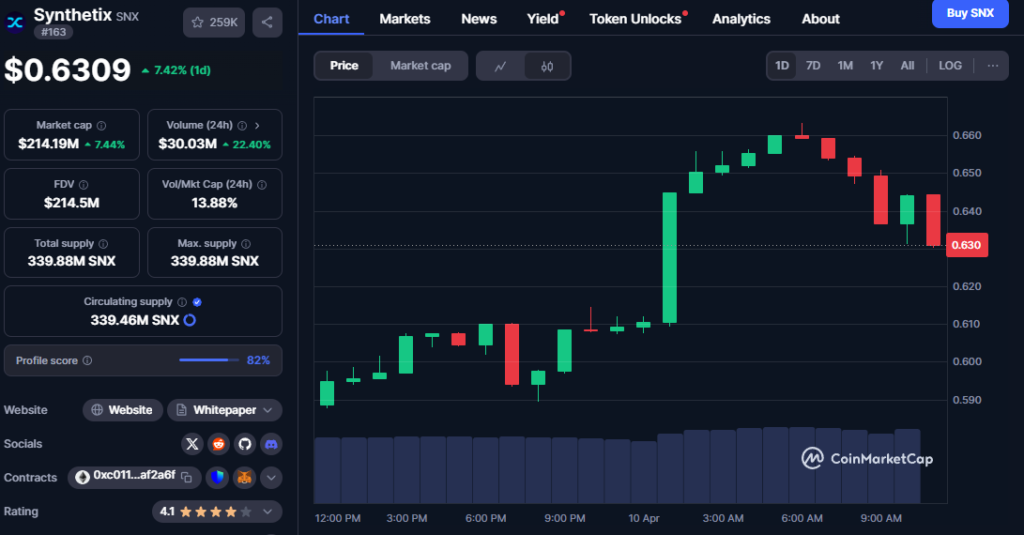
Despite sUSD being deeply mired in de-pegging, SNX recorded a 7.5% single-day surge on April 9th, a striking contrast. Market optimism might stem from expectations of SIP-420's long-term benefits. If the new mechanism successfully lands, it could enhance SNX staking yields and ecosystem status, driving Synthetix's competitiveness in DeFi. Warwick's mentioned "Debt Jubilee" plan might also inject investor confidence, suggesting historical debt clearing will reduce system burden.
Community response shows polarization. On X platform, some users worry sUSD might enter a "death spiral", questioning mechanism adjustment's rationality; others argue that with a $25 million market cap, sUSD's impact is limited, and SNX's rise truly reflects market confidence. Professional analysis institutions like The Merkle News indicate SIP-420's transition period risks are underestimated, but SNX's performance suggests Synthetix still has comeback potential.
Summary
From an industry perspective, sUSD's de-pegging has limited impact. Its $25 million market cap is negligible in the stablecoin market, far from USDT or USDC's scale, with minimal cascading effects on DeFi ecosystem. However, for Synthetix internally, persistent de-pegging might undermine user trust. If liquidity pool funds continue outflowing, sUSD's utility will be restricted, further weakening its position in synthetic asset trading.
Short-term, intensified de-pegging might trigger more selling, potentially further pressuring price. But SNX's resilience buys the protocol a time window. If the new mechanism stabilizes in the coming weeks, coupled with the debt relief plan, sUSD still has re-pegging potential. Long-term, Synthetix needs to learn from this crisis, optimize stablecoin design, and avoid similar painful recurrences. The success of mechanism adjustments will determine whether it can establish a foothold in the competitive DeFi market.
Unlike the external shock in 2024, this crisis's endogenous nature makes its recovery path more tortuous. The Synthetix team needs to simultaneously optimize mechanisms and rebuild market confidence to overcome the challenge. For investors, sUSD at $0.84 is both a risk position and a potential opportunity. Whether buying the dips or waiting, closely monitoring the protocol's subsequent developments will be crucial. In this de-pegging storm, Synthetix's future trajectory is worth continuous tracking.