Written by: Nian Qing, ChainCatcher
Yesterday, Web3 social media platform Wunder.Social announced the completion of a $50 million financing round, led by Rollman Management. According to CoinDesk, the platform also plans to launch its token later this month. Against the backdrop of a continuously sluggish primary market, this large financing round is particularly eye-catching, and with both the project team and venture capital firm being relatively unknown, it further deepens doubts about the authenticity of the financing.
Rollman Management is not new to media coverage. Established in 2022, the institution began frequently making moves from the end of 2024. In less than 5 months, Rollman Management has invested in 11 crypto projects, with most investments exceeding $20 million. The cumulative investment amount surpasses $200 million.
Meanwhile, Rollman Management's portfolio projects have low visibility, mostly located in Europe and Australia, with financing history limited to this abrupt large-scale investment by Rollman. At the end of the financing press releases, most of these projects are about to conduct an IDO or token sale. Additionally, Rollman Management almost always invests alone, without collaborating with well-known venture capital firms.
Broad Business Scope
According to its official website, Rollman Management Digital is a global investment network and consulting company providing mergers and acquisitions, venture capital, real estate, and digital asset services for family offices, high-net-worth individuals, and entrepreneurs. As described, Rollman's business scope is extremely broad, offering strategic planning consulting, investment and transactions, marketing, customized banking consulting solutions, and institutional-level Web3 services.
Its institutional-level Web3 services are almost all-encompassing—covering over-the-counter (OTC) trading, banking, hedge funds, venture capital, marketing, cryptocurrency/AI mining, financing, issuance platforms, market makers, liquidity providers, decentralized exchanges (DEX), and centralized exchanges (CEX) comprehensive solutions. Rollman Management also provides marketing strategies for projects to enhance their visibility and promote customer engagement.
Portfolio and Style Analysis
According to data from RootData and Cryptorank, Rollman Management currently has a portfolio of 11 projects, as shown in the image:
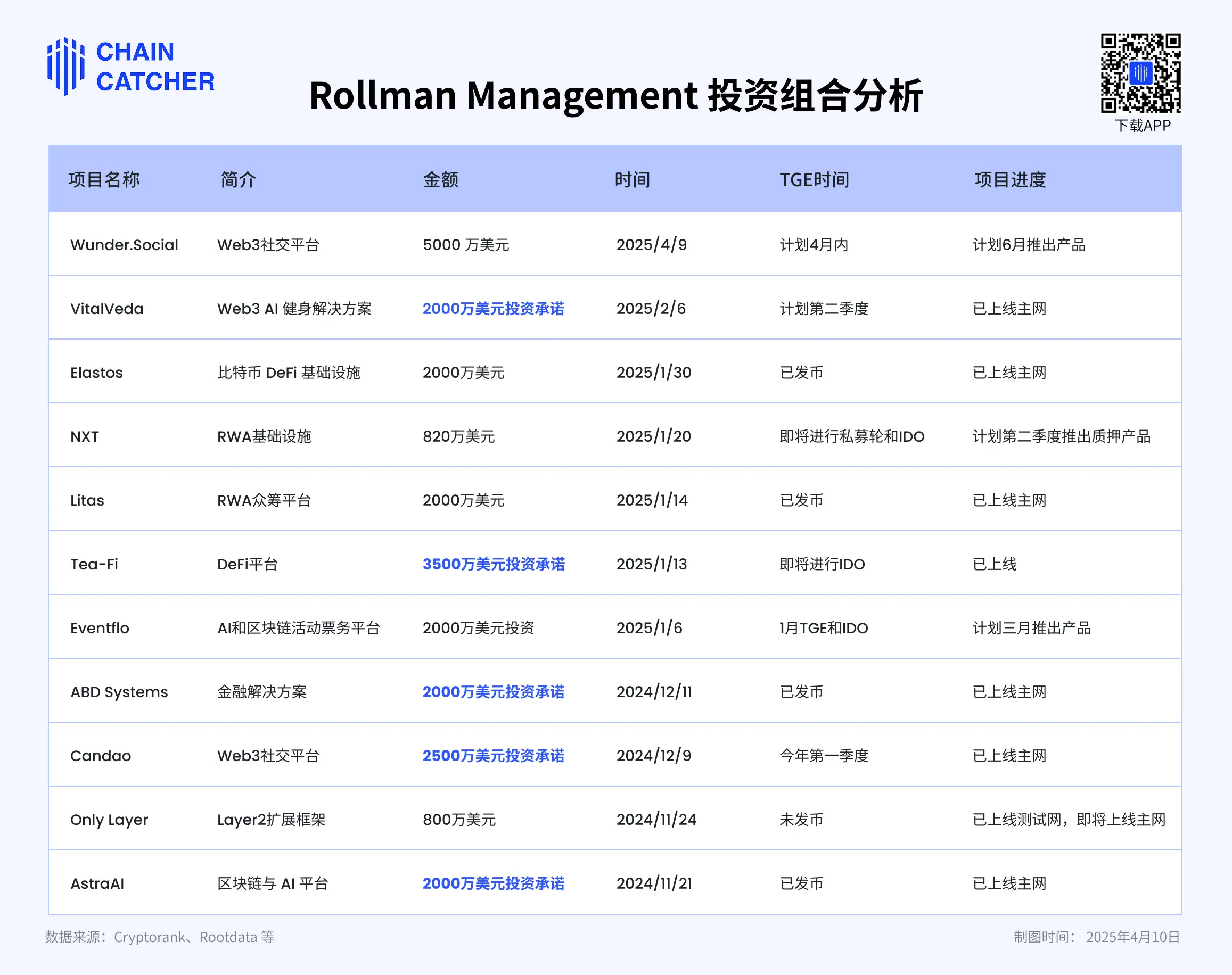
"Investment promise" is a term that requires vigilance. Literally, it refers to the project team promising to invest a specific amount in the project. However, there is significant room for manipulation behind this.
Previously, ChainCatcher had investigated a venture capital firm similar to Rollman Management's investment style, GEM Digital. A project leader once stated that GEM Digital had contacted the project via email, promising a $50 million investment, but when signing the investment contract, the project team discovered that GEM stated it would not directly transfer funds, but instead fill the investment amount with profits from selling tokens.
Related reading: The Most "Lavish" Crypto Venture Capital Firm GEM Digital Behind the Scenes: A Covert and Bizarre Capital Game
Rollman Management's "investment promise" may differ from GEM Digital, but its investment style is generally similar:
1. High-frequency, large-scale "investment promises": Rollman Management's investments are relatively dispersed, involving social, RWA, AI and infrastructure, and DeFi tracks, with a median investment amount of $20 million. Among these, nearly half of the invested projects like VitalVeda, Tea-Fi, and Candao are investment promises rather than normal investments.
2. Choosing low-profile projects: Except for the Elastos project, which was established earlier and has some visibility in the Chinese region due to its Chinese origin, the other 11 projects invested by Rollman had almost no news coverage before, and the launched projects have barely been listed on mainstream exchanges.
3. Using media to create momentum: Rollman Management's investment news is often published on mainstream platforms like Cointelegraph and CoinDesk. The majority are published on Cointelegraph (with "sponsored" marked in the news), and they are almost template-like financing news with highly similar article structures, clearly originating from Rollman.
Rollman's investment news has only one purpose—token promotion for projects. Rollman exploits the crypto community's sensitivity to financing news. By spreading "massive investment" news through authoritative media, they attract market attention and potentially drive token prices up. Of course, even if the project hasn't issued a token, it is usually planning an IDO or token sale.
4. "Pump and dump" pattern in invested project tokens: The tokens of Rollman's invested projects show a trend of rapid price increase after news release, followed by a decline. For example, on November 21, 2024, when Rollman's investment in AstraAI was announced, its token price rose from $7.7 to a high of $25, and is currently priced at $4.
On January 30th this year, Rollman announced an investment in Elastos, and the Elastos token also experienced a rapid increase, rising from $13 to $21.
Hanging a VC Sheep's Head, Selling Dog Meat Marketing
Overall, Rollman is more like a conservative version of GEM Digital. Most of its partner projects are pre-token projects, so compared to GEM Digital's model of boosting prices through positive news, Rollman is essentially using investment activities to promote tokens for project teams.
"Pump and Dump" was extremely common in cryptocurrency's early days, especially during the ICO boom, when many projects attracted funds through false propaganda and exaggerated financing news, then ran away or collapsed. The approach of institutions like Rollman and GEM Digital can be seen as an "upgraded version" of this strategy, using "investment promises" as a legal disguise and systematically operating through media and low-profile projects.
With the current crypto market being weak and the primary market cooling down, project survival has become more difficult, especially for projects without background or reputation. Where there's demand, there's a market, and with incomplete regulations—particularly the lack of definition and constraints on ambiguous behaviors like "investment promises"—this provides operational space for institutions like Rollman.
ChainCatcher hereby reminds industry participants (including investors, project teams, media, and retail investors) to remain vigilant about such investments and avoid becoming sacrifices in capital games.