Author: Frank, PANews
On February 23rd, Binance founder CZ caused a stir on the BSC chain with a simple test - when he attempted to purchase MEME coins, his on-chain data was tracked in real-time, leading the community to mistakenly believe it was an official action and triggering massive user follow-up investments. CZ helplessly clarified: "This was just a personal test."
Behind this misunderstanding, the "privacy paradox" caused by blockchain transparency was exposed: on-chain behavior is like being naked, with sandwich attackers targeting transactions, hackers conducting targeted phishing, and MEME players tracking smart money only to be harvested. Aleo founder Howard Wu incisively commented: "CZ's first experience with AMM is a typical example of why I created Aleo. I just want my account to be visible only to me, and I don't understand why the entire world needs to see it." Blockchain's transparent traceability, once a revolutionary advantage, has evolved into a fatal weakness in complex scenarios like DeFi and GameFi: privacy leakage becomes an attack entry point, and transparent ledgers become a breeding ground for malicious actions.
According to Certik's report, phishing attack losses due to exposed on-chain behavior reached $1 billion in 2024. When transparency transforms from a trust foundation to a developmental shackle, does blockchain need a privacy revolution? Aleo's answer is: reconstruct privacy boundaries with zero-knowledge proofs, allowing users to regain control of their data.
Building a Bridge in Cryptographic Deep Waters
While other privacy projects waver between "complete anonymity" and "regulatory compliance", Aleo chose a more fundamental breakthrough path: using ZKP technology to achieve "selective transparency" - users can hide sensitive data while proving authenticity to specific parties. This vision is implemented through three technological pillars.
Aleo's core technologies primarily have three breakthrough layers: zkCloud (privacy computing layer), Leo language (developer tools layer), and AleoBFT consensus (network layer).
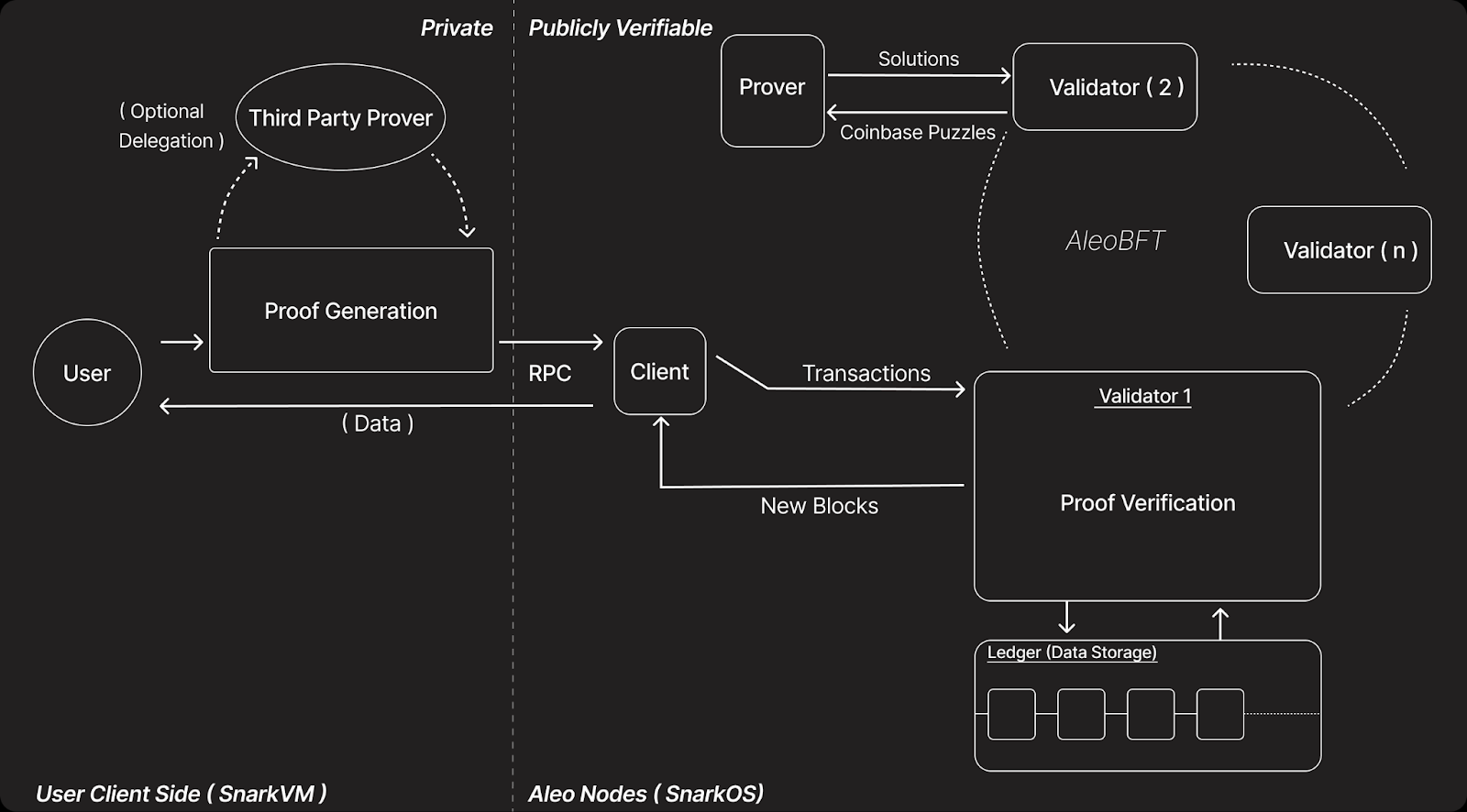
zkCloud is a core Aleo technology that moves complex computational tasks from the chain to users' own devices for execution, then verifies the correctness of these computations through zero-knowledge proof technology. This protects user privacy while improving blockchain operation speed.
The key is off-chain execution. A blockchain is like a shared ledger where all transactions and computations are publicly recorded. But if everyone writes on this ledger, it becomes slow and lacks privacy. zkCloud is like giving everyone a "private notebook" where you can quietly complete calculations and only submit the results to the public ledger. This approach is both fast and prevents detail leakage. According to Messari's report, zkCloud can reduce privacy transaction processing time from seconds to milliseconds, and lower computational costs by over 90%.
For this purpose, Aleo specifically designed a programming language - Leo language - for developing decentralized applications requiring privacy protection. It simplifies complex zero-knowledge proof (ZKP) technology, allowing developers to create privacy applications without being cryptography experts. ZKP technology itself is complex and difficult for ordinary programmers to directly handle. Leo acts like a "translator", converting sophisticated cryptographic concepts into simple programming syntax. Developers can write as if creating a regular program, with Leo automatically handling ZKP details. With this low-threshold support, Aleo's official data shows a 150% growth in dApps developed using Leo in 2024.
AleoBFT is Aleo's consensus mechanism, combining the advantages of PoW and Proof of Stake (PoS), using a dynamic committee to quickly confirm transactions while maintaining network decentralization and security. AleoBFT first selects a committee through PoW, then this committee quickly confirms transactions using PoS. This ensures decentralization while improving efficiency. Aleo's testnet data shows AleoBFT's average transaction confirmation time is 2 seconds, much faster than Ethereum's 15 seconds, suitable for scenarios requiring rapid transactions. zkCloud protects privacy and enhances efficiency, Leo language lowers development barriers to drive innovation, and AleoBFT ensures fast decentralized transactions.
Giants Join Hands: Google Cloud and Coinbase's Trust Anchor
Although zero-knowledge proofs and privacy computing are obscure to ordinary users, tech giants seem to have long recognized the potential of this track. Before mainnet launch, Aleo raised over $200 million in total funding, setting a record for the zero-knowledge track. Investors include a16z, SoftBank, Coinbase, Samsung, and other renowned institutions.
Advanced technological concepts and industry giant endorsements clearly bring Aleo more industry recognition and further promote Aleo's ecosystem governance.
On February 27, 2025, Aleo announced a strategic partnership with Google Cloud, becoming the first zero-knowledge Layer1 network in the Google Cloud ecosystem. In this collaboration, Google Cloud also participates in running Aleo mainnet validation nodes, enhancing network decentralization and stability. For Aleo, developers can use Google Cloud's BigQuery tool to analyze Aleo network data (such as transaction volume, on-chain records), improving development efficiency. Additionally, Coinbase became one of the first validators during mainnet launch.
In the fourth quarter of 2024, Aleo's ecosystem continued to grow, with daily active addresses increasing by 10.6% and new addresses growing by 34.4%. As of March, Aleo's validation nodes have reached 25.
Simultaneously, Aleo's governance route is actively advancing. In May 2024, before mainnet launch, Aleo Foundation's governance platform was introduced, allowing Aleo token holders to vote on protocol upgrades and improvement proposals. After mainnet launch, the ambassador program was divided into Apprentice, Voyager, and Maestro levels, with participants submitting content to accumulate AleoPoints and drive community governance. The platform uses ZKP technology for private voting to avoid external interference. As of March 2025, the governance platform has processed multiple proposals, such as ARC-0042 in December 2024 (dynamic reward adjustment, with 93% community support).
From On-Chain Privacy to Real-World "Data Passport"
Aleo's capital layout and strategic partnerships have paved a fast track, with technological breakthroughs requiring ecosystem prosperity. As technological dividends begin transforming into practical use cases, Aleo's zPass protocol is gradually moving towards implementation.
"If privacy is not built-in, cryptocurrency will never truly enter the real world," Howard Wu's declaration on X reveals Aleo's true goal of using privacy computing to open more industry doors for blockchain.
zPass is a protocol developed by Aleo based on zero-knowledge proof technology, allowing users to securely verify specific identity attributes (like age or nationality) without revealing complete personal information. It's like a "privacy passport" that lets you prove "I'm an adult" or "I'm a US citizen" without exposing your name or address.
In February 2025, Aleo announced the first five projects implementing zPass in production environments, including Playside, World3, Humine, GeniiDAO, and ThreeofCups (3oC), covering gaming, finance, medical, educational, and social domains.
For instance, Playside uses zPass for age verification, ensuring young users have safe, age-appropriate experiences with interactive AI agents. This includes verifying user eligibility for specific game content.
Humine, a decentralized clinical trial platform, uses zPass to help patients prove research qualifications (such as specific diseases or age) without exposing complete medical records.
Clearly, zero-knowledge proof applications seem capable of covering more traditional industries, not just crypto and finance. This is the driving force behind Aleo's vision of returning user data sovereignty and constructing a new Web3 ecosystem centered on "privacy as a service".
From blockchain attacks causing $1 billion in losses to CZ's MEME coin blunder, Aleo's narrative characteristics actually verify the evolution of blockchain value: When technology shifts from pursuing "absolute transparency" to "controllable anonymity", a new social contract is born - in the digital world, the true essence of freedom is not unconditional openness, but the right to control one's own data boundaries.