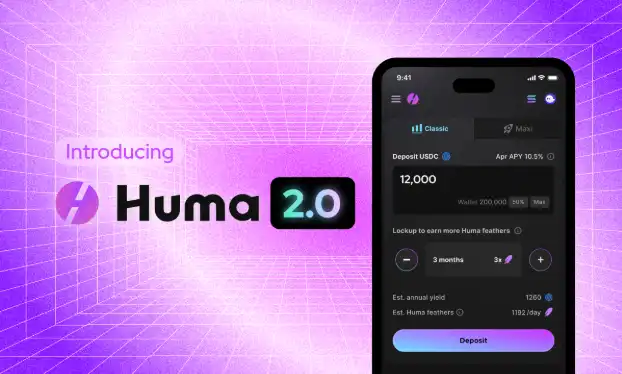
The first payment financial network, Huma Finance, today announced the launch of Huma 2.0, a permissionless, compliant, and composable real yield platform built on Solana. The platform opens up stable real yields generated from global payment financing in daily commercial trade activities to global users, marking a significant breakthrough—double-digit stable yields previously difficult to access outside institutional finance are now widely available to individual users. The existing licensed service has been renamed Huma Institutional, continuing to serve institutions and qualified investors. Users can immediately start depositing on the new Huma 2.0 platform.
Huma 2.0 offers users diverse liquidity participation methods, launching two main modes to cater to different needs: Classic Mode is designed for users seeking stable double-digit USDC yields (currently 10.5% annually, updated monthly), while providing basic rewards called Huma Feathers; Maxi Mode is suitable for users wanting to maximize Huma Feathers accumulation, offering 5 times the benchmark reward rate (but without USDC yields). Users can switch modes for existing positions at any time.
DeFi composability is Huma 2.0's core feature, implemented through PayFi Strategy Token (PST). This liquid yield-generating LP token allows holders to integrate their Huma positions with leading Solana ecosystem protocols. Initially, users can exchange PST for USDC through aggregator Jupiter, the first step in a series of integrations with top Solana DeFi platforms. Soon, users will be able to use $PST as collateral on Kamino and trade future yields through RateX. Participation requires no lockup, but users can choose 3 or 6-month terms to significantly boost Huma Feather rewards through multipliers. Notably, these reward multipliers will be substantially enhanced as a limited-time promotion, especially in Maxi Mode. These features provide users with greater flexibility and choice in managing their positions.
In just two years, Huma Finance's payment financial network has rapidly scaled, processing over $3.8 billion in transactions and generating $8 million in annual income. Huma helps partners generate yields from their payment financial businesses. Unlike DeFi yields dependent on token incentives, market speculation, or traditional financial low interest rates, payment financial yields directly stem from fees paid by enterprises using the network for payment financing and settlement liquidity. Funds typically circulate quickly within days, continuously compounding from fees generated by real economic activities. This mechanism enables Huma to consistently provide stable double-digit USDC yields, with a sustainable model endorsed by top investors and recognized by industry analysts like Messari—payment finance is poised to leverage a $30 trillion market size.
"Huma 2.0 is more than just another yield product—it represents structural transformation," said Erbil Karaman, co-founder of Huma Finance. "By providing payment institutions with a 24/7, capital-efficient new liquidity source, we're creating a new type of yield rooted in real economic activities, with composability and transparency. It finally allows DeFi to access yield sources long monopolized by institutional investors, without compromising DeFi's core advantages."
Huma 2.0's launch comes at a critical transformation period for global finance and the DeFi ecosystem. As traditional payment infrastructures like SWIFT face challenges in speed and transparency, and trillions of capital remain inefficiently allocated, blockchain-based modern solutions are increasingly in demand—reportedly, stablecoin annual transaction volume has exceeded $35 trillion. Huma 2.0 seizes this opportunity, providing efficient settlement liquidity that allows global individuals to benefit from fundamental financial activities—opportunities previously mainly limited to institutional participants.
Crucially, yields from payment finance do not fluctuate with cryptocurrency market cycles. Regardless of market boom or downturn, underlying economic activities like payment trade continue to operate, providing a stable source of Huma yields. This makes double-digit stable yields especially valuable during bear markets—more advantageous when speculative yields fade. As DeFi matures, the market is prepared for yields rooted in real business (not token speculation). Payment finance, as a foundational layer, is generating new DeFi strategies, such as Splyce's recent Solmate product—combining Huma's $PST yields with SOL liquidity staking, bridging decentralized finance and productive economic uses.
Huma 2.0 marks a key step in building the financial future, fundamentally expanding the scope of financial revolution through open and equal participation. Early participants can enjoy various reward multipliers, including historical deposit user bonuses and promotional boosts. As the platform expands more DeFi integrations and plans to be the first major project in Jupiter's LFG 2.0 launch platform—Huma continues to build a truly inclusive financial system.
To learn more about Huma 2.0 or participate, please visit this link or follow @humafinance on X platform.
About Huma Finance
Huma is the first PayFi network with an open liquidity protocol stack, covering key application areas such as cross-border payments, stablecoin bank cards, and trade finance. The network targets a market exceeding $30 trillion, dedicated to accelerating fund flow for an never-stopping world.
Welcome to join BlockBeats official community:
Telegram Subscription Group: https://t.me/theblockbeats
Telegram Communication Group: https://t.me/BlockBeats_App
Twitter Official Account: https://twitter.com/BlockBeatsAsia